Rubaiyat of Omar Khayyam of Naishapur was first published by The Rodale Press, London, in 1955. It used FitzGerald’s first version and contained six coloured illustrations by Charles Stewart (Coumans #39 & Paas #3938–9.) A parallel edition was also published in America in the same year by Rodale Books Inc., of Emmaus, Pennsylvania. A second edition followed in 1958, published by the Rodale Press in London, but by A.S. Barnes & Co. and Thomas Yoseloff Ltd. in New York (Paas #214.)
The six illustrations are shown here.
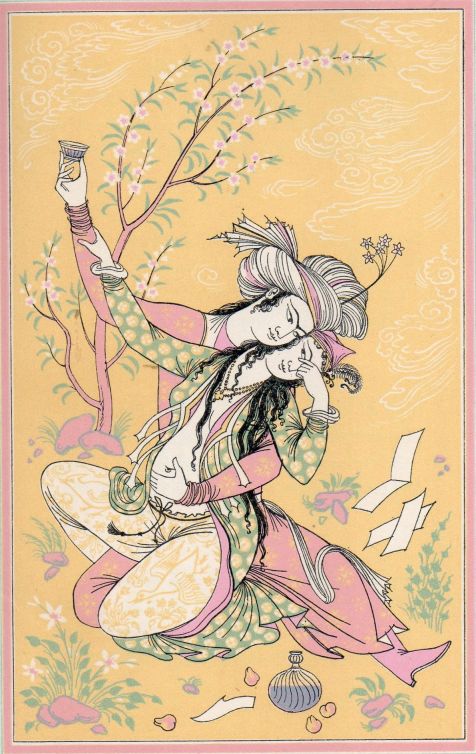
Fig.1a: faces quatrains 4 to 7. It may relate to quatrain 5 (“And still a Garden by the Water blows”), “blows” probably being used here in its now near–obsolete sense of “blooms,” but if taken to refer to wind, it may explain what could be wind–blown papers on the right of the picture. The illustration may also refer to quatrain 7 (“Come fill the Cup &c”), and also to quatrains 10 (“With me along some Strip of Herbage &c”) and 11 overleaf (“Here with a Loaf of Bread beneath the Bough &c”.)
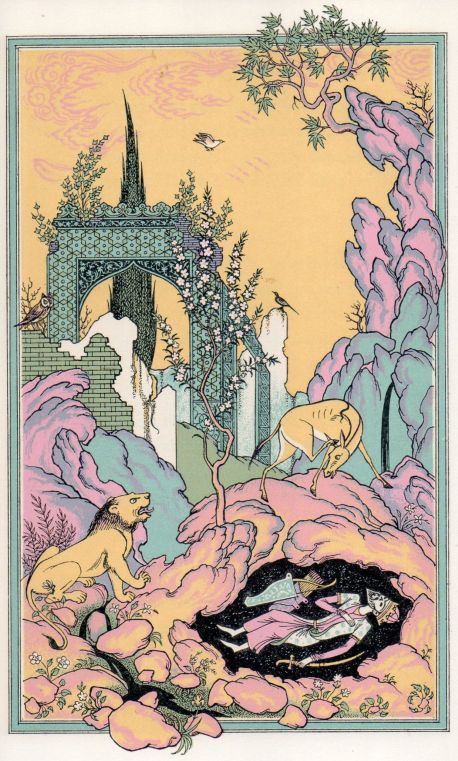
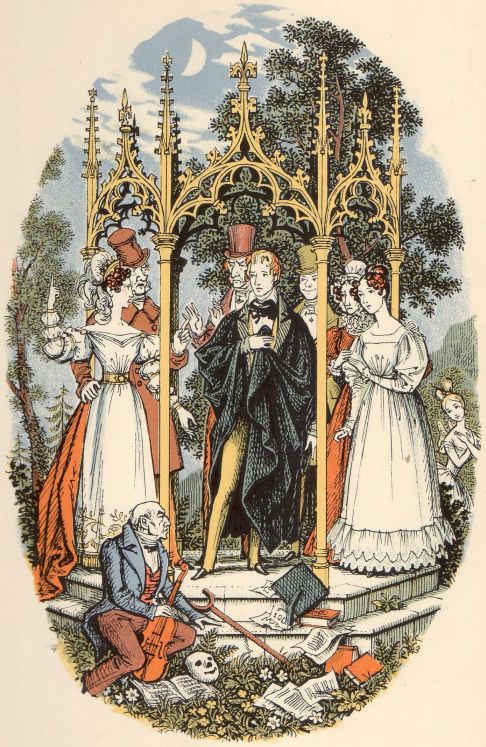
Fig.1b: faces quatrains 16 to 19 and clearly relates to quatrain 17 (“They say the Lion and the Lizard keep &c”) though there is no lizard. Bahram and the Wild Ass are, however, present. The ruined “Courts where Jamshyd gloried and drank deep” are clearly shown in the background.
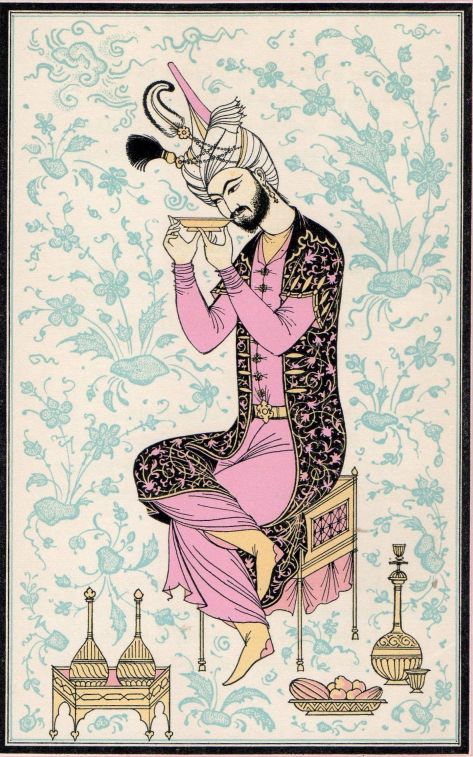
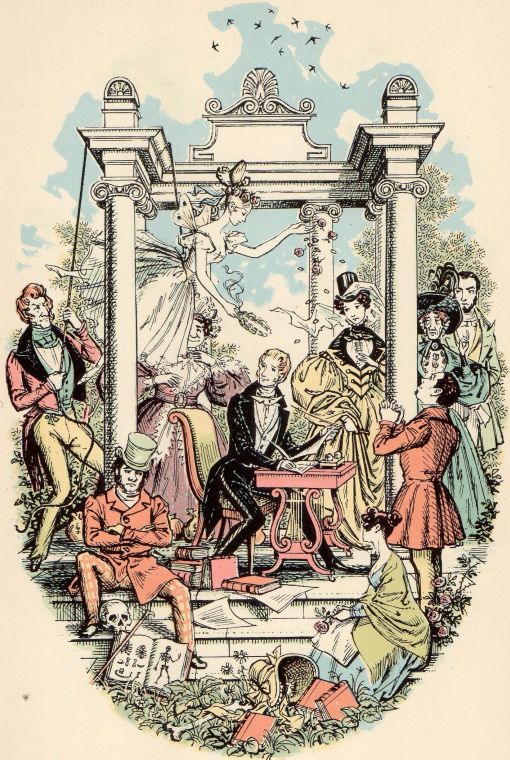
Fig.1c: faces quatrains 36 to 39, and perhaps relates to quatrains 37 (“Ah, fill the Cup &c.”) and 39 (“Better be merry with the fruitful Grape &c.”) It could also refer back to quatrain 34 (“Then to this earthen Bowl did I adjourn / My Lip &c.”)
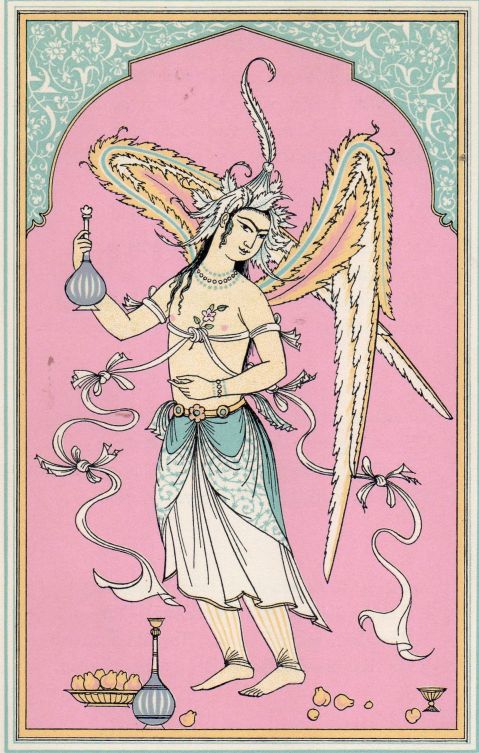
Fig.1d: faces quatrains 40 to 43, and presumably depicts the “Angel Shape” of quatrain 42, though the Vessel of Wine is not on his shoulder, and there is another at his feet.
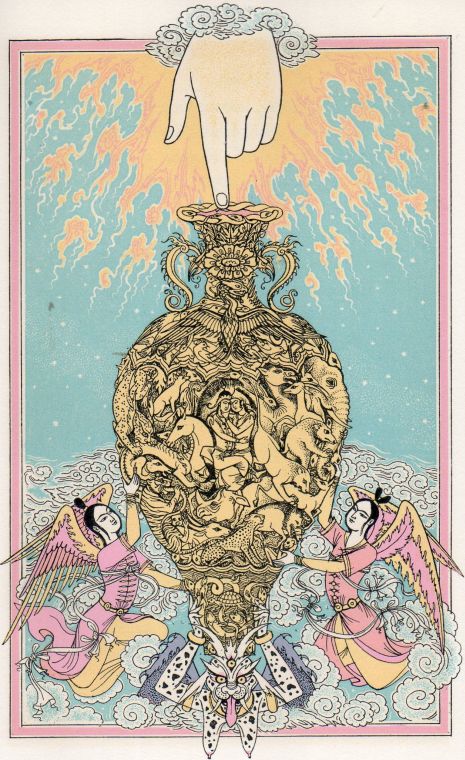
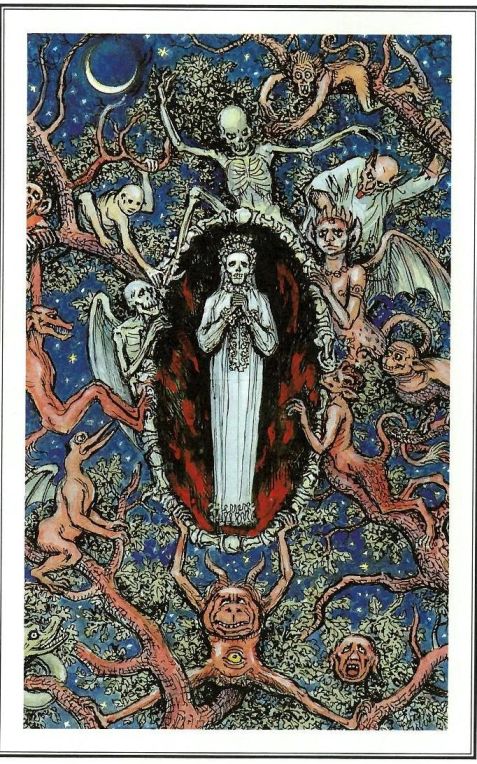
Fig.1e: faces quatrains 59 to 61, the opening quatrains of the Kuza–Nama or House of Pots, but seems only to relate this section of the poem generically. In the clay of a huge pot we seem to have Omar and his Beloved at the centre surrounded by various animals, all being infused with life by the Hand of God from above, his ‘frilly cuff’ presumably being stylised clouds, the Angels & Demon near the base, referring to the “strict Testing of us” under the threat of “the Smoke of Hell” (quatrain 64.) Recall also the “threats of Hell and Hopes of Paradise” of quatrain 66 in FitzGerald’s second version (quatrain 63 in his third and fourth.)
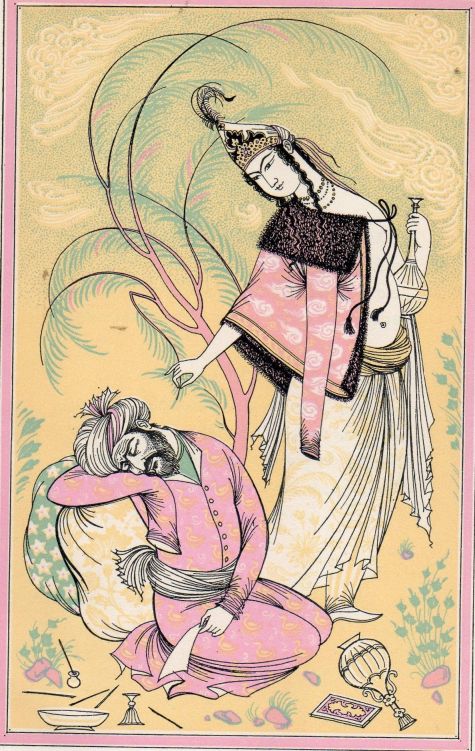
Fig.1f: faces quatrains 69 to 72 but doesn’t seem to relate specifically to any one of them. Perhaps we have here a drunk Omar who has drowned his honour “in a Shallow Cup” (qu.69 = the bowl to the lower left ?) and sold his “Reputation for a Song” – note the abandoned pens, one dipped into a small pot of ink near the bowl, and, next to the overturned wine bottle at the lower right, a cast–aside book. (It has been pointed out that this book looks very like the cover of Stewart’s Rodale edition!) If so, the illustration may also refer to quatrain 71 (“And much as Wine has play’d the Infidel, / And robb’d me of my Robe of Honour &c.”) Less certainly, the young woman in the illustration may represent Spring (quatrain 70), with Wine rather than a Rose “in hand”, about to tear his “thread–bare Penitence” to pieces with the new (?) flask of wine she is carrying. To the right of the bowl is what looks like an upturned glass, perhaps in reference to the phrase “turn down an empty Glass” at the end of quatrain 75, though there are no “Guests Star–scatter’d on the Grass.”
The illustrations, then, seem often to relate to more than one quatrain, and to border on the generic in some cases (particularly Fig.1e). Be that as it may, it seems to me that the artist has successfully given a Persian feel to the human figures in his illustrations, though I am told that some details are more Indian than Persian, and his use of background colour is suspect.
The book was also reprinted, probably in the 1970s, by Castle Books of Secaucus, New Jersey (Paas #724), but with some of the plates differently placed & seemingly without regard to the quatrains they face.
[The images can be browsed here.]
In the 1960s Charles Stewart illustrated two books for young readers by Barbara Leonie Picard, The Story of Rama and Sita (George G. Harrap, London, 1960) and The Story of the Pandavas (Dennis Dobson, London, 1968.) They are based on the two great Indian epics, the former on The Ramayana, the latter on The Mahabharata.
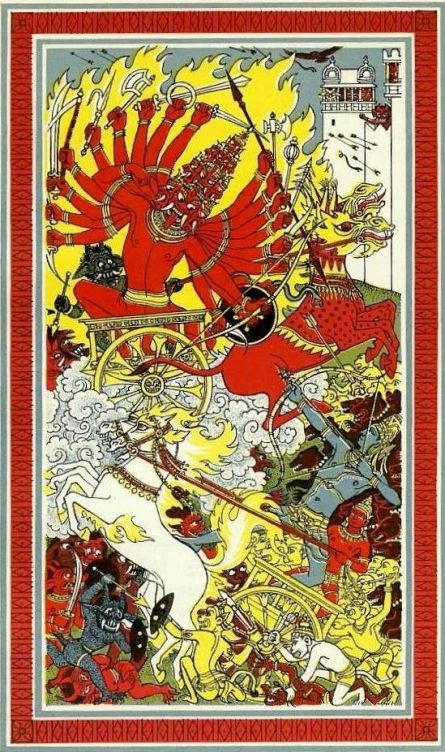
Three examples of the six illustrations (including the frontispiece) for The Story of Rama and Sita are shown here.
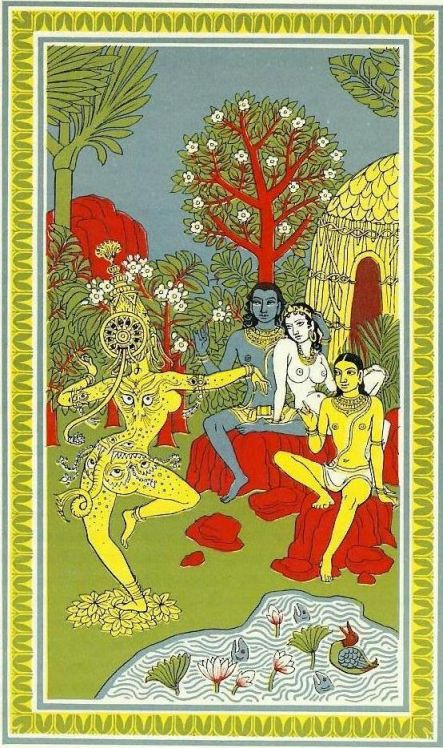
Fig.2a: Surpanakha appears before Rama, Sita and Lakshmana (facing p.46.)
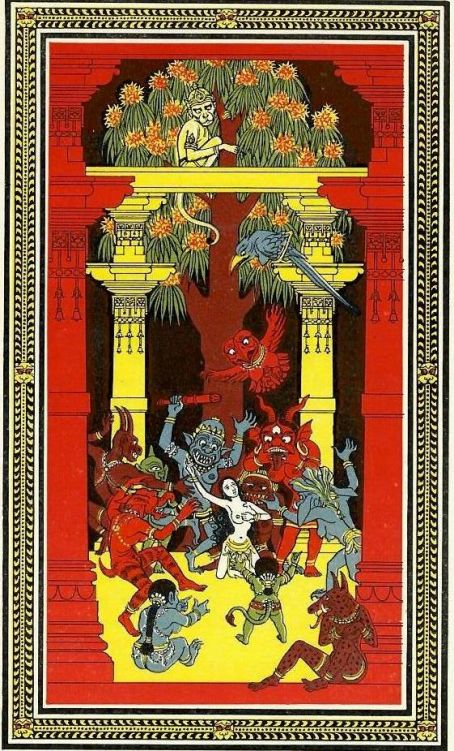
Fig.2b: Sita threatened by Ravana’s demons (facing p.66.)
Fig.2c: Rama battles with Ravana (facing p.86.)
Again, Stewart nicely captures the style of Indian art, though I cannot help but think they are a bit sophisticated for younger readers!
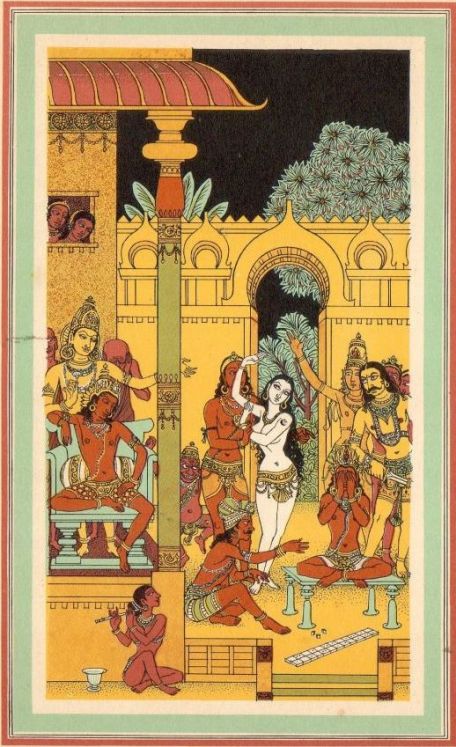
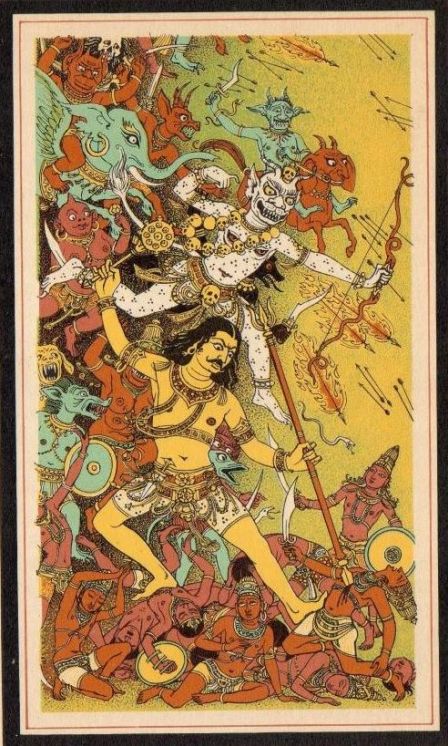
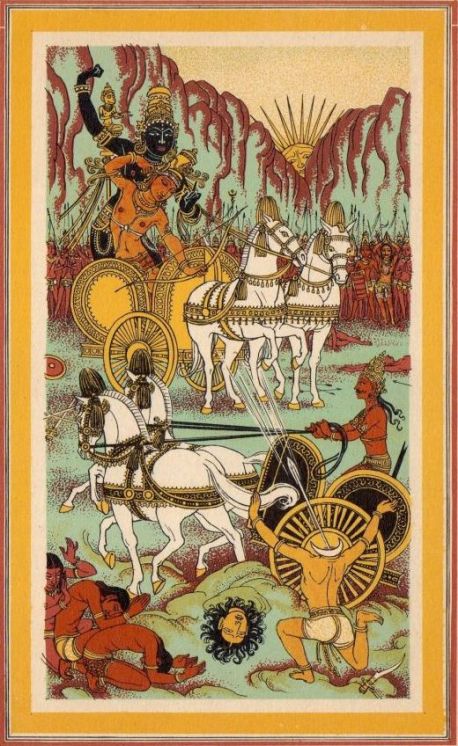
Three examples of the five illustrations (including the frontispiece) for The Story of the Pandavas are shown here.
Fig.3a: Presumably depicts the princess Draupadi as a slave–girl, having been lost in a game of dice by one of her husbands, Yudhishthira – he is seated, covering his eyes, the dice on the floor in front of him. Another of her husbands, Bhima (to the right) draws his sword in anger at her treatment (facing p.45.) For those puzzled, Draupadi is the common wife of the five Pandava brothers, Yudhishthira and Bhima being two of them. The winner of the dice game is Shakuni, who is allied to the Kurus or Kauravas, the enemies of the Pandavas. He is seated on the floor to the left of the dice.
Fig.3b: Bhima, with his rakshasa (demon) followers, slays many in the battle between the Pandavas and the Kurus (facing p.88.)
Fig.3c: In battle Arjuna, another of the Pandava brothers, decapitates Karna with a crescent–tipped arrow. Karna is his half–brother, but he has sided with the Kurus. (facing p.114.)
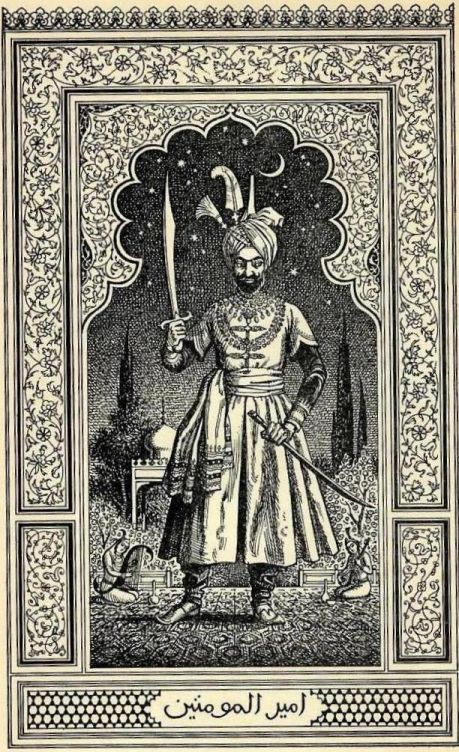
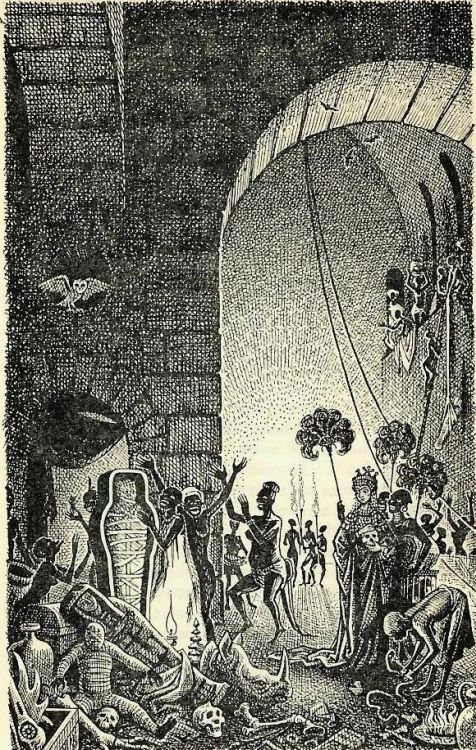
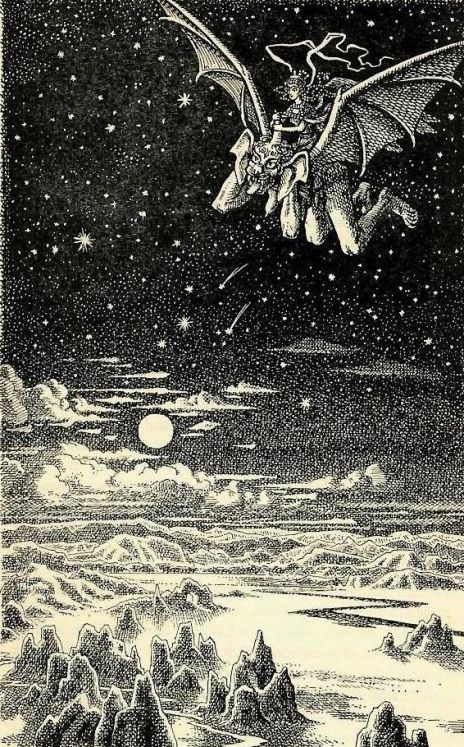
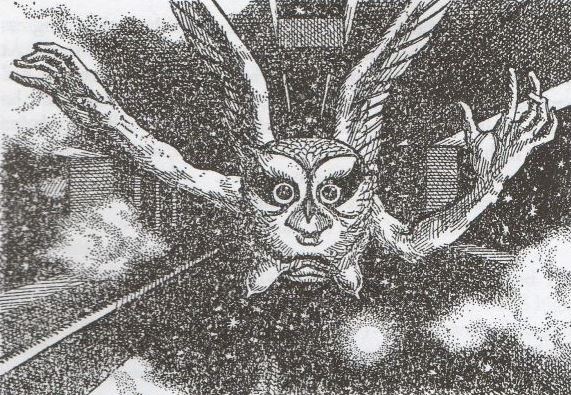
An ‘Orientalist’ relative to the foregoing is William Beckford’s well–known supernatural tale of the Caliph Vathek, an edition of which, translated from the original French by Herbert B. Grimsditch and illustrated by Charles W. Stewart (the W stands for William), was published by the Bodley Head, London, in 1953 – two years before his Rubaiyat. It contained eight black and white illustrations, including the frontispiece, which certainly capture the Gothic nature of the story. Three examples are shown here.
Fig.4a: The frontispiece – its inscription reads: Amir al–Momenin (Commander of the Faithful) – effectively, sword in hand, a proclamation of his Caliphate – his power over all. Vathek was, addicted to pleasures of the flesh, and had five palaces each devoted to the satisfaction of one of the senses. When angered “one of his eyes shone with such a terrible light that no man could endure its gaze” (p.17.)
Fig.4b: Vathek’s mother, Carathis, in her repository of mummies, assembled for magical purposes, which is guarded by fifty dumb negresses, each blind in her right eye (p.42.)
Fig.4c: Carathis riding on the back of the afrite (a type of demon) “who complained horribly of his burden (p.119.)
I have to say that in some ways I prefer these black and white illustrations to the coloured Persian and Indian illustrations above – they are more atmospheric, somehow.
[The images can be browsed here.]
At this point it is useful to take a look at the life of the artist.
Stewart’s life is well documented (1), unlike many featured in my Rubaiyat Artists series, so why feature him at all? If I were to ask readers, “What is the connection between ballet, a huge collection of historic dresses (mostly women’s), Gothic horror stories, and The Rubaiyat ?", most readers, I guess, would be puzzled. Since the answer is Charles Stewart, that is the justification for his inclusion in this series.
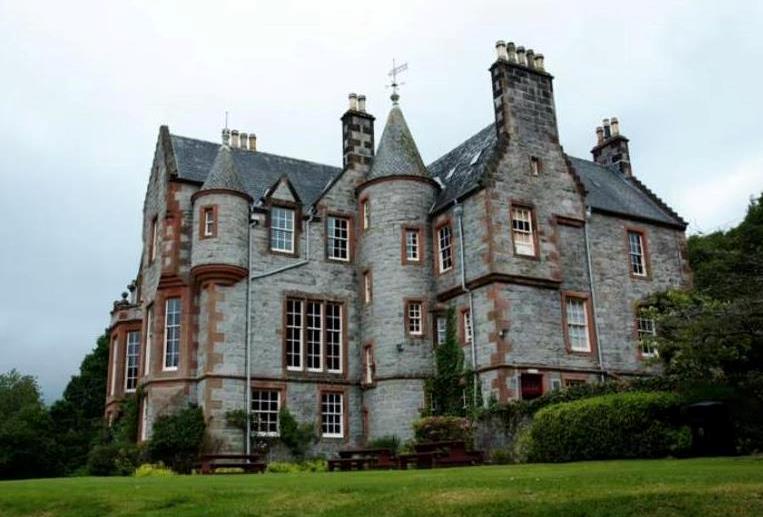
He was born at Iloilo in the Philippines on 18 November 1915, where his father, Alexander, worked for the merchant firm of Smith, Bell & Co., later becoming a partner in it. In 1918 his mother (2a) brought him back to the UK, leaving him in the care of his uncle, Captain William Stewart, and his wife (2b), at Shambellie House (Fig.5), New Abbey, Dumfries, a place of considerable importance in the story of our artist, as we shall see.
His sister, Margaret (2c), was born in the Philippines in 1922, and the following year his mother brought her back to the UK as well, buying a small house in St. Leonards–on–Sea, East Sussex, where Charles and his sister were left in care of a nurse, a nursery maid and “a kindly Edinburgh widow.” (Their father only returned on leave every five years, but their mother returned every two years to spend a year with the children.)
Charles was educated at a preparatory school in Surrey and in 1928 was sent to Radley College, near Oxford. In 1930 Charles’s aunt and uncle both died, at which point his father inherited Shambellie House. Unfortunately, the firm in the Philippines had gone bankrupt, as a result of which the family were unable to afford to live at Shambellie until 1936. Meanwhile, in 1932 Charles was sent to the Byam Shaw School of Drawing and Painting in London.
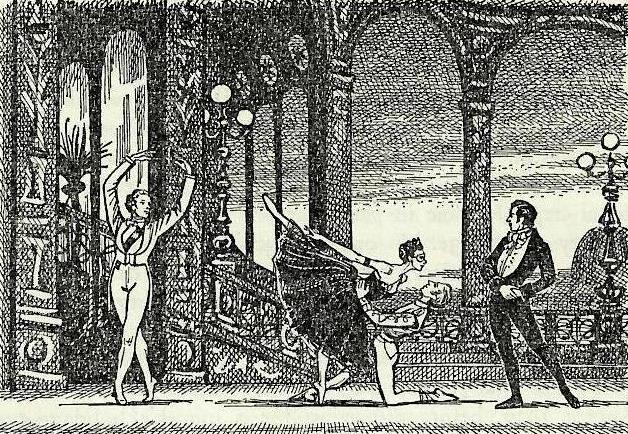
In 1933 the Ballets Russes de Monte Carlo came to London, and Charles fell so much under its spell that in 1934–5 he began to go to ballet classes in the evening and to take private lessons. In 1936, he tells us, in his autobiography Holy Greed: the Forming of a Collection (1980):
By a freak of fortune I was engaged as a member of the corps de ballet for Beecham’s forthcoming opera season at Covent Garden, performing in the ‘Tales of Hoffman’ and ‘Aida’. Designed costumes for male dancers in ‘Aida’ and for Lydia Sokolova who danced the solo. Also performed with three other dancers in ‘Figaro’ at Glyndebourne (p.29–30.)
In 1937:
Engaged again for new season at Covent Garden. For ‘Die Fledermaus’ and ‘Salome’. The last performance of ‘Salome’ was conducted by Strauss himself. Won a scholarship for an extra year at the Byam Shaw, but trouble with the Principal because ballet rehearsals were interfering with my work. Decided to give up dancing but I hoped to design for the theatre (p.30.)
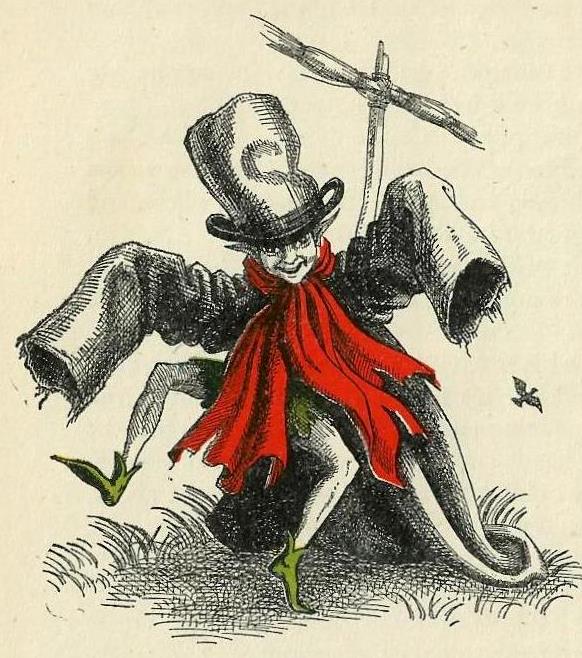
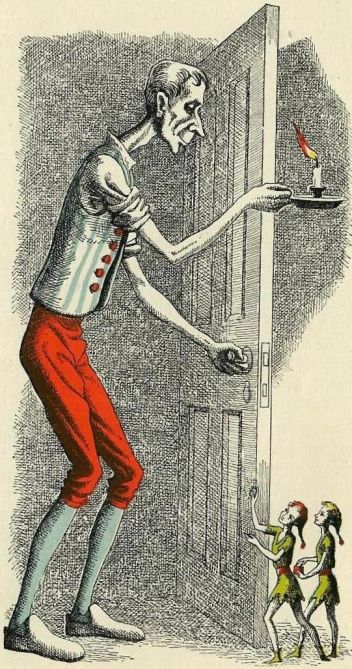
In 1938 he left the Byam Shaw, and when the War broke out the following year, as a Conscientious Objector he served as a stretcher–bearer in the ARP at the same time as teaching himself to draw with pen and ink, these skills leading to his first book illustrations in 1944: Rose Fyleman’s book for children, Hob and Bob: A Tale of Two Goblins. Two examples are shown here as Figs.6a & 6b. The first show Hob dressing up in the clothes of a scarecrow; the second, Hob & Bob calling on Jack Sprat (he who could eat no fat, of course) and his wife (who could eat no lean.) Incidentally, in their adventures they also encounter Miss Muffet and, of course, that troublesome spider that sat down beside her.
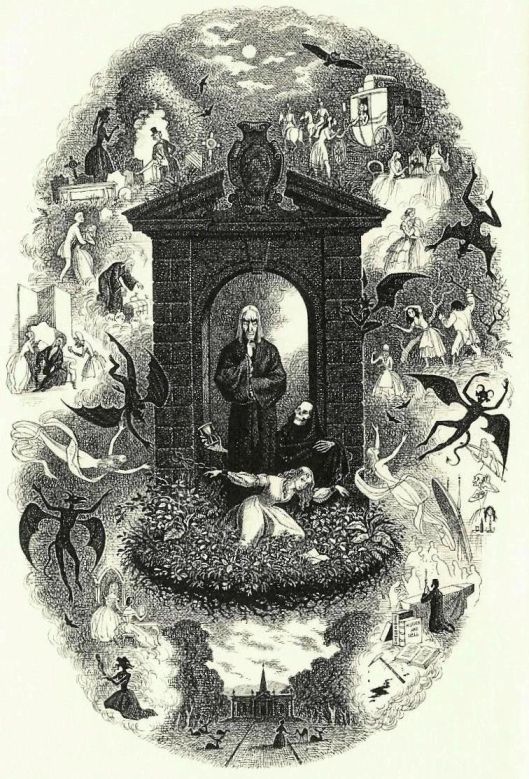
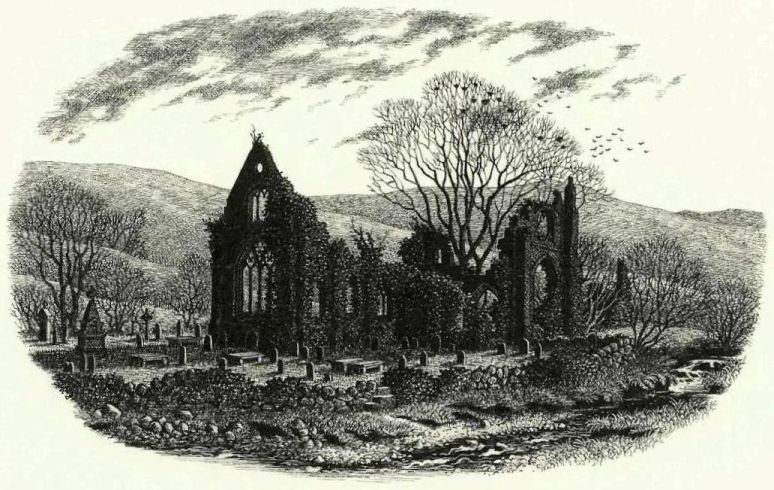
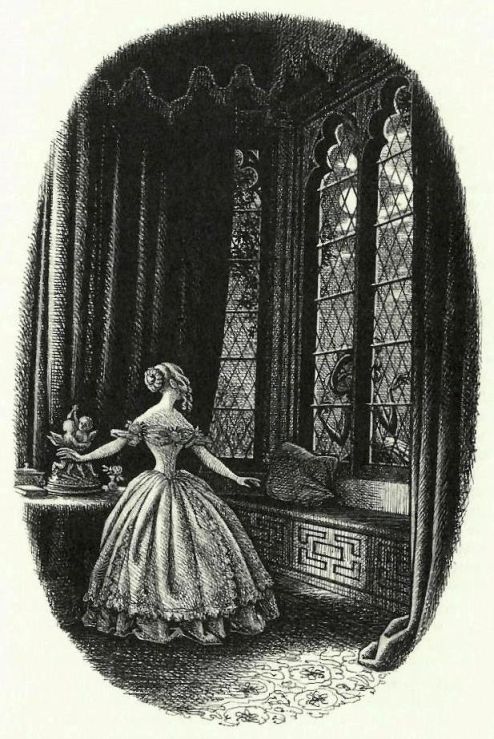
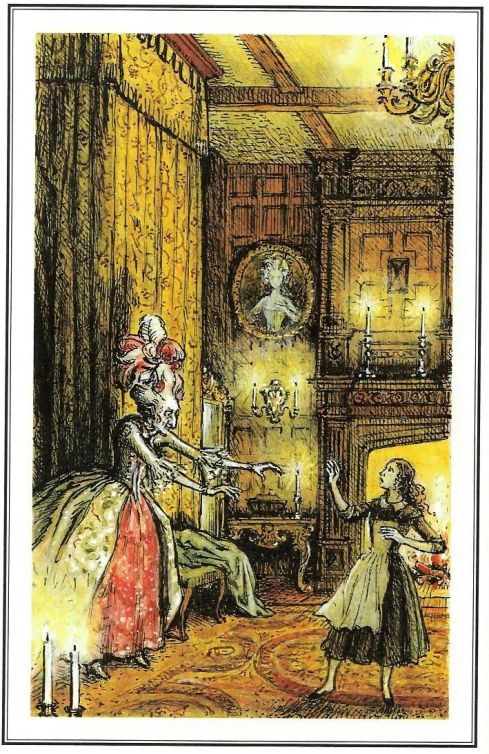
In 1946 a major commission came his way – to do a set of 32 illustrations for a Bodley Head edition of Sheridan Le Fanu’s novel, Uncle Silas, on which he worked for 18 months. Disappointingly, for technical and financial reasons, it was not to be published until the Folio Society of London issued it in 1988. It is of particular interest for two reasons. Firstly, its Gothic setting in the isolated mansion of Bartram–Haugh resonated with Stewart&rsquo's life at Shambellie House, of which more later. The wonderful frontispiece of Uncle Silas says it all (Fig.7a), as does image of the small ruined abbey with graveyard shown in Fig.7b (facing p.33). Secondly, the novel being set in the 1840s, it necessitated much research into the costumes of that period: Fig.7c (facing p.15) combines period dress with Gothic horror, for the young woman is peering through the window at a tall woman in grey, gobbling and crackling shrilly, and smiling very unpleasantly on her.
Stewart had had an interest in costume from childhood, when in a shop window in Edinburgh he saw a china doll in pseudo–eighteenth century costume. A couple of years later, at kindergarten near Shambellie House, he derived great pleasure from designing ‘medieval’ costumes for a school play. At the age of 8, by now in St. Leonards–on–Sea, his nursery maid delighted him by creating a ‘Greek’ costume, with cloak, for him. His passion for dress was further fuelled by visits to the cinema and the theatre. By the time he went to the Byam Shaw School, he had developed the idea of working in the field of stage design, and of course that linked up with his passion for ballet.
At first he bought historical costumes for research purposes related to book illustration, but the collecting bug took over from that, as he explains in detail in his above–mentioned autobiography, Holy Greed. Eventually the collection ran to over 2000 costumes and accessories, mainly women’s, but with some men’s and boys’.
When Charles’ mother died in 1960, he re–located from London to help his by–then invalid father run the Shambellie estate. When his father died in 1962, he inherited Shambellie and the collection was subsequently moved into it. But managing the collection and the Shambellie house and estate was proving too much for him, so he negotiated with the Royal Scottish Museum for them to take over the whole, “for the Nation”, resulting in the Shambellie House Museum of Costume, which opened in 1982. “Almost immediately,” he wrote, “as though a mission had been accomplished and I had no further concern in the matter, my interest in collecting costumes mysteriously melted away.” Sadly, the Museum was forced to close in 2013, and the collection was transferred to the National Museum of Scotland in Edinburgh.
But we must mention Rosie. To help in his illustrations of costumes, Charles bought a good 19th–century life–size lay model, whose limbs could be manoeuvred into almost any pose. He named her Rosie. When Pietro Annigoni needed a lay–figure for his work on his 1955 portrait of Queen Elizabeth II, to avoid the Queen having to remain still for long periods while he painted her robes, he borrowed Rosie, who was duly driven to Buckingham Palace in a taxi, returning to Charles after regally living there for five weeks. Rosie, of course, eventually ended up Shambellie, later going to live with her owner in Oxford. After his death, in sheltered accommodation there on 3 October 2001, she was transferred to Kensington Palace – an appropriate final resting place.
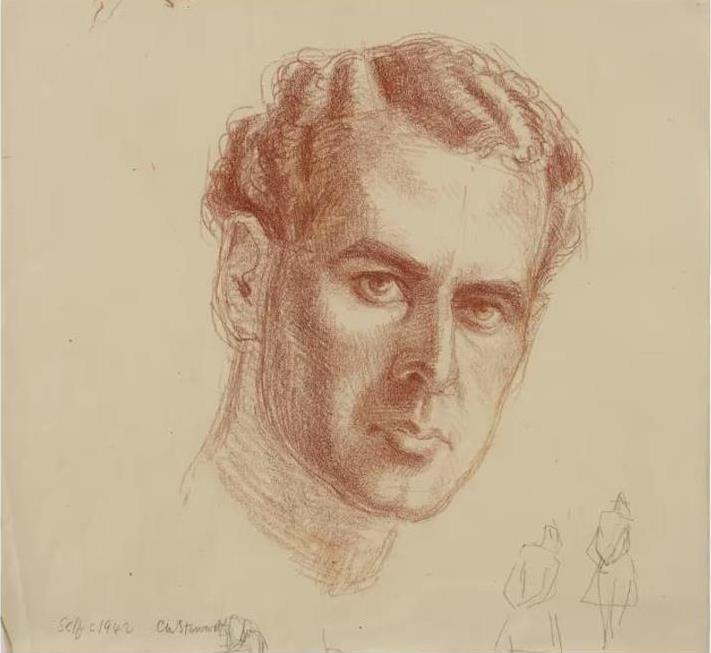
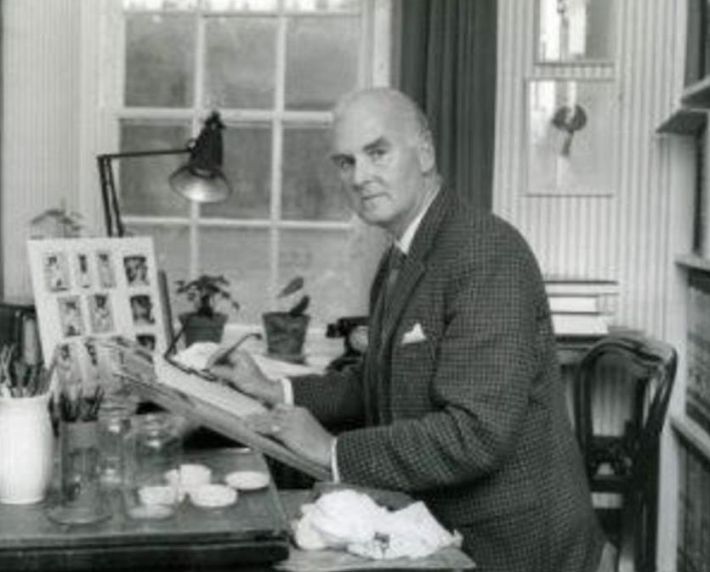
Returning to his artistic career, in 1950 he was engaged to teach Life Drawing and Illustration at the Byam Shaw School, becoming a joint–Principal there in about 1955. He retired from teaching in 1958. A self–portrait of him done in about 1942 is shown in Fig.8a and a photograph of him, taken in later life, in Fig.8b.
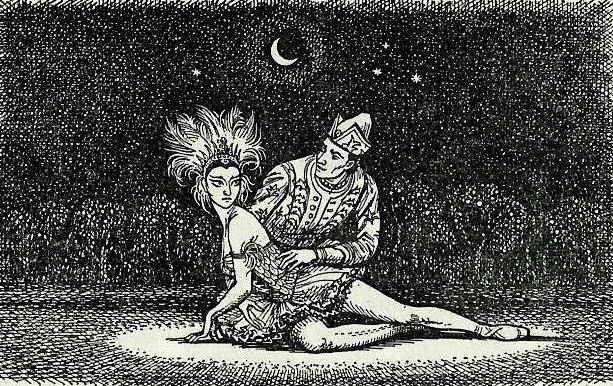
Of books illustrated, Pigeon Crowle’s book Come to the Ballet (1957) must have brought back many memories for him. Charles did twelve black and white chapter headpieces for it. Fig.9a illustrates The Firebird and Fig.9b The Lady and the Fool. Likewise, his illustrations for Thackeray’s Pendennis, published by the Limited Editions Club in Ipswich in 1961 gave scope for his penchant for period costumes. The generic frontispieces for volume 1 (Fig.10a) and volume 2 (Fig.10b) are excellent examples - the central character in both is Arthur Pendennis, the central character of the novel, of course.
[The images can be browsed here.]
Charles’ love of the Gothic, already seen in Vathek and Uncle Silas above, deserves a section to itself.
In 1997, The Folio Society of London published Ghost Stories and Other Horrid Tales, selected and illustrated by Charles W. Stewart. More than that, it included a Preface by him, in which he talks of being taken as a child by his mother to the above mentioned Shambellie House:
The house, built in the romantic baronial style of the 1850s, was situated on a steep hillside, surrounded by ancient woodlands...In the long spring and summer evenings when the green twilight never seemed to get really dark, I used to lie in bed listening to the blood–curding shrieks of the owls in the woods and the whir of the nightjars...In those days the house was lit by oil lamps and candles. Although not very large, to a small child it seemed like a giant’s castle. (p.ix–x)
After explaining that he slept in wing shut off from the rest of the house by a swing door which opened on to a stone spiral staircase in a tower, he goes on:
Human voices, occasionally drifting up from below, seemed very far away and the mysterious upper regions sometimes emitted startling creaks and bumps, and at times a curious slithering sound which I have never been able to identify, but which suggested a large, soft but heavy creature dragging itself stealthily along the floor. (p.x)
Added to all this, of course, were the eerie sounds of scurrying rats so common in old country houses. “I am sure my surroundings stimulated such latent talents as I possessed,” he said, “although they gave a darker tone to my imagination.” (p.x)
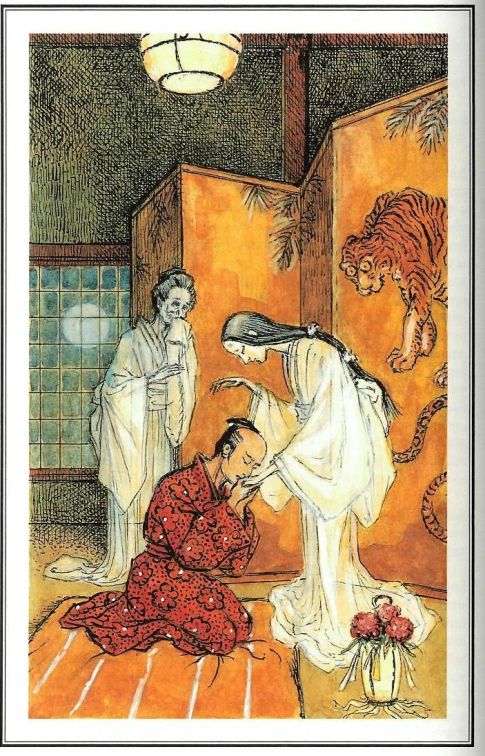
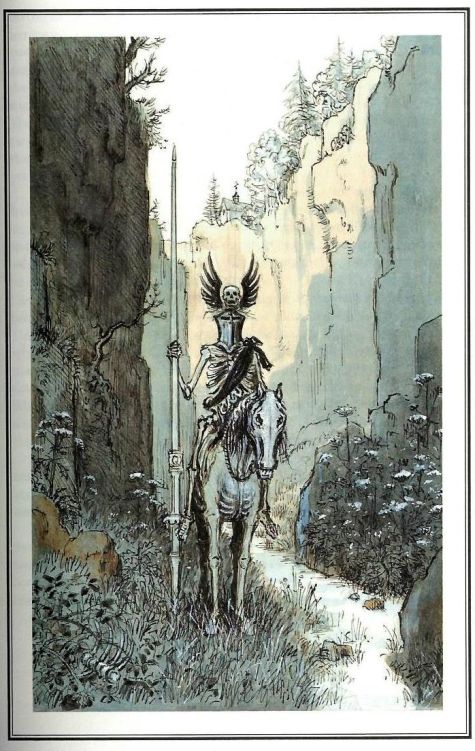
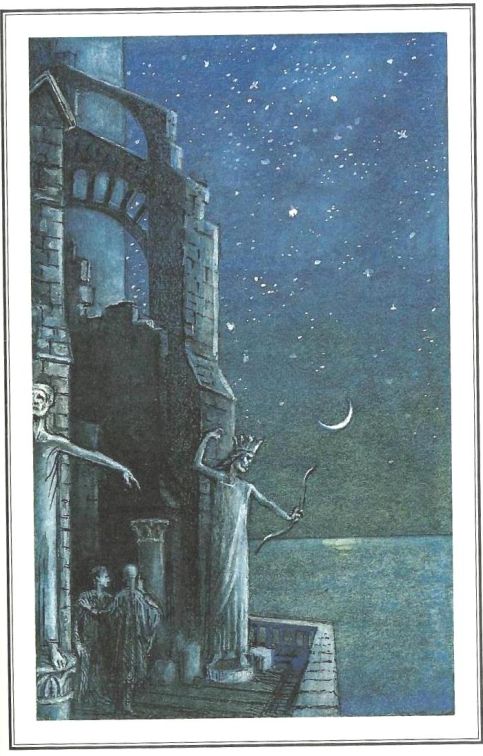
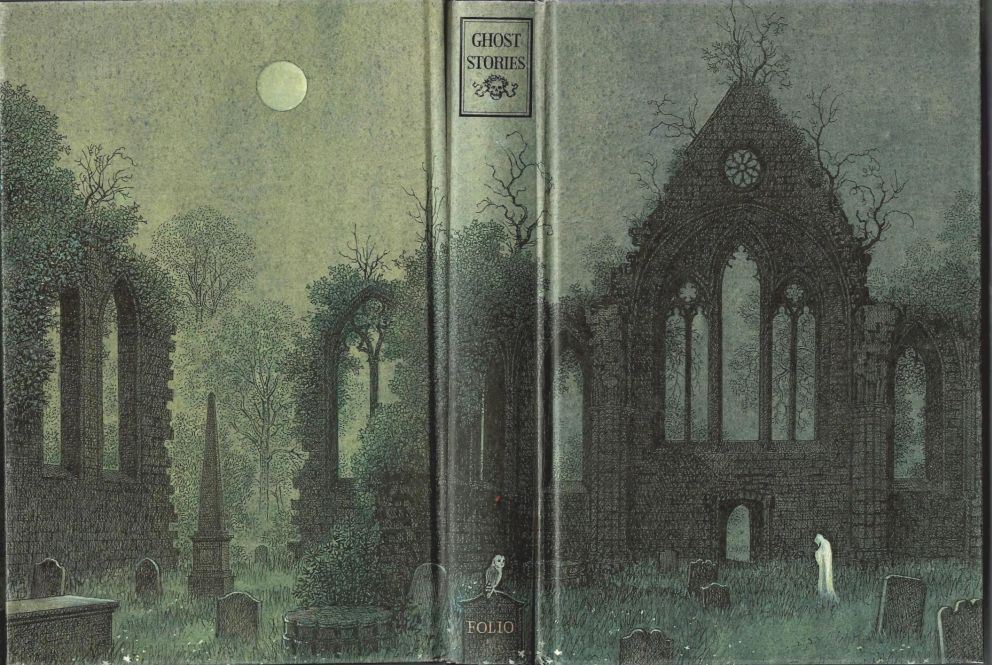
Ghost Stories and Other Horrid Tales, featured another wonderfully generic frontispiece, so characteristic of Stewart (Fig.11a), plus 20 other full–page illustrations in colour, not quite one for each story. Thus Fig.11b illustrates Sheridan Le Fanu’s story “Madam Crowl’s Ghost”; Fig.11c, Lafcadio Hearn’s “A Passional Karma” (set in Japan); Fig.11d, Vernon Lee’s “The Lady and Death”; and Fig.11e, Walter de la Mare’s “All Hallows.” The cover also has a wonderfully evocative design extending from the front, across the spine, and onto the back (Fig.11f.) A ruined church or abbey, especially with an attendant and haunted graveyard, by night, and lit by a full moon – what more could one ask for ?
Sleep well!
[The images can be browsed here.]
When I first read Mervyn Peake’s ultra–Gothic trilogy Titus Groan (1946), Gormenghast (1950) and Titus Alone (1959) some fifty years ago, I was absolutely bowled over. Reading them again a couple of years ago, I found their impact had lessened, and the text seemed overly exaggerated. Nevertheless, I still regard the books as classics of the Gothic type, and I still delight in the bizarre and colourful names Peake gave to his characters. So, I was pleased to find that in 1973–4 Stewart had done 21 illustrations for the first two volumes of the trilogy, alas never published, and done simply for his own pleasure, as the books had such an impact on him. They reside today in the Royal Academy Library (3) and can be viewed online. I give six examples here:
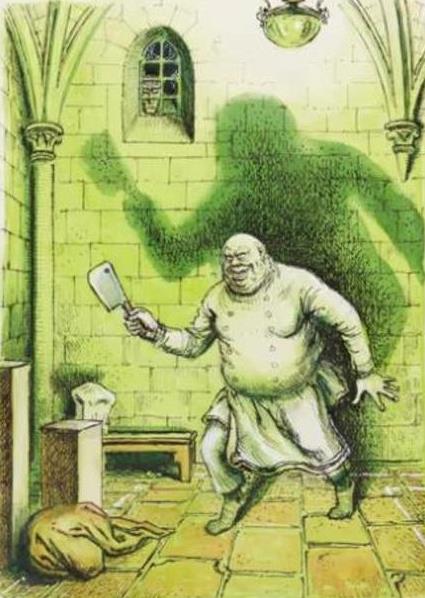
Fig.12a: Titled: Swelter Rehearsing. An early side–plot in Titus Groan. This shows Swelter, the head–chef at Gormanghast practising for the murder of Flay, the personal servant of Titus’s father, Lord Sepulchrave. His plot fails and he loses to Flay in a battle fought to the death in the sinister Hall of Spiders (also illustrated by Stewart, but not shown here.)
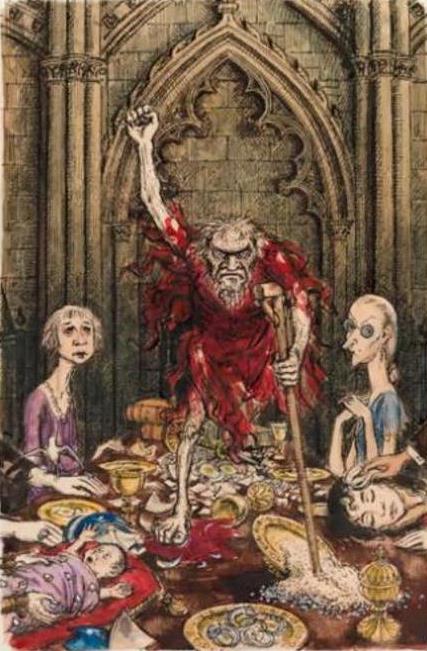
Fig.12b: Titled: The Dark Breakfast. Barquentine, the one–legged Master of Ritual at Gormenghast, with his crutch, ceremonially trampling down the breakfast table celebrating the ‘Earling’ of the infant Titus (lower left.) The two women are presumably Fuschia (left), the older sister of Titus, and Irma Prunesquallor (right), the sister of the castle doctor. The head on the table is a bit of a mystery – perhaps the Countess of Groan (Titus’ mother) who finds the ceremony particularly tiresome.
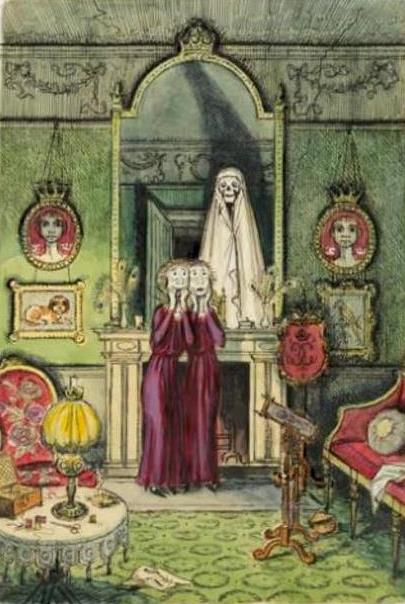
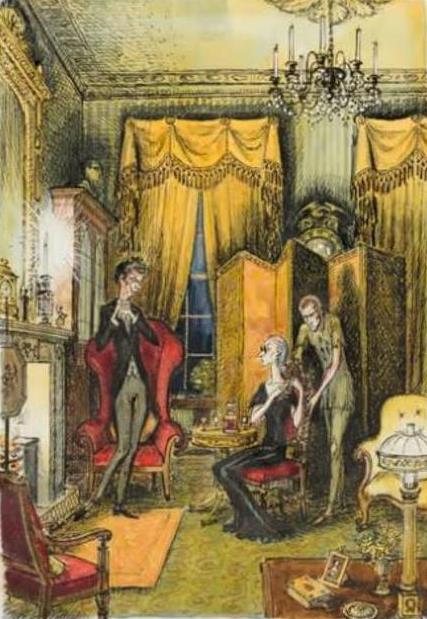
Fig.12c: Titled: The Apparition. Steerpike, the ambitious anti–hero of the tale, poses as a ghostly death–like figure to terrify the identical twins Cora and Clarice Groan (sisters of Lord Sepulchrave) into covering up his arson attack on Lord Sepulchrave’s beloved library, and thus helping him to gain power in the castle.
Fig.12d: Titled: The Prunesquallors engage Steerpike. Again to help his rise to power, Steerpike ingratiates himself with Dr Alfred Prunesquallor, the castle doctor, and his sister Irma. He is engaged as an apprentice to the doctor, but moves on as he gains in power.
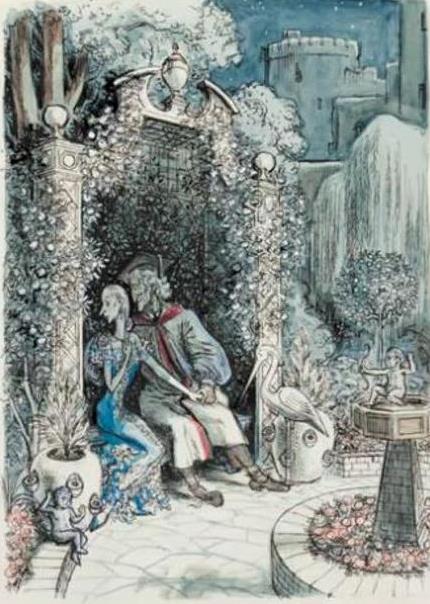
Fig.12e: Titled: Irma and Bellgrove. A light hearted interlude in Gormenghast. Irma Prunesquallor is both plain and vain. In her quest for a husband she throws a party, but the only man who takes any interest in her is Bellgrove, one of Titus’s teachers at Gormenghast School. He eventually becomes its Headmaster. Note the cupid on the pedestal to the right, the putto to the left, and the stork looking in on the couple!
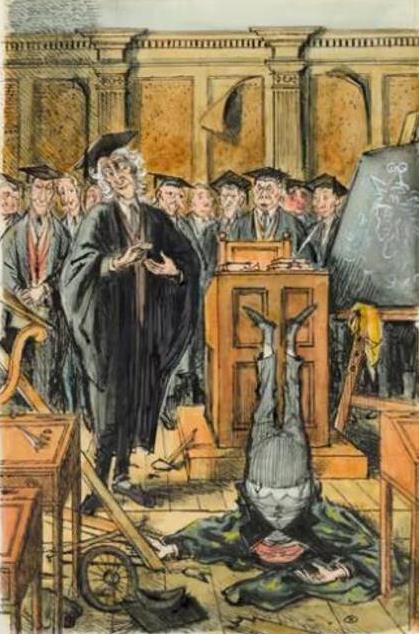
Fig.12f: Titled: The Death of Deadyawn, Following on from the preceding, Deadyawn is the Headmaster of Gormenghast School. He spends much of his time asleep in a high–chair on wheels, and dies when he is accidentally tipped out of it, landing on his head. After his death Bellgrove becomes Headmaster. Note the typically English Public School setting. This is presumably a deliberate parody as Stewart did another picture titled “The Masters Common Room”, not shown here, which supports a parodic view.
[The images can be browsed here.]
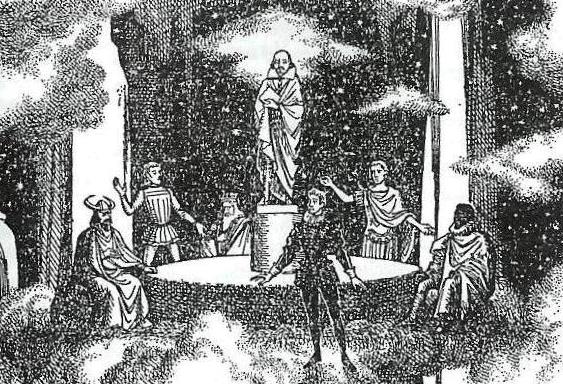
This is not another excursion into Gothic fiction, but a brief account of Stewart’s illustrations for Bertrand Russell’s quirky book Nightmares of Eminent Persons and Other Stories, first published by the Bodley Head in 1954. I give three examples here of the ten nightmares, for each of which Stewart did a head–piece.
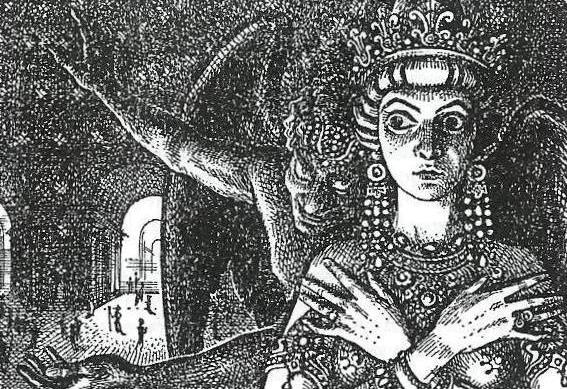
Fig.13a: “The Queen of Sheba’s Nightmare.” It shows Beelzebub, in her dream, making her doubt the true affections of King Solomon, and making her believe that to him she was no more than a future concubine. The story involves the Biblical Song of Solomon, a jewelled volume of which the King gives to the Queen on her departure, and by the language of which she is much flattered – until Beelzebub tells her that the King has given copies to many other women before her.
Fig.13b: “The Psychoanalyst’s Nightmare.” The dream of Dr. Bombasticus, the Psychoanalyst, is that his analysis of six Shakespearean characters effectively ruins their respective plays. Thus Romeo’s so–called love for Juliet was merely an adolescent fancy, his real motivation being rebellion against the father figure. The illustration shows the six characters analysed (Hamlet, Lear, Macbeth, Othello, Antony and Romeo) with poor old Shakespeare stood on the central pedestal, accused of lying about his characters.
Fig.13c: “The Mathematician’s Nightmare.” The mathematician Professor Squarepunt dreams that the numbers endlessly introduce themselves to him as odd, even, square, cube, prime, perfect, pyramidal, symbolic etc etc ad nauseam, with the number 137 being particularly insistent on its prominence. (This relates to Sir Arthur Eddington’s hypothesis that the so–called fine–structure constant in Atomic Physics was exactly the reciprocal of 137, now known to be approximately true, but not exactly so. Eddington was a friend of Russell’s.) Stewart cheated with this illustration, using the same one for “Mr. Bowdler’s Nightmare”, “The Metaphysician’s Nightmare”, “Eisenhower’s Nightmare” and “Dean Acheson’s Nightmare.”
Between 1944 and 1997, Stewart illustrated some 28 books, of which the ten covered above amount to about a third of his output. He gives a comprehensive list up to 1975 in Holy Greed (p.31), the only additions to which are the above mentioned Uncle Silas (1988) & Ghost Stories (1997), and T.H. White’s children’s story, Mistress Masham’s Repose (1989), all of these being published by The Folio Society of London.
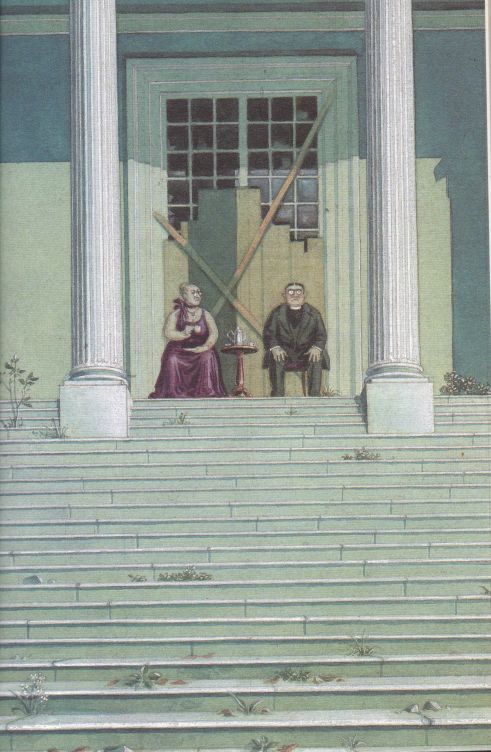
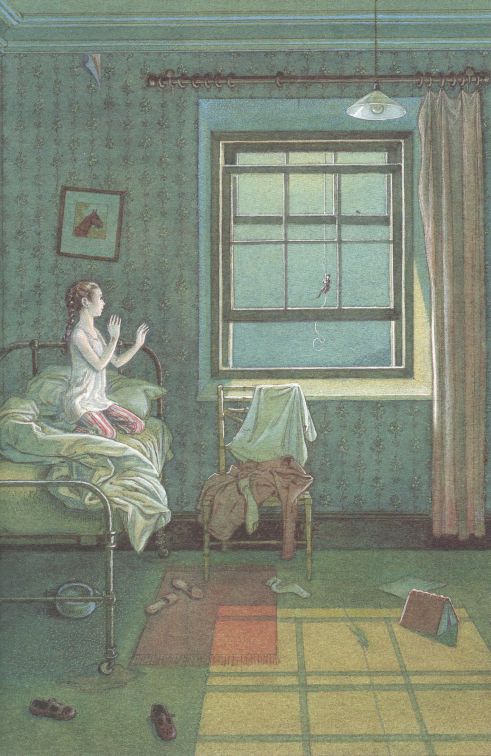
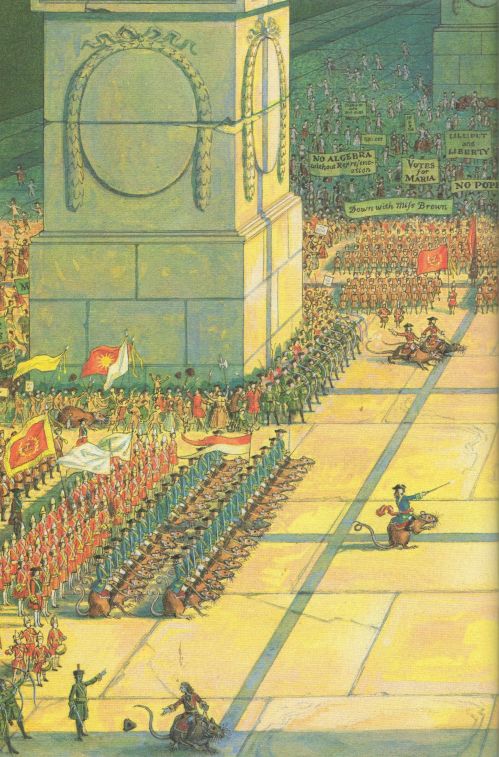
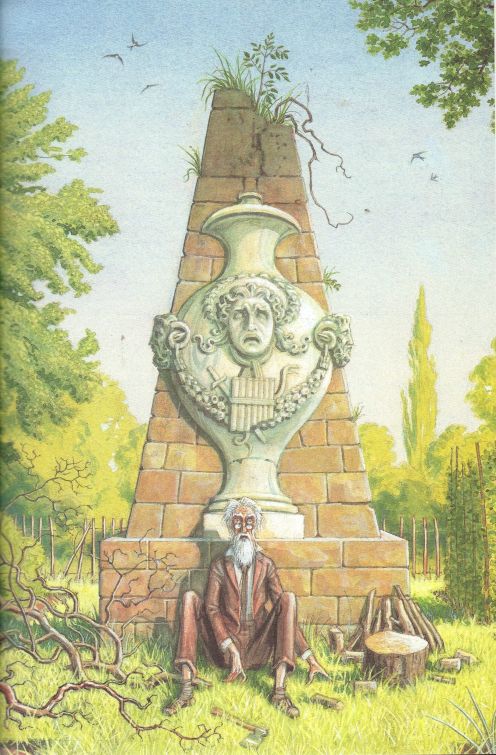
Not the best known among children’s stories, it is set in rural England in the period just after the Second World War. It tells the story of Maria, a young orphan girl, who lives with her guardian, Mr Hater, the local vicar, and Miss Brown, her governess, both of whom treat her badly, in the dilapidated mansion of Malplaquet. Her only friends are the Cook and an eccentric Professor who lives in the grounds of the mansion – plus a colony of Lilliputians who inhabit an island in an ornamental lake on the estate. The book contains ten illustrations in colour, four of which are shown here: Fig.14a shows Mr Hater & Miss Brown taking tea; Fig.14b, a Lilliputian messenger hanging outside Maria’s bedroom window; Fig.14c, the Lilliputian army marshalled for battle; and Fig.14d, the Professor. As can be seen, these are in a rather different style to anything which has gone before.
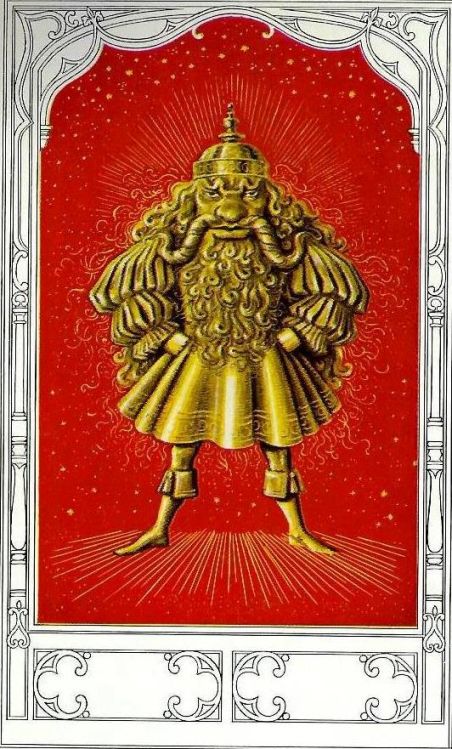
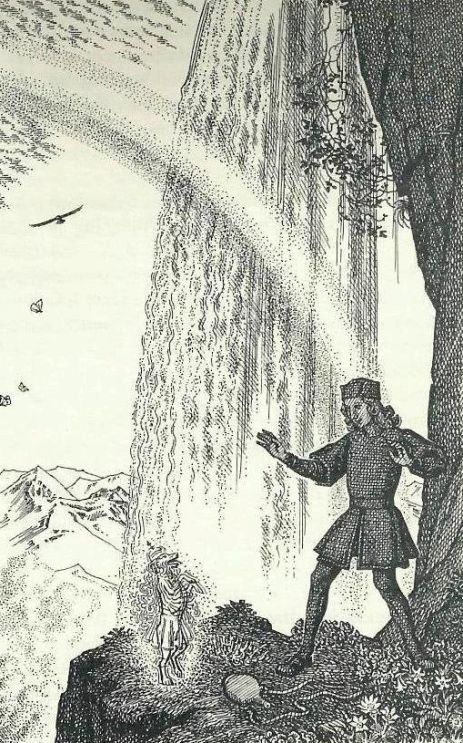
Many of the books illustrated by Stewart were children’s books, another notable one being an edition of John Ruskin’s story The King of the Golden River or The Black Brothers (1958). This is the Cinderella–like story of the good boy Gluck’s triumph over his two wicked brothers, Schwartz and Hans, thanks to the intervention of the King of the Golden River, he being shown here in Fig.15a (the coloured frontispiece.) Stewart also did fifteen black and white illustrations for the book, Fig.15b being the one showing Gluck and the King by a mountain waterfall, a rainbow arching in the background, which, of course, has a pot of symbolic gold at its end.
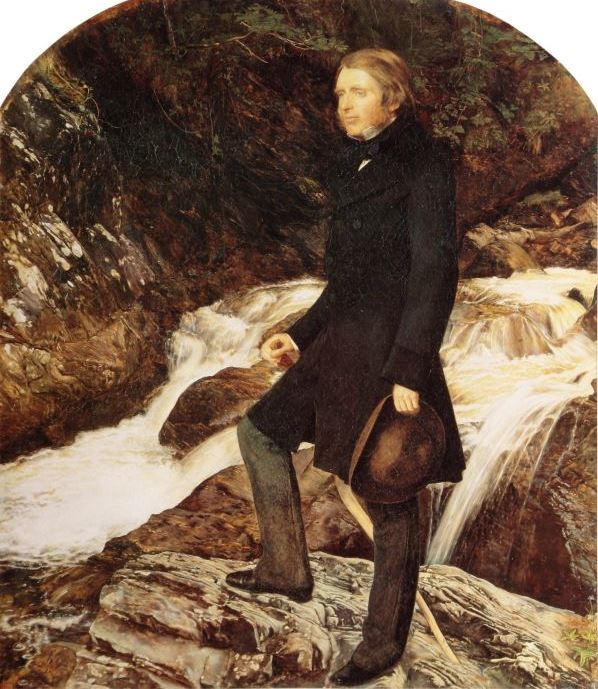
But there is a coda to this. Ruskin’s story was originally written in 1841 for the twelve years old Effie Gray, who subsequently became Ruskin’s wife. The marriage was eventually annulled on account of Ruskin’s non–consummation of it, and she later married the Pre–Raphaelite artist, Millais, Ruskin having been almost the lone champion of that art movement back then. Now, Millais began a portrait of Ruskin whilst he was with Ruskin and his wife in the Scottish Highlands in 1853, but he only finished it back in London in 1854, the year of the annulment of the marriage – an awkward business to say the least, for it was clear by this time that Millais and Effie were in love. It shows Ruskin standing on a rocky outcrop next to a mountain waterfall (Fig.16.) The link between this and Fig.15b is probably just coincidence, arising from Ruskin’s known love of mountain scenery rather than a manifestation of the likes of Kammerer’s Seriality or Jung’s Synchronicity, but it is worth a mention all the same, particularly since the story was written for Effie Gray, who, incidentally, was also painted by Millais, sitting on the same rock, in 1853.
[The images can be browsed here.]
Note 1: Primary sources are Stewart’s autobiographical booklet Holy Greed and his preface to his Collection of Ghost Stories, both cited in the body of this article. Of secondary sources, Stewart was well–enough known to merit obituaries in The Independent on 18 October 2001, The Times on 3 November 2001 and The Daily Telegraph on 15 November 2001. He also features in the standard dictionaries of artists and book illustrators.
Note 2: a) His father was Alexander McCulloch Stewart (1882–1962) and his mother Elinor Louisa Stewart (née Davenport) (1881–1960). b) His uncle was William Stewart (1879–1930), the older brother of his father. His aunt was May Grace Stewart (née Brown) (1882–1930.) c) His sister was Margaret Anne Constance Stewart (1922–1991) and he had an older brother, Alexander Davenport Stewart (1908–1956) (known as Alec.)
Note 3: They can be browsed via this link: https://www.royalacademy.org.uk/art-artists/search/works-of-art?all_fields=charles+stewart Clicking on an individual image brings up a short commentary. The pictures were sold to the RA by Lou Greenshields, the artist’s niece and executor, in 2016. It was she who told me that her uncle had done them purely for pleasure, as he so loved the books. She also told me that he only illustrated Titus Groan and Gormenghast – not Titus Alone, as that part of the trilogy was something of a disappointment to him – he thought perhaps that Peake had been affected by his early onset dementia at the time he wrote it, a view shared by others, though not all.
**********
My thanks are due to Fred Diba, Joe Howard and Sandra Mason for sharing their thoughts on Charles Stewart’s Rubaiyat illustrations. Also to Ann Hill for some background information on the Costume Collection; to Adam Waterton of the Royal Academy Library for some background information on the Titus illustrations; and to Lou Greenshields for the information making up note 3.
**********
To return to the Notes and Queries Index, click here.
To return to the Index of the Rubaiyat Archive, click here.