Did Omar’s quatrains have Spiritual / Sufi significance, or were they the carpe diem verses of an agnostic who took pleasure beneath the bough, with his Beloved and a jug of wine ? And just which quatrains were really written by Omar ? What better way to settle such questions than by hearing the explanations of Omar himself, and that is precisely what happened to the American spiritualist Mrs Esther O’Neill, the results being published in a rather curious little volume entitled Omar’s Rubaiyat Re–Written (Vantage Press Inc., New York, 1954.) The book was actually co-authored by her and a certain Rhama Singha, the nature of their co–authorship being made clear in the Introduction, which I here quote in full. The original is printed wholly in capital letters, incidentally:
The Rubaiyat of Omar Khayyam has been translated into an understandable form for students of the psychic world and its planes, conditions, and natural laws.
This translation is the work of a “teacher”, who identifies himself as the ancient Hindu, “Rhama Singha.”
Rhama Singha says that he also was Omar Khayyam.
Mediums and students of the metaphysical are invited to check this work. Slight variations will be due to individual shades of understanding of cosmic symbols.
The manual work has been done clairaudiently by Mrs Charles E. O’Neill; medium.
Since Omar was Persian, I presume that “the ancient Hindu Rhama Singha” was an Indian reincarnation of him. “Clairaudiently”, as the word itself indicates, means that, effectively, ‘Omar’ dictated the work to her, and she wrote it down.
Readers may be interested to know how ‘Omar’ came to team up with Mrs O’Neill, and fortunately she tells us all about it in an Epilogue to the book. Rhama Singha it seems, first made contact with her in 1935 when she was about 30 years old (she had been interested in Occult studies since she was a young girl of 13.) He did not reveal himself as ‘Omar’ though until the winter of 1948, and in these circumstances:
As I was walking down a certain street, in a certain town, passing a second hand book store, Omar literally took me by an elbow, and turned me into the store. ‘We’ went directly to a shelf in the back of the store, and took down my copy of Fitzgerald’s work. I had not been in that store before – nor since. While I was paying for the book, I was thinking that this was the silliest thing I had ever done in my life, because I did not care for the Rubaiyat. I’d had the opportunity to read it some twenty years before, and after reading three or four pages of it, had laid it aside as being so much ‘drivel’. Neither did I know anything of Fitzgerald (sic). So you see I had no ‘background’ for this work. What little I know of him is contained in the volume ‘we’ bought that day, and I did not read that till I had finished the work Omar wanted me to do for him. In fact he told me not to read it till we had finished. He told me that evening that he had been Omar, and asked me to this transcription for him. So we began immediately. (p.45–6)
The volume they bought that day, she tells us, was “a copy of the fourth volume from the Ouseley manuscript in the Bodleian Library at Oxford” (p.45) – FitzGerald’s fourth version, in other words.
Here then, by way of an example, is verse 1 of FitzGerald’s fourth version, together with a ‘correct’ translation / interpretation of it:
Wake! For the Sun who scatter’d into flightThe Stars before him from the Field of Night, Drives Night along with them from Heav’n, And strikesThe Sultan’s Turret with a Shaft of light.
Wake Spiritually, for the Maker of Things, material and Spirit, who placed Star–gleams of Spirituality in our night of Spiritual Consciousness, in the Beginning – drives them, and our Night, before Him. Banishing our Spiritual Darkness with the Pure Brightness of SPIRITUAL Knowledge of Wisdom. Impressing on Material Man, Incarnate Spirit, the duty and privilege of evolving SPIRITUAL Wisdom and Knowledge.
As I understand it, then, “the Sun” is a symbol of “the Maker of Things, material and Spirit”, whilst “the Sultan’s Turret” is a symbol of “Material Man.” One wonders what FitzGerald would have thought of this, but to continue.
Examples of other spiritually ‘correct’ interpretations of FitzGerald are: Jamshyd’s Seven Ringed Cup (v.5) represents Seven Earth–Connected Cycles of reincarnation; the “Strip of Herbage strewn / That just divides the Desert from the Sown” (v.11) represents the zone that separates the wholly spiritual from the wholly material; the “Book of Verses” (v.12) is that of the lessons of spiritual wisdom to be learned in life, and “singing in the Wilderness” represents the “Ideal Evolvement of Spiritual Harmony in Eternal Cosmos”; the “batter’d caravanserai” (v.17) represents the “material School–room world of experience”; the “Muezzin from the Tower of Darkness” (v.25) represents “those High Ones on the Other Side”; the Seventh Gate to the Throne of Saturn (v.31) represents the Seventh Plane of Spiritual Knowledge; “the Angel of the Darker Drink” (v.43) is the Spirit that gives you your role in a higher Cosmic Place; and “Is and Is not” (v.56) represent two spiritual grades, the perfect and the evolving.
Finally, as a good example of Rhama Singha / Omar in full flow, here are verses 68 to 71 inclusive, together with their ‘correct’ translations / interpretations:
Verse 68:
We are no other than a moving rowOf Magic Shadow–shapes that come and go Round with the Sun–illumin’d Lantern heldIn Midnight by the Master of the Show;
Spirit is no part Material. Its natural PLACE IS IN THE SPIRIT WORLD, taught and guided by Teachers who are NATURALLY gathered round the Christ–guardianship of our Earth.
Verse 69:
But helpless Pieces of the Game He plays Upon this Chequer-board of Nights and Days; Hither and thither moves, and checks, and slays, And one by one back in the Closet lays.
Spirit is helpless to evolve, except HE helps, and Teachers has HE ordained for that. Help in Learning is both HERE and THERE. And Spirit passes to New Plane as Spirit learns to rise, and waits Spirit for none other, to finish School.
Verse 70:
The ball no question makes of Ayes and Noes,But Here or There as strikes the Player goes; And He that toss'd you down into the Field,He knows about it all - HE knows - HE knows!
Evolving Spirit knows that Grades for learning in planes is fair and just. Spirit gets what he earns, and earns what he gets. The Guardian knows how Spirit works, positive or negative – the answer grades the evolvement.
Verse 71:
The moving finger writes; and having writ,Moves on: nor all your Piety nor Wit Shall lure it back to cancel half a Line,Nor all your tears wash out a Word of it.
Incarnate Spirit builds while HERE, the place and circumstance to live while THERE. Inward SPIRIT is exact Judge. “Religion”, nor bargaining, nor regret – can change the BUILDING, once it is DONE.
Speaking for myself, it all gets rather tedious after a while, and its language, like that of so many esoteric works, seems like it says something deep, though one can never quite see exactly what it is! The book is notable solely for its curiosity value rather than for any light it might throw on “the true Omar.”
As regards the verses which Omar – now Rhama Singha in the Spirit World – says he didn’t write, these are verses 81, 90, 92, 99 and 101 (again using FitzGerald’s fourth version.) Each of these verses is accompanied by the clear message: “OMAR” SAYS HE DID NOT WRITE THIS ONE, AND TO LEAVE IT OUT.
Obligingly, Rhama Singha also dictated an Epilogue to the book, beginning, “Greetings! Fellow Student of Spirit; You who have arrived at this page. For those of you who ‘wondered what Omar meant’, the ‘mystery’ is solved.” And he concluded his Epilogue with these comments on FitzGerald and his translation:
About Edward Fitzgerald, a word must be said, and his work of original translation. He also was One with whom previous arrangement had been made, to do that part, in seeing that the meanings of the quatrains were made clear in this ‘time’. You who are familiar with his work, know that he ‘filled in’ some lines in certain quatrains, that were damaged; when the original manuscripts were brought to his attention. In this work, we have disregarded those lines, and several parts, and interpreted the quatrains, according to the hidden meanings, as originally written. The four ‘fill in’ quatrains that ‘Omar’ did not write, have been pointed out. (p.44)
It is a bit of a puzzle why Omar / Rhama Singha chose to comment, via an American medium, on FitzGerald’s admittedly loose translation and ‘mashing together’ of his verses, rather than, via a Persian medium, on the original Persian sources for them. Or, if he couldn’t find a Persian medium, and for the benefit of western readers who could not read Persian script, why he didn’t comment on FitzGerald’s sources as revealed by Heron Allen’s masterful study, Edward FitzGerald’s Rubaiyat of Omar Khayyam, with their Original Persian Sources, Collated from his own Manuscripts, and literally translated (1899). Of course, it is possible that the second hand book store into which Omar guided Mrs O’Neill back in 1948 just didn’t have a copy of Heron Allen’s book, merely a copy of FitzGerald’s fourth version. Readers of this essay may also wonder why Omar waited until Mrs O’Neill came along in 1948, and why he didn’t deliver all this via Louis C. Alexander back in 1907 when he was ‘downloading’ Omar’s Wasiyyat or ‘Last Testament.’ (1)
I have seen only one review of this book, that in the Roseburg, Oregon newspaper The News Review (5 August 1954, p.2.) The review, based on an interview with Mrs O’Neill at her home in Sutherlin, Oregon (about 14 miles north of Roseburg), is too long to quote in full, and in any case it repeats much of what has been said above, but some details of her contact with Omar are of interest:
The contact ran five hours a night five nights a week until the book was completed, she states, and she was grateful when the sessions came to an end.
Mrs O’Neill is an ordained spiritual minister and has no patience with ‘fortune tellers’ and the like. She labels them ‘commercialists’ and says they give true spiritualism a black eye. As witness to the authenticity of her work, both with the Rubaiyat and other instances, the book has been accepted by the Philosophical Research Library in Los Angeles (2). The Society gives serious study to spiritualism in all phases.
The article goes on to tell us that Mrs O’Neill, in addition to having the clairaudient abilities used in ‘downloading’ her Rubaiyat, had some clairvoyant and automatist abilities – that is, she could sometimes foresee future events and sometimes receive messages via automatic writing. (Her husband Charles, we are told, had some interest in spiritualism, but lacked the natural bent that his wife had.) She also conducted Bible classes and was apparently a healer, as well as being a firm believer in reincarnation as a process of spiritual progression through successive lives. Though she had never seen one herself, she firmly believed in poltergeists, or “fun–ghosts” as she dubbed them, as the practical jokers of the spirit world who get their energy from the adolescent boys or girls around whom they tend to flit. Nor could she produce ectoplasm, though she had a friend who could. Finally, according to the author of this review, on the wall of Mrs O’Neill’s room were four life–like portraits, hand–painted on glass by her whilst in a trance. They were of four of her spirit teachers, one of whom, of course, was Omar (aka Rhama Singh), and as you moved around the room, the eyes of the portraits followed you. “Not frighteningly,” the reporter noted, “for your eyes keep going back to them, and they are friendly faces.” Mrs O’Neill herself, incidentally, said she had no artistic skills of her own, so the portraits were, as she saw it, all down to the spirits (3).
It is a pity that the portrait of Omar wasn’t reproduced in the book.
In the Roseburg, Oregon newspaper The News Review (24 July 1954, p.1) there appeared an article headed “Sutherlin Mother Locates Son After 20 Years Effort.” The mother was Esther O’Neill, and the article tells us:
Mrs O’Neill lost track of her son about 20 years ago after the accidental death of the son’s father. The youngster was taken by another family to give him a home, but family and son disappeared.
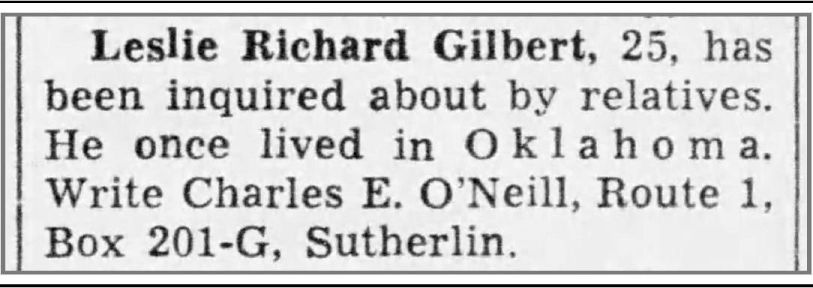
With the help of the Red Cross, police searches, and her husband, who paid some hefty phone bills and lodged notices in various newspapers (Fig.1 is from The Oregon Daily Journal, 8 October 1952, p.29), she finally located him in California:
She found her son, Leslie Richard Gilbert, 27, was the father of five children. The gratification of finding she was a grandmother was combined with her thanks especially to the local Red Cross chapter at Roseburg.
It was lucky that the family who adopted him kept his birth name, or the search might have been much more difficult. It is this fact which helps us to put together a brief biography of Esther O’Neill, for it tells us that before becoming Esther O’Neill, back in about 1927 at the time of parting with her son, she had been Esther Gilbert.
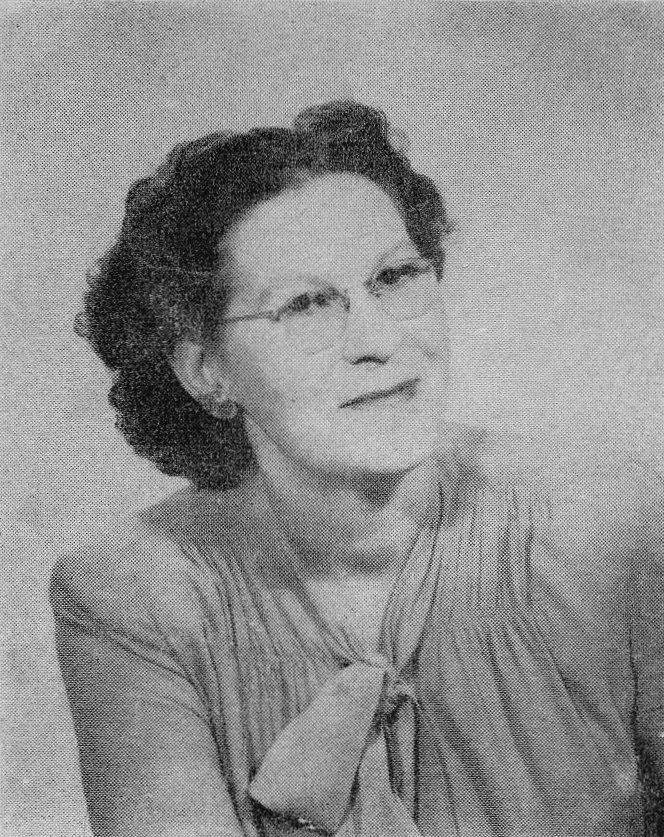
According to the back of the dust–jacket of Omar’s Rubaiyat Rewritten, she was born in Portland, Oregon and was 49 years old at the time of publication, and so was born in 1905, give or take a year depending on month of birth and month of publication. We also know from the dust–jacket that at the time of publication she was resident in Sutherlin. Oregon and from her Introduction that she was Mrs Charles E. O’Neill (as in Fig.1.) The back of the dust–jacket, too, gives us a photograph of Esther at the time of publication, this being reproduced in Fig.2.
In the US Federal Census for 1950, there is only one Charles E. O’Neill resident in Sutherlin, Oregon, but his wife is listed as Cecil D. O’Neill, who was 45 at the time of the census, & thus born in 1905, give or take a year. He is aged 48, and works in a Saw Mill.
Concentrating on him for a moment, and working backwards, in the 1940 Census he was 38, single, working as a farm hand, and living with his brother Cecil T. O’Neill, his wife Myrtle, and their daughter, in Washington State. In the 1930 Census, age 28, he was also living with them in Washington State, again as a farm hand. In the 1920 Census, he & his brother Cecil lived with their parents in Washington State. Whilst living with his parents, he seems to have been known as Everett, presumably to distinguish him from his father, Charles – hence Charles E = Charles Everett.
Something is clearly odd about Cecil D. O’Neill. Cecil can be used as a woman’s name, but it is more often Cecilia. But what is the D, and why is there no Esther ? Following Charles Everett O’Neill in the search for clues, on his death in 1972, he merited a couple of obituaries in local newspapers (4). From these we know that he was a retired Lumber Mill worker who, at the time of his death was living in Yachats, Oregon, and that he was survived by his wife Esther, his brother Cecil, and his stepson, Rick Gilbert – he is Esther’s above–mentioned lost son, Leslie Richard Gilbert, of course. It is via him that we can now (partially) clarify that Cecil D. O’Neill.
There seems to be no direct record of his birth, but in the 1930 US Federal Census, Leslie R. Gilbert (age 2) is the son of Otis B. Gilbert (age 24), a labourer in a logging camp, and his wife Esther C. Gilbert (age 25), who are living in Nehalem, in Tillamook County, Oregon. In 1932, Otis died of a brain tumour, his wife being named on his death certificate (and in the official death record) as Cecila, a variant spelling of Cecilia, Cecile or Cecily. This explains the Cecil in the 1950 Census, then. As we saw in the Lost Son section above, Esther fostered out her son about 20 years before 1954, which fits with this being a couple of years after Otis’s death (though Otis’s death was not an accident, as she stated.)
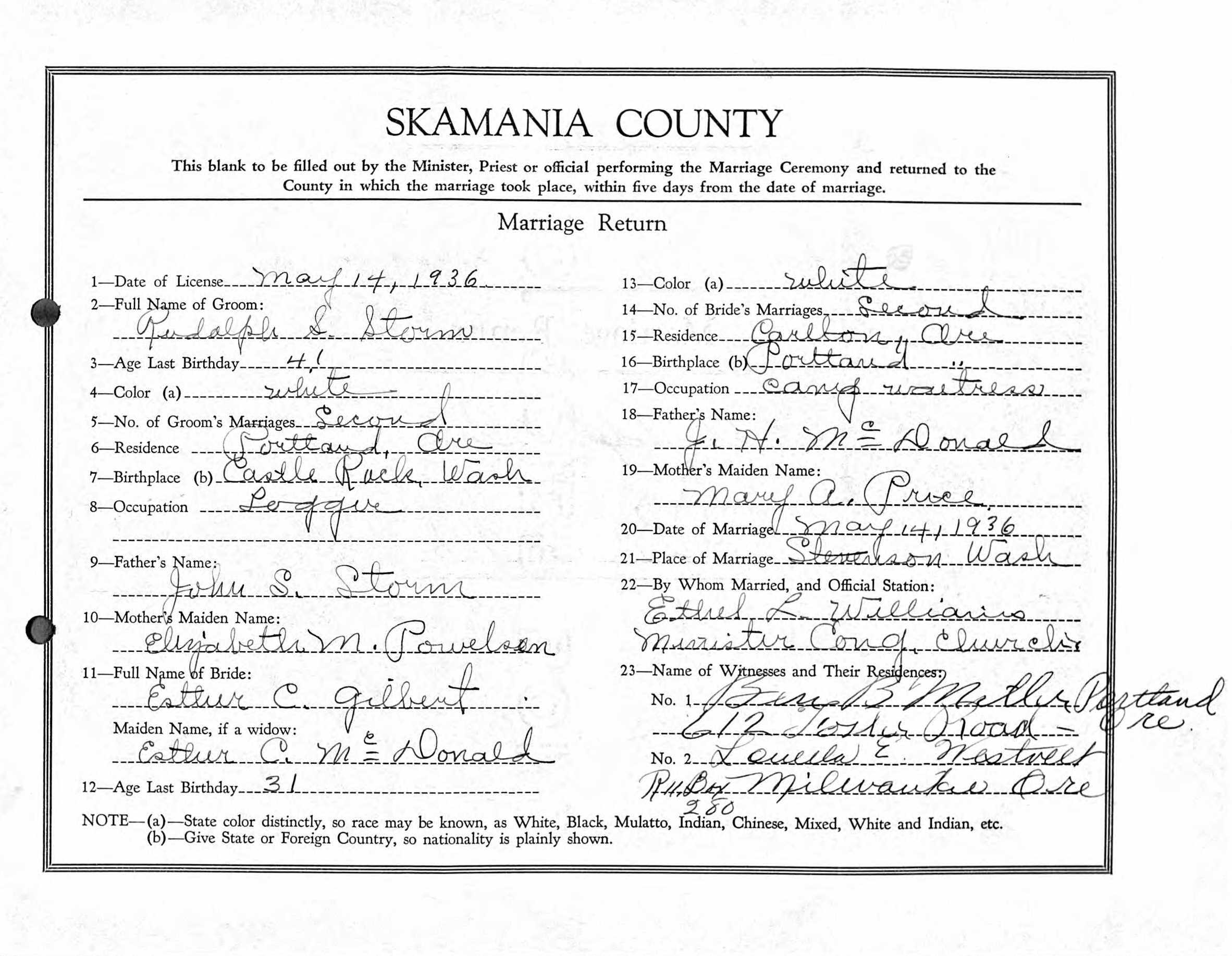
In Stevenson, Skamania County, Washington, in 1936, Esther C. Gilbert (age 31) married a logger (another!) named Rudolph S. Storm (age 41.) For reference, I reproduce the wedding certificate here as Fig.3. From this, we see that, Esther C. Gilbert being her name from her previous marriage, her “Maiden name, if a Widow” is listed as Esther C. McDonald. Her father is named as J.H. McDonald and her mother’s maiden name as Mary A. Price. (Esther’s occupation seems to be “camp waitress”, meaning logging camp waitress ? Certainly we know from her Epilogue (p.47) that “due to family conditions” she had “no formal education in school” and that all of her life she had worked at “the only sorts of ‘hard labor’ open to such people.”) Thus Esther would seem to have been born Esther Cecila McDonald.
But there is a problem, aside from that leaving the D in the Cecil D. O’Neill in the 1950 Census unexplained, and it is this: there seems to be no record of the birth of Esther Cecila McDonald in 1905, and no record of her and her parents together in the 1910 US Federal Census.
Furthermore, in the “US Social Security Applications and Claims Index, 1936–2007”, under Social Security Number (SSN) 533265261, we find applications/claims under the names Esther O’Neill. Esther C. O’Neill and Esther Cec O’Neill, her date of birth being given as 21 November 1904, which fits with her being 45 in the (April) 1950 US Federal Census, and her date of death as October 1978, which is correct as death records show that she died on 22 October 1978. But here is the problem: this SSN records another application/claim under the name Esther Cec Dickson, which, though it might explain that D in her entry in the 1950 US Federal Census, gives Esther’s parents as James H. Dickson and Mary A. Price. This is strange, because her parents in Fig.3 are J.H. McDonald and Mary Addie Price – the initials are identical, as is the surname Price! Did Esther’s father change his name for some reason ? I do not know, I’m afraid, but I can think of no other reasonable explanation.
At this point, enter Adrian Dickson (female), born in 1903 of parents James Harrison Dickson (age 27) and Mary Addie Price (age 19). Adrian’s birth was not registered at the time, and we learn from a “Certificate of Birth – Delayed Registration” dated 1943 that she was adopted a few months after her birth by a friend of her father’s, Clara Smith Hillard. (Recall the fostering of Esther’s son, above.) If Esther’s parents changed their surname from Dickson to McDonald, then the change took place after Adrian’s birth in 1903, and would make Adrian Esther’s sister, born two years earlier and fostered out. I wonder if Esther ever knew of her existence, but again, I do not know, I’m afraid.
So, what of Rudolph S. Storm ? As we know from Fig.3, this was the second marriage for both him and Esther, and it wasn’t to last. By the time of the 1940 US Federal Census, only four years after their marriage, he was married to Ethel (née Catlin) with three children, Barbara (8), Harold (7) and Elizabeth (2)! The first two are labelled daughter and son respectively, not step–daughter and step–son, but were presumably (one hopes!) Ethel’s children by a previous marriage / relationship. When he died in 1961, his funeral was announced in the Portland, Oregon newspaper, The Oregon Daily Journal (9 July 1961, p.33), his children Barbara, Harold and Elizabeth being mentioned in it, along with his 8 grandchildren. His death certificate gives his full name as Rudolph Sylvester Storm, his marital status as divorced (not widowed), and the informant of his death as his daughter / step–daughter, Barbara. To add to the mix, Ethel Storm married John Hubbell in 1952, and died in 1993 at the home of her daughter, Barbara, leaving, besides her three above–named children, Barbara, Harold and Elizabeth, 12 grandchildren, 8 great–grandchildren and 1 great–great grandchild! (5)
Despite my determined efforts, I have not managed to find when Esther Storm married Charles Everett O’Neill, but it seems fairly likely to have been in 1942 or 1943. Either way, this marriage was to last, for, as we have seen, Esther died in 1978, six years after her husband.
Note 1: Louis C. Alexander, The Testament of Omar Khayyam (The Wasiyyat) (London, 1907.) Alexander was a spiritualist and he almost certainly received the text of the Wasiyyat through automatic writing. He certainly ‘downloaded’ Echoes of Whistler (London, 1910), a collection of essays by the deceased artist, and The Autobiography of Shakespeare (1911), by that means. For a full analysis see my essay Louis C. Alexander & The Testament of Omar Khayyam in Appendix 27 on this website
There is also a booklet version of the essay.
Note 2: The Philosophical Research Library in Los Angeles was founded in 1934 by Manly P. Hall, author of numerous books on astrology, alchemy, nature spirits & ghosts, reincarnation, healing, the interpretation of dreams, Ancient Wisdom & Occult Philosophy, Freemasonry & Rosicrucianism. The aim of the library, which still operates, was to promote the study of these fields and to help students, interested in such esoteric matters, in their research. Probably Hall’s best known work was The Secret Teachings of All Ages, first published in 1928, but reprinted many times since.
Note 3: For an alternative view see my article “Gifts from the Grave ?”, published in 1978 in the Canadian journal Chaos (vol.1, no.2, p.50-54.) More related background material can be found in the essay cited in note 1 above.
Note 4: See the Washington newspaper The Olympian 18 July 1972, p.3 and the Salem, Oregon newspaper The Capital Journal 18 July 1972, p.7.
Note 5: Ethel’s obituary appeared in the Longview, Washington newspaper The Longview Daily News, 9 November 1993, p.10.
**********
To return to the Notes and Queries Index, click here.
To return to the Index of the Rubaiyat Archive, click here.