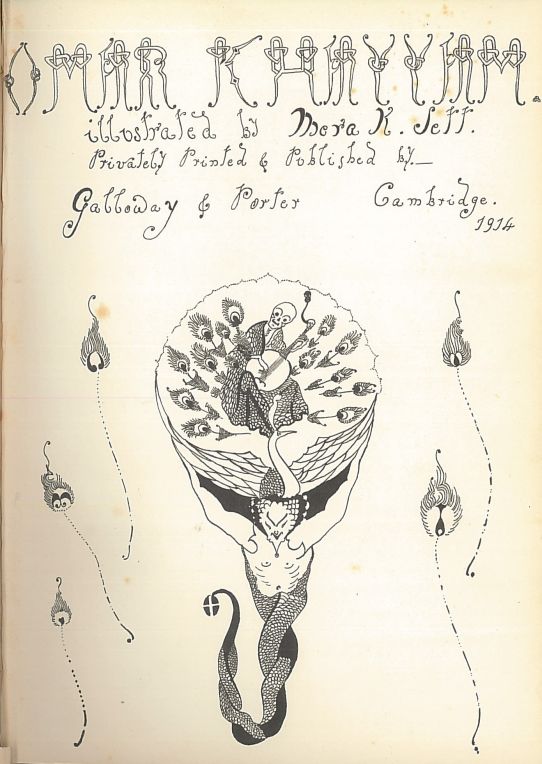
In 1914, or so the title–page tells us, the Indian artist Mera K. Sett published his illustrated edition of The Rubaiyat (titled Omar Khayyam.) Privately printed and published by Galloway and Porter of Cambridge, in a limited edition of 250 copies, it used FitzGerald’s first version. It is Potter #104 & Paas #1939. However, though ostensibly dated to 1914, it would appear from the following notice in The Westminster Gazette for 13 September 1915 (p.2) that it was actually published towards the end of 1915:
Still another edition of the “Rubaiyat of Omar Khayyam” – this time a fine and limited one. It will be illustrated by Mera K. Sett, a Parsee. The text is described as “written in Oriental type of letters, photolithographed from the artist’s MS., and interspersed with his drawings, and with fifteen full–page plates, illustrating fifteen quatrains, photolithographed on imitation Japanese vellum.” The artist claims originality for his work. Messrs. Gallow (sic) and Porter, of Cambridge, will publish the book.
In addition, The Bookseller for 8 October 1915 (p.886) announced that it was “nearly ready for issue by subscription”. In fact, we know exactly when it was published, for it was mentioned in the “Books Published This Week” column of The Athenaeum of 18 December 1915.
The book consists of a 4 page Foreword by Sett in which he tells us that he claims originality for his work, which cost him “more than a year of strain and many sleepless nights.” It is original, he adds, in being the interpretation by a Parsee / Parsi with a thorough knowledge of Persian literature. He tells us that he owned a copy of nearly every illustrated Omar published in the previous half–century; of his particular regard for the editions illustrated by Edmund Dulac, René Bull and Abanindranath Tagore; and of his wish that Kay Nielsen had illustrated Omar. He goes on to tell us that some English publishers found the naked figures in his own work too shocking and considered that they were likely to offend the sensibilities of “decent–minded English people.” Since he refused to make them decent by adding strategically placed fig–leaves, publication was eventually financed by his father, though the book was “Dedicated to the Loveliest and Noblest Bloom in the Garland of Womanhood, my Mother,” with no mention of his father! Sett went on to deny that, despite the stylistic resemblances noted by some, he was in any way influenced by Aubrey Beardsley (1). “Till quite lately I knew not of Beardsley,” he wrote, adding:
I formed my style on the study of Eastern drawings, especially Indian, The possibilities of black and white appeared to me from some black and white Chinese drawings I have in my possession.
Next, as regards the peacock symbol which appears repeatedly in Sett’s illustrations, he wrote:
I have followed the usage of the East, and have taken to myself a symbol, to sign my pictures with. It is a ‘peacock’, and its neck forms the letter 'S', the first letter of my name. It also lends itself to decoration, and like the Japanese artists I place it to balance my pictures.
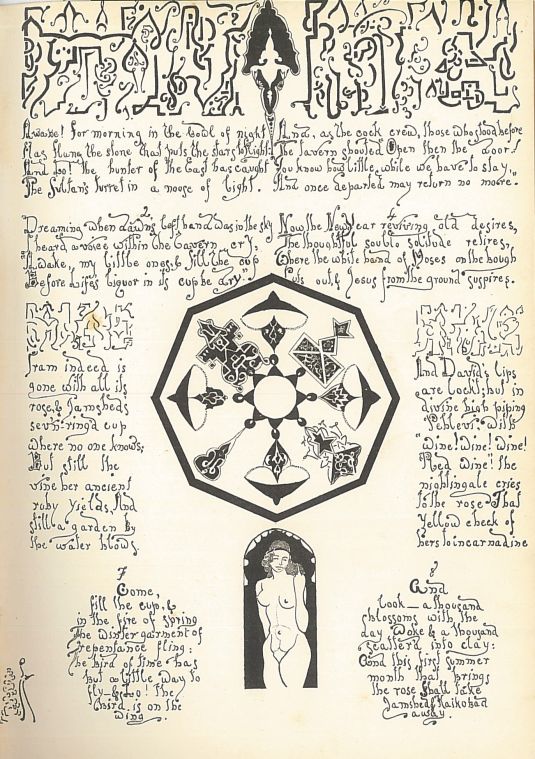
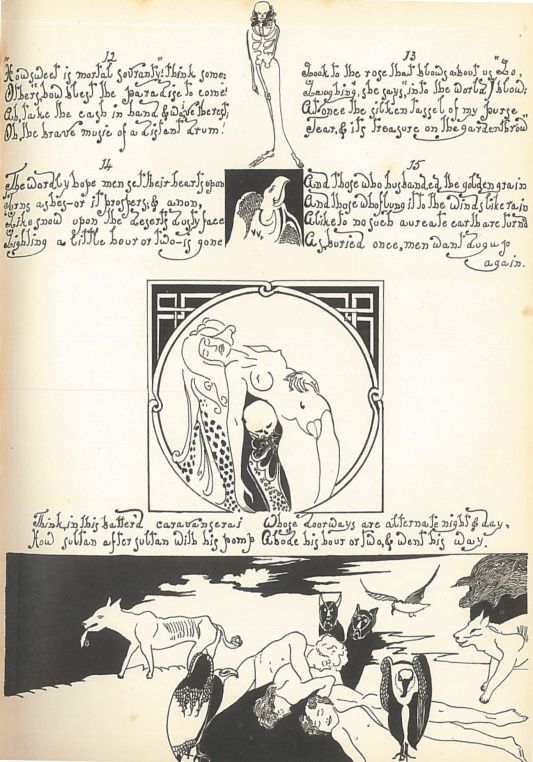
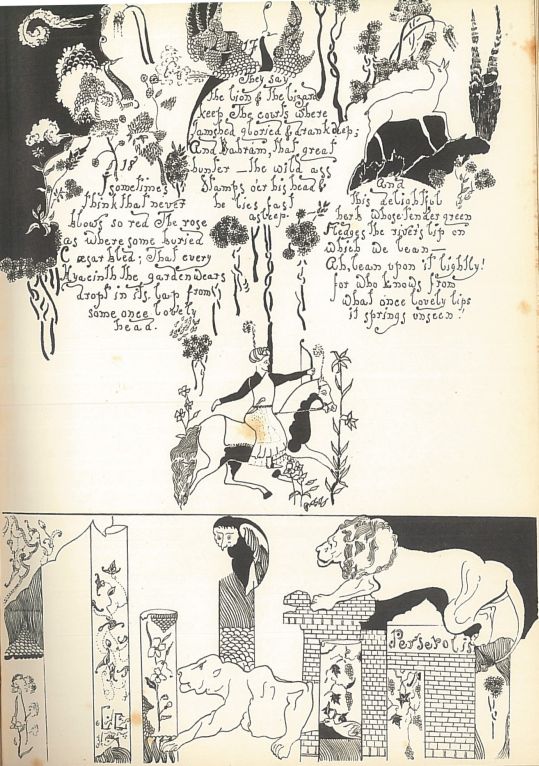
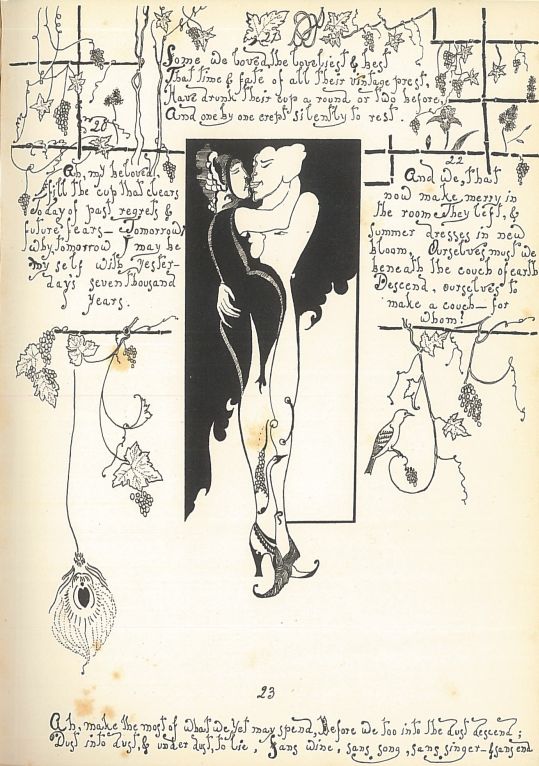
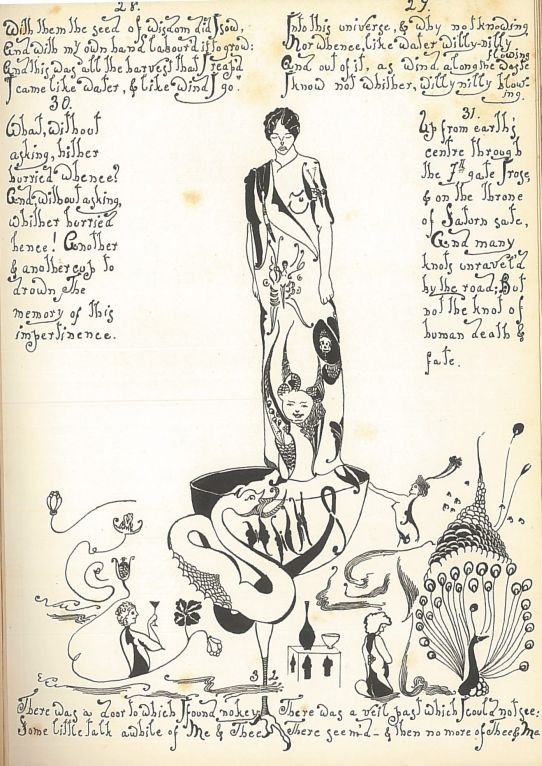
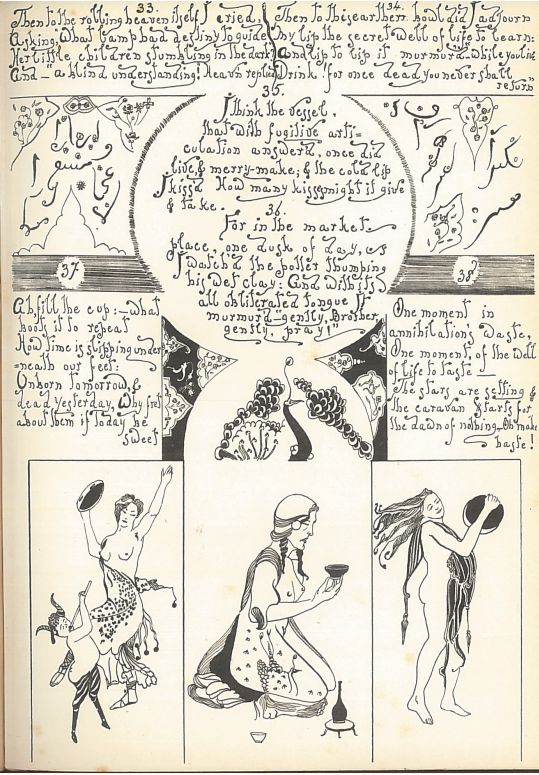
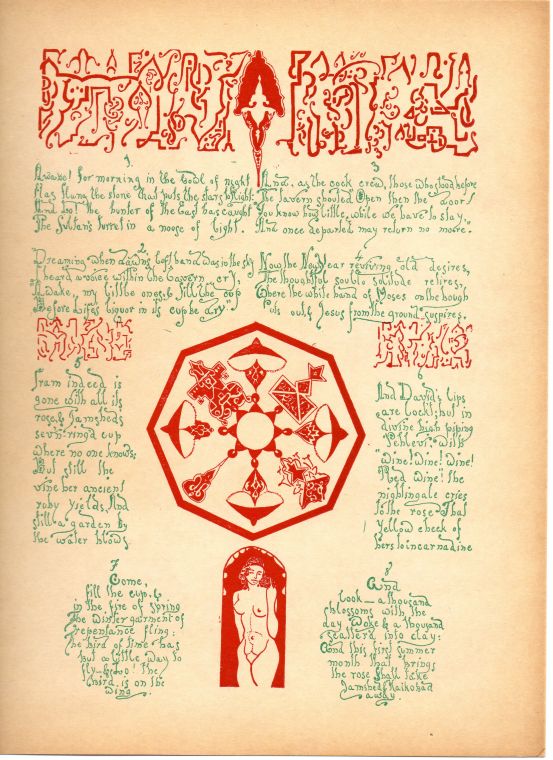
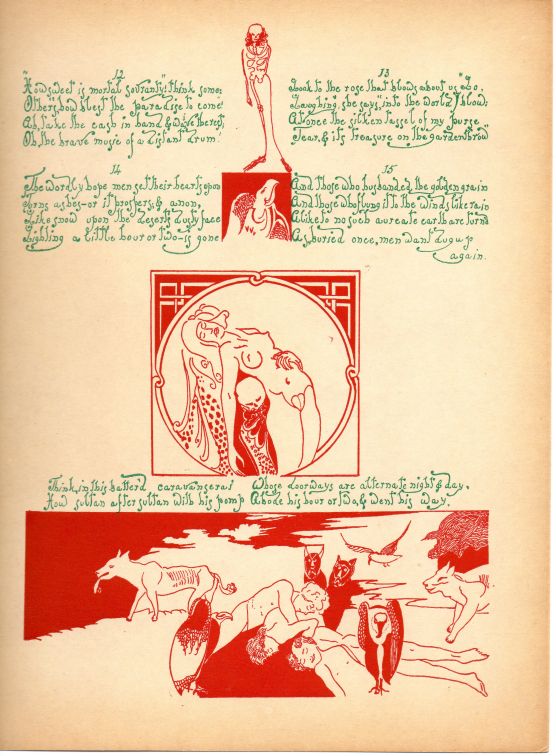
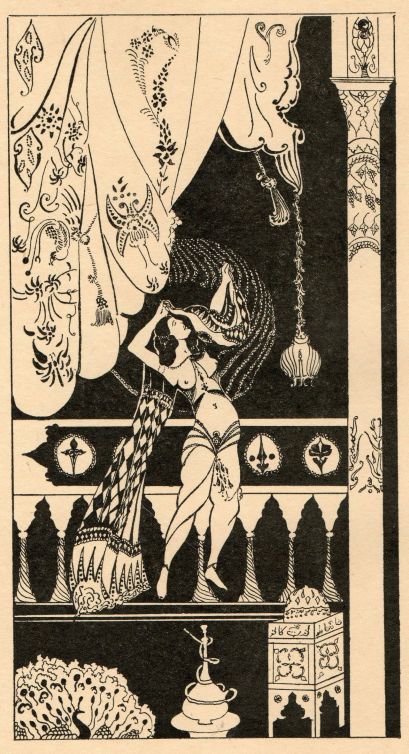
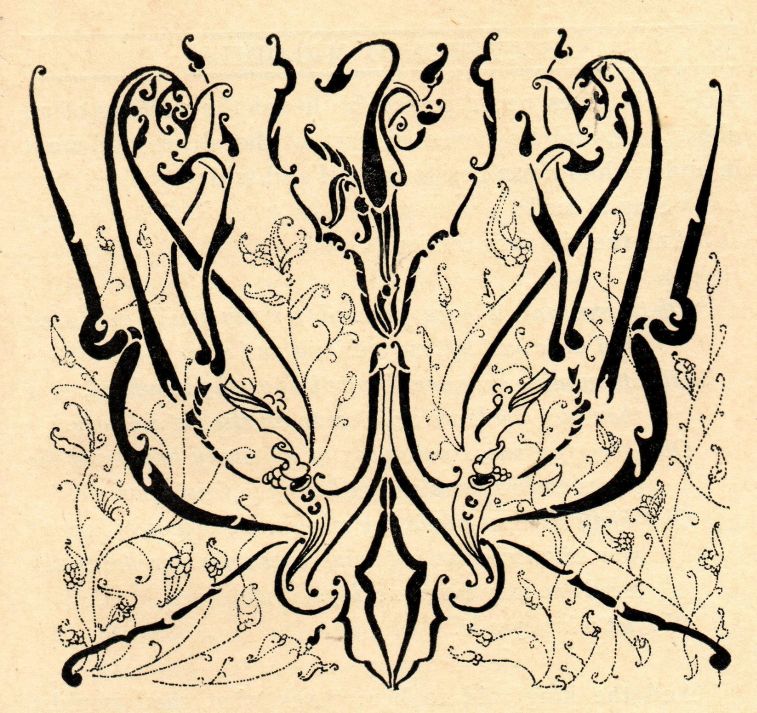
The Foreword was followed by an elaborate hand–crafted title page (Fig.1a), a 15–page illustrated manuscript version of FitzGerald’s first version (Figs.1b, 1c, 1d, 1e, 1f & 1g are sample pages), each containing several verses, and finally, 15 drawings, each of which accompanies a specific verse (Figs.1h, 1i, 1j, 1k, 1l, 1m, 1n, 1o, 1p, 1q & 1r are examples, their accompanying verses being printed on their tissue guards.) All pages are printed on one side only. [The illustrations can be browsed here.]
Sett’s textual illustrations and drawings are frequently an obscure mixture of symbolic representations and purely decorative designs, and the borderline between the two is often far from clear. For this reason, I will look at the drawings first, for at the end of his Foreword, Sett gave a brief explanation of each of these “very symbolic” drawings. These are well worth quoting here as they give us a good idea of the way Sett’s mind worked in translating a verse into its illustration.
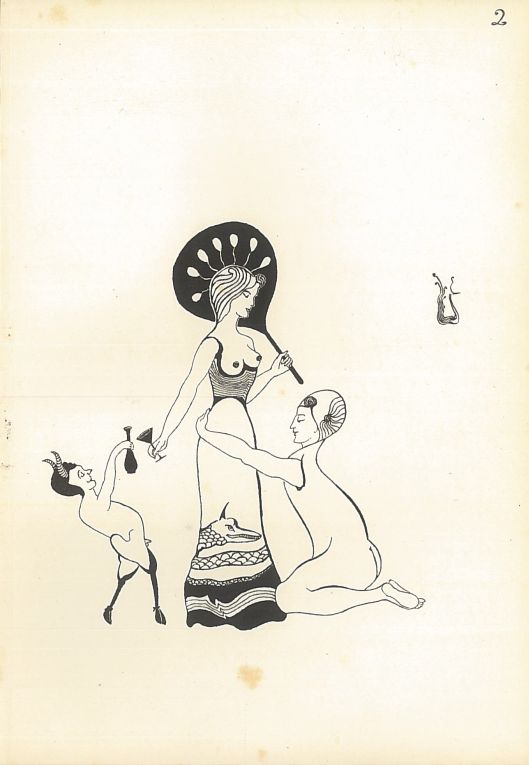
Thus, as regards Fig.1h, which accompanies verse 7 (drawing #2: “Come, fill the Cup, and in the Fire of Spring &c”) he writes:
The Persians think that the wine improves when poured out by a beautiful boy. A generous poet once gave away Samarkhand and Bokhara in exchange for the mole on the cheek of his beloved Sakki.
The “generous poet” was Hafiz, this episode coming from one of his odes. But even given Sett’s explanatory note, the drawing is still obscure. The rather crudely drawn kneeling figure is presumably Omar in worship of his topless Beloved, but why is the Saki not depicted as a beautiful boy, but as a somewhat sinister and diminutive faun–like creature ? Is this perhaps via an association with the Roman Bacchanalia ? (cf Figs.1j, 1o & 1r below.) As for the small figure in the upper–right this seems to be a rather stylised peacock signature of the artist.
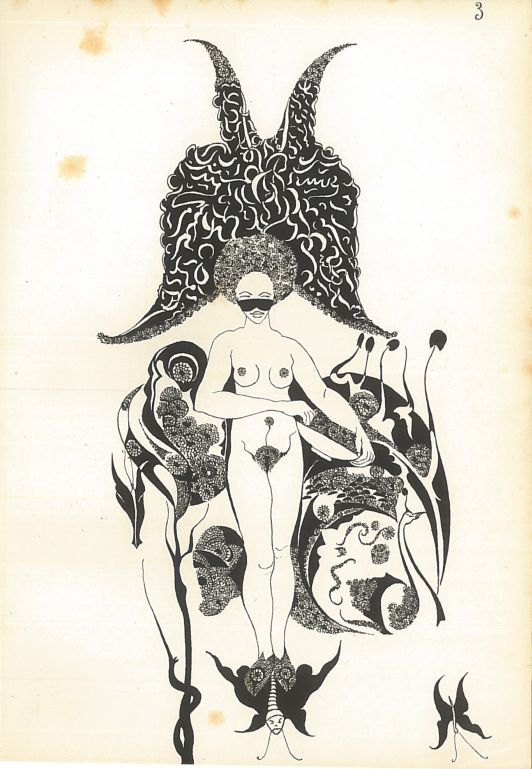
Of Fig.1i, which accompanies verse 13 (drawing #3: "“Look to the Rose that blows about us &c”), he writes:
The perfume of the Rose. The mystery of the rose has often been revealed to me in a beautiful garden at the death of day. The Rose of the East is not the pale scentless flower of the West; but is passion wild and warm, and its secret has intoxicated me; to waken smouldering longings and dying desires long thrust away in the cavern of memory.
The secret – its perfume – came to me tripping through the air borne by pale blue butterflies.
Without Sett’s explanatory note and the verse being quoted on its tissue guard, one would hardly identify which verse this drawing accompanied, or what it was about. The principal figure is clearly the personification of the Eastern Rose, with two of the pale blue butterflies depicted, one at her feet and the other to the lower right. Her head–dress, too, appears to be an inverted butterfly. The bowl she holds is presumably filled with roses, though they are poorly drawn ones, and similar roses swarm the picture, notably in her hair, on her nipples, in her navel and pubic region, and on her footwear. But what is the black ‘mask’ running across her nose, but leaving her eyes and mouth exposed ? Sett’s peacock signature is to the right of her legs, with a purely decorative design to the left of her legs to balance things up.
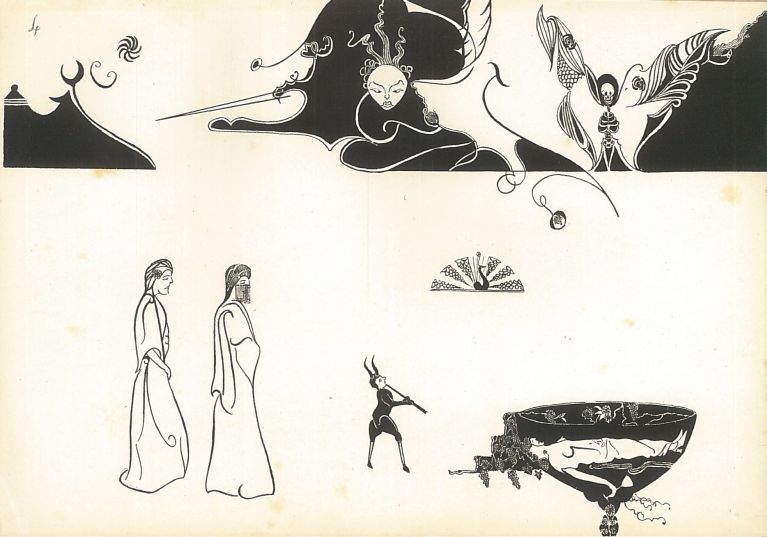
Of Fig.1j, which accompanies verse 21 (drawing #4: “Lo! some we loved, the loveliest and best &c”), he writes:
The end of life is death. And death is the one thing to make life bearable. The favourite mode of death of different races would make a fascinating volume. I picture Omar longing for oblivion; to lie drowned in a mighty bowl of warm red wine.
Again, even with Sett’s explanation, though Omar “drowned in a mighty bowl of warm red wine” is clear enough, the rest of the drawing is a puzzle. The figure to the left of the bowl is presumably the faun–like Saki already seen in Fig.1h, here playing the faun’s traditional pipe; above the bowl is Sett’s peacock signature; and the two figures on the left are presumably mourners (is the one at the front a veiled pregnant woman ? Birth following Death in a cycle ?) But the top part of the drawing seems to be a purely decorative fantasia. Note the strange face at the centre, this one like an oriental mask, such faces being one of Sett’s favourite additions, and one which we shall meet again (cf Figs.1f, 1k, 1l & 1m below), as is the crude skeletal figure on the right (cf Figs.1a & 1c below.)
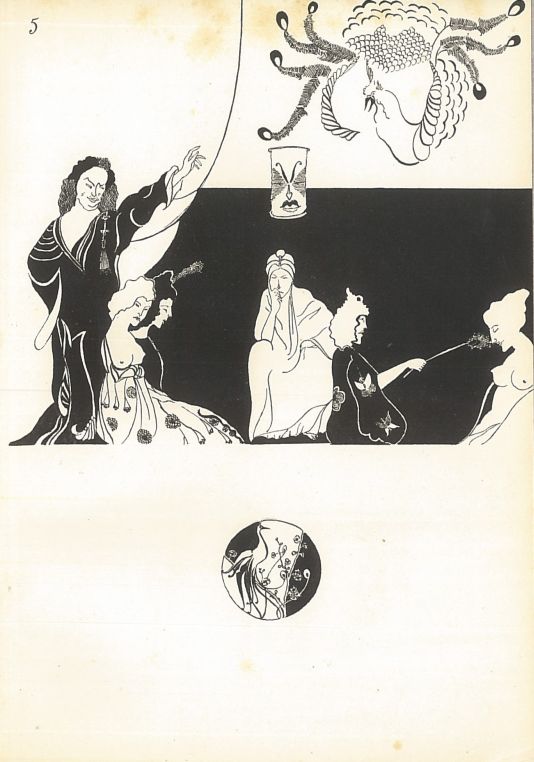
Of Fig.1k, which accompanies verse 27 (drawing #5: “Myself when young did eagerly frequent &c”), he writes:
Omar at the theologians’! It must have been as amusing as a modern sermon.
Again, Sett’s explanation doesn’t help much here. The pensive figure at the centre is presumably Omar, and the design in the upper right another peacock signature (though his more regular signature is in the medallion below.). But who is the figure on the left holding back what seems to be curtain whilst pointing heavenwards with his left hand (a theologian ? Recall “There was a Veil past which I could not see” in verse 32.) And who are the women – one pair on the left, the other pair on the right ? One of each pair is dressed in black, the other in white; the two in white are topless, and in the right hand pair, the one in black seems to be tickling the nose of the other with a peacock feather! Do the women represent the worldly temptations away from the weighty matters of theology ? Finally, what is the object hanging above Omar, another of Sett’s strange faces in a sort of sinister lantern shape ?
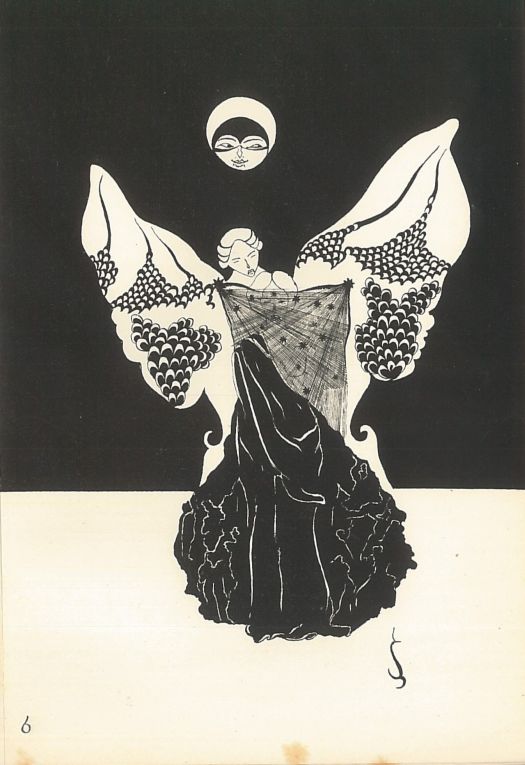
Of Fig.1l, which accompanies verse 32 (drawing #6: “There was a Door to which I found no Key &c”), he writes:
Ignorance is dear to all ecclesiastics; for the ignorance of the laity is the priests’ staff of life. When one veil is rent by an Omar, the priests place another stronger and more mysterious.
Another illustration which bears little relation to Setts’s explanation. There is clearly a young woman hidden behind a central veil, her black dress stretching from her right shoulder down to the ground, leaving her left breast exposed. The veil is held in place by the Angel–like figure behind her, with another of Sett’s strange faces peering through a sort of hole in the black background. Sett’s signature is here the vaguely peacock–ish S shape to the lower right.
Of Fig.1m, which accompanies verse 46 (drawing #8: “For in and out, above, about, below &c”), he writes:
Eternity is a never–ending flame; and beings, the moths that court it. A tripping measure, a valse, a dirge, and then, finish – like the flowers that give us joy of life, the waves whose talk is like the murmur of the beloved, and the beautiful moon; to die! (How soon the beautiful dies!)
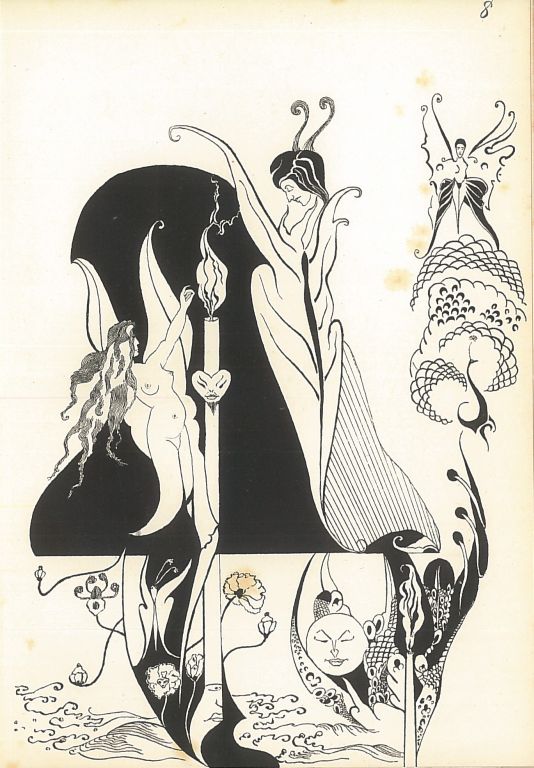
The central candle (of the Sun) is clear enough, with a strange face in a heart shape half way down it (with another partial face at its base), and the two figures either side of it, one a naked young woman, are presumably phantom figures. The figure to the upper right is perhaps a moth (with another directly below the girl), and the strange round face to the lower right the moon, these relating to Sett’s explanation rather than verse 46 itself. Sett’s peacock signature is below the moth at the upper right, and to the right of the moon is what looks to be another candle, though why it should be there is a mystery. This illustration is a good example of Sett’s tendency to illustrate not simply the verse, but also the images that that verse conjures up in his imagination.
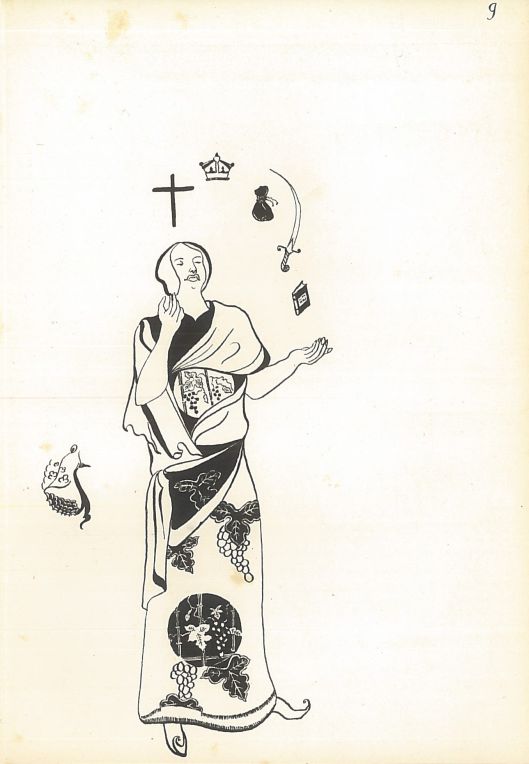
Of Fig.1n, which accompanies verse 50 (drawing #9: “The Ball no Question makes of Ayes and Noes &c”), he writes:
Fate is never tired of its own joke, the paradox it plays on the world. The church, the crown, the greed of gold, the lust of blood and knowledge; all have paid their tribute of laughter and wail to Fate. Nothing escapes Her except wine!
Another drawing that owes more to Sett’s own imagination than the verse it is supposed to illustrate. The central figure is clearly Fate, juggling the emblems (working clockwise from the top) of church, crown, riches, blood–lust and knowledge. As regards nothing escaping Fate except wine, recall verse 43:“The Grape that can with Logic absolute / The Two–and–Seventy jarring Sects confute.” Sett’s peacock signature is on the left.
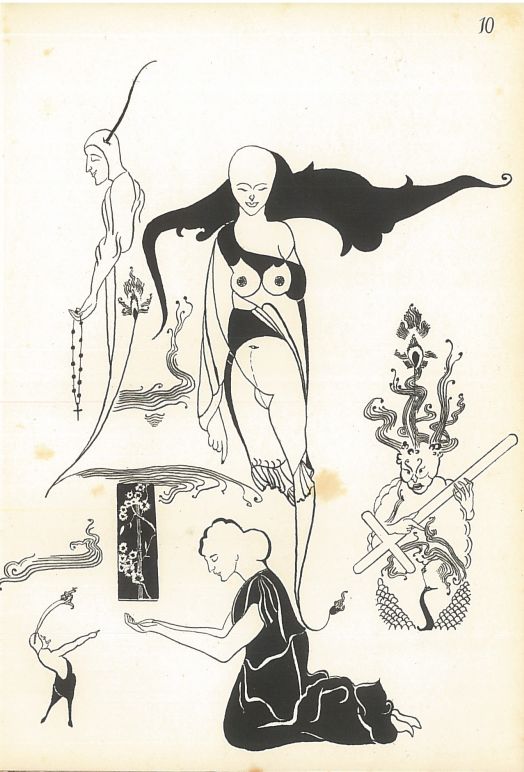
Of Fig.1o, which accompanies verse 52 (drawing #10: “And that inverted Bowl we call The Sky &c”), he writes:
Deism is the middle figure. A woman with the eternal feminine allurement and seducement; with her promises bound up in a purse of cobweb. To the right is “the Peacock” getting his ounce of fun even on the cross. The rude little boy, with his tongue out, is Knowledge. Religion, smug, fat and sleek, is in the left hand top corner.
There is nothing at all here that relates to “that inverted Bowl”, the key detail of FitzGerald’s verse. Instead we have another illustration which stems purely from Sett’s vivid imagination, so we can at least follow his track given the above description. Note the faun–like legs of “the rude little boy” to the bottom left, and the rectangular floral design above the hands of the kneeling woman, with swirls to its left and above it – the cobweb of Sett’s note on the illustration ?
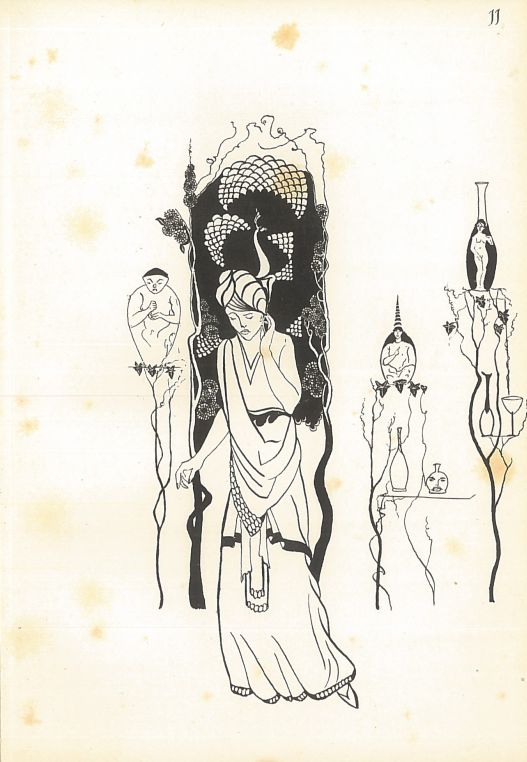
Of Fig.1p, which accompanies verse 60 (drawing #11: “And, strange to tell, among that Earthen Lot &c”), he writes:
The pots are speaking. The dogmatic pot is banging his fists. The argumentative bottle is saying: “Now let us be logical.” And the feminine jar asks: “First tell me, is anyone looking at us ?”
A much more literal illustration of the verse than Sett’s usual! The central figure is thus presumably Omar (though with a somewhat effeminate face), with the dogmatic pot to his right, the argumentative bottle to his left, and the feminine jar (another of Sett’s nudes) further to his left. Sett’s peacock signature emerges from Omar’s turban.
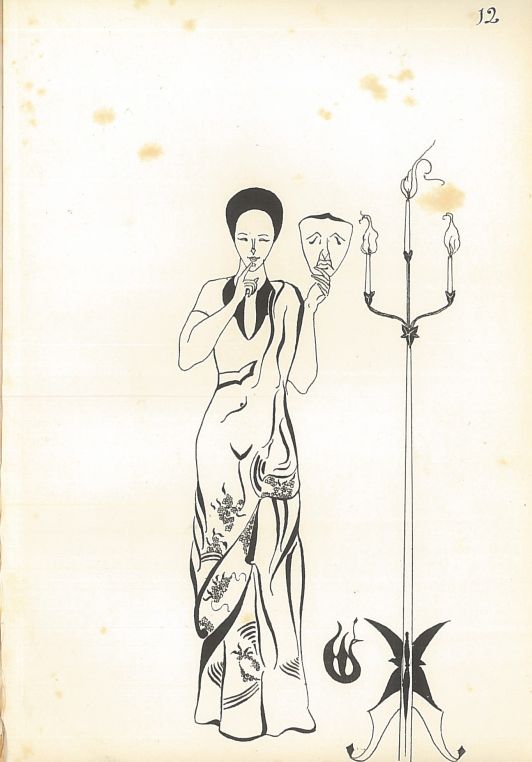
Of Fig.1q, which accompanies verse 70 (drawing #12: “Indeed, indeed, Repentance oft before &c”), he writes:
I, too, have cried repentance on my sins – in public – and have pulled a face like that of a pope whilst bestowing his (pope’s) illegitimate child on a courtier, with a moral homily on his (courtier’s) sins.
This is clearly written on a very personal note, whose background, not to mention the somewhat scathing reference to the pope, remains obscure. (Is it, perhaps, a garbled reference to the inappropriately named Innocenzo, Pope Julius III’s rescued street–urchin lover / ‘son’, who was ‘adopted’ by the Pope’s brother to avert scandal ?) The central figure is presumably a penitent, and the mask she (?) holds perhaps indicating the false nature of her repentance. It is not clear whether the candelabrum on the right is symbolic of throwing a light on her sins, or whether it is purely decorative. Sett’s peacock signature is at the foot of the illustration, between the penitent and the candelabrum.
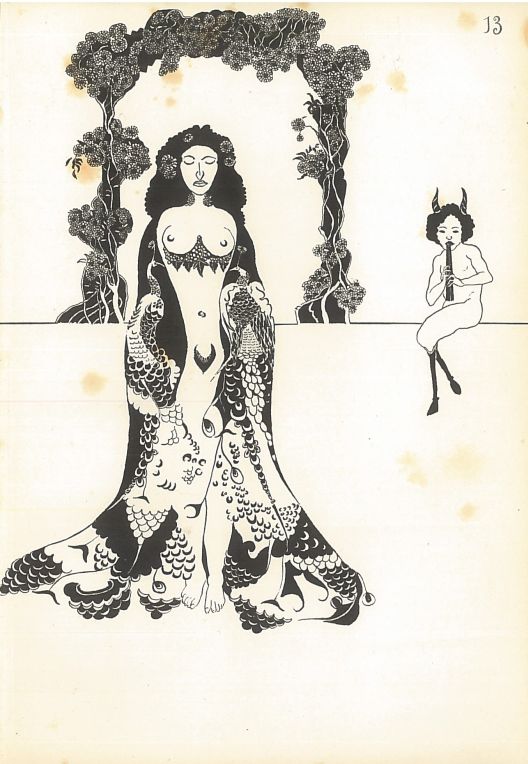
Of Fig.1r, which accompanies verse 74 (drawing #13: “Ah, Moon of my Delight who know’st no wane &c”), he writes:
Someone pointed out that it lacks a moon. Such interpretations I leave to the English Artists.
Unfortunately, though the reference is clearly to Omar’s “Moon of my Delight”, rather than a literal Moon, this comment doesn’t tell us much about the drawing itself, in particular about the child–like pipe–playing faun in the background, seen earlier in Fig.1h.
[The illustrations can be browsed here.]
As can be seen, it is a matter of opinion as to how useful some of Sett’s explanations of his drawings are, but at least they are there for the taking. Sett gave no explanation whatever of the drawings that accompanied the hand–written verses, so with them we have no guide at all, merely the foregoing (hopefully!) to guide us towards the input of his imagination.
Looking at the title–page in Fig.1a, we have a serpentine and Atlas–like figure with a somewhat demonic face supporting a bowl (= a wine glass ?) in which is seated a skeletal figure playing a lute or similar instrument, surrounded by peacock feathers. The decorative peacock feathers relate to Sett’s personal peacock signature, of course, but the Atlas–like figure is a total mystery, unless it is somehow related to a remark made by Sett on the first page of his Foreword that “Goethe depicted Hamlet as an amateur Atlas groaning under the load too gross for the fragile royal shoulders.” In other words, here, a burden (death ?) almost too great to be borne (as being sung by the lute player ?) Be that as it may, the message of the title–page is presumably a generic one: the pleasures of this world are transient, and there is nothing you can do about it beyond enjoying them while they last. But of course that is a guess, as is necessarily much else in what follows!
In Fig.1b the ‘banner headline’ is presumably purely decorative, as is the central octagonal medallion, but the naked young woman at the base seems to serve no purpose beyond titillation, as seems to be the case in many others among his illustrations (eg Figs.1g, 1i & 1m), unless she is one of the thousand blossoms of verse 8.
In Fig.1c the illustrations are clearly generic death–related images, having no direct and literal connection to the verses quoted on that page: a crude skeletal figure at the top, the head of a vulture below, an image of what seems to be Death and the Maiden (another of Sett’s nudes) below, and at the bottom, a heap of corpses attended by vultures and jackals. It is noteworthy that Parsi / Zoroastrian funerary practices involve the exposure of the body in a dakhma or Tower of Silence so that its flesh can be consumed by vultures, thus avoiding contamination of the Earth by burial or Fire by cremation. The bones are subsequently transferred to an ossuary pit for further disintegration.
Fig.1d, for once, is clear and literal: at the base we have the ruins of “the Courts where Jamshyd gloried and drank deep”, inhabited by the Lion, the Lioness and the Owl by the looks (no sign of a Lizard) – actually labelled “Persepolis”, with “Bahram, that great Hunter” in the centre (all verse 17). A hunted deer (?) is to the top right, Sett’s peacock signature to the top middle, with simple space–filling decoration elsewhere.
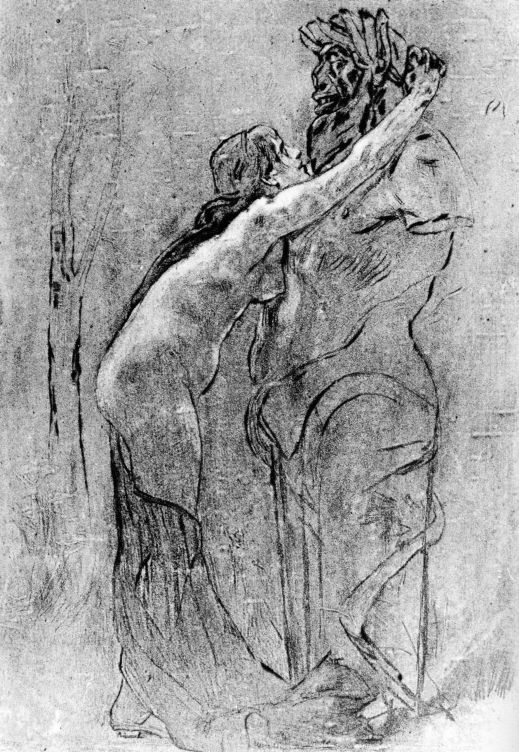
Fig.1e is a rather bizarre drawing whose central figure seems to bear no relation to the verses on the page. The decorative surround of the verses is clearly based on grapes on the vine (the “vintage prest” of verse 21), with the bird to the lower right perhaps a look back to the Nightingale who cries “Wine! Wine! Wine! Red Wine!” to the Rose in verse 6, or a look forward to the Nightingale “that in the branches sang, / Ah whence and whither flown again who knows !” in verse 72, the latter relating to the transience of youth and beauty. So what of that central figure ? It reminds me very much of “Le Vieux Faun” (The Old Faun) by the extraordinary Belgian artist Félicien Rops (1833–1898) (Fig.2), Sett’s version perhaps depicting a young woman following Omar’s advice in verse 23 to “make the most of what we yet may spend” – in a sexual manner! The peacock feather to the lower left presumably relates to Sett’s peacock signature.
Fig.1f is another drawing whose central figure seems to bear no relation to the verses on the page. Is this Omar or a generic Seeker after Wisdom, perhaps tempted from the Path by the figures relating to Wine and Women at the base, with the Serpent–like figure recalling the Temptation of Eve and the Fall of Man in the Garden of Eden ? But then this serpent seems to have a single leg and a curious spider’s–web–like attachment to its body (signifying entrapment ?) Note also another curious face on the dress of the central figure (cf. Figs.1j, 1k, 1l, & 1m above.) Sett’s peacock signature is at the bottom right, of course.
Fig.1g is a fairly clear reference to enjoying life while it lasts, as represented by the three Wine, Women and Song illustrations at the base – note the Bacchanalian faun again (cf.Figs.1h, 1j, 1o & 1r above.) Sett’s peacock signature is above them, and to either side of the circle containing quatrains 35 and 36 is what seems to be some Persian script, but in fact is just pseudo–Persian decorative nonsense.
At the foot of the page bearing FitzGerald’s verses 72–75 Sett wrote: “In the name of Auhra (sic) Mazda, the compassionating of the compassionate. Written & pictured by the humble citizen of Bombay, Mera ben Kavas ben Jal Sett, begun, in 1912, finished in 1914, in the reign of George V of England, on whom be peace.” The reference to Ahura Mazda confirms the Parsi origins which he mentions in his Foreword, Ahura Mazda being the wise and beneficent god of Zoroastrianism. How much this tells us about Sett’s own religious beliefs isn’t clear: from his comment on religion in his notes on Figs.1l & 1o above, he clearly shared some of Omar’s outlook, Parsi by birth or otherwise.
[The illustrations can be browsed here.]
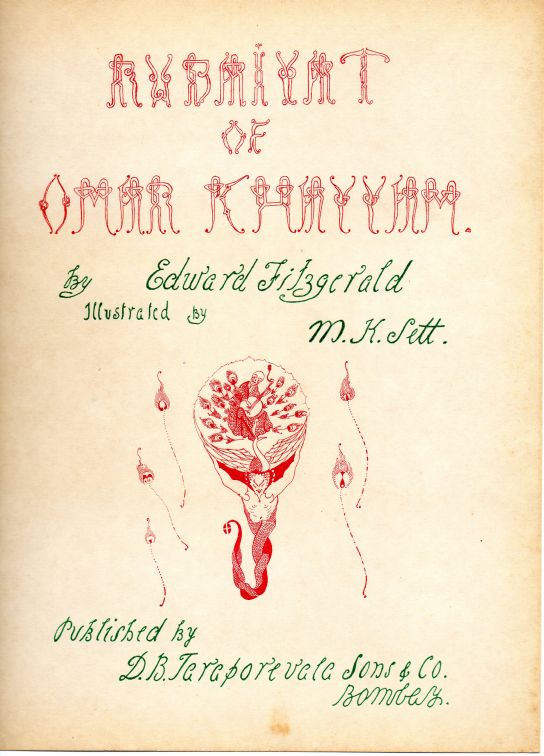
Sometime after the end of the Second World War – and probably not long after – a second (undated) edition of the book appeared, but in a very different, portfolio format. This was titled Rubaiyat of Omar Khayyam, and is Coumans #104 & Paas #4220. Basically it consisted of a series of 31 unbound cards, together with a 12 page stapled booklet, the whole contained within a dark green fold–out box somewhat like an artist’s portfolio. This was published by D.B. Taraporevala Sons & Co. of Bombay (see Fig.3a) which may well suggest a 1946 publication date, for in March 1947 the publisher seems to have become D.B. Taraporevala Sons & Co. Pte. Ltd. An earlier date has been suggested for this edition – for example, Coumans #104, dates it as “ca.1914”. However, a post Second World War date is implied by the opening paragraph of the Introduction, in which Sett talks of “two global wars.” (2)
The stapled booklet replaced the Foreword of the book edition with a new Introduction. The first part of the Foreword, which had contained Sett’s views on other illustrated editions of The Rubaiyat and his Acknowledgements to various friends for their support, was dropped in favour of a tirade against Modern Art (“never has the world of Art fallen to such abysmal depth”) and a paragraph saying that he had been persuaded by his publisher that, despite the way the Art world was going, there was “still a class of discriminating public who still love beauty and who appreciate it.” “I trust their judgement,” Sett added, and publication went ahead.
The second half of the original Foreword – containing his denial that he had in any way been influenced by Beardsley, plus the explanations of his symbolic drawings – was retained, only it was now followed by a printed version of FitzGerald’s first edition, presumably to serve as a guide to those who struggled with his calligraphy. The rest of the book version – the title page, the 15 pages of the verses with illustrative drawings, and the 15 symbolic drawings – were all now printed on 31 unbound cards. The 15 symbolic drawings remained in black and white, with their accompanying verses now printed on the back rather than on tissue guards, but the rest – the title page and illustrated verses – were now printed with the text in green, and the drawings & decorations in red. The effect, to be honest, is not very pleasing, and one wonders what Sett thought of it. The title–page is shown in Fig.3a and Figs.3b & 3c are sample pages of text.
At the beginning of the booklet enclosed with the portfolio edition was a Publishers’ Note. This is worth quoting in full:
Mr M.K. Sett had a great reputation as an artist in Europe. We used to read of the high esteem in which he was held by the art-loving public.
Rupert Brook (sic), the famous poet, once wrote a two–column critique of Mr Sett’s art. His last para was ‘If Mr Sett has not been universally acclaimed as the greatest draughtsman and decorator living, the fault lies with his own exclusive and publicity shunning nature. His Omar will have the pride of place in my library.’
Art journals of France, Germany, England, and America praised the book as outstanding. In many schools of art it was used as a model by the students.
Mr Sett was known in Europe as an Interior Decorator. He has illustrated many other works.
Anyone who has ever tried to find out any information about Sett will find some of this reported acclaim difficult to believe. As regards his “great reputation as an artist in Europe”, this must surely be what we would now call publisher’s hype, as he receives no mention in any major dictionary of artists. Indeed, without wishing to be unkind, it has to be said that, interesting as Sett’s illustrations are, they are rather amateurish in production – his imagination outstripped his artistic abilities. Likewise, I have found no evidence for the claim that Sett was “known in Europe as an Interior Decorator” (what we would now call an Interior Designer, I suppose.) The Rupert Brooke critique sounds promising at first, but finding it is quite another matter – see section (v) below.
As regards art journals praising Sett’s work, I know of only one such example of praise, that which appeared, not in an art journal, but in Cambridge Daily News on 19 February 1916 (p.4) under the heading “The Latest Omar.” It began:
Many illustrated editions of FitzGerald’s Omar have been published...but this stands alone, not only in its form and manner, but in its weird beauty and its absolute originality both of conception and execution. It is in reality an illustrated transcript of the poem, a decorated text, rather than an illustrated edition as commonly understood. The entire work, from the title to the imprint, is in the artist’s own hand, and the pages are lithographic reproductions of the original, beautifully done on Japanese vellum. Every page is a fresh revelation of the artist’s interpretive genius and marvellous craftsmanship, and one wonders how it is one has never heard of such a master before.
As regards any similarities to Beardsley, the author of this lavish praise (A. Rought Brooks, the Editor of the newspaper) accepts Sett’s denial of any such influence (quoted earlier), adding, in an echo of Sett’s own words in his Foreword:
The probability is that Beardsley’s style was so varied and his methods so wide that few black and white artists of the future, if their work show much thought or ingenuity, will be able to escape from the suspicion of plagiarism.
Finally, as regards those people taking offence at Sett’s nudes, Brooks wrote:
The man or woman who sees offence in Mr Sett’s wonderful symbolism ought to be imprisoned for life in a suburban villa filled with early Victorian furniture and decorated with cheap reproductions of pictures by Presidents of the Royal Academy.
Aside from the foregoing, there are only the mere mentions of his Rubaiyat in The Westminster Gazette (13 September 1915), The Bookseller (8 October 1915) and The Athenaeum (18 December 1915), cited earlier. In America, a review of his Rubaiyat appeared in The Dial of 8 June 1916. “So exotic and weirdly unconventional is the artist’s work that one is almost at a loss to judge of its artistic quality,” the reviewer said, adding later that, “the artist has not been afraid to express the spirit of frank sensuousness that is inherent in the quatrains.”
As for Sett illustrating “many other works”, I can find only one such, Sculptured Melodies, privately printed and published in a limited edition of 500 copies by Grant Richards of London in 1922. Being such a rare book, and with Sett himself being so little known, it seems worthwhile to devote the next section to it, for it is a curiously interesting work.
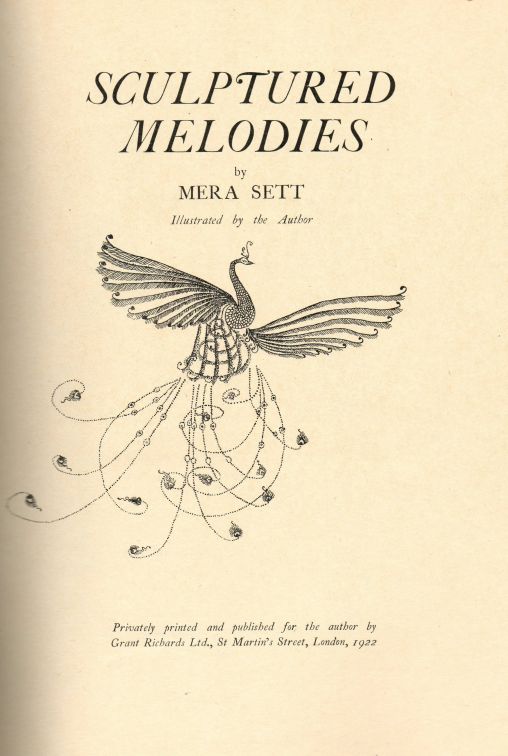
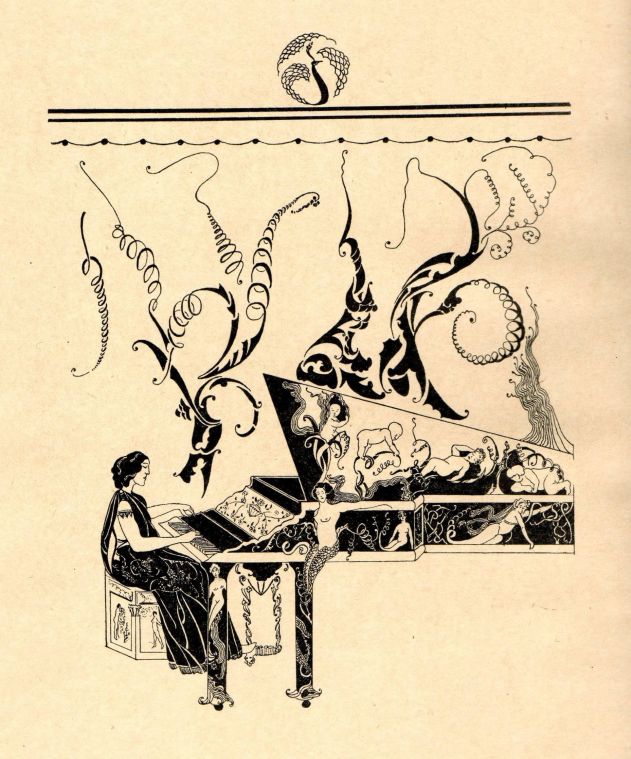
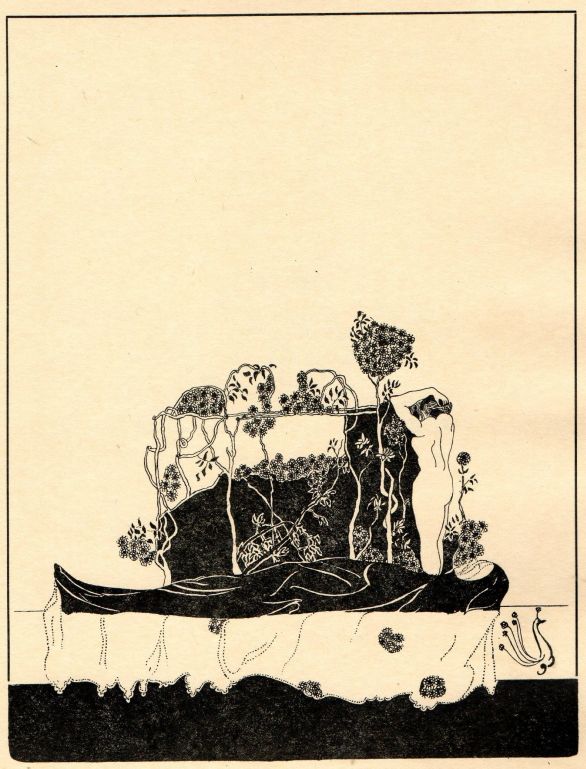
Basically, the book was a collection of 11 illustrated stories, written by Sett himself, based on or inspired by musical works by various famous composers – 5 by Chopin, and 1 each by Beethoven, Dvorak, Gounod, Rubinstein, Schumann and Tchaikovsky. Fig.4a is the Title Page and Fig.4b the Frontispiece – the latter denoting that all the musical works are piano pieces of one sort or another. Note the characteristic peacock signature in both Fig.4a & Fig.4b – it also features in several other illustrations in the book, though not in all. Curiously, in Fig.4b, the piano lid is decorated with naked babies, whilst the body of the piano and the piano stool are decorated with naked women. Mercifully, the modesty of the pianist herself is preserved, for she is fully clothed. Each of the stories has a full page drawing associated with it, and the text of each story opens with a head–piece and finishes with a tail–piece. These subsidiary drawings are sometimes associated with the theme of the story and its principal drawing, but in other cases they seem to be purely decorative space–fillers.
So, how are the stories associated with the music ? By nothing more than Sett’s own personal whim, it seems, rather than anything the composer himself intended. Sett seems to have listened to the music and let his imagination take him wherever it chose to go and, as we saw with some of his Rubaiyat illustrations earlier, given half a chance his imagination could wander off into non sequiturs and obscure symbolism!
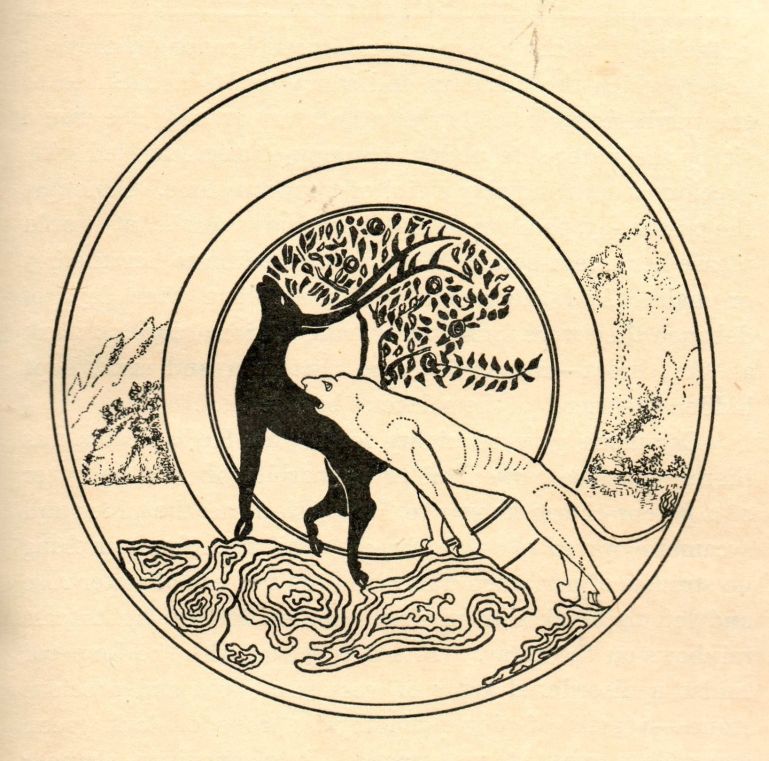
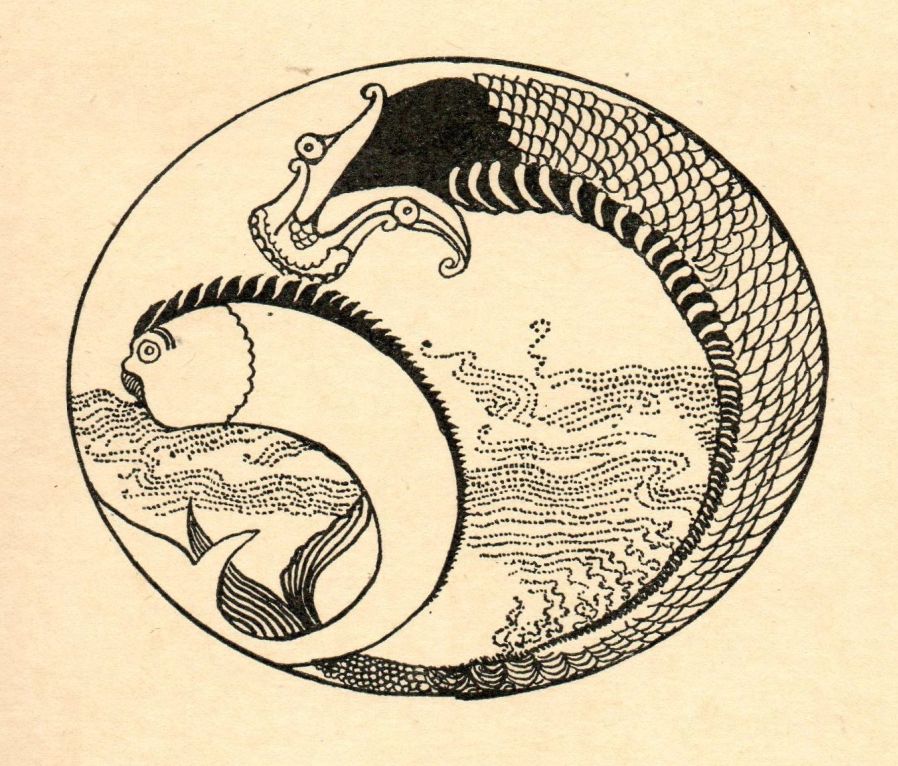
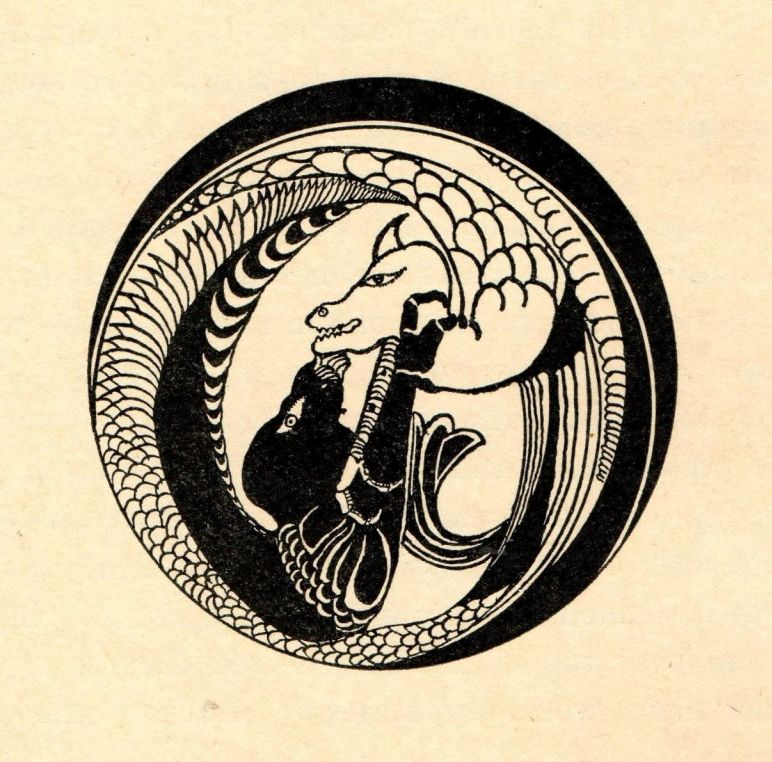
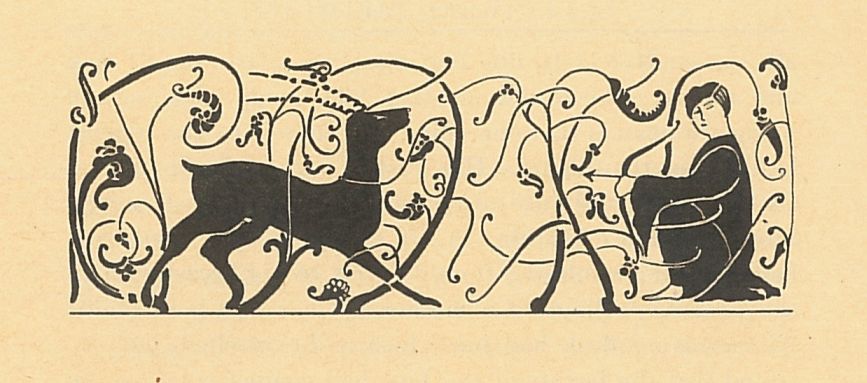
Fig.4c is the principal drawing of the opening story, which is associated with Rubinstein’s “Romance” (Opus 44, no.1.) The story, an interesting variation on the theme of the Wandering Jew, is about a Roman courtesan, Caramena, who can only die when she fails to kill one of her lovers – she has actually lived for thousands of years, but always looks to be in her mid–twenties. She falls in love with the nephew of the Emperor, but still she kills him at the last minute, and she lives on. The drawing shows the nude Caramena with her shrouded dead lover in the foreground. The head–piece of this story is shown in Fig.4d and its tail–piece in Fig.4e. The former clearly shows Caramena as a leopard, about to devour her lover in the form of a stag; the latter, I would guess, Caramena in the form of a (Chinese ?) dragon about to devour a fish. (Recall Sett’s claim, made in the Foreword of his ‘1914’ Omar Khayyam, that one of the main influences on his art came Chinese drawings in black & white.) Cf. Fig.4j below.
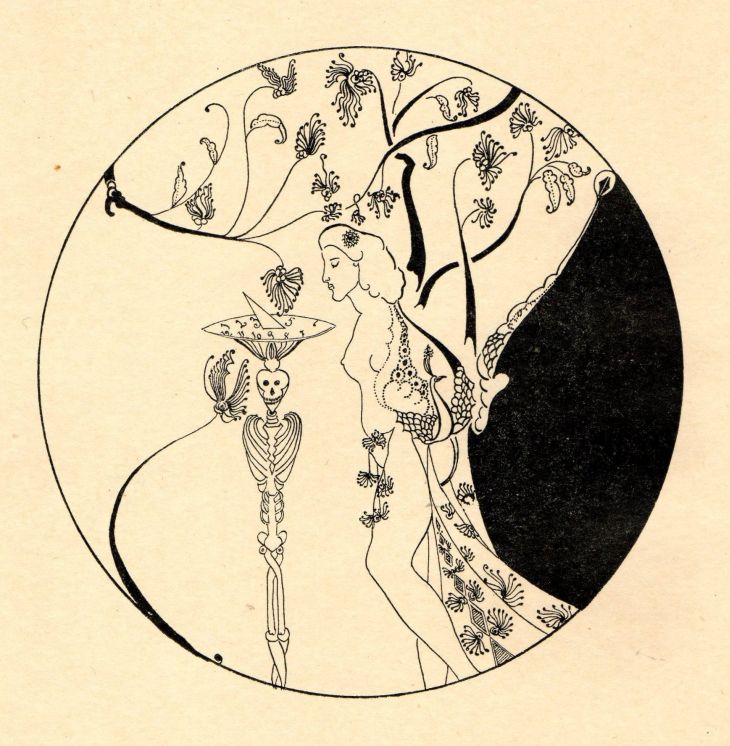
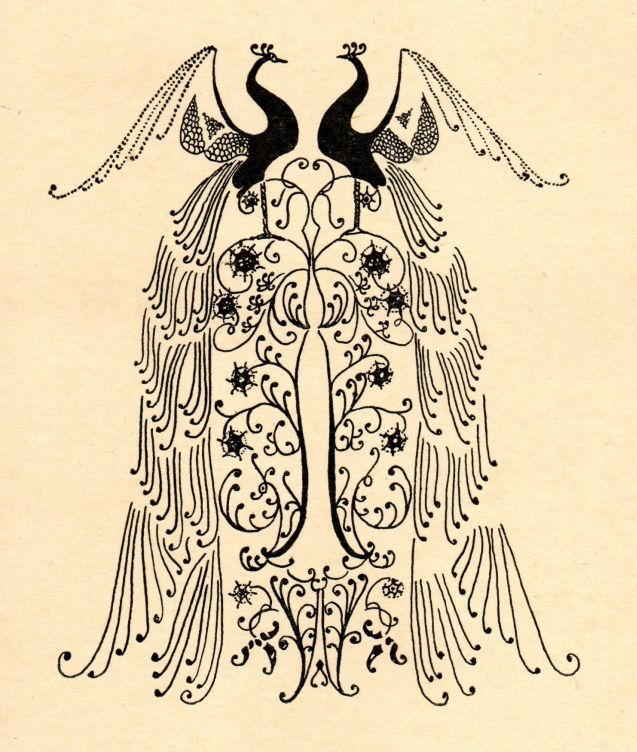
Fig.4f is the illustration that goes with the second story, which is associated with Chopin’s “Valse Triste” (Opus 34, no.2.) This accompanies the story, of an Indian dancing girl whose lover drowns whilst trying to swim to her across a storm–lashed river. The illustration seems to be only loosely associated with the story, let alone with the music, though the “triste” half of the title of the music certainly fits the story. At any rate, the naked dancing girl stands before a sundial (time) on a pedestal in the shape of a human skeleton, symbolising death with the passage of time. Both the head and tail pieces of this story are purely decorative, being based on the artist’s peacock signature. The tail piece is shown here as Fig.4g a particularly elaborate form of his signature!
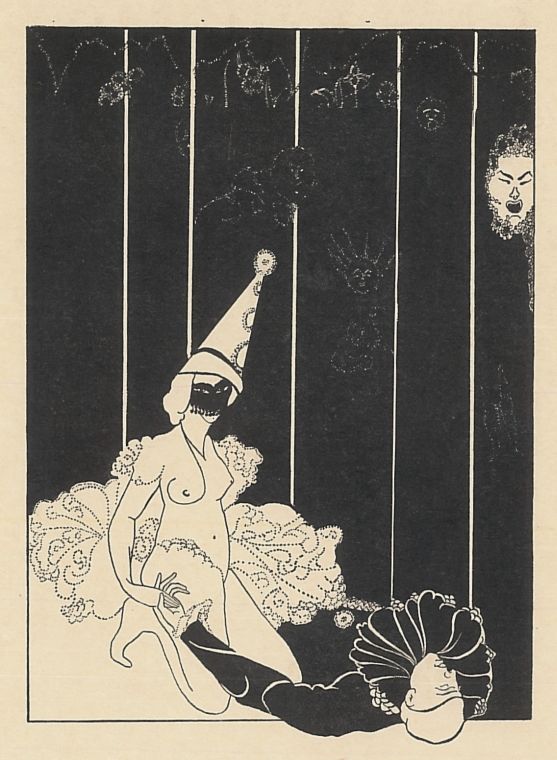
Fig.4h is the principal illustration for the third story, and relates to Chopin’s “Fantaisie Impromptu” (Opus 66.) The story here is that of Ninon Sylvietta, a celebrated courtesan who has led a champagne lifestyle in searching for her ideal lover. She auditions prospective lovers via a masked mime–dance, one written for her by a former lover who had later rejected her. Would–be suitors must dance the dance with her, but if they fail to impress her, they must die. Of course, the one who succeeds turns out to be the author of the dance–play, but just as the dance finishes, he dies at her feet – hence the illustration. The face on the right is presumably a mask of tragedy. The head–piece for this story is shown in Fig.4i and the tail–piece in Fig.4j (cf. Fig.4e above.) Both would seem to relate, somewhat obscurely to the love and death theme of the story.
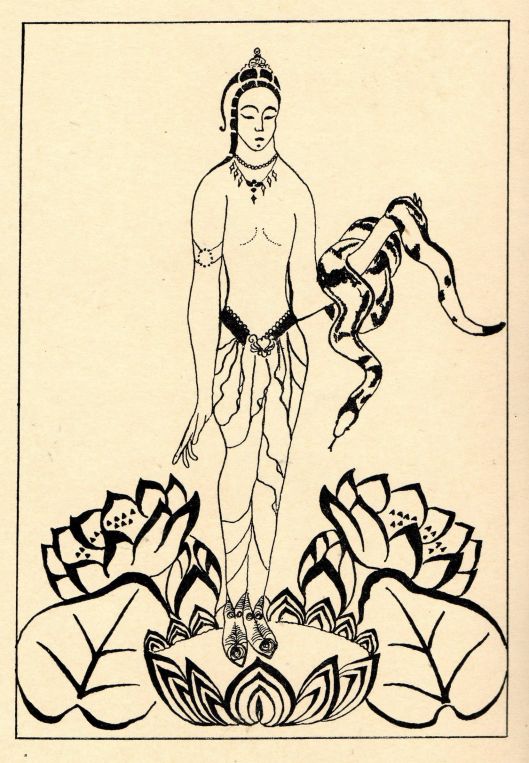
Fig.4k is the principal illustration of Sett’s fifth story, and relates to Dvorak’s “Dumky Trio.” This is the story of a couple who go from England to India. The wife gets bored with the so–called “wondrous East”, but then a living, speaking, polished bronze statue appears, wearing a silken loin–cloth, and with a gold python winding its coils about him, to steal her away from her husband. This explains the illustration, though as with the other illustrations, its link with the music remains obscure, aside from “dumky” signifying a song of lament! The head and tail pieces are purely decorative, and of no particular note.
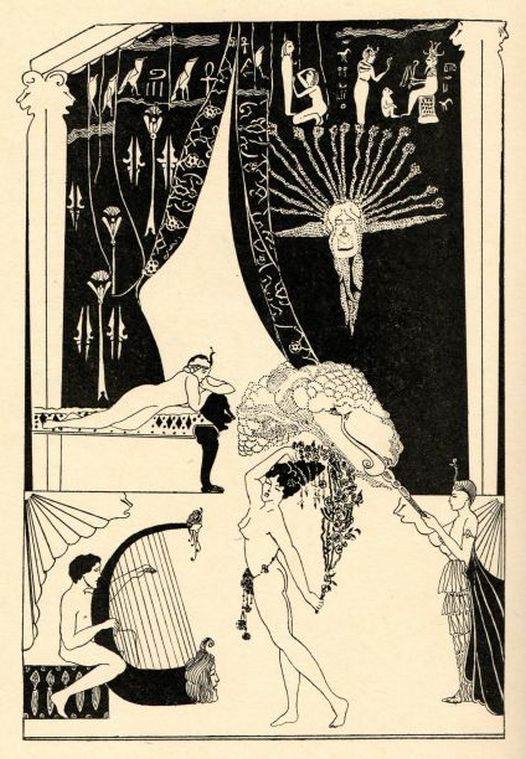
Fig.4l is the principal illustration of the seventh story, and relates to Chopin’s “Prelude, Op.7” (presumably he means Op.28, no.7.) This is a particularly good example of the gulf between the music and its associated story – that of Salome doing the Dance of the Seven Veils before her step–father, Herod. In Fig.4l, the dance takes place with what seems to be the severed head of John the Baptist hovering in the background, the whole scene taking place in front of some curtains which are embroidered with Egyptian hieroglyphs. Now, so far as I know, when Chopin wrote this piece, sometime in the period 1835–1839, he did not have the New Testament story of Salome in mind (for which see Matthew 14:1–12 & Mark 6:14–29.) Indeed, Chopin himself did not give names to his Preludes, and he seems to have left no indication of what inspired them, so the field is wide open for guesswork. I have to say, though, that when I listen to this particular piece of music, it doesn’t seem to fit in at all well with the figure of Salome performing an erotic dance!
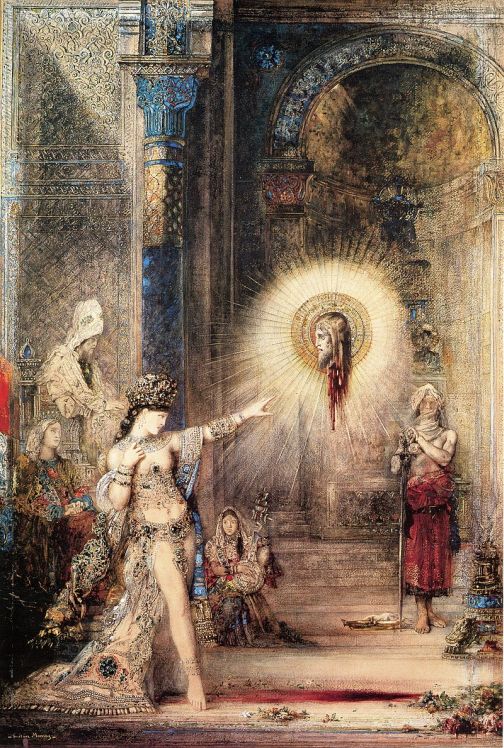
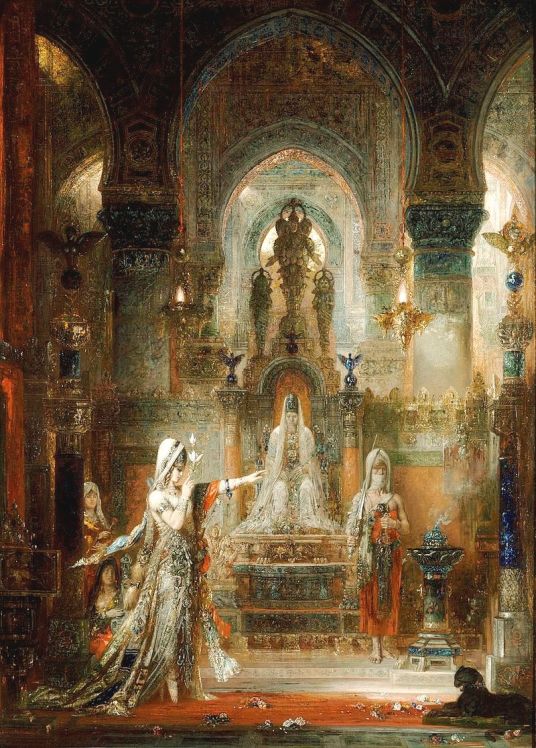
The story as told in Sculptured Melodies – with Salome having a sexual interest in John the Baptist, who is beheaded for spurning her advances – seems to be Sett’s own re–telling of the tale as it is depicted in Oscar Wilde’s play Salome, Wilde, so far as I can tell, being the first to come up with this re–interpretation of the New Testament story. The play has somewhat complex origins, one source of inspiration for it being the description of two paintings of Salome by Gustave Moreau, given in chapter 5 of J.K. Huysman’s novel A Rebours (better known in England as Against Nature) – “The Apparition” (Fig.5a) and “Salome dancing before Herod” (Fig.5b), both dating from 1876 (3a). However, Huysman’s telling of the Salome story is simply an eroticised version of the Biblical account, with Salome’s dance designed to sexually arouse Herod in return for beheading John the Baptist in accordance with a plan of her mother, Herodias – quite different from Wilde’s. It is an intriguing possibility, though, that if at some stage Wilde had seen “The Apparition” (or an engraving of it) in Paris when he was there in 1891 working on his play – and he seems to have left no record that he did (3b) – he could have re–interpreted it, not as John the Baptist haunting Salome, but as Salome dancing erotically for the head of the man who had spurned her in life.
Now, Sett’s depiction of Salome in Fig.4l is sufficiently reminiscent of Fig.5a that the resemblance seems unlikely to be accidental, and one wonders if Sett too had read Huysmans, or even, perhaps, have seen the painting (or an engraving of it) in Paris in 1912 at the time of his above–mentioned exhibition there (3b). But there is no firm evidence that he did either, and he mentions neither Huysmans nor Moreau.
Finally, both the head and tail pieces of this story are purely decorative, and of no particular interest.
Fig.4m is the principal illustration of the tenth story, and relates to Chopin’s “Ballade, Op.3” (presumably he means Ballade no.3 in Op.47.) The story here is that of an old king who grants the wish of his concubine to be with her true love – but only for two years, at the end of which if they do not still love each other, they must die. Their love fades during the two years, but they honestly confess this to the king, who thereupon pardons them from the death penalty. The young woman depicted is presumably the concubine in a palace setting. Note Sett’s peacock signature at the base. Both the head and tail pieces are purely decorative, the head–piece (Fig.4n) being the only one of any note.
[The illustrations can be browsed here.]
We shall revisit these illustrations below, for each story is dedicated to someone known to Sett, and these dedications give us some useful glimpses into Sett’s personal life.
As regards reviews of his Sculptured Melodies, under the heading “Volume that Will Delight the Music–Lover”, a reviewer in The Aberdeen Press and Journal on 23 November 1922 (p.5) tells us that “Miss Mera Sett has put into languorous, exotic prose many of our classic concert and pianoforte pieces and illustrated it herself with expressive drawings a woodcuts that are in entire harmony with the written music.” After giving a list of the composers involved and their music, the reviewer went on, “The keynote of the book throughout is a luscious sensuality, at times exotic, more often tragic, in which the feeling is accentuated by the illustrations.” (Poor Sett, his sex change followed on from a listing of the book in The Bookseller on 9 November 1922 which named him as Mena Selt!) Another reviewer in The Scotsman on 7 December 1922 (p.2) tells us that, “Music conveys different impressions to different people, and in Sculptured Melodies Mr Mera Sett, taking a number of familiar musical compositions, has set down with pen and pencil the fancies with which they have inspired him ... There are eleven tales, all more or less in the style of Eastern fables, and with their exotic romance reinforced by the delicate, fanciful drawings by which they are accompanied.” Rather less positive was the review which appeared under the heading “Decadence” in The Liverpool Daily Post on 30 May 1923 (p.9):
“Sculptured Melodies,” by Mera Sett, appear to be a series of prose interpretations of certain well–known items of classical music, mainly in the form of erotic tales. The interpretations will not appeal to musicians, and the writing is of no literary distinction. The book is lavishly produced and printed privately for the author by Grant Richards (one guinea net). Its only excuse is a number of illustrative designs with some power of suggestion. The rest of the book is merely crude, and makes one regret that so much fine paper and printing should have been expended on it.
Sculptured Melodies also attracted mere mentions in “The Week's Books” column of The Nation & The Athenaeum of 25 November 1922 and in the “First Glance at New Books” column of The Saturday Review of 2 December 1922.
But perhaps the most interesting, if almost passing reference to it, is in the following short piece which appeared under the heading “Man Who Refused Fame” in the (London) Evening News on 19 January 1922 (p.9):
“These I am taking with me back to Bombay where I am going to build a museum to hold some of India’s art.”
A barrister–at–law of the Middle Temple, Mera Sett does not practise. He has written a book of short stories, “Sculptured Melodies,” which is being published within the next few weeks, and is also writing a book on Indian art from olden times to the present day. Some pictures he has taken eight years to paint are being reproduced in book form.
When he exhibited his pictures in Paris in 1912 a French collector offered to purchase the whole set, but he refused to sell.
“I will make you famous,” was the persuasive request of the prospective buyer.
“Ah, I don’t want fame,” the artist replied. And he has never sold one of his pictures.
Did he build that museum ? Was his book on Indian art ever published ? And what of that book reproducing some of his paintings ? Indeed, what became of those paintings, if none were sold ? I do not know, I’m afraid. But we do know quite a bit about his training as a barrister.
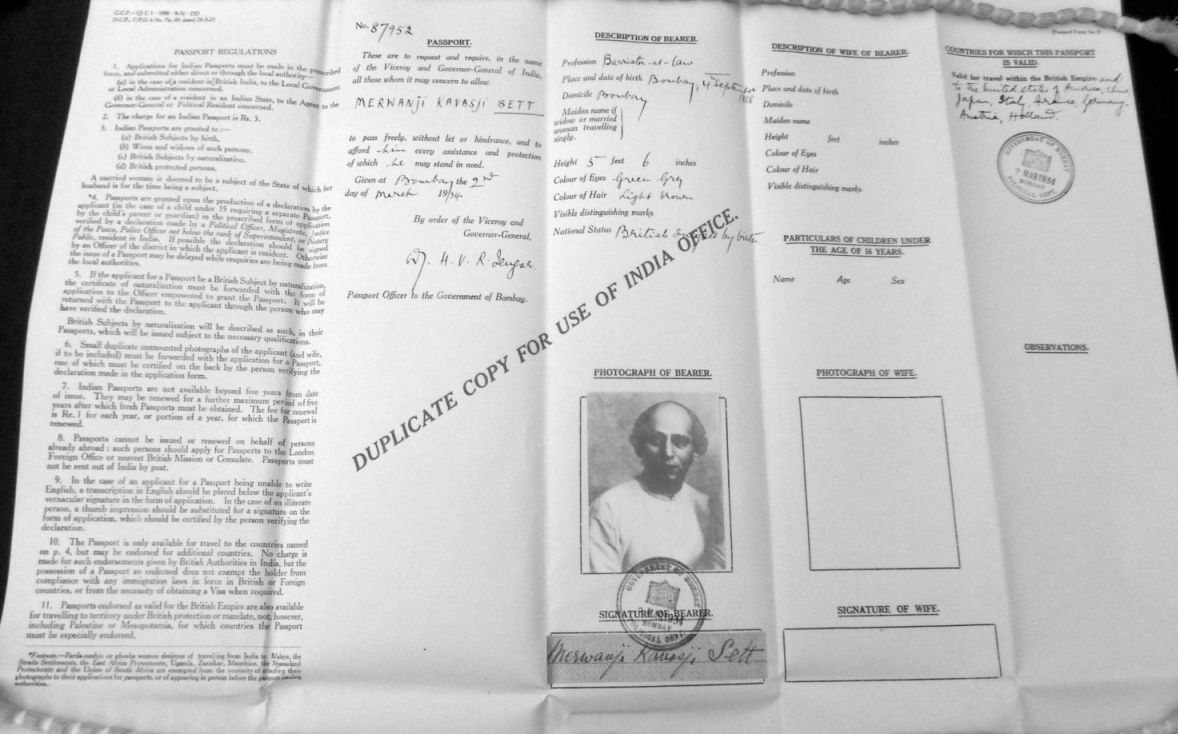
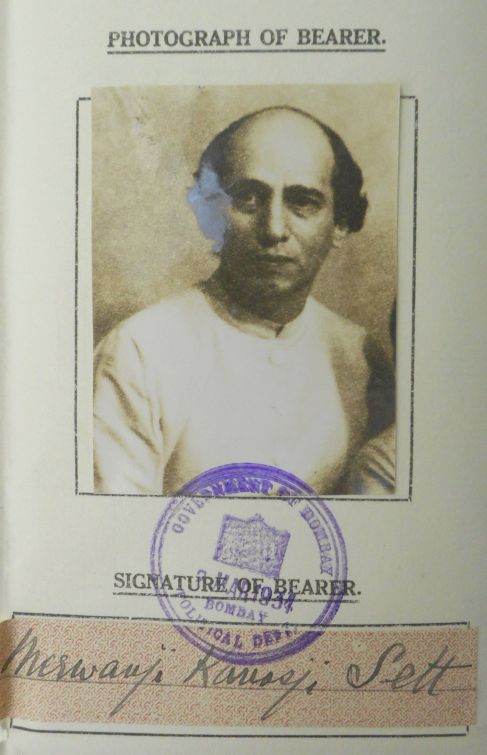
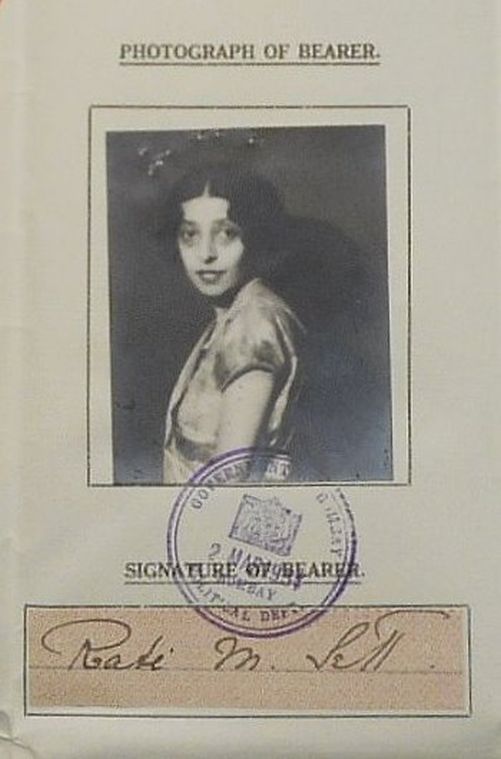
So who was Mera .K. Sett ? Information about him is not easy to come by, and one of our most useful sources turns out to be a passport of his, issued at Bombay on 2 March 1934. A duplicate copy of it is housed in the British Library (4), a broad view of this being shown in Fig.6a. From this we see that his full name was Merwanji Kavasji Sett, so Mera was presumably a shortened form of his first name. We further learn that he was born in Bombay on 4 September 1888, that he was 5 feet 6 inches tall, with green–grey eyes and light brown hair; that he was a British subject by birth; and that he was a "Barrister–at–Law" by profession, of which we shall have more to say presently. It is of particular interest that the passport furnishes us with a rare photograph of him (Fig.6b.)
Likewise, we learn much from a similar document relating to the passport of his wife, Rati, also issued on 2 March 1934, and again housed in the British Library (4). Her full married name was Mrs Rati Merwanji Sett, and her maiden name was Rati Jamshidgi Panday. She was born in Bombay on 21 May 1892; she was 5 feet tall with dark brown eyes and dark brown hair; and that she was a British subject by birth, and married to a British subject by birth. She was of no stated profession, though we do learn that she had been busy as the mother of twin sons, Jal and Rustom, born on 3 March 1925. Again, the passport furnishes us with a rare photograph of her (Fig.6c.)
Backtracking slightly now, we know that, at the age of 21, having gained a degree at the University of Bombay, he came to London to train as a barrister, and under his full name of Merwanji Kavasji Sett, he was admitted to the Middle Temple on 16 November 1908. He was called to the bar (in effect, graduated as a barrister), having gained a Class III in his Final Examination, on 1 May 1912. (5a)
Again under his full name, he matriculated at Downing College, Cambridge on 22 October 1910. (In the Foreword to the ‘1914’ edition of Omar Khayyam he talked of being an undergraduate at Cambridge.) Records show that he got a 3rd in the Part I of the History Tripos in the Easter Term of 1912. He then switched to the Law Tripos, but failed the examinations for Part II in the Easter term of 1913. He then downgraded to the Ordinary BA (ie. without honours) in Law, and in the examinations in the Michaelmas term of 1913 he managed to get a third class degree. He graduated BA on 19 December 1913 (5b), though he is only recorded in the residence books of Downing College until June 1913.
That it was the same Merwanji Kavasji Sett who was on the books of both the Middle Temple and Downing College, Cambridge, is shown by The Solicitors’ Journal & Weekly Reporter, vol. 56, p. 487, 4 May 1912, which says that, “The following gentlemen were called to the Bar on Wednesday...” and among them is “Merwanji Kavasji Sett, Downing Coll., Camb.” Enquiries at the Middle Temple reveal that it was certainly possible and, in fact, not at all unusual for a young man to be at university at the same time as reading for the Bar at an Inn of Court.
Finally, at the time of writing the Foreword to his ‘1914’ edition of Omar Khayyam, Sett tells us that he was “thousands of miles away” from his friends, Mr & Mrs H.P.Adams, in Cambridge (p.2), and indeed, at the end of the Foreword (p.4), he gives his actual address as Pedder Road, Bombay. Presumably, therefore, he went back home to his parents, having left Downing College at the end of 1913, if not (temporarily ?) before – recall that exhibition in Paris in 1912, mentioned earlier. This raises the question of how he actually organised the publication and distribution of his book by Galloway & Porter in Cambridge – before he left England, or from back home in India – but unfortunately, as the late Garry Garrard told me (in a personal email, dated 26 September 2012), having himself made enquiries, Galloway & Porter no longer hold any records dating back that far. However, it may well be that Sett’s absence abroad was responsible for the actual publication date being put back from the projected 1914 to the end of 1915.
Recalling the review of Sett’s Omar Khayyam, supposedly written by Rupert Brooke (of which more presently), it is Sett’s presence in both Cambridge and London which raises the possibility that he and Rupert Brooke might have met at some point. His time at Cambridge certainly overlaps with that of Brooke. Indeed, Christopher Hassall, in his Rupert Brooke – a Biography (1964), tells us that on 9 February 1913, Brooke was actually at Downing College playing billiards with Howard Marsh, the Professor of Surgery there, who was also the father of his friend Edward Marsh (p.375.) The game was apparently watched by no less than A.E. Housman, who had been appointed Professor of Latin at Trinity College, Cambridge, in 1911. Hassall’s detailed biography, though, makes no direct mention of Sett.
Again, during his time at the Middle Temple in London Sett could have met Brooke, who is on record as having stayed in Edward Marsh’s chambers at Gray’s Inn at various times between 1909 and 1913, during which spells in London he is known to have met many writers and artists (6). But again it is to be emphasised that no record of any actual meeting between Brooke and Sett has yet come to light.
Whether Sett ever went on to pursue any sort of career in law I do not know, though we do know from the clip quoted from the (London) Evening News above that he did not practise at the time Sculptured Melodies was published. But then he did give his profession as barrister on his passport in 1934. It transpires that he had a wealthy father (the Middle Temple records list him as a merchant) who paid for him to go to London and Cambridge, but then he was either not up to the mark academically, or else he wasn’t really interested in doing either History or Law. Possibly he had decided, as so many other young men – and women – have done in the past and, no doubt, will do in the future, that he really wanted to be an artist. As we have seen, Sett worked on his Omar Khayyam between 1912 and 1914, this involving “more than a year of strain and many sleepless nights” – hardly conducive to his studies of History or Law! His father does seem to have supported him in this by paying for the publication of his Omar Khayyam in ‘1914’ – and also, perhaps, his Sculptured Melodies in 1922. (The latter also contains its fair share of nudes, so he may have had the same problem with publishers as he had had with his Omar Khayyam a few years earlier.) But his father’s support apparently did not extend to supporting him through art school rather than legal studies, and with what success he pursued any artistic career remains unclear: he may well, in effect, have led the life of “a gentleman connoisseur of private means.”
Each of the eleven stories in Sculptured Melodies is dedicated to someone, and these dedications tell us a little about Sett himself. As we have already seen, he was married, and the first story in the book, illustrating Rubinstein’s “Romance” (Fig.4c), was dedicated to his wife, Rati. More than that, in his Foreword to the '1914' edition of his Omar Khayyam, Sett acknowledged the encouragement of Mrs J. L. Panday and Miss Rati J. Panday, and the story associated with Chopin’s “Fantaisie Impromptu” (the third story – Fig.4h) was dedicated to Mrs J.L. Panday. As we saw above, Rati J. Panday was Rati’s maiden name, which all suggests that by 1922 Mrs Panday had become Sett’s mother–in–law. Finally, the copy of the book in the John Rylands Library in Manchester bears the inscription: “To Monsieur & Madame Ammann, with kindest thoughts & greetings, from Rati & Mera Sett, 29 November 1922, Paris.” This certainly tells us that Sett and his wife were in Paris together on that date in 1922. The Rylands copy also bears the bookplate of August Ferdinand Ammann. He seems to have been associated with the Volkart Brothers of Zurich, who had business interests in India – hence the elephant and howdah on his bookplate. The story, relating to Chopin’s “Funeral March” (the fourth story), the tale of a Brahmin and his ill–fated love for an Indian noblewoman, was dedicated to him.
The story illustrating Chopin’s “Valse Triste” (the second story – Fig.4f) was dedicated to the little–known composer, pianist and writer on music, Kaikoo Sorabji, more fully known as Kaikhosru Shapurji Sorabji (1892–1988), though his real name was actually Leon Dudley Sorabji. The son of a Parsi father and, as he liked to pretend, a Spanish–Sicilian mother (she was actually English), he appears to have lived pretty much his whole life in England – mostly in London, but from about 1950 as something of a recluse in Corfe Castle, Dorset. In 1987 he moved to Winfrith Newburgh, Dorset, where he died, though his ashes were interred in God’s Acre Cemetery in Corfe Castle. Despite this, he apparently didn’t like to be thought of as English, which presumably explains his rather ostentatious name–change, adopted sometime before 1913. The dedicatees of Sett’s stories all seem to have been personally known to him, and Sett’s use of the familiar name “Kaikoo” does rather suggest that he knew the composer personally. But though there is an extensive archive of material related to Sorabji, there is no mention of Sett anywhere in it, and no evidence that the two ever even met (7). Sorabji’s Parsi connections via his father link up with Sett’s Parsi origins (and his Zoroastrian reference to Ahura Mazda above – see the end of section i), plus the fathers of both artist and composer hailed from Bombay, but these are about the only two connections between them that we know about, aside from the dedication in Sculptured Melodies. (Incidentally, the publication of much of Sorabji’s music was financed by his wealthy father, just as Sett’s Omar Khayyam and his Sculptured Melodies were financed by his father.) However, if Sorabi officially declared himself a Parsi on his name change sometime before 1913, then it is possible that Sett met him through the London Parsi community, for Sorabji certainly lived in London at that time and Sett commuted between Cambridge and London. But of course this is pure speculation at this stage.
The story illustrating Chopin’s Prelude Op.28, no.7 (the seventh story – Fig.4l) was dedicated to Mr & Mrs H.P. Adams, with whom, according to the Foreword of his ‘1914’ Omar Khayyam, he seems to have lodged during his undergraduate days at Cambridge. He clearly had very happy memories of them, but curiously, there is no reference to them in the census returns for 1911, unless they be theatre clerk Percy Henry Adams and his wife, Annie, who lived in the Chesterton suburb of Cambridge, though Sett is not registered as living with them. (Nor does he seem to be listed anywhere else in the 1911 census.)
Sett’s tenth story, illustrating Chopin’s “Ballade Op.3” (Fig.4m) was dedicated to Harry Wellington White Esq. He appears to have been a trained teacher of the deaf, later turning his attention to the education of the dumb. His books On Training Colleges for Teachers of the Deaf and The Mechanism of Speech were published in 1890 and 1898 respectively, for example. But what on earth was his connection with Sett ? Equally puzzling is Sett’s connection to Miss C. Crichton Imrie, the dedicatee of the eighth story, related to Tchaikovsky’s “Chanson Triste”, a New Zealander who appears to have been involved principally in Child Welfare work!
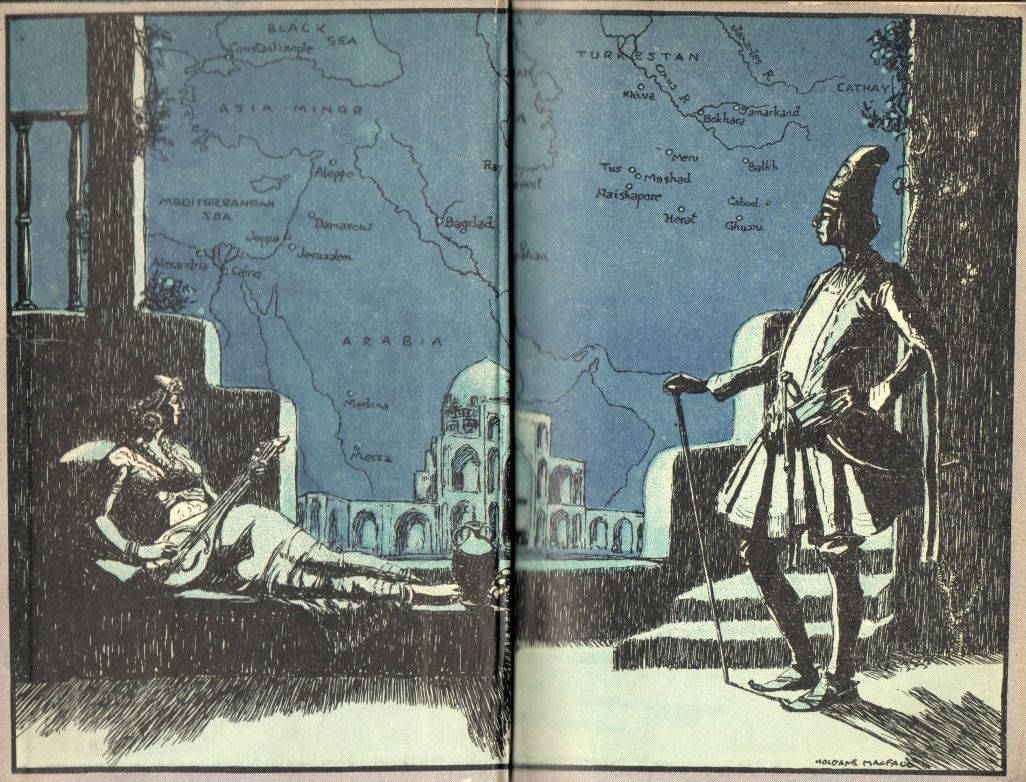
Finally, Sett’s eleventh story, illustrating Gounod's “Ave Maria,” was dedicated to Haldane Macfall and his wife. Macfall (1860–1928) retired with the rank of Major after serving in the First World War, and wrote several novels, including The Three Students (1926), which is a curious production loosely based on the life of Omar Khayyam and the story of the three friends as told by FitzGerald at the beginning of his Preface to The Rubaiyat. An amateur artist himself, he did the end–papers for The Three Students (Fig.7). Macfall also wrote A History of Painting in eight volumes (1911), and several art monographs, which include one on Whistler (1905) and another on Beardsley (1928). Macfall and his wife were also acknowledged in Sett’s ‘1914’ Omar Khayyam for their encouragement to go ahead and publish when he himself was in two minds about it.
Little information is available about Sett’s later life, but we do know, from a ship’s manifest, that on 24 March 1950 he arrived in Liverpool from Bombay (as it then was), after travelling first class aboard the Jal–Azad. His proposed address was 15 Parliament Hill, Hampstead, London, and his profession / occupation / calling was listed as “Landlord”, not Barrister or Artist. England is listed as his country of intended future permanent residence, though “permanent” here means only residence for a period of a year or more. His age is given on the ship’s manifest as 60, whereas he was actually 61 going on 62.
Sett died, probably in Bombay, on 22 May 1961 (8).
There is no reference to any review by Brooke of Sett’s Omar Khayyam in Geoffrey Keynes’s Bibliography of Rupert Brooke (1954). Though Keynes lists various reviews by Brooke, his critique / review of the Sett book isn’t among them. The Rupert Brooke Society has never heard of it, and nor has the archivist of the Rupert Brooke Archive at King’s College, Cambridge (at which Brooke matriculated in 1906, and at which he was elected a fellow in 1913.) The latter did say that though their records were far from complete, particularly for the period of the Great War, there was no sign of the Brooke review in any of their records from 1913 to 1919. The Great War, of course, disrupted everything, but the plain fact remains that no–one seems to know where this review was published, or indeed if it ever was actually published, though the author of the Publisher’s Note in the Portfolio Edition does seem to have seen it somewhere.
Brooke does mention various periodicals in his letters besides those listed in Keynes’s Bibliography – The Saturday Review, The Quarterly Review and The Cornhill Magazine are three. But Brooke’s review of Sett’s Omar Khayyam has not turned up in any of them either.
As we saw above, Sett’s Omar Khayyam was begun in 1912 and finished in 1914 (the date on the title-page), but as we now know, it wasn’t actually published until December 1915. Since Brooke died on 23 April 1915, he cannot have seen a published version, and must therefore have seen either the original MS or a publisher’s mock–up. This may explain why, in the Publisher’s Note in the Portfolio Edition, Brooke was quoted as saying, “His Omar will have the pride of place in my library,” the “will have” implying that it hadn’t actually been published at the time he wrote the review.
Looking at when Brooke might have written his review it is instructive to look at a summary of his comings and goings from 1912, the year in which Sett began work on his Omar Khayyam. The year 1912 was one of emotional turmoil for Brooke, and he moved back and forth from England (Rugby & Rye) to various places in Europe (France & Germany.) The year 1913 is more promising, for, as we saw in the last section, Sett and Brooke could well have met in either London or Cambridge, so he could conceivably have seen Sett’s MS at around this time. However, as pointed out earlier, there is no mention of Sett in Christopher Hassall’s Rupert Brooke – a Biography (1964), nor is there is any mention of him in Geoffrey Keynes’s The Letters of Rupert Brooke (1968), in which there are three brief allusions to FitzGerald’s Rubaiyat, none of them making any reference to any particular edition, Sett’s or otherwise (9).
At the end of May 1913, Brooke headed off to America and Canada, and from there to Hawaii, Samoa and Fiji. For the first half of 1914, he was travelling from New Zealand and back to America, via Tahiti, then returning to England. (By this time, as we saw in the last section, it seems likely that Sett had returned to India.) Brooke was back in Rugby in June, and in Gloucestershire for part of July to arrange for the publication of some of his South Sea poems in the periodical New Numbers. (He was, therefore, publishing some material during this period.) He was in London when war was declared on 4 August, and by 1 October he was with the Anson Battalion near Walmer in Kent. Shortly after that date, he took part in a brief but abortive action in Belgium, but was back in London again by 17 October to write about his experiences to Cathleen Nesbit (Keynes, Letters, p.622–5.) He remained in England until the end of February 1915: having been drafted to the Hood Battalion at Blandford in Dorset early in December 1914. It was from here that, on 1 March 1915, he set out for action in the Dardanelles. He never got there, of course, dying en route on 23 April, of septicaemia as the result of a mosquito bite.
For Brooke to have had sight of a MS or publisher’s mock–up of Sett’s Omar Khayyam, and to have written a two–column review about it, it seems likely that the review must have been written either during the period when he might have met Sett in 1913, before the MS was actually finished, or between June 1914 and February 1915 from a publisher’s mock–up, Sett by now being (probably) back in Bombay. When and whether the review was ever actually published is not clear. If it was published, it was presumably after the book came out in December 1915 – ie in early 1916 – but if so, where ? And if it wasn’t published, on account of Brooke’s death, what was it that the writer of the Publisher’s Note in the Portfolio Edition saw ? It has been suggested that the writer of the Publisher’s Note saw a draft of the review in a letter to Sett. But no such letter is known to have survived, and besides, the description of it as “a two–column critique” suggests an already published newspaper / magazine format.
I have long wondered if Sett trained as a barrister at his father’s behest, the publication of his Omar Khayyam and Sculptured Melodies being financed as a ‘reward’ for his compliance. I get the impression that Sett was much more intent on being an artist (and one who didn’t sell his paintings!), but that ‘artist’ not being a fit profession in the eyes of his father, he never got the financial backing from him to take formal art training. If so, that is a pity, and inevitably one wonders what he might have produced had he received such training. We will never know. But I have to say that, despite his limitations as an artist, his Omar Khayyam intrigues and appeals to me more than many an edition illustrated by much more skilled artists.
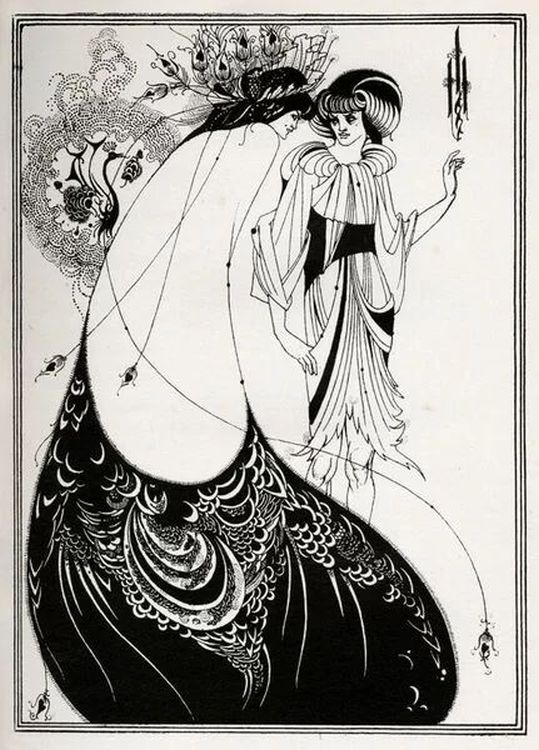
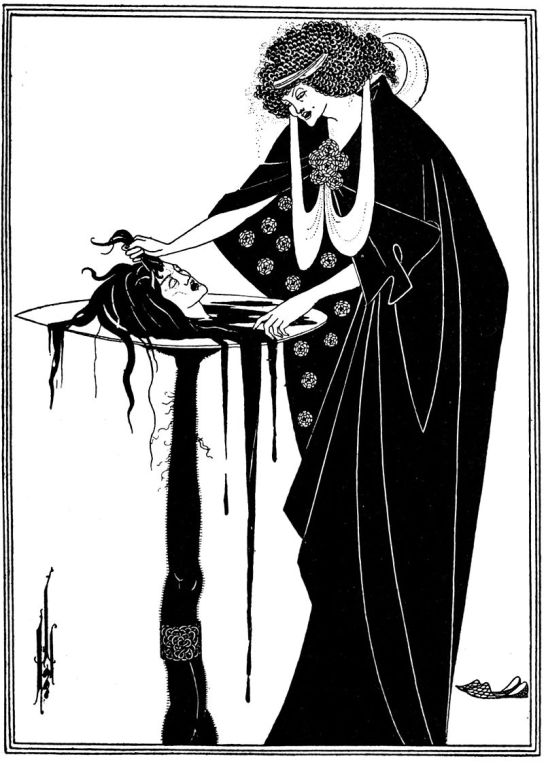
Note 1: We have to take Sett’s word for this, though he should have been flattered, Beardsley being a much more skilled draughtsman! Perhaps what led to such claims was the dramatic use of black and white by both artists, with similar use of decorative frills, plus Beardsley’s extensive use of the peacock and its feathers, though this last was a fairly common usage in the later nineteenth and early twentieth centuries – Whistler’s famous Peacock Room is a good example, as is Walter Crane’s Peacock Garden Wallpaper. Beardsley’s most famous peacock design is probably The Peacock Skirt (Fig.8a), one of his illustrations for Oscar Wilde’s play Salome, regarding which see note 3a below. Beardsley’s illustration not only contains peacock feathers galore, it also features a Sett–like peacock to the upper left.
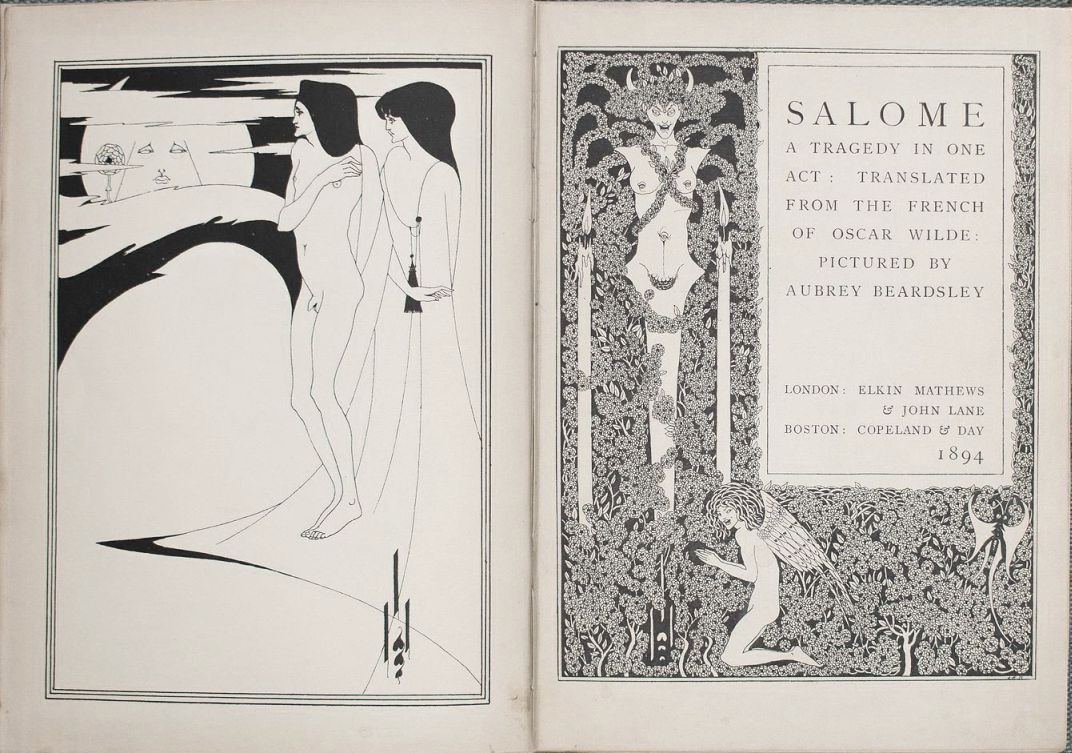
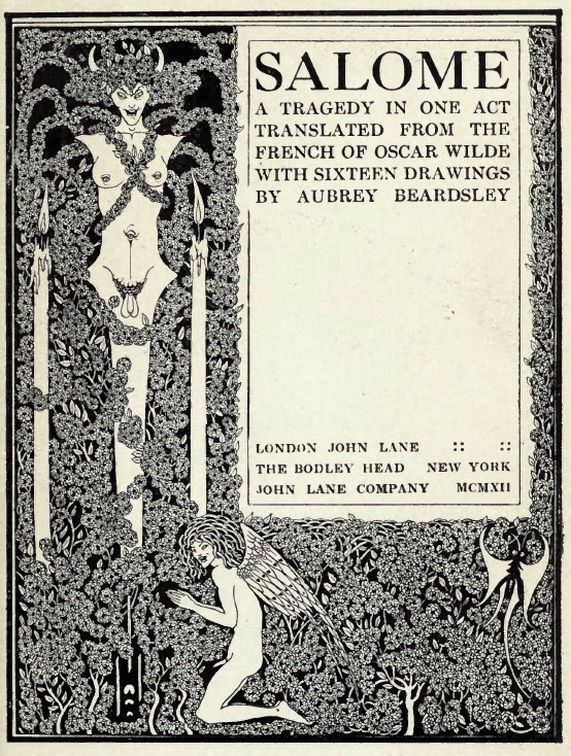
Again, Fig.8b shows the frontispiece and title–page of the 1894 edition of Salome, the former showing the Moon with a strange face, actually a caricature of the bloated face of Oscar Wilde, with his famous green carnation. This perhaps invites a parallel with the strange faces that feature in some of Sett’s illustrations (Figs.1j, 1k, 1l & 1m.) In the title–page, some characteristics of the nude figure on the left (breasts, navel & pubic area), vaguely resemble those of Sett’s Rose in Fig.1i, as do the floral decorations in both, as well as the butterfly / moth–like figure in the lower right of each. (However, this version of the title–page had been edited: originally the figure was androgynous, with a penis and testicles, these being restored in the title–page of the 1912 edition, and certainly not shared by Sett’s Rose – Fig.8c.) But these are arguably rather superficial resemblances which could just be coincidental.
Wilde’s play was first published in an unillustrated edition in French in 1893, with an English edition of it illustrated by Beardsley being first published by John Lane in 1894, with reprints in 1906, 1907, 1908, 1911, 1912, 1920 and later. Thus, time–wise, Sett could certainly have seen a later copy of this, and still honestly stated in his Foreword to the ‘1914’ Omar Khayyam that he had not heard of Beardsley until “quite lately.”
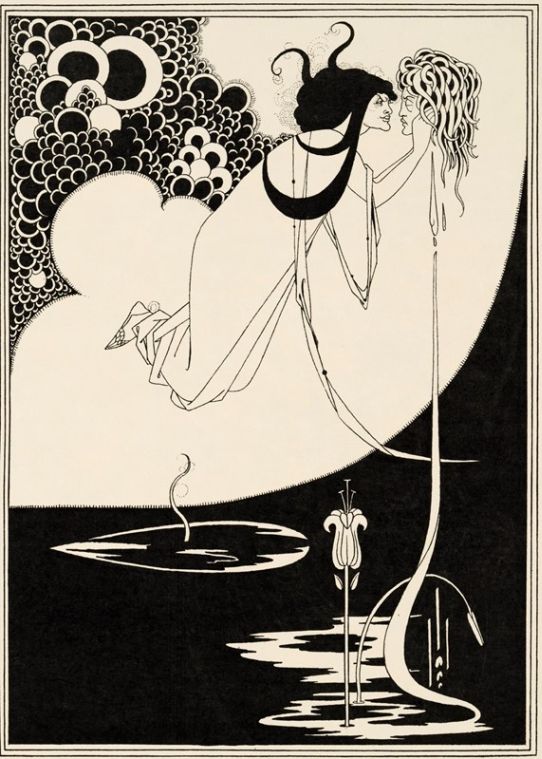
Beardsley’s depictions of the main theme of Salome – the beheading of John the Baptist – are shown in Figs.8d & 8e, the latter showing Salome kissing his decapitated head, her levitation presumably representing an almost perverse ecstasy. (Given Beardsley’s penchant for sexual innuendo, one wonders if he intended a double meaning in the title he gave to this illustration, “The Climax.”) Clearly Sett was not influenced by Beardsley here!
Note 2: See Garry Garrard’s article. “A Cautionary Tale” in Omariana, vol.10, no.1, Summer 2010.
Note 3a: According to Richard Ellmann, Oscar Wilde (Penguin Paperback Edition, 1988), “the principal engenderer” of Wilde’s play (p.321) was the account in chapter 5 of Huysman’s novel of Moreau’s paintings “The Apparition” (Fig.5a) and “Salome Dancing Before Herod” (Fig.5b). Wilde had discovered the novel shortly after its publication, whilst on honeymoon in Paris in 1884, and it became something of a ‘Bible and bedside book’ for him (Ellmann, p.237–8.) But Wilde’s play was not to be written for another seven years – it was mostly written in 1891 (Ellmann, p,290) & finished in January 1892 (Ellmann, p.343) – and besides, Huysman’s telling of the Salome story is simply a sexed up version of the Biblical account, as noted above, so what happened in those seven years, if it wasn’t an inspirational ‘bolt from the blue’, to induce the quantum leap to the final form of the play ?
There is more to the play’s genesis than just Huysman’s novel or Moreau’s paintings. There are many literary variations of the story of Salome, some of which may have impacted on Wilde to varying degrees, for a basic overview of which see Ellmann, p.320ff. One of the most curious was J.C. Heywood’s Salome, the Daughter of Herodias – A Dramatic Poem published anonymously in New York in 1862. In it Salome has a reciprocated platonic love for John the Baptist, she being forced to have him beheaded by Herodias, who has an unrequited passion for him. In due course, Herodias has her revenge by mocking his severed head and kissing it. This is not by any means Wilde’s version of course, but some of its elements do find echoes in Wilde, and it is the closest approach I’ve seen. In short, no variation of the story before Wilde’s play (at least that I have seen) posited the notion that Salome had a sexual interest in John the Baptist, so this does seem to have originated with Wilde himself, and thence to have ‘infected’ Sett.
Note 3b: “The Apparition” was exhibited at the opening of the Grosvenor Gallery in London in the summer of 1877. Now, Wilde wrote a review of this exhibition, published in The Dublin University Magazine in July of that year, yet he makes no mention of the painting in it – perhaps not surprisingly, as his play was still some fourteen years in the future, but, equally, odd that he didn’t recall seeing it later, it having supposedly become such a key source of his play. Might he have seen it again later ? In 1879 it was acquired by the wealthy collector Charles Hayem, who, along with his wife, used their Paris apartment both as a gallery and as a literary and artistic salon. “The Apparition” seems to have remained there until 1898, when, along with a number of other paintings, it was donated to the Musée du Luxembourg. It was subsequently transferred to the Musée d’Orsay, and in 1929, to the Louvre. We know Wilde was in Paris in 1891, and that Sett was there in 1912, but there is no record of either of them seeing the painting. However, engravings of it were certainly available as early as 1878, and so Wilde and Sett could have seen a copy of one of those, though I stress that there is no evidence that either of them actually did.
Note 4: Sett’s passport can be found at shelf–mark IOR/L/PJ/11/3/1933; his wife’s at shelf–mark IOR/L/PJ/11/3/1934.
Note 5a: See H.A.C. Sturgess, Register of Admissions to the Honourable Society of the Middle Temple (1949), vol.2, p.774. For those interested in the details, his examination results can be tracked in the “Council of Legal Education” column of The Times between 1909 and 1911, as follows:
12 Jan 1909, p.3, Class III in Roman Law 2 Nov 1909, p.3, Class III in Criminal Law and Procedure 6 Apr 1910, p.4, Class III in Constitutional Law and Legal History 2 Nov 1910, p.5, Class III in Real Property and Conveyancing 2 Nov 1911, p.2, Class III in Final Examination
His calling to the bar, on 1 May 1912, was recorded in the “Calls to the Bar” column of The Times on 2 May 1912, p.4.
Incidentally, third class results were not at all uncommon in those days, as the records in The Times show – about three–quarters of those who passed got a third – so these results are not as poor as they might appear to us now.
Note 5b: Recorded in the “University Intelligence” column of The Times on 20 December 1913, p.10.
Note 6: See Hassall, Biography p.220–1, p.357, p.373 & p.391. Further details of Brooke’s literary and artistic contacts in London can be found in Hassall’s other book The Prose of Rupert Brooke (1956), p.xxix–xxx. For more details of the London scene in which Marsh was involved, see Hassall’s Edward Marsh: Patron of the Arts (1959), p.187, p.188–9, p.206–7, p.211, p.213.
Note 7: There is an article about him in The New Grove Dictionary of Music and Musicians (2001), vol.23, p.739–741 and a good detailed Wikipedia page about him at: https://en.wikipedia.org/wiki/Kaikhosru_Shapurji_Sorabji. The most detailed account of him, though, is to be found in Marc–André Roberge, Opus Sorabjianum: the Life and Works of Kaikhosru Shapurji Sorabji (Faculté de Musique, Universié Laval, Québec, 2021), which can be accessed online and downloaded in pdf format at: https://roberge.mus.ulaval.ca/srs/07-prese.htm. The first repeats the Spanish–Sicilian mother myth, whilst the two latter name his mother as the very English Madeline Matilda Worthy. Roberge (p.436) is the only source which mentions Sett (“whose name does not appear anywhere in the extant documents”) and his Sculptured Melodies.
Note 8: Sett’s date of death is given in The Sett And Sethna Family of Rustom Maneck (17th to 21st Century) Genealogy and History, by Louiza Rodrigues, Ravinder Kaur Cheema, Meher Mistry and Rinkesh Dharod, (Mumbai, 2014) pp. 76–77. This source does not say where Sett died or give the location of his final resting place, but since he was by then a trustee of several charitable trusts set up by his wealthy family in Bombay, it would seem very likely that he died there. Furthermore, since his family were prominent in the Parsi community, and indeed had set up the first Tower of Silence in Bombay in 1670, it is more than likely that he would have been excarnated in Bombay according to Parsi custom (see the note on Fig.1c above.)
This source also tells us, unfortunately without going into much detail, that he was a keen practitioner and proponent of homeopathy; that he lived for many years in Nice (no dates given); that his twin sons (born in 1925) spent their childhood in France, moving to India only when they were nine or ten years old; that neither of them ever married; that Rati Sett was a spiritually inclined person, influenced by Krishnamurthi’s philosophy; that she practised yoga, visited the Himalayas many times, and was a linguist who spoke eleven languages, French being the language in which she was most fluent. She wrote a book on ‘Aphorisms’ (of which I have found no trace) and a book of poems, titled Thy Will be Done, published in Bombay in 1970. She died on 9 January 1977.
By way of background: the Sett family became very wealthy through acting as brokers and commission agents for the various European traders, of which the English East India Company was one, of course. Rustom Maneck Sett (1635–1721), though a priest, was the pioneering member of the family in this field, their accumulating wealth and its funding of charitable works leading to them being regarded as the guardians of the Parsi community.
Note 9: Brooke is most famous, of course, as one of those poets who died young in the First World War – not as a result of enemy action, but as a result of blood poisoning arising from a mosquito bite. He was certainly familiar enough with FitzGerald’s Rubaiyat to quote from it in his letters – but only on a couple of occasions. The main one of these – a quotation from verse 20 of the First Edition – is quoted in the following context (Keynes, Letters, p.636):
I spend my odd moments in a grave perplexity, about marriage. I rather feel that if the war hadn’t happened, I’d have gone on eyeing the brink ... until I relapsed into a friendly celibate middle–age ... But oh! this threatens a hastiness of decision. ‘Tomorrow Why tomorrow I may be, myself, with yesterday’s seven thousand years.’ If it’s true the war’ll last two years more, there’s very little chance of anyone who goes out in January 1915 returning. Now, if I knew I’d be shot, I’d marry in a flash – oh any of two or three ladies – and do my best to leave a son ... But, oh, if I came back in a year and found myself caught. It’s easy to select a wife for a month: but for a lifetime – one must be a little more certain. (Undated letter to Dudley Ward of early December 1914.)
Brooke clearly liked this phrase, for he used it in an earlier letter written to Edward Marsh in March 1914, referring back to January of that year as “now itself some way down in the heap of yesterday’s seven thousand years” (Keynes, Letters p.567.) His only other reference Omar comes in a letter to Cathleen Nesbitt, written from aboard ship in the Pacific in April 1914. He talks of looking out for the Southern Cross, but looking for it in vain “like the moon for Omar Khayyam”, an adaptation of verse 74 of the First Edition (Keynes, Letters p.570.)
**********
The above could not have been written without the generous help of the following: Lorna Beckett of the Rupert Brooke Society; Jacqueline Cox of the University Archives at Cambridge University Library; Patricia McGuire, Archivist at King’s College, Cambridge; Kate Thompson, Archivist at Downing College Cambridge; Lesley Whitelaw, Archivist of the Middle Temple, London; and my old friend Michael Behrend for his researches on my behalf in Cambridge University Library. For their help in finding Sett’s date of death, which had long eluded me, I must also thank I must Sandra Mason, Almut Hintze of the School of Oriental and African Studies, Malcolm Deboo of the Zoroastrian Trust Funds of Europe, and especially Firoza Punthakey Mistree, an independent researcher in Zoroastrian Studies in Mumbai, and editor of books on Zoroastrianism and the Parsi community, who drew my attention to the rare sourcebook cited in note 8. Finally, my knowledge of Persian being next to nothing, I must thank Fred Diba and Barney Rickenbacker for their comments on the ‘Persian script’ in Fig.1g.
**********
To return to the Notes and Queries Index, click here.
To return to the Index of the Rubaiyat Archive, click here.