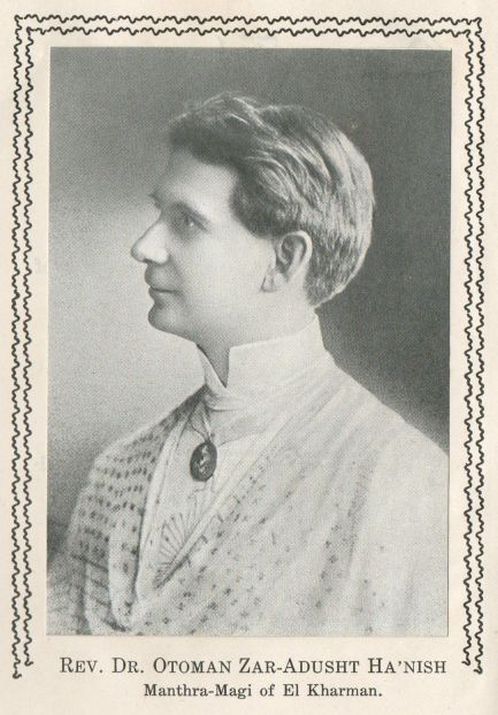
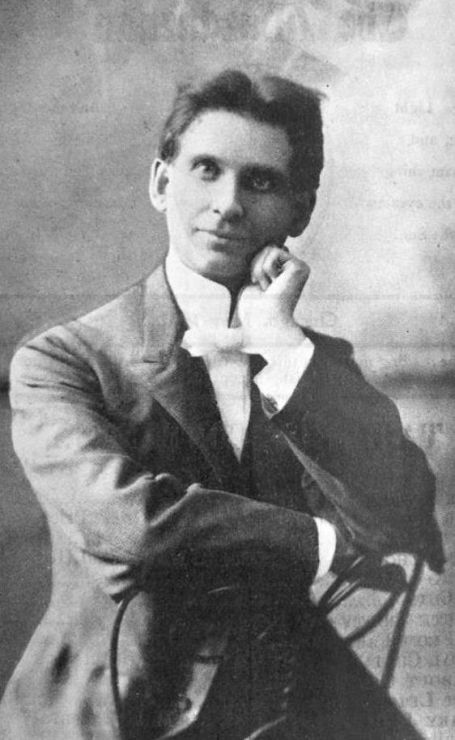
One of the inhabitants of the stranger shores of Rubaiyat literature is a little book by Dr. Otoman Zar–Adusht Ha’nish (hereafter Hanish) entitled Omar Khayyam in his Rubaiyat – with a true History, Life and Biography of the Persian Poet, Astronomer and Statesman first published by the Mazdaznan Press of Los Angeles, California, in 1924, but seemingly with later reprints still bearing just the original copyright date of 1924. It is Potter #331 & Paas #4593. The book has, as its frontispiece, a picture of the author which I reproduce here as Fig.1a. As can be seen from its caption, the Reverend Dr. Hanish was “Manthra–Magi of El Kharman”, which turns out to be one of his many titles.
The Mazdaznan Press takes its name, we are told, from Mazda meaning Wisdom and –znan, an abbreviation of yasnian, meaning worshipper. Hence Mazdaznan signifies Wisdom Worshipper, though Hanish seems to have preferred the translation “Master Thought,” in the sense of Mastery of Thought. Notably too there is a connection with Ahura Mazda, the supreme & beneficent God of Zoroastrianism, the Lord (Ahura) of Wisdom (Mazda.) The movement was founded by Hanish in Chicago in about 1899, spreading from there across America, into Canada, and thereafter to Europe. Interest in it rather declined after Hanish’s death in 1936, and today it appears to be pretty much defunct. Basically it promoted spiritual development and physical well–being through a vegetarian diet, sunlight (Ahura Mazda was associated with both light and the Sun), fresh air and a regime of breathing exercises, set against a religious and philosophical background which is a curious mixture of Zoroastrianism and Christianity, with elements of Hinduism and Buddhism thrown in. But more of this later. In the first half of the twentieth century it was a hugely popular cult, with the Revered Doctor Hanish – “The Master” – at its head.
As might be expected from the foregoing, Hanish’s take on The Rubaiyat leans towards the Sufic – “Omar lived a pure Sufi life”, he assures us (Introduction p.xxxiii). For more than twenty five years, he tells us in his Foreword, he worked on putting together a better version of the quatrains than had hitherto appeared – one which revealed the true Omar, for whom Wine, Woman and Song were, respectively, Thought, Deed and Word. Not that Omar was a hard–line Sufi – on the contrary, the quatrains do refer to wine as the literal juice of the grape, and not as the misleading spiritual wine of the hard–line Sufis. But Omar wasn’t just referring to drinking: he was “pointing to the praise of the beauty in ‘wine’” and likewise “to the laud of the beauty in ‘song’, and to the honor of the beauty in ‘woman’” (Introduction p.xxxv.) Omar’s drunkenness, he assures us, was merely an act to evade the strictures of both orthodox Islam and the more hostile of the Sufis, “as the old belief had it that the obsessed, the insane, and drunkards cannot be made responsible for their utterances.” (Introduction, p.xxxix.)
Hanish’s version of The Rubaiyat, which he hoped would “supply the want of mental and psychic hunger” of his readers (Foreword), runs to 191 quatrains, unfortunately unnumbered. His heavy debt to FitzGerald is easily demonstrated despite his claim of throwing aside all earlier occidental translations (Foreword). Here, for example, is a verse from p.2:
Come! Join your Old Khayyam and leave the lotOf Kaikobad and Kaikhosru forgot! Let Zal and Rustum with greater anger fume;Let Hatim cry: “To supper!” – mind them not!
This, of course, is suspiciously like verse 9 of FitzGerald’s first edition. Again, from p.6:
With book in hand, reclining ’neath a bough,A jug of wine, a half a loaf and thou Beside me, singing songs of love divine,Turns deserts into paradise enow.
This too is suspiciously like verse 12 of FitzGerald’s third and fourth editions. Here is another verse, from p.21 this time:
Join Old Khayyam, and leave it to the WiseWho talk of Hell and Hopes of Paradise! Life flies – that’s certain, all the rest is – Lies;The flow’r that once has blown, forever dies.
This, of course, is a conflation of verse 26 of FitzGerald’s first edition and verse 66 of his second (verse 63 of his third and fourth.) And a final example is from p.36:
I scanned Saturn’s rings, and on the roadI solved so many problems with my thot. But when I came to solve the Human Fate,My keenest thot was brought at once to naught.
This is clearly based on verse 34 of FitzGerald’s second edition (verse 31 of his first, third and fourth), but it is an amateurish effort at best, where the rhyming pattern is preserved only by “thot” (= thought) rhyming with “naught”! (One of the peculiarities of this book is that “thought” is consistently mis–spelt thus throughout the book!)
And so it goes on, with FitzGerald repeatedly being his dominant source, with other verses apparently adapted from the translations by Whinfield, Heron–Allen & McCarthy (Introduction p.ii).
What, then, of the promised “Life of Omar”, given in the introduction of the book ? It is not clear where the word statesman in the sub–title of the book comes from, but I presume it is based on the many years that Omar spent in the service of Sultan Malik Shah, during which time, of course, he worked on the famous Jilali Calendar (p.xxxii). Be that as it may, in addition to learning that Omar was an astrologer and a healer (p.xliv), of particular interest is Hanish’s account of Omar’s love for Shahreen, the beautiful daughter of his teacher Imam Mowaffak. It is a tale involving “the fluttering of hearts, and the tongue uttering kaleidoscopic sounds, while the silvery laughter reveals the happiness of enraptured souls” (p.viii). Unfortunately Shahreen had been promised by her father to the Sultan; their romance was hopeless; and after a few brief clandestine star–lit meetings in which “the two lovers basked in the radiations of their pulsating hearts” (p.x), Shahreen was taken away, at dawn, to the Sultan’s palace (p.xii). It was apparently at this point that Omar penned the opening verse of Hanish’s Rubaiyat:
Awake! For Korshed now has thrown the StoneInto the Bowl, and all the Stars are gone; While arrows reach the Sultan’s turret first,And strike with greater speed his golden throne. (1)
Note again the borrowing from the opening verse of FitzGerald’s first version. Half a page later, having realised that “position, not knowledge, gives power” and that “he who is void of favor must yield to designs that know no pregnability” (p.xii), he penned Hanish’s second verse, this time with a lesser nod towards the second verse of FitzGerald’s second, third & fourth versions:
The phantom of False Dawn just now has past,True Dawn is breaking thru the clouds at last; The Saki cries: Come to the Tavern, come!Drink wine and shun the Mosque – break here thy fast.
But wine for breakfast and shunning the mosque wasn’t quite the end of it. Two years later, after further heart–rending verse–writing, a baby girl was brought to Omar “from the far off country” (p.xiv) – it was his daughter by Shahreen. It later transpired that the Sultan had rejected Shahreen precisely because she was pregnant, though her fate was not known to Omar until twenty years later, when she was discovered in a brothel (p.xv). Unfortunately there was to be no happy ending, for too much water had passed under the bridge. Except for their daughter, “now a full–grown beauty”, there was little to hold them together, for “the pangs of a wounded heart had furrowed deeply into the very ganglia.” (p.xv)
Unfortunately, Hanish gives no sources for his information on all this, and one wonders if it has any more basis in fact than the romantic element introduced into the Omarian novels of Nathan Haskell Dole, Haldane Macfall, Harold Lamb, and Manuel Komroff (2).
Readers may be interested to know that Hanish also wrote a couple of other books, both ‘lives’, and both of a similarly suspicious nature as regards their sources.
Ainyahita in Pearls was first published by the Mazdaznan Press in 1913. It was allegedly translated from valuable ancient manuscripts discovered in the Gobi Desert, plus later finds in the Plateau of Tibet (Preface). It is supposedly a biographical account of Ainyahita “purest of the gems of heaven and pearls of the earth” (p.11), who lived over 9000 years ago, and her spiritual quest for what turns out to be just like that of Hanish and his followers. Those 9000 years, plus the Gobi Desert & Tibet, of course, amount to long, long ago, and far, far away – the setting for many good fairy tales (3).
Hanish also wrote a “Life of Christ” – Yehoshua Nazir: Jesus the Nazarite: Life of Christ, first published by the Mazdaznan Press in 1917. It was supposedly based on information gathered from “Johannanitan communities, Coptic monasteries, and other recognised sources of so–called Gospel teachings which Christian associations dare not deny” (Foreword.) Much of it follows the New Testament story, of course, but with additions. Thus we learn that Christ trained as an adept in both Greece and Egypt (p.31–3), then later in India (p.34), and that he didn’t really die on the Cross at all, having been given a dose of hyssop to promote the appearance of death (p.70–73.) (4) It is interesting that in Yehoshua Nazir Christ becomes recognised as “The Master” (p.35) who found Egyptian methods of healing deficient; who then went to India to hone up his skills and “gather a few more blossoms of wisdom” (p.34); that he had a “magnetic personality and authoritative manner” (p.51); and that as the crucifixion approached “He stood before His accusers in angelic majesty” (p.67). Hanish was, of course, also “The Master” to his disciples, allegedly with skills of healing and lots of oriental wisdom, plus a magnetic personality and authoritative manner, though a tad deficient in facing his accusers, as we shall see presently. It is hardly surprising, then, that Hanish came to promote himself as Christ reincarnated. What is amazing is that so many of his disciples believed him!
Both Ainyahita and Yehoshua Nazir, like Omar Khayyam, appear to have been issued in undated reprints, retaining only the copyright date of the original.
So who was Hanish ? According to the story he himself promoted – and details do seem to vary a bit over time (5a) – he was born in Iran of Russian and German parents (some accounts say of royal lineage) in 1844. At the age of 12, as a somewhat sickly child, he was taken to the Mazdayasni Temple (or Temple of Enlightenment) of Math–EI–Kharman in the Mountains of Iran, about 150 miles south–west of Tehran. At first the Patriarchs would not take him in on account of his weak constitution, but eventually they relented on condition that his parents forfeited all claims to him. He battled his way back to health, and after 20 years (some say 30) of arduous training he graduated as Manthra–Magi (a sort of Doctor of Spiritual Philosophy) – hence the caption on his photo in Fig.1a. After graduating, he set out as a missionary to Europe and America. The Temple of Enlightenment, he said, had records going back 142,000 years. These were originally engraved on stone, but following some unspecified persecutions about 60,000 years ago, they were transferred to copper plates for easier transportation. “The newest wing of the Temple was built about 4000 years ago,” he told one newspaper reporter, “and it was in this wing that Jehoshua Nazir (Jesus, the Nazarine) studied the art of healing before entering on his career as the Savior. We have complete records of the life, work and crucifixion of Christ.” (Leavenworth Chronicle–Tribune, 10 December 1901, p.7.) According to his followers, Hanish did not die in 1936, but “joined the immortals.”
Had Hanish not got himself and his followers involved in a succession of scandals involving court appearances and private detectives, his charade might have gone on unchallenged, but as it turned out, his true and rather less glamorous story came out in the open (5b). His real name was Otto Zachariah Hanisch, and he was born in Germany, most likely in 1866 (6), of a German father, Richard Edmund Hanisch, and a Polish (Silesian) mother Franziska (née Anslikewitz.) His father was a music teacher who at some stage had turned to Mormonism. In 1881, with his parents and two younger sisters, Emily & Fannie, he emigrated to America, landing in New York, where his father set up as a teacher of German as well as music. At some stage they moved to Utah, where his father became Professor of Music at the Brigham Young Academy at Provo, to the south of Salt Lake City, and Otto became first a printer’s devil and later a typesetter for local newspapers. Father and son were apparently also both involved in the tedious task of translating The Book of Mormon into German, a task which, as Louis Adamic says, may have been “the germ that later impregnated him with the idea to become a ‘religious’ leader.”
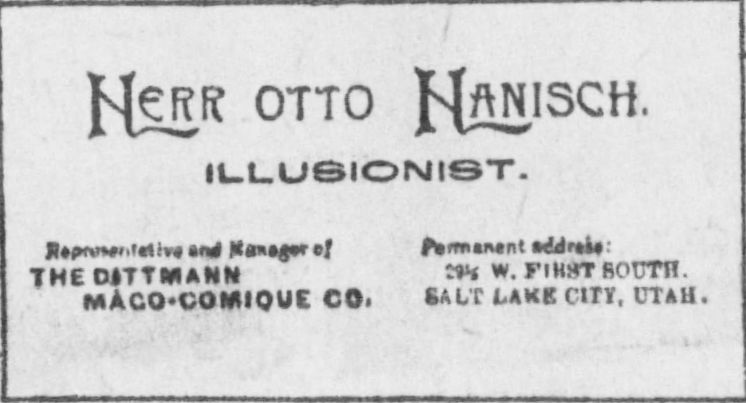
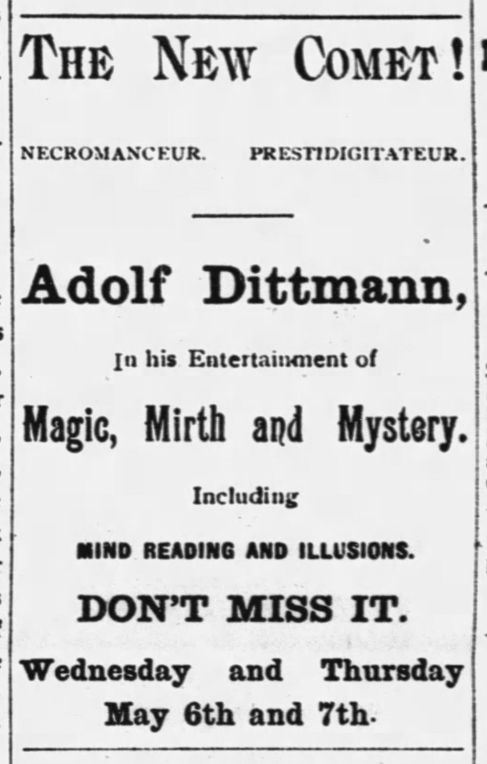
But Otto tired of all this, and in about 1896 he teamed up with a sleight–of–hand performer by the name of Adolph Dittman (7a), forming The Dittman Mago–Comique Company, of which Otto was its “Illusionist – Representative and Manager” (Fig.2a). An early advert for Dittman’s act (note the double n), taken from the Utah newspaper The Ephraim Enterprise (6 May 1896, p.4) is shown in Fig.2b. Otto and Adolf apparently toured Utah, and though the business was not good, they remained together as a team, Dittman later being involved in the Mazdaznan cult, as we shall see. In addition, at some stage a phrenologist called Dirkus became involved, but that seems to have been a short lived association. After phrenology, Otto tried his hand at fortune telling, palmistry, and spiritualism, and in spirit readings he seems to have been quite successful – money–wise. It was at this stage that he realised how easy it was to dupe people, a phenomenon which seems to have amused him greatly, an amusement which no doubt continued in a heightened form when the Mazdaznan Cult took off. But that is later – at the moment we are still in Utah, in 1897–8, at which time a Swami Mohamet Tieber and at least one other unnamed Swami were giving lectures and running study courses there, some of which were eagerly attended by Otto. Following this, he began to read books on oriental wisdom and such like, including health–practices – this marking the start of part of his “mission”. Apparently he opened his own studio, or “parlor” as he called it, running his own ‘courses’, giving ‘consultations’ and providing ‘healing’ by a process called pantopathy – apparently it involved pricking the skin with a needle to release the root cause of the ailment. It was an old Persian method, he claimed. (It wasn’t – it had a German origin.) According to the Salt Lake City newspaper, The Deseret News (14 May 1900, p.8), for which Otto had worked in the past, “Rev. Dr. Otoman Zaralucht–Hanish, sunworshipper, addressed a small audience last night at 59½ W. First South street, on ‘The Principles of Sun Worship According to the Mogdozan Philosophy’.” Apparently his lectures were free, but a collection was made at the end – a pattern he carried forward to the Mazdaznan Cult. (It is interesting that Zachariah became first Zaralucht, then Zar–Adusht, and that Mogdozan became Mazdaznan.) He made some money at this time, but not enough, for in 1900 he moved to Chicago and by the time of the 1900 US Federal Census, Otto Hanisch and the above–mentioned Adolf (sic) Dittman were sharing an address there, Otto listing his occupation as “Teacher of Science” (presumably ‘medical’) and Adolf listing his as “Actor /Magician.”
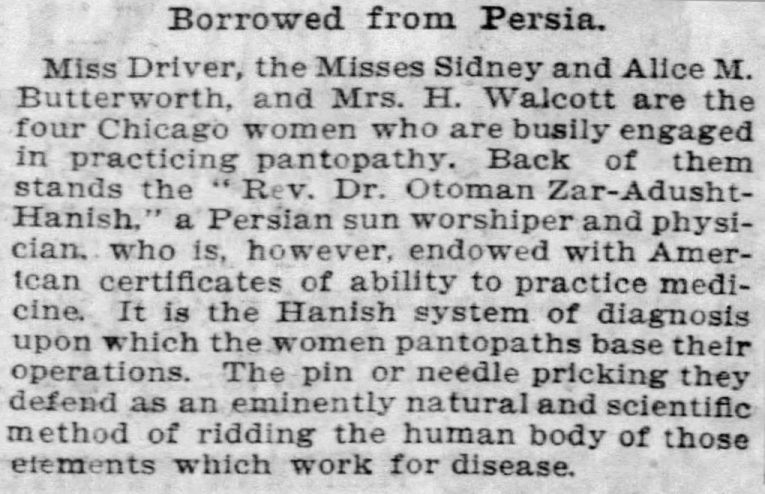
On 2 December 1900 The Chicago Tribune reported that “The Rev. Dr. Otoman Zaradusht–Hanish will preach at 7.30pm: Subject: ‘The Teachings of Zoroaster’” (p.32) and that on 16 December (p.31) he (now billed as “from the Orient”!) would be preaching on “Ancient Baptism.” By 1901 he was attracting attention further afield and featuring in articles about him and his practices. Thus on 17 March 1901, The Cincinnati Enquirer featured an article under the banner headline “Right Breathing the Secret of Long Life” (p.27) billing it as “Professor of a New Faith gives for the Attainment of Health and Happiness Some Unique Rules, Based Upon the Lectures of a Persian Rab–Magi”, adding, “Women in All Public Places, He Declares, Should Cross Right Foot Over the Left, Press Their First Fingers with Thumbs and become Eggs.” (By way of explanation, this last was supposed to offer protection for what we would now call “personal space.”) By the end of 1901 he had launched The Sun Worshipper periodical, its issue being noted by The New York Herald on 31 December (p.6). Adolf Dittman was apparently its printer (7b). By now Otto was promoting himself as “Manthra–Magi of the El–Kharman Temple, Apta–Perest of the Mazdaznan Philosophy, Manthra for the Communion of Universal Friends and Dastur in the Art of Breathing.” (Curiously, one of his other titles was “His Humbleness”!) Finally, Fig.3a, taken from The Chicago Tribune on 27 July 1902 (p.42) serves neatly to demonstrate three things: Hanish’s ‘cures’ by Pantopathy (mentioned earlier) were being practised by his followers – here all women – and under the reassurance that their guru was a qualified medical practitioner. He wasn’t.
A successful guru must have a personal charisma as well as ‘the gift of the gab’, and Hanish certainly had both, not to mention a special attraction for women, this last perhaps reinforced by the pre–Mazdaznan photo shown in Fig.1b.
The first scandal to embroil him concerned one of his followers, Miss Marion H. Berry of Denver, who, according to the Chicago newspaper The Inter Ocean (24 August 1902, p.35), had become “a raving maniac as the result of taking treatment from Hanish.” Miss Berry was a somewhat emaciated consumptive, but Hanish convinced her that he could cure her by a regime of fasting, drinking nothing but flax seed tea, and breathing exercises. After two weeks of this, she went crazy and was taken into custody by the police, almost dead of starvation. When real doctors came to treat her, she called upon the Sun to come and strike them down, so convinced was she that Hanish was bona fide. When the authorities sought to detain Hanish for questioning, he had disappeared, and on enquiring at the Mazdaznan HQ in Chicago, the authorities were met by Mrs Wolcott and the Misses Butterworth, they of Fig.3a, the practitioners of Pantopathy. In the absence of Hanish they claimed that the Master was in no way responsible for Miss Berry’s plight, as they had all been miraculously cured by Hanish’s regimes of fasting, potions and breathing exercises. They also produced a testimonial letter from a lady who had exactly the same illness as Miss Berry, and she was cured by exactly the same regime. It was Miss Berry’s fault – unfortunately she hadn’t followed the regime correctly.
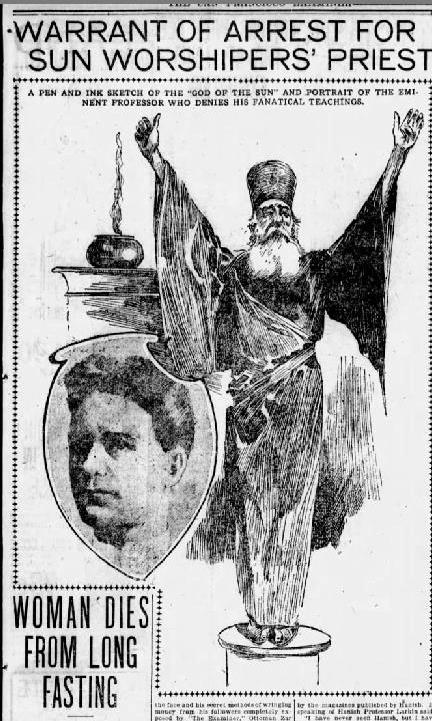
Amazingly, the case of Miss Berry blew over, and Hanish continued to ‘practice’, But then in 1904, history repeated itself. As The Chicago Tribune reported it (7 May 1904, p.7) a Miss Emma Rousse had lost her reason through an application of Hanish’s teachings. Having survived a fast of 40 days, she decided to carry on in the hope of becoming a Master herself, but she lost her reason, and was removed to a detention hospital where she was not expected to survive. “Several unsuccessful attempts were made yesterday by officials of the hospital to induce the Persian to call on his demented disciple,” the newspaper said, but all such attempts received the reply that he had “just gone out.” According to a report in the San Francisco Examiner (11 May 1904, p.3) “a desperate attempt was made by the Mazdaznian Society to get Miss Rousse into a place of hiding after she became insane.” Worse, Miss Reusse’s sister believed that she may have turned over her estate to the Mazdaznam Society – certainly all her jewellery and her valuable library had “mysteriously disappeared.” Worse still, the paper reported on the death of a Mrs Gilbert, another of Hanish’s fasting devotees. Her association with the Mazdaznan Cult had been a source of friction between her and her husband, but just before she died she told her husband that he had been right all along. Mr Gilbert told the Examiner that Hanish had planned to build $5 million Temple in Chicago, in which he was “to live in splendour, rivalling an oriental potentate.” It was to have been financed, Mr Gilbert said, from Mrs Gilbert’s share of the Lund estate of Norway, valued at $16 million. All these indications of financial shenanigans, plus growing concerns that Hanish wasn’t actually a real doctor, led to the issue of a warrant for his arrest. The article came with the headed illustration shown here as Fig.3b. (Marital friction as a result of cult membership, like that of Mr & Mrs Gilbert became an increasing issue, with cases of divorce as a result in some cases.)
But somehow, Hanish escaped justice, either by evading the police, with or without the collaboration of his devotees, or on account of legal arguments. He kept a low profile, using the above–mentioned Adolf Dittman, now his ‘business manager,’ (7c) to stave off as much unwelcome attention as possible. Yet he continued to practice.
Other deaths through fasting and resultant mental imbalance followed: Mrs Dora Greenlee and Benjamin Schiller – unusually, a young man of 18 (Evening Telegraph (Wisonsin) 31 August 1904, p.7.) More horrific was the case of Miss Martha Smith who died as a result of setting fire to herself in a dervish dance “the Persian version of Suttee for maidens.” When interviewed, Hanish simply said that Miss Smith had “misunderstood the basic teachings of the faith.” (Evening Times–Republican, 9 March 1906, p.1.)
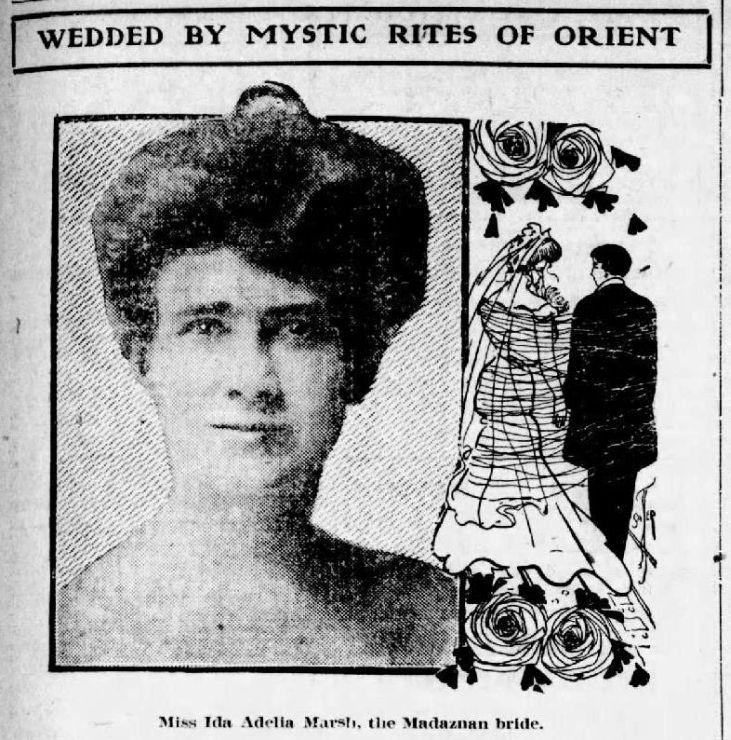
Then there was the issue of Mazdaznan weddings. That between Miss Adella Marsh and Mr Hooper Mallet took place on 19 December 1906, the ceremony being conducted by Hanish himself, of course, amid much ‘oriental’ symbolism involving entwining the bride and groom in symbolic gold and green silk threads. Fig.3c headed a notice of the wedding in The Grand Rapids Press (20 December 1906, p.9.) We shall hear more about Mazdaznan weddings later.
Tongues began to wag even more when a “Kiss of Peace” ceremony was held at the Sun Worshippers’ Convention. As a front–page report in the Delaware Evening Journal put it on 29 June 1908:
Clad in filmy, almost transparent robes of silk, sleeveless and decollette, twelve young women, all members of prominent families, surrounded ‘Dr.’ Otoman Kar (sic) Adusht Hanish, of Chicago, the high priest of the sect, and took part in a spectacular sun worship ceremony. The service concluded by an exchange of the ‘kiss of peace’ Dr. Hanish starting the sacred osculation with the twelve elect at the altar.
Later in 1908, at a probate hearing brought by Mrs Mabel Dutton to prevent her elderly aunt from giving her property to the Mazdaznans, a great deal of damning evidence against Hanish was given, much of it from a surprising source: Mrs Elsie Stein Dittman, “wife of Adolf Dittman, a ranch owner living near Brownsville, Texas” (7d) (The Bangor Daily News (Maine) 14 October 1908, p.1.) Mrs Dittman was actually the wife of our Adolph / Adolf (spellings vary) Dittman, he and Hanish having had a fall–out in 1906 (7e). Reports in different newspapers differ in some details, but the key ones are that Mrs Dittman had known Hanish in Salt Lake City 10 years earlier; that he claimed to be a native of the far east and “a new Christ greater than Jesus of Nazareth”; that she went with him as a follower to Chicago at the opening of his Sun Worshipping Temples, having been given the name Garomanda by him, meaning “Crushed Purity”. But she came to realise it was all fraud and became disillusioned. At the hearing she revealed his real name was Otto Hanisch and he was about 44 years old. Despite his dietetic beliefs, she said, she had seen Hanish and his inner circle eating meat and drinking beer on the quiet; that articles sold at high prices to the faithful as being from the East actually came from 10 cents stores; and that the incense he sold to the faithful had something added to it to “deaden the mind” – he had done a great deal of experimenting with drugs, she said. Plus too many members of the cult paraded around the Temple doing their sun worshipping in a near naked state. As for his claim to be a qualified doctor, the following comes from an account of Mrs Dittman’s testimony given in The Grand Forks Herald (22 October 1908, p.9):
There was an old doctor in Chicago named Dutton, who became interested in Sun Worship. Hanish said one day that the old physician wanted a diploma showing that he was a graduate of the cult, and he was willing to give his doctor’s degree for one.
We made a diploma for Dr. Dutton that was a masterpiece. It was covered with signs of the Zodiac and a jumble of Oriental and English words which pleased him greatly. He turned over his degree for the one we gave him. That is the only degree I know of.
Presumably then, if true, Dr. Dutton’s degree had to be tampered with if Hanish was to pass it off as his own in the face of doubts about his medical qualifications. I say “if true” because in an exposé of Hanish published in the Chicago newspaper The Inter Ocean on 13 March 1912 (p.3) it was revealed that his “medical education” was “secured from the Dutton correspondence school, which was forced by state authorities to quit business.” It is possible then that the con–man Hanish was himself conned by ‘Dr’ Dutton! This same article talks of “Hanish’s quarrel with his manager, Adolph Dittman, who was said to have taken $10,000 and cancelled his contract with Hanish,” adding, “Dittman is now a moving picture promoter in Texas.” (7d)
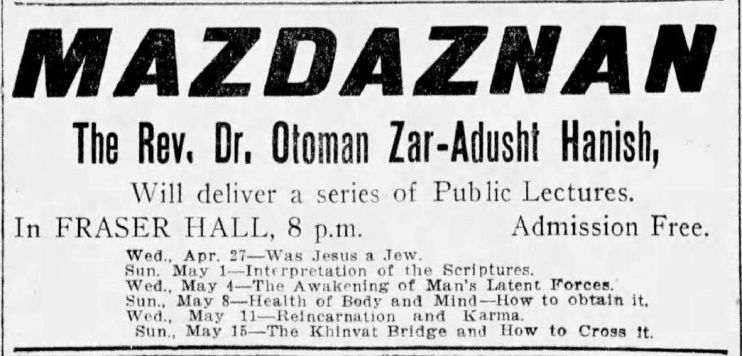
Amazingly such revelations failed to dent the popularity of the Mazdaznan cult, the faithful (many of whom were women from ‘high society’, remember) dismissing such revelations as what is now known as “fake news”. By 1910 he was delivering lectures in Canada – Fig.3d is from The Montreal Star (23 April, p.11) and in 1911 in England – Fig.3e is from The Daily Mirror (26 August, p.16.)
The year 1911 almost saw a serious rift in the Mazdaznan movement. The trouble began at the International Mazdaznan Convention (or so–called Gahanbar) held in Leipsig, Germany in July, at which Hanish had ceremoniously blessed the American flag. According to the Chicago newspaper The Inter Ocean (29 December 1911, p.3) the schism was sparked by an “anarchistic speech” in which he “attempted to renounce his oath of allegiance to the United States and declared he would no longer consider himself an American citizen,” an about–face from his earlier blessing of the flag. Exactly what brought this on is not clear, but “he denounced the entire American government” (not to mention its judicial system!) With the opposition from his American followers, he seemed set to head for Europe, where he already had a considerable following eager to welcome him, leaving those of his American followers who had turned on him to the charge of his deputy, his High Priestess Marie Elizabeth Ruth Hilton. She, incidentally, had led the revolt and written an anti–Hanish pamphlet which I regret I have never seen. The rift seemed to have healed, though. Hanish did not go to Europe and went on to dedicate a reprint of his book Ainyahita in Pearls to her (3).
Then, in January 1912, came the Billy Lindsay case. Billy, aged only 12, was the heir to the large fortune of his late father. His mother, Mrs Elizabeth Lindsay, was a devotee of Hanish, her cult name being Vahdah. Billy’s relatives were rightly worried that the Mazdaznan Cult was no fit place for the boy to be brought up, and took legal action to have him removed from the clutches of ‘Vahdah’ and Hanish (no doubt particularly the latter in view of Billy’s future inheritance.) The family had good cause to be worried: Mrs Lindsay was so under the spell of Hanish that (as she told her sister) she believed he was the reincarnation of Christ, Zarathustra, Moses and Napoleon; that she was a princess; and that her son Billy was the Lost Dauphin of France! (Chicago Tribune, 5 January 1912, p.5.) The case was followed in detail in numerous newspapers, but with the spiriting away of Billy and his mother by the sect, plus legal technicalities (Hanish was as slippery as ever and had wealthy disciples more than willing to fund legal costs), things dragged on. Suffice it to say that it wasn’t until 20 February 1913 that the Supreme Court ruled that Elizabeth Lindsay was, after all, a proper person to have custody of her son, and that Hanish had not tried to indoctrinate the lad! Meanwhile, trouble was brewing on another, but connected, front – Hanish’s book Inner Studies first published by the Sun–Worshipper Publishing Company in 1902.
The book consists of 12 lessons, dealing with a diverse range of life issues, such as the physical and spiritual effects of constipation and piles, DIY colonic irrigation, the danger of corsets, vaginal bathing, menstruation, the benefits of sunlight, and cures for various ailments using herbal or vegetable medicines. There is a delightful one for constipation on p.29 which involves inserting a clove of garlic into the rectum, and another on p.92 for those who suffer from catarrh and lung problems. Basically it consisted of burying yourself, whilst sunbathing in the nude, face down in warm sand, with an umbrella over your head. The last three lessons of the book, though, related to issues of sex – the male organ; self–abuse and lust; the electric and magnetic forces involved in sexual attraction; the determination of the sex of a child by thought transference during intercourse; selective breeding; asceticism and enjoying sex without orgasm, thus transferring the orgasmic energy into spiritual and mental development. Much of this was delivered with suitably high–sounding pseudo–scientific gobbledegook. Sections of Inner Studies were read out in court as evidence that the Mazdaznan Temple was not a suitable place for Billy Lindsay to grow up. Oddly enough it wasn’t the spicier bits that got read out in court, but part of Lesson 11 relating to marital sex, and the problems of husbands losing sexual interest in their wives within months of marriage. According to The Chicago Tribune (7 January 1912, p.7) at this point of the proceedings, “Hanish squirmed uncomfortably and a few more women left the room. Those who remained kept their gaze on the floor.” The book wouldn’t raise an eyebrow these days, of course, but back then it was deemed “obscene”, and since Hanish had been selling it through the post, he had committed a criminal offence.
The result was that this time Hanish was nailed. Though eventually found not guilty of obscenity, he was arrested on a charge of “using interstate commerce to transport books of an indecent character,” being found, after a long search of the Mazdaznan Temple, “wedged in by the side of a coal bin in the basement of the temple,” still dressed in his priestly robes (The Courier (Iowa), 5 March 1912, p.1.) On 16 December 1913 he was finally found guilty and sentenced to 6 months in prison, with a $2500 fine, a considerable sum in those days. He appealed against the sentence, but lost his appeal, and finally went to jail on 8 December 1915. It is significant that by this time Hanish’s wrong–doings were so far beyond the pale that even his own father and his two sisters had testified against him! His father was quoted in one newspaper as saying:
“The stories he tells of Persia and of his having been dedicated to a religious life by the prophets of Zoroaster in the monasteries after having been torn from the claws of death by a miracle are entirely imaginary. Massachusetts is about the nearest he has ever been to Persia.” (The Lima Morning Star and Republican Gazette, 19 May 1912, p.1.)
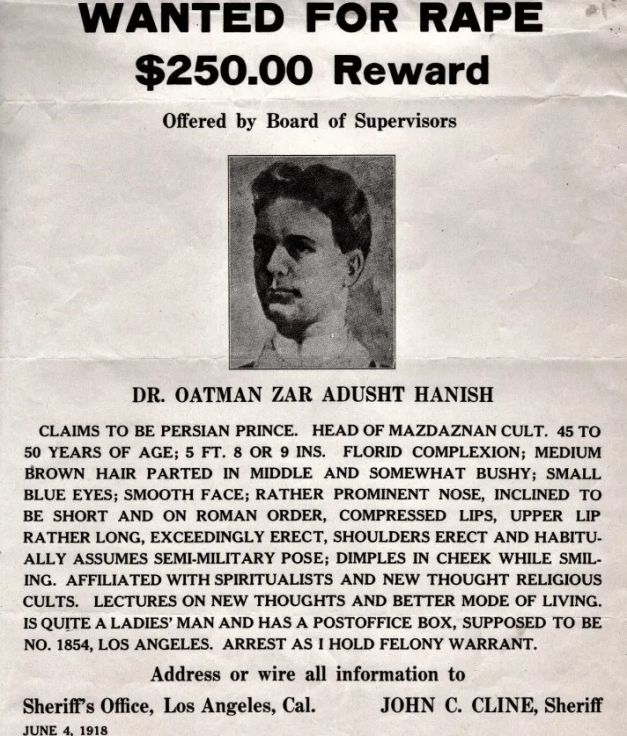
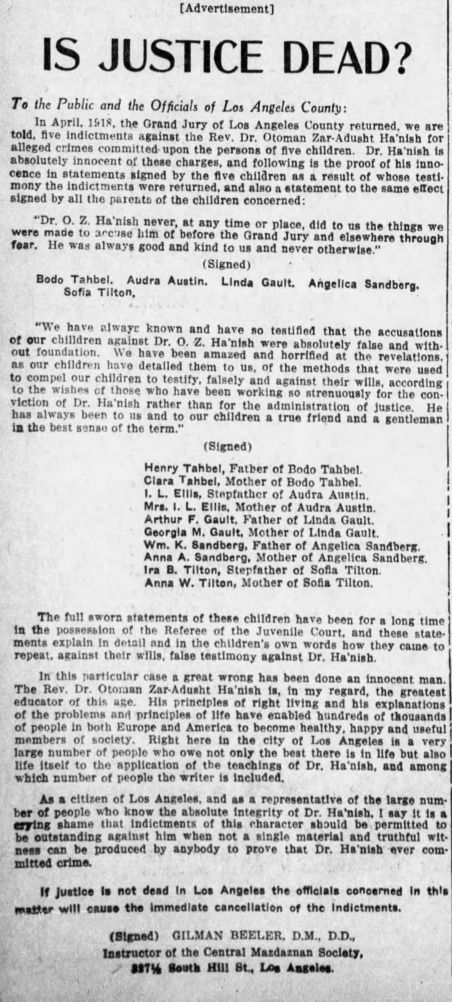
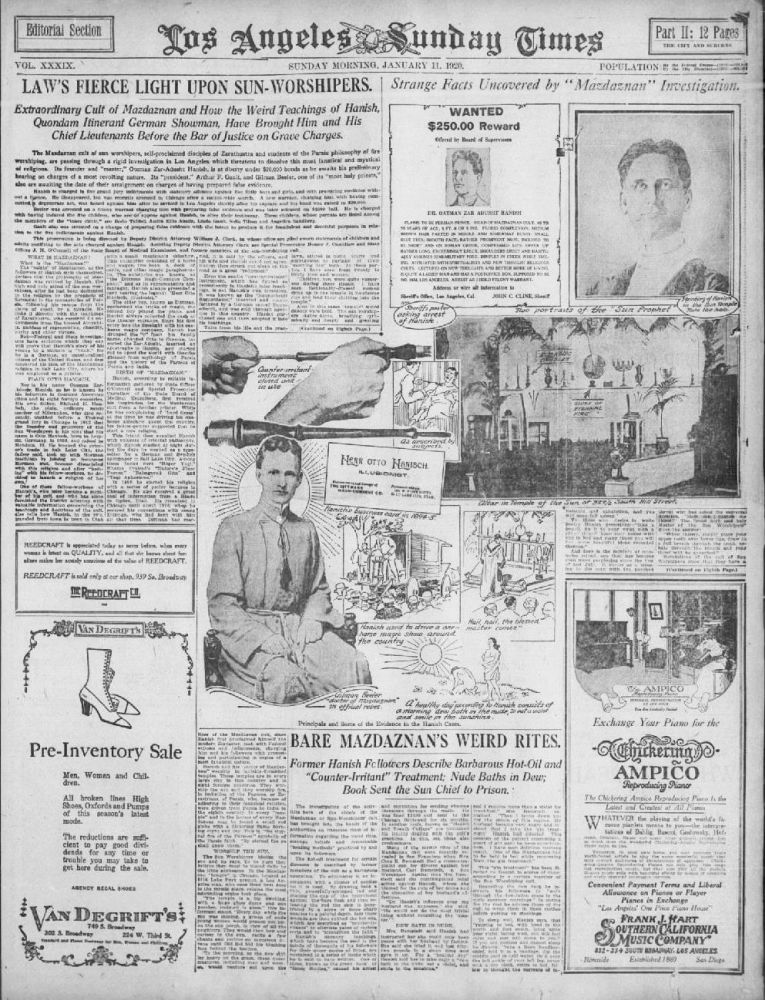
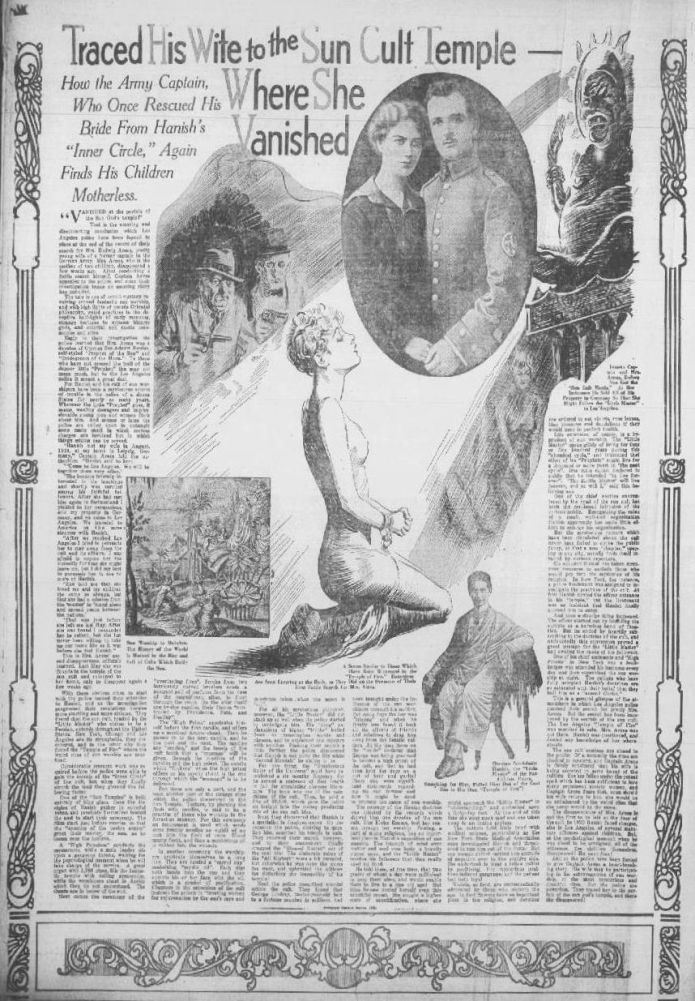
Come 1918, after his release, he was in trouble again – this time for child abuse (discreetly described as “a statutory offence.”) Accusations surfaced in The Los Angeles Times on 26 April 1918 (p.15) and centred mainly on a 13–year old boy named Bodo Tahbel, who confessed that Hanish had taken him to a hotel (other accounts say on more than one occasion), where the offence(s) were committed – the boy referred to “ten assaults of one nature, and eight attacks on another account.” Detectives claimed that at least 16 other boys were involved, the offences taking place in various places, among them Hanish’s home and the Temple of Enlightenment. An arrest warrant was issued, but as usual Hanish was nowhere to be found. Curiously, the warrant was centred more on the specific charge of practicing medicine without a licence, than anything connected with assault or abuse. The day after this report, the same newspaper reported (p.10) that seven young girls, ranging in ages between 5 and 15, were also due to be interviewed. But the problem was that the parents of the children – boys and girls – including the father of Bodo Tahbel – were devout members of the cult for whom Hanish could do no wrong, and they believed that the children had been coerced into giving evidence against the Master. If they didn’t actually secrete the children away from the authorities, they refused permission for them to be interviewed. Only one parent – the mother of one of the girls – stated that she wanted “to ’get’ Hanish at the first opportunity” (Los Angeles Times, 2 May 1918, p.18.) On 1 May 1918 The Los Angeles Times reported further, under the heading, “Fugitive Sun Prophet Believed Hun Worker” (p.21), that the parents of the seven young girls were all German, with German sympathies, and thus anti–American in respect of the War. The legal wranglings, not to mention the elusiveness of Hanish, meant that the child abuse issue hung around. In early June a Wanted Poster was issued for him (Fig.3f), curiously mis–spelling Otoman as Oatman. As late as 30 August 1919 the parents of five of the children placed an advert (Fig.3g) in The Los Angeles Times proclaiming Hanish’s innocence (p.18). By January 1920 the scandal was making a full–page feature in The Los Angeles Times (11 January 1920) by which time he had been arrested, charged with “committing a degenerate act”, as well as practicing medicine without a licence, and released on $20,000 bail. Two of his officers were charged with preparing false evidence. As can be seen (Fig.3h), the paper went to town on exposing Hanish. Incredibly, it wasn’t until 20 April 1920 that Hanish’s trial concluded, and, even more incredibly, that he was cleared of all child abuse charges!
Despite this verdict, it seems clear that Hanish was guilty of what is now known as ‘grooming’ (under the guise of Mazdaznan ‘training’), particularly of teenage boys – Bodo Tahbel was just the latest of a string of them, dating back to at least 1911. I say “at least” because that is when examples began to surface in the newspapers as detectives and reporters pursued the Billy Lindsay case. One of the first to attract attention was a boy of 17 named Maurice Clements, whose ‘official’ post seems to have been a door keeper at the Sun Temple. (His sister had a rather more grand position, being Commander Obedient of the High Wing of the Terrestrial Court of Women.) Be that as it may, the humble door keeper had accompanied The Master on his journey to the above–mentioned 1911 Mazdaznan Convention in Germany, sharing the same suite of rooms on the ship as well as in various hotels in Europe (The Inter Ocean, 31 December 1911, p.3 & 1 January 1912, p.8.) Add to that, that on his passport application for this 1911 trip, he names Maurice Clements Hanish as his adopted son. Further revelations featured in The Inter Ocean on 8 January 1912 (p.3) when three other boys were named (with others mentioned but unnamed), among them Max Clark. It may be just coincidence that in the 1910 census a Max M. Hanish, age 20, was listed as Hanish’s “adopted son.” It all gets rather murky and its murkiness continued. In 1924, Hanish sought to adopt a 16 year old boy, Ulrich Fieberger, the son of Frederick and Antonia Fieberger of Silesia, coincidentally (?) the country of birth of Hanish’s own mother. The legal authorities were alerted, and moves made to block the adoption in view of Hanish’s past record. It is not clear why Ulrich’s adoption was blocked, whereas Hanish’s adoption of Emanuel Bachman a year earlier had gone ahead unopposed, but that was what happened. (Los Angeles Times 13 November 1924, p.17.) Nothing further is heard of Ulrich Fieberger after another court hearing in which Emanuel Bachman testified that “conditions in the Hanish home are ideal.” (Los Angeles Evening Express, 27 November 1924, p.21.)
Meanwhile, in 1919 yet more adverse publicity came to Hanish as a result of Mr.Carl Hemstedt suing his wife for divorce on the grounds that she had refused to become a Saint in the Mazdaznan Order. According to The Buffalo Times (5 January 1919, p.16), she had been a follower of Hanish, but had lost faith in him when she heard him refer to his followers as “suckers.” She was alarmed by the amounts of money Hanish induced his followers to give him, charging her husband $5 for every bit of advice. She said he paid Hanish $20 for a wedding feast on the eve of their marriage. “The ‘feast’ ...consisted of four artichokes, two pieces of brown bread and a cup of chocolate.” Since he had left her, Mrs Hemstedt added, her husband had taken up residence with two Mazdaznan Saints – Gretchen and Hortense – and he now referred to her as “an earthly hound.”
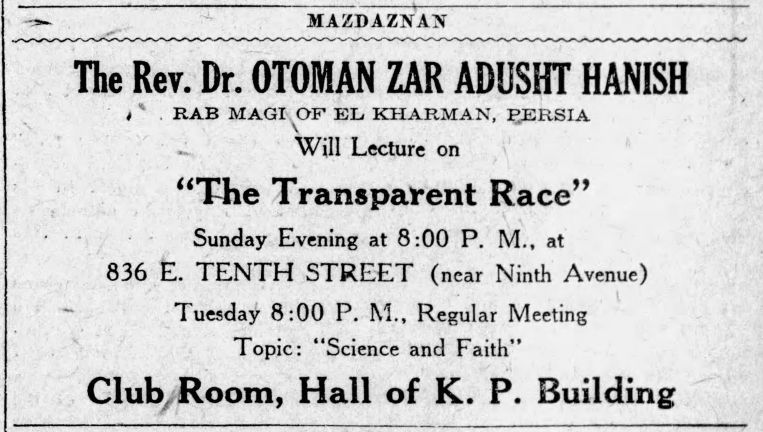
The year 1920 became that of Mazdaznan weddings arranged by séance, and it related to Hanish’s plans for the creation of a spiritually superior race by selective breeding – he called it “the Transparent Race.” The plan has a complex history going back to 1918, at which point plans had to be postponed on account of legal interference (nothing new there, then!), but the plan was resumed in 1920, under the auspices of Mother Maria, “the reincarnation of the goddess Ainyahita ... mother of the Aryan Race.” Twelve young couples were to be married by Mother Maria (aka the above–mentioned Marie Elizabeth Ruth Hilton (3)), and they were to be the pioneers of the Transparent Race. As one of the young women involved told a reporter later:
The selection of the twelve young couples was made at séances conducted by Mother Maria her home here. The young people would gather around a table holding hands. A dim blue light was always burning above the table, giving the room a moonlight effect, and on the wall hung a painting by Ainyahita, the so–called ‘Mother of the White Race’, scantily clad. After sitting in silence for a few minutes we would sing in chorus various hymns of the cult. Then Mother Maria would stop the singing abruptly and would select one girl in the group and advise her that only a certain man would make her happy and it was the desire of the Master that she marry him. (Los Angeles Times 18 April 1920, p.19.)
Before the ceremony they were told not to tell their parents about it and after the ceremony they were told that if they didn’t comply with Mother Maria’s choice, the Master would never want to see them again, and they would lose his blessing – not to comply would be seen as selfishness! “Most of the marriages turned out to be failures,” the informant continued, “as one of the conditions of marriage was that they were to live as brother and sister for two years, during which time they could find out whether or not they would be harmonious.” Each wedding cost $50, and – presumably to avoid further brushes with the law – each cult marriage was always followed by a civil marriage ceremony.
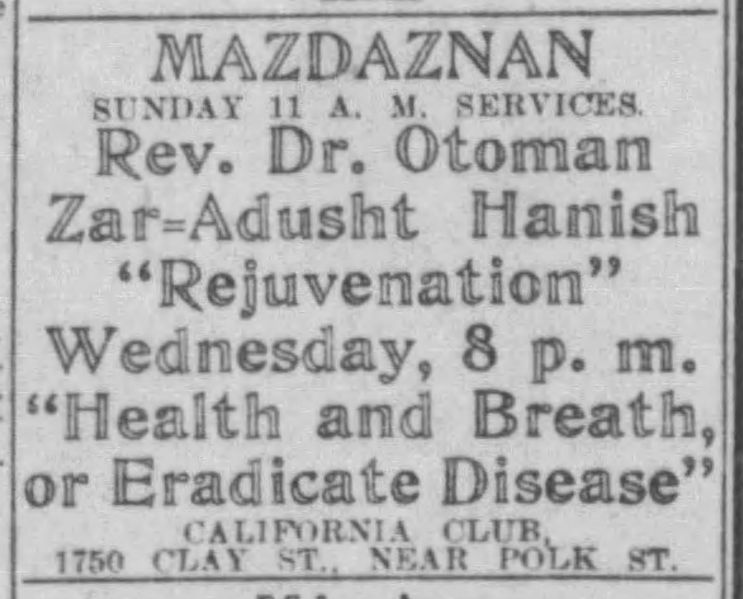
In the midst of all the troubles, Hanish continued to preach and give lectures. Fig.3i is an advert for a lecture on Hanish’s above–mentioned plans to create “The Transparent Race”, taken from The Oakland Post Enquirer (23 September 1922, p.17.) Fig.3j is an advert for Hanish’s lectures on “Rejuvenation” and “Health and Breath, or Eradicate Disease” taken from The San Francisco Examiner (25 March 1923, p.81.)
In the summer of 1925, plans were afoot for Hanish to go to London and lecture to the Mazdaznan Society there. The Daily Chronicle sent a reporter to interview Lieut. Col. Arthur F. Gault, Chief Mazdaznan of the British Empire, and, incidentally, one of the officers accused of preparing false evidence in the child abuse case. The result was an article in the issue of 27 March 1925 (p.9) which by and large trotted out the usual fare on Mazdaznan practices and beliefs, but this being the year after the publication of Hanish’s Omar Khayyam, it carried a couple of interesting extras. Under the sub–heading “Belief in Omar”, the article read:
“We believe in Omar,” continued the colonel, “Not Omar the sensualist but Omar the spiritual. He was wrongly translated until Dr. Hanish undertook a translation. Even FitzGerald himself agreed that nine–tenths of his translation was faulty.”
I gathered that Omar is often quoted at the meetings and that anyone was allowed to conduct the gatherings at the temple. The colonel himself officiates at times.
The reporter was also shown a copy of The British Mazdaznan Magazine in which there was a poem to Omar, the first verse of which ran thus:
Great Prophet, Teacher, Sage,Thy wisdom, truth and love,For all mankind and age, Fills earth and heights above.
Unfortunately, Hanish’s reputation had preceded him, and on 16 May 1925 John Bull launched a scathing attack on him and “his religion of gold–gilt and mumbo jumbo” (p.15), exposing his dodgy history & real identity, proving him to be “beyond doubt, a charlatan,” and calling for a ban on his coming to England. In the end his visit didn’t take place, ostensibly for financial reasons (John Bull, 10 October 1925, p.11.)
In 1928 came the Arens case. A Los Angeles merchant and former German army officer, Louis H. Arens, brought a $250,000 alienation suit against Hanish on the grounds that his wife, Hedwig, had been alienated from him by her membership of the Mazdaznan Cult. This, accompanied by some lurid details from Hanish’s past made for a full–page spread in some papers – Fig.3k is from the Virginia Portsmouth Star (30 December 1928, p.20.) Unfortunately, Arens failed to win his case.
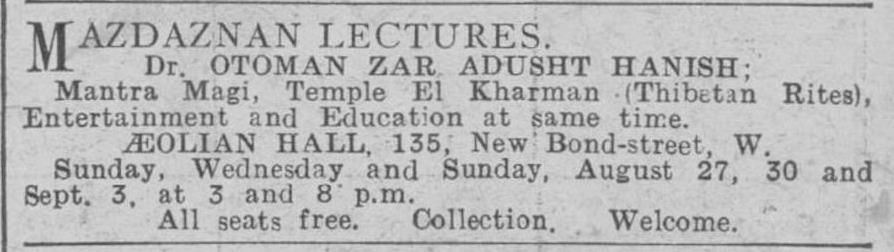
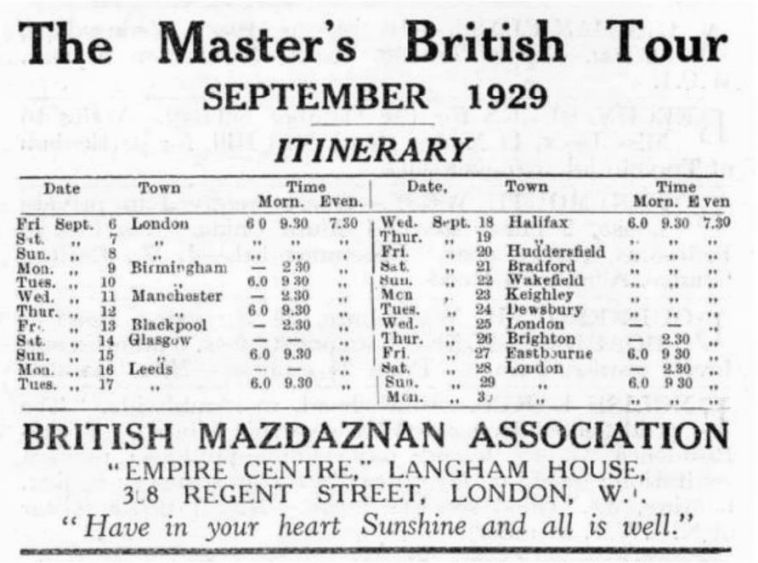
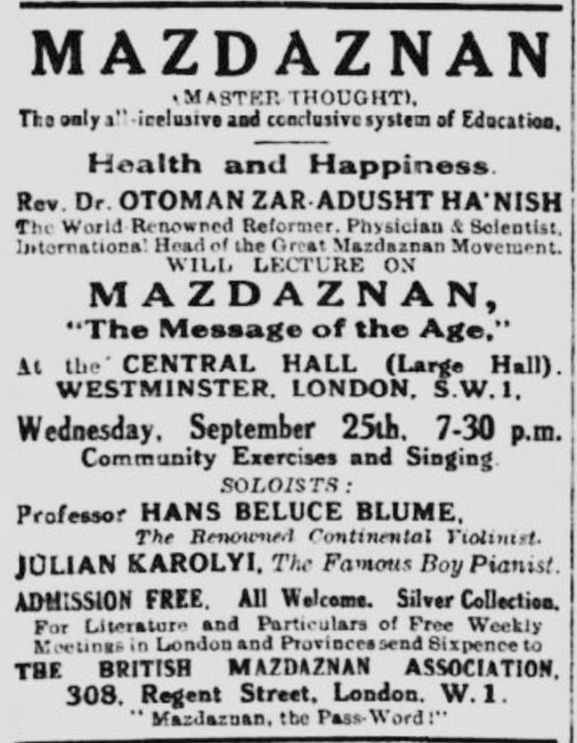
Though Hanish did not make it to England in 1925, he did do a lecture tour here in 1929, its schedule being shown in Fig.3l. The tour did not go without its problems, though, for the lecture advertised to take place at the Westminster Hall in London on 25 September – an advert for it is shown in Fig.3m – was forced to cancel. The story was covered by The Daily Chronicle (19 September 1929, p.3 & p.4) under the heading “London Ban on the ‘Persian Prince’.” The problem was that the venue was the great Wesleyan Methodist meeting place in London, and when the Wesleyan authorities got wind of what the Mazdaznan Cult was all about, they declared that it was all contrary to Wesleyan principles. The lecture was cancelled and all posters and hand bills inside and outside the hall were removed.
The Chronicle went on to describe some rather curious Mazdaznan bathing rituals and rhythmic breathing exercises which could only be properly conducted by buying the correct, and rather expensive, oils and ointments from the Mazdaznans. The newspaper added that if readers wanted to know more, they could write to Dr. Hanish himself, but warning that “letters are not answered unless accompanied by five dollars and self–addressed and stamped envelopes.” As for Hanish’s tales of being a Persian Prince, the paper reported that his own father had dismissed such claims as “tommy rot.” The newspaper did seek to interview the Master to allow him to clarify things, but he refused to be interviewed.
The day before the above–mentioned article, on 18 September 1929, the same newspaper, under the heading “The ‘Persian Prince’ and Royal Family” (p.3 & p.4) gave the details of an extraordinary circular, in the form of a bright yellow leaflet, issued by the British Mazdaznan Association to accompany his British lecture tour, which stated that “Her Majesty Queen Victoria was so impressed with Dr. Ha’nish’s teachings that a Mazdaznan tutor was engaged for the Royal Family.” There was, of course, no record of this, and no–one who had been in intimate touch with the Court circle of that day was still alive to ask. However, the reporter who wrote this article did visit Mazdaznan HQ in London, and asked an official there if she knew anything about Hanish’s connection with the Royal Family. “No,” she replied, “but I know it is a fact.”
The leaflet repeated the usual story of his Royal birth in Persia in 1844, adding:
He has gone through three wars, experienced many shipwrecks, terrible floods, conflagrations and epidemics; he has crossed burning deserts, walked 1800 miles in a stretch, and reclaimed vast wastes of land and waterways for habitation.
In addition, the leaflet claimed that Hanish had designed 2500 different types of homes and buildings; engineered railways, bridges and roadways; been behind many great inventions; discovered gold, silver and copper mines, and oilfields; written works on nature, music, and regenerative subjects; and saved the lives of thousands through medicine and hygiene. Finally, he was the inaugurator of the League of Nations idea, and was responsible for interesting President Wilson and European statesmen in it.
It is a pity that no example of the Yellow Leaflet seems to have survived, for it would surely be the pinnacle of human gullibility (or at least, one of them.)
Incidentally, as regards those great inventions behind which Hanish was the real driving force, The Salt Lake Herald (1 February 1920, p.19) provides some details – and more:
Many great projects are credited to the fertile mind of the ‘master’ by his loyal followers. They say he is responsible for giving Ford the idea for a cheap automobile, Edison his idea for electricity, and Marconi his idea for the wireless. Indeed the war was ended by none other than this single and solitary ‘master of the sun cult’ – he will tell you so himself. Otto repeats often that he dispatched a delegation of his saints to France when the orgy showed signs of being prolonged and soon afterward the armistice was signed, because of the dealings of these ‘saints’.
For those experiencing at this point a flash–back to the closing scene of the 1979 film “Being There”, you are not alone.
It only remains to say that though the Mazdaznan movement continued after 1930, Hanish and his cult rather dropped out of the newspapers, and even his death, on 29 February 1936, went largely unnoticed. It is ironic that, in an interview in The New York Herald on 31 January 1904 (p.23), he had claimed that by following Mazdaznan regimes of diet and breathing one could live to be 475 years old, for, as his death certificate indicates, he died of diabetes and pneumonia. If born in 1866, then he died aged only 69 – not quite the traditional Biblical quota of three score years and ten!
[The illustrations can be browsed here.]
In researching Hanish’s career I have been constantly amazed at his effrontery and the gullibility of his followers. It staggers belief that he could have got away with so much for so long, particularly since so many of his followers died as a result of his teachings. It is also incredible that when accused of child abuse, the parents of the children involved would believe the ‘Master’ rather than their own children, or believe the abuse to be ‘training’! Again, it is difficult to believe that when, in later years, his followers were questioned about the scandals surrounding Hanish, they could make excuses for him and claim the ‘offences’ to be the result of a conspiracy against their guru – fake news! In their view, Hanish had been unjustly condemned, as Christ had been before him.
I must also add that along the way I became rather intrigued by Adolf Dittman, who surely merits more than just a footnote to Hanish. It would be good to know more about his life as a travelling magician & illusionist; more about his split with Hanish in 1906; and more about his life as a cinema owner and film–maker. It would likewise be interesting to know more about Marie Elizabeth Ruth Hilton, the High Priestess of the Cult & cult marriage ‘fixer’ (8), and other members of Hanish’s Inner Circle.
Finally, charlatan though he was, it is interesting that he managed to write his Omar Khayyam, his Ainyahita in Pearls and his Yehoshua Nazir, not to mention his Inner Studies, his Mazdaznan Dietetics and Cookery Book, and his books on Mazdaznan Health and Breath Culture and Egyptian Postures. Heavily larded with gobbledegook disguised as wisdom & science, and with fact and fiction mixed willy nilly, they still took some writing.
Though Hanish was a charlatan, and a money–grabbing and controlling one at that, I do find myself wondering what made him what he was, and, equally, what made some of his devotees what they were, because so much of their story beggars belief.
Of Hanish, his father said in an interview quoted in The Lima Morning Star and Republican Gazette (19 May 1912, p.1) that his son had severed all connections with his family some 20 years earlier. It is also an interesting fact that Hanish’s older brother was a clergyman, the respected Rev. Richard David Hanisch. He stayed well away from the hullabaloo surrounding the ‘Master’, though one wonders what tongues must have wagged in his congregation.
Of Hanish’s devotees, one of the key facts is that so many were wealthy women. As an article in the Meriden, Connecticut newspaper The Journal (30 September 1907, p.2) put it:
Sun worshipping appeals particularly to middle aged society women, the leaders of the cult say because they are told that devout attention to the doctrine of the society will make them look thirty years younger and add that much to their span of life.
I leave readers to make of that what they will.
Note 1: This, of course, is partly based on the famous opening verse of FitzGerald’s first version. Korshed is presumably intended as a reference to the Sun as “Khosrau like” or as the “Kai Khosru of the day” – for the former, see E.H.Whinfield’s translation, verse 233 (1883 edition), and for the latter, see Edward Heron–Allen’s Edward FitzGerald’s Rubaiyat of Omar Khayyam with their Original Persian Sources (1899), p.3. Ha’nish certainly knew of Whinfield’s and Heron–Allen’s translations (Introduction p.ii.)
Note 2: Nathan Haskell Dole, Omar the Tentmaker (1899); Haldane Macfall, The Three Students (1926); Harold Lamb, Omar Khayyam (1936); and Manuel Komroff, The Life, The Loves, The Adventures of Omar Khayyam (1957). In Dole, the romantic element is supplied by the Greek girl Agape; in Macfall, by the inn–keeper’s daughter Leela; in Lamb, by the book–seller’s daughter, Yasmi; and in Komroff by Sharain, the daughter of Imam Mowaffak (cf. Hanish). Judging by publication dates, it is possible that Komroff took his lead from Hanish, though their love–plots are different. Presumably, at its root, all this represents a natural urge to put a name to the Beloved with whom Omar shared his loaf of bread, his flask of wine, and his book of verse, “beneath the Bough.” Quite how much reality there is behind the details in any of these stories, though, is quite another matter. Hazhir Teimourian, in his book Omar Khayyam – Poet, Rebel, Astronomer (2007), tentatively suggests that Omar did marry, that he died before his wife did, and that by her he had at least two sons and one daughter (p.122–3 & p.161), so Hanish’s account may not be totally fanciful, though it should clearly be taken with a grain of salt, and almost certainly classed with the accounts by Dole, Macfall, Lamb and Kamroff as a novel.
Note 3: The book version of Ainyahita arose from ‘fragments’ published in The Mazdaznan in 1907, 1908 & 1909, and which turned out to be popular among the faithful. Hanish possibly derived the name Ainyahita from the Persian goddess Anahita, often invoked alongside Mithra and Ahura Mazda, and who dutifully appear in the book. The 9000 years was not in the first edition, but appeared in a new edition, in its dedication to “To the Memory of Mother Maria [Elizabeth Rose Ruth Hilton]”, who had served the cult for 40 years. She died in 1942, so the new edition must post–date that.
Note 4: For the additions, Hanish’s sources were most likely Nicolas Notovich, The Unknown Life of Jesus Christ (New York, 1894) and Mirza Ghulam Ahmad, Jesus in India, which had been serialised in The Review of Religions in 1902–1903, and received mentions in the international press in association with his claims that he was the True Messiah, not Christ. See for example The Hull Evening News (19 March 1903, p.4) & The New York Herald (30 March 1903, p.4.) He may also have drawn on Levi H. Dowling, The Aquarian Gospel of Jesus the Christ (Los Angeles, 1911.)
Note 5a: Details can be found in an account of the life of Hanish published in the Mazdaznan Magazine in 1944 to mark the centenary of the birth of ‘The Master’, but details can also be found in various newspaper reports and interviews, for example: the Leavenworth, Kansas, newspaper The Chronicle–Tribune (10 December 1901, p.7) and The New York Herald (31 January 1904. p.23).
Note 5b: An early exposé featured in Upton Sinclair’s book The Profits of Religion (1918), in Book 6, “The Church of the Quacks”. Later and more detailed was Louis Adamic’s two–part article “Ottoman Zar–Adusht Ha’nish, America’s Master Charlatan” in the Haldeman–Julius Monthly, June 1926 (p.109–120) and July 1926 p.60–72. Exposés featured in various newspapers, of course, as the scandals unfolded, key examples being noted in the body of the article.
Note 6: On a passport application dated 1911, Otto Z. Hanish gave his place of birth as Stuhm, Prussia and his date of birth as 17 December 1866. This is consistent with the record of his Confirmation in Rochester, New York, in 1884, where he is Otto Hanisch and where his age is given as 17. But in the 1900 US Federal Census, as Otto Hanish, he gave his date of birth as February 1868 and in the 1910 US Federal Census, as Otoman Hanish, he gave his age as 65, consistent with his fictional birth in Persia in 1844. In the 1930 census, Otto Hanish gave his age as 74, which would imply his birth in 1856, and this is consistent with the record of his death in 1936, which gives his name as Otoman Hanish and age at death as 81, the age given in his obituary in the Los Angeles Evening Citizen News (2 March 1936, p.7). His actual death certificate, though, in the name of Otoman Z. Hanish, gives his date of birth as 19 December 1854 and his age at death as 81 years 2 months 10 days. The Wikipedia page on Otoman Hanish gives his date of birth as 19 December 1856 on the basis of the baptismal certificate they cite for him, but this is for Ernst Otto Haenisch, whose parents were named Heinrich Ernst and Anna Dorothea – not our Otoman / Otto Hanish, then. On balance, since the Confirmation record would presumably have been set up by his parents, the age of 17 in 1884 would suggest that 1866 is probably correct, that year also being cited by Adamic in his article (note 5b above.)
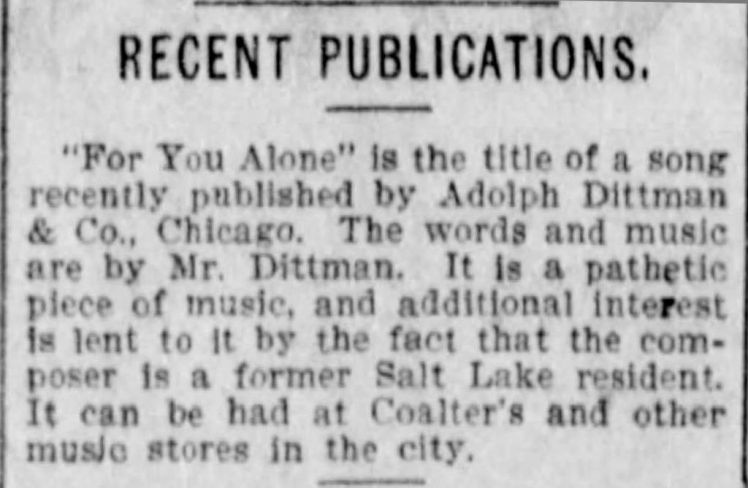
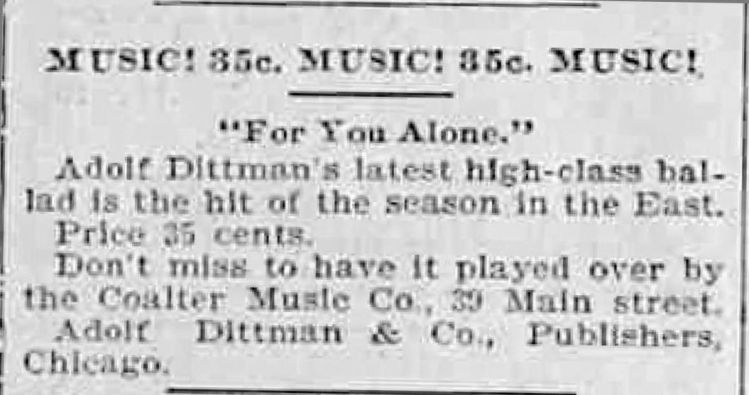
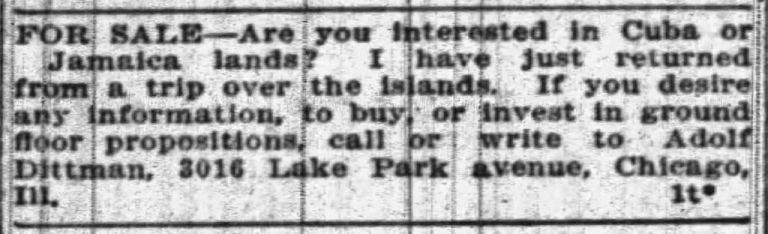
Note 7a: Adolf Dittman is difficult to trace through newspaper articles, partly because he was sometimes Adolph and sometimes Dittmann, but also because Adolf Dittman, give or take variants, is a surprisingly common name – in searching for him I came across a dentist, a farmer, a brewer, and a general labourer with the same name. Having noted that our Adolf Dittman was certainly a magician, I found it difficult to believe that he was the Chicago song writer and music publisher mentioned in Fig.2c (The Deseret News, 11 March 1901, p.4) and Fig.2d (The Salt Lake Tribune, 24 March 1901, p.14). But his publishing activities detailed in note 7b below, and the connection with Salt Lake City confirm it. Likewise the advert in Fig.2e (South Bend Tribune, 23 December 1905, p.15) might suggest another Adolf Dittman, a property developer, were the address given not that of the Mazdaznan Temple in Chicago!
Note 7b: The Deseret News, 2 January 1902, p.4; in the Cleveland, Ohio newspaper The Plain Dealer on 12 June 1904, p.1, Adolf Dittman is named as “manager of the publishing company which puts out the Mazdaznan literature.”
Note 7c: The Minneapolis Daily Times 17 April 1904, p.16, has him as “Secretary Adolph Ditman (sic), who manages the Mazdaznan college of health”; The Post–Bulletin of Rochester, Minnesota, 28 May 1904, p.1 has him as “his manager” fending off Hanish’s unwelcome accusers; The Florida Times Union on 13 June 1905, p.5, has him, as “Adolf Dittmann, the business manager of the Mazdaznan Temple Association and private secretary to Rev. Dr. Otoman Zar–Adusht Hanish,” scouting for land for a new Mazdaznan colony (not founded in the end.)
Note 7d: The ranch is a bit of a puzzle, but by 1908 Dittman was certainly managing a cinema, the Electric Theater, in Brownsville, Texas (The Brownsville Herald, 15 April 1908, p.3) and by September of the following year was its proprietor (The Brownsville Herald, 28 September 1909, p.1). The same newspaper, on 30 April 1944 (p.11 & p.15) tells us that Dittmann (note the double n again) came to Brownsville in 1907 and started his Electric Theater (now demolished) there the following year. The article gives a fascinating account of Dittman’s career both in running an early cinema, showing silent films then sound pictures when they came along, and subsequently in making his own films, notably newsreels of the Mexican revolutions along the Rio Grande. Adolf Dittman is relatively easy to trace through ancestry records. He was born in Berlin in 1877 and came to America with his family in 1885. His career with Hanish is documented above, and having moved to Brownsville in 1907, Federal Census records show that he lived there for the rest of his life, dying there in 1965. His obituary in The Brownsville Herald (29 November 1965, p.1) tells us that he retired from the movie business in 1922, that he opened the Lakeside Trailer Park in 1928, and that he ran it until his death. The obituary makes no mention of Otoman Zar Adusht Hanish – some things are best forgotten, as they say.
Note 7e: The Los Angeles Times on 11 January 1920, p.17, in detailing Hanish’s career, said: “He remained in Chicago till about 1906, when he severed his connections with young Dittman, who had been with him all that time. Dittman had married, it is said by the officers, and his wife and Hanish could not agree.” As regards Dittman’s wife, Mrs Elsie Stein Dittman, if their marriage was a Mazdaznan ceremony, it was presumably not one recognised in law, for, with no indication of her death or their divorce, in 1917, in Brownsville, Texas, he married Miss Iva Kouns, by whom he went on to have three children. Iva died in 1959.
Note 8: By way of some basics: She was born Mary Elizabeth Ruth in 1859; became Mary Elizabeth Ruth Brubaker on her first marriage to Henry J. Brubaker, in 1878; and Mary Elizabeth Ruth Hilton on her second marriage, to Dr. George Whitfield Hilton, in 1901. He appears to have made his fortune from peddling his patent medicine, “Dr. Hilton’s Specific No.3”, said to cure colds and prevent pneumonia by bringing the organs of the body into harmonious vibrations. He and his wife paid to set up the Mazdaznan Temple of Spenta Maria in Lowell, Massachusetts in 1907, and by 1911 he had become Ambassador Eminent of the Universelle of the Celestial Twelve. She, of course, became Hanish’s second in command, and as such was said by the faithful to be in constant telepathic communication with him. She was also believed to be the reincarnation of a prophetess. She died in Los Angeles in 1942; her husband died in Lowell, Massachusetts, in 1915.
My thanks are due to Marc Demarest and John Buescher of the International Association for the Preservation of Spiritualist and Occult Periodicals (IAPSOP) for the use of their background research on Hanisch, and in particular the family tree compiled by Marc.
**********
To return to the Notes and Queries Index, click here.
To return to the Index of the Rubaiyat Archive, click here.