It is as well at the outset to address the issue of whether or not Omar Khayyam was a Sufi mystic whose verses are to be interpreted symbolically, not literally. In other words, when Omar talks of drinking Wine does he really mean drinking the Juice of the Grape, or does he use the drinking of wine as a symbol of achieving the divine intoxication of a revelation from God ? Are the Taverns in his verses really taverns, or are they symbolic of the psychic state in which one achieves communion with God ? Are the cups he drinks from physical ones, or are they symbolic of the means to achieve that communion with God ? And is the Beloved that features here and there in his verses a woman of flesh and blood, or is ‘she’ actually symbolic of God ?
My own view is that of FitzGerald himself, as expressed as early as the introduction to his first edition of 1859, and in more detail from his second edition onwards (following the publication of the Sufic Les Quatrains de Khéyam by J.B.Nicolas in 1867): namely, that Omar was no Sufi:
“...his Worldly Pleasures are what they profess to be without any Pretence at divine Allegory; his Wine is the veritable Juice of the Grape; his Tavern, where it was to be had; his Saki, the Flesh and Blood that poured it out for him; all which, and where the Roses were in Bloom, was all he profess’d to want of this World or to expect of Paradise.” (First Edition.)
Indeed, as FitzGerald says earlier in his introduction, Omar “is said to have been especially hated and dreaded by the Sufis, whose Practice he ridiculed.” The title of this essay, “a Sufi pipkin waxing hot,” is a phrase used in quatrain 87 of his third and fourth versions, though this phrase may well be one of FitzGerald’s own devising, expressing his personal view, rather than having been taken from any Persian original of Omar’s.
One problem is that the verses of the original Omar (1) have been mixed in with those of his imitators, some of whom may well have been Sufis who used Omarian imagery to their own symbolic ends. Some verses certainly do admit of a Sufic interpretation. But to go from a possible Sufic ‘contamination’ of Omar’s original verses to the view that everything in the original Omar is necessarily Sufic is, in my opinion, unjustified. By way of a rough statistical demonstration, let us look at the Bodleian Manuscript, the oldest known manuscript of The Rubaiyat, dating from about 330 years after Omar’s death. As the oldest, it is likely to contain comparatively less additions by later hands among its 158 verses than later manuscripts, and thus provide a better picture of the true Omar. Now, in Heron Allen’s facsimile, transcript and translation of the Bodleian Manuscript’s 158 verses, at least 50 are irreligious if not blasphemous, with real wine as an adjunct to a carpe diem outlook, and so hardly indicative of Sufism. The vast majority of the remaining verses are ‘neutral’ in that they are amenable to Sufic as well as non–Sufic interpretation, and to my mind only one (verse 86) is seemingly inconsistent with FitzGerald’s Omar. This is not conclusive proof that Omar wasn’t a Sufi, of course, but it is certainly supportive of that view.
Nevertheless, there have been many who have firmly believed that Omar was a Sufi, and this essay takes a closer look at some of them.
Carl Henrik Andreas Bjerregaard (Carl Henry Andrew) was born in Denmark in 1845, graduated from the University of Copenhagen in 1863 and from the Military Academy of Denmark in 1866. After a brief spell at the Danish Legation in St. Petersburg, he emigrated to America in 1873. In 1879 he obtained a post at the Astor Library in New York (eventually it became part of the New York Public Library) and subsequently became chief of the reading room at the NYPL, a post he occupied for over 40 years.
Outside the library he occupied himself with lecturing on and writing about mysticism, the “inner life”, and various Oriental religions and beliefs, notably Sufism, which he hoped to promote in the West. Presumably toward this end, in December 1913 he, together with a group of Brahmins, Buddhists, Confucians, Moslems and Christians, helped set up the Daily Temple in New York, “a Temple for All Creeds.” (It appears to have run until at least 1917.) Though apparently not a prominent member of the American Theosophical Society in New York, he nevertheless delivered a number of lectures to them between about 1909 and 1913. These were regularly announced in The New York Times, and among the usual metaphysical fare was this intriguing one, “The Most Ancient Portraits of Jesus, with Photographic Illustrations” (18 December 1909, p.17.) Unfortunately the text of this lecture seems not to have survived.
At the age of 70, after retiring from lecturing and writing, and to stimulate his mind, he took up drawing and painting, these apparently all being done from memory or imagination, some taking shape ‘automatically’, many of them based on his dreams, and some, he thought, based on vague memories of past lives. An exhibition of these was staged at the Hotel Majestic in Manhattan in late 1920 and there was apparently an exhibition catalogue, though I regret I have never seen it, or indeed seen any of his paintings or drawings. In 1920, too, he was awarded a knighthood of the Danish Order of Dannebrog. He died in New York in 1922 (2).
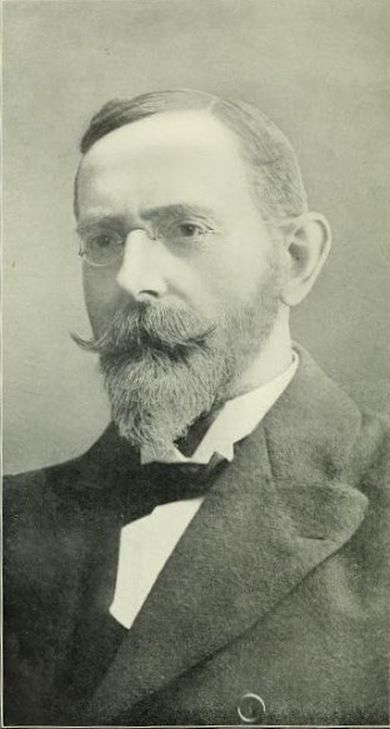
Bjerregaard wrote two books on Omar as a Sufi, Sufi Interpretations of the Quatrains of Omar Khayyam and FitzGerald (J. F. Taylor & Co., New York, 1902) and Sufism: Omar Khayyam and E. FitzGerald (The Sufi Publishing Society Ltd., London, 1915) (3a), both using FitzGerald’s fourth version. He regarded the latter as an improved and expanded version of the former, and it is that edition I will use here. The photograph of him shown in Fig.1 is the Frontispiece of the later edition.
As regards the opening verse, Bjerregaard writes:
The Sufi’s call in the morning is intense. The Muezzin’s call cannot compare with it. The Muezzin’s cry is an admonition to ritual prayer, but the Sufi’s Wake! destroys illusions and restores spiritual conditions. It heralds the Sun behind the sun: the ONE, who is both named and unnamed.
The “New Year reviving old desires” of verse 4 means “retiring to solitudes and the eternal wells found there; wells which never dry up.” The “Wine! Wine! Wine!” of verse 6 is Wisdom “‘the wine of God’s grace’ and from the cup ‘which hath no brim’”, though, confusingly, in the commentary on verses 7 & 8, “The Cup is the body and the soul is the Wine.”
As regards “the Rose of Yesterday” (verse 9):
The Sufi knows also another rose. Yesterday’s rose is subject to transmutation, but the other rose is the Rose of Mystery. The planets borrowed their curves from it. Its stamens and pistils are shaped like the fingers of the Beloved. That rose is the Sufi’s cup of blessedness. In it he finds the Divine Presence. It is not far from him. It is found in the Garden of the Beloved. (p.16)
Quite what the curves of the planets are, is unclear, but the Beloved, of course is God, who sings “A Book of Verses” to the Sufi “underneath the Bough” (= the Tuba Tree of Paradise, a source of Spiritual Abundance or Blessedness) in verse 12. If I understand it correctly, the Jug of Wine is heavenly Wisdom and the Loaf of Bread the Earthly Life. (p.18)
As regards “the Saints and Sages...like foolish Prophets” (v.26) and the hearing of “Doctor and Saint... but evermore came out by the same door” (v.27), these denote that: “By intellect alone we never ascend in the house of God” for only “Sufi, Love, Beauty and Rhythm master everything everywhere.” (p.25)
As for the “momentary taste of Being” (v.48), it is not time–related in the conventional sense, rather, “It is a sudden inrush of Reality. It is an opening up inwards. It is an ‘indivisible point’ yet of inward dimensions unknown to mathematics.” (p.33)
The Potter’s Shop is, of course, a rich source of symbolism. As regards “did the Hand then of the Potter shake” (v.86), Bjerregaard assures us that, “Love and Wisdom make the soul express external Beauty. ‘Could we but find it’ we should see how all Nature’s forms and shapes hold Beauty.” (p.43). As for, “Who is the Potter, pray, and who the Pot ?” (v.87), the Sufi answers: “The two are one! Alike the treasure and the casket. Beauty teaches that lesson.” (p.44) (Bjerregaard makes no comment on it being FitzGerald’s “Sufi pipkin waxing hot” who asks the question, though in his first edition he says, “The Sufi will meet with patience ‘the loquacious lot’, among them ‘the Sufi pipkin,’ that flings about with words, dogmatic and empty.”)
The Potter’s Shop leads us into an amusing tailpiece to this section. In early 1914 “Pourer” wrote to The New York Herald (10 January p.6) complaining that, after pouring liquid from a pitcher into a container, a few drops inevitably dripped onto the table instead of draining back into the pitcher. Could the lips of pitchers not be better designed ? A few days later, inspired by the Sufic interpretations of Bjerregaard, another reader wrote to suggest that the drips were perhaps tears of mortal anguish from the formerly human clay of the pitcher, “So deal gently with your pitchers, Brother ‘Pourer,’ pray.” (14 January p.8.)
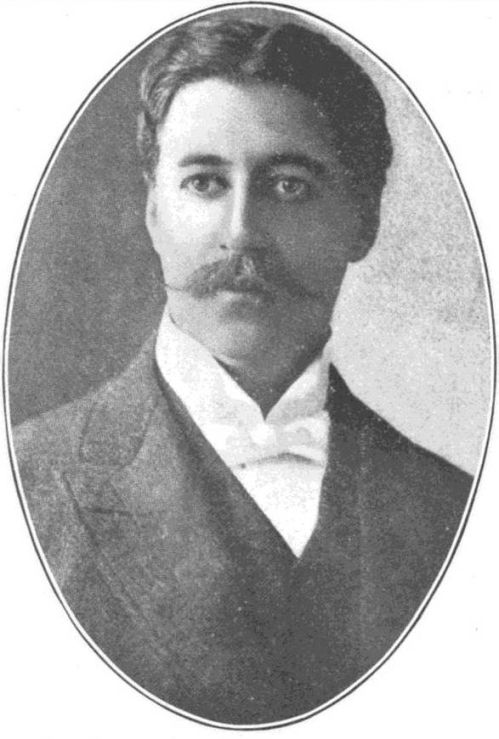
Hazeldine’s book The Sufism of the Rubaiyat, or, the Secret of the Great Paradox was first published by the Smith–Brooks Company of Denver Colorado in 1902, with a second edition of it being published (privately ?) in 1908, probably in Los Angeles (where it was printed.) (3b) A photograph of him used as the frontispiece to both editions is shown in Fig.2.The second edition differed little from the first, with only minor changes of wording, the main difference being that the one hundred ‘verses’ (actually prose) were numbered. In what follows page numbers refer to Hazeldine’s second edition and verse numbers will refer to FitzGerald’s 4th version unless otherwise stated.
According to Hazeldine’s Notes at the beginning of his book (p.3–4), Iram (verse 5) is “the nameless center of the universe, the womb from whence all things are born”, Bahram Gur (verse 18) “symbolizes the sun in the astronomical sign of Sagittarius”, whilst Parwin (The Pleiades) and Mushtari (Jupiter) (verse 75) symbolise, respectively, “spirituality, gentleness, kindness etc” and “benevolence, religion, toleration and big heartedness.” As for the famous “Book of Verses underneath the Bough” (verse 12) Hazeldine has the Book of Life being read beneath a bough of the Tree of Knowledge, with the jug of wine symbolising “the life of opportunities” and the loaf of bread symbolising “experience” through which we learn wisdom (p.10–11.) As if that weren’t enough, in his Notes (p.3) Hazeldine also has “Rubaiyat” signifying “A reading between the lines, a meaning, within a meaning, a paradox” (hence his subtitle) and “Omar Khayyam” signifying:
The Tent Maker, an ancient Persian manner of expression signifying the Supreme Creator, for a tent to their minds represented the universe, the earth formed its level or floor, and the heavens its canopy. Again, the expression Astronomer Poet was another title for the Creator. He who laid out the heavens as a garden and placed the stars in design or order. He was also the Controller of the seasons, the Lord of the Vernal Equinox and the Prince of Horsemen.
With the likes of Iram and Bahram Gur replaced with their meanings as Hazeldine sees them, and with wording altered so as to convey his interpretation better, it is often very difficult to find the verses in FitzGerald’s text on which they might be based. Hazeldine’s first ‘verse’, though, clearly derives from the first verse of FitzGerald’s first version given its opening two words (though Hazeldine nowhere names FitzGerald):
Awake! Awake! Oh, slumbering souls,Arise like HIM who rules the morn and leads forth the stars with song. Oh, Master hail to Thee! strike Thou with Wisdom’s shafts the enemies of man’s progression, Thou who art known as the Dispeller of Mortal Darkness and the Light of the Life to Come. Lead us to that Sure Path to where the SPIRITUAL SUN doth rise and where MORTAL DARKNESS sets beyond the clouds of FEAR, ANGER, SORROW, INDOLENCE and CRIME,Where THE GREAT PEACE reigns and THOU OH LORD ABIDEST
Reading this one cannot help but think that Hazeldine’s text owes more to his own imagination than to anything either Omar or FitzGerald wrote. As a reviewer in The San Francisco Call Bulletin for 12 July 1908 put it, “Some of it is not unreasonable, but much of it is very ‘far fetched’.” (p.9)
So who was the author ? He was baptised Norton Fairfax Whitbourne Hazeldine in Godstone, Surrey on 28 December 1865, the son of George John Hazeldine, a Railway Contractor, and his wife Harriet Laura. The family were still living there at the time of the 1871 census, but by the time of the 1881 census he was at boarding school in New Shoreham, West Sussex. The 1891 census records him living in Shanklin on the Isle of Wight, his Profession / Occupation being listed as “living on own means.” Sometime in the next couple of years he emigrated to America, where he was to spend the rest of his life. In 1895 in Boston, Massachusetts, he married Marion Louise Tyler, his profession being listed as Physician. Though I could find no record of her death or divorce, in 1900 he married Susan Nelson Herold, a dermatologist, in Los Angeles. She died in 1906, and he married for a third time in 1909, to Lillian Brown, again in Los Angeles. The 1900 US census results are not available online, so the next glimpse we have of him is in the census returns for 1910 and 1920, in both of which he and his wife are resident in Los Angeles. It is interesting that in 1910 his occupation is listed as “Physician, General Practice” whereas in 1920 his occupation is listed as “Chemist, Dehydration Co.,” and therein lies a tale to which we shall return below. The 1920 census also tells us that he had two children, Ione Hazel, aged 17 (thus the daughter by his second wife, Susan) and Fairfax, aged 8 (thus the daughter by his third wife, Lillian.) Hazeldine died in Los Angeles on 4 August 1929.
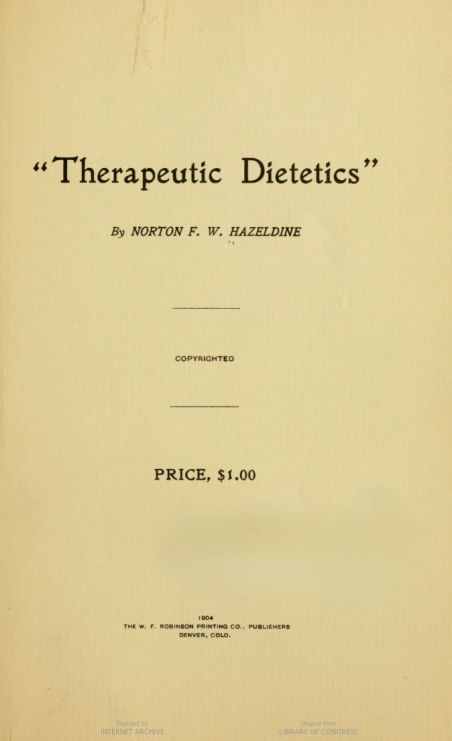
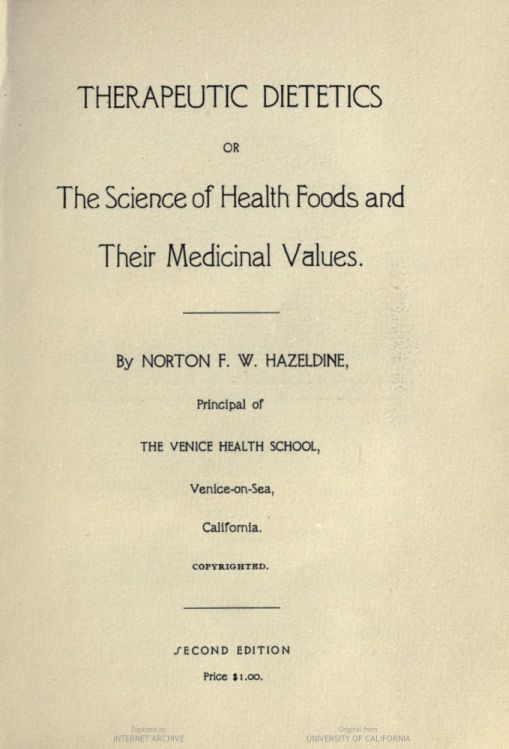
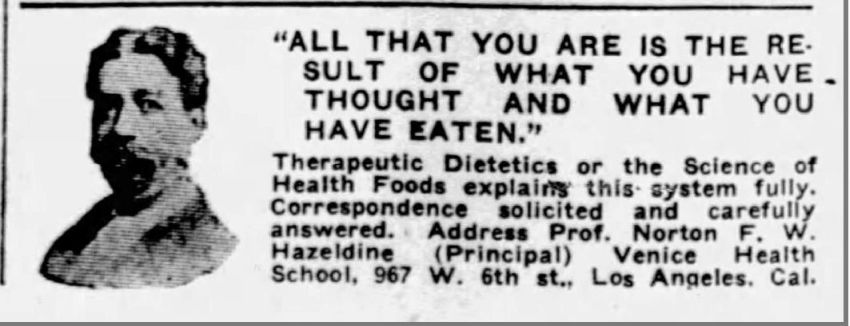
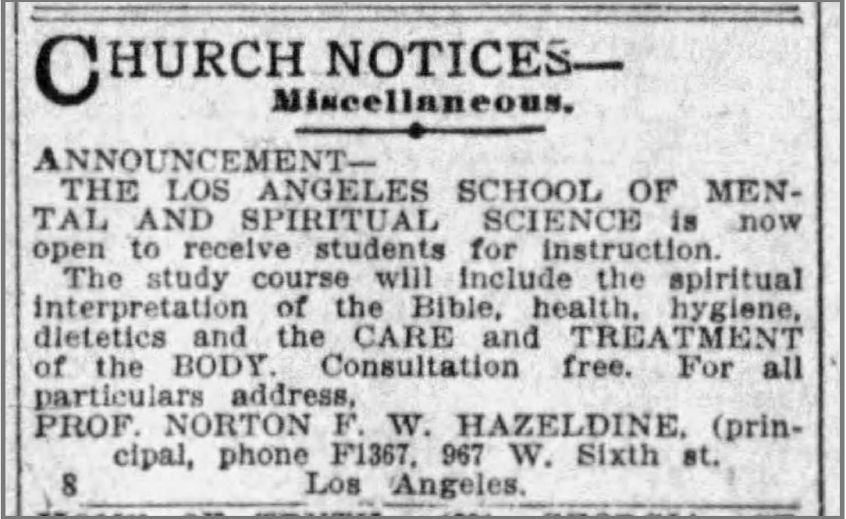
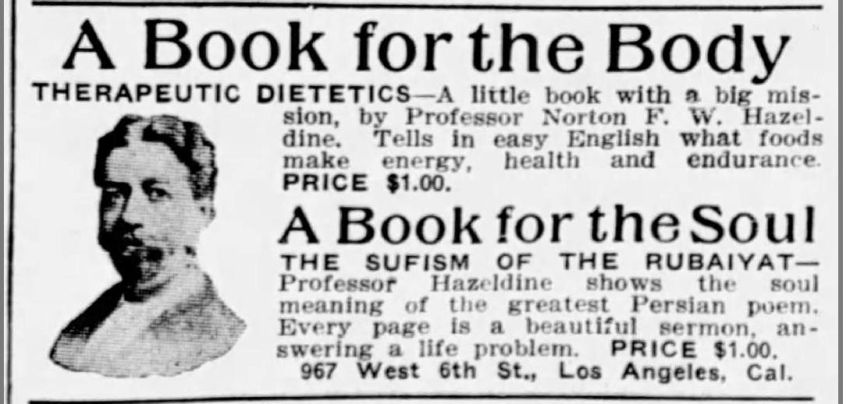
Backtracking to 1902, now, in addition to his first edition of The Sufism of the Rubaiyat he also privately published an edition of The Dhamadpada, or The Path of Righteousness, a collection of the sayings of Buddha. In a newspaper interview in 1905 (4a) he claimed that much of his early life was spent in India with his parents, where he became interested in Buddhism and adopted the religion, but this seems unlikely given his above–mentioned appearances in the UK census records, and the fact that his father died in Keston, Kent in 1878! Be that as it may, at the time of this interview Hazeldine was apparently enthralling society women with the theory that “beauty is an ethical as well as physiological phase of evolution of character” and that a healthy mind in a healthy – and beautiful – body, with the help of proper diet, “simple oleaginous, cereal, nutal and fruital”, was the way thither. It will come as no surprise, then, to learn that another book by Hazeldine, Therapeutic Dietetics – basically tasty vegetarianism for just such a mind and body – had been published in 1904. Its first edition had a modest title–page (Fig.3a) but its second edition (undated but c.1908) was rather more ‘flashy’ (Fig.3b), with Hazeldine now the Principal of the Venice Health School, Venice–on–Sea, California. Fig.3c is an advert for it from The Los Angeles Times on 4 October 1908 (p.125) in which Hazeldine has been promoted to Professor. The same newspaper on 8 November 1908 (p.47) featured an advert for Prof. Hazeldine’s School of Mental and Spiritual Science (Fig.3d), presumably a re–named Venice Health School or a branch of it, as they shared the same address. From the same address, of course, one could buy his books – Fig.3e is from The Los Angeles Times for 11 October 1908 (p.125).
Note that the advert in Fig.3d offers a study course in the spiritual interpretation of the Bible. Back in April 1907 he had delivered a lecture on the Spiritual Interpretation of the Book of Genesis (4b) and in October 1908 he was running an Undenominational Bible Class aiming “to throw new light upon all obscure passages and bring the Bible into perfect harmony with modern thought and science” (4c). Alas, no details of these lectures appear to have survived.
Equally elusive are an article he did for the September 1905 issue of an untraced (American ?) magazine, Mind, titled “Hypnosis, or the World of Delusion” (4d), and the text of an anti–vaccination lecture he gave in Los Angeles in February 1912 in which he proclaimed that “vaccination is an abomination” (4e). Two years later he was apparently involved in “The First Temple and College of Astrology”, an advert for it, taken from the Los Angeles Morning Tribune on 24 May 1914 (p.42) being shown in Fig.3f. Unfortunately the text of this Address appears not to have survived.
[The illustrations can be browsed here.]
But to return to health issues, when the idea of Prohibition was being discussed, Hazeldine came out against it on the grounds that a glass of wine or beer was good for the digestion, and that drunkenness could be avoided by encouraging a proper diet more effectively than by Prohibition (4f). When Prohibition did come into force, Hazeldine came up with a “Kickless Booze” which “Looks like Alcohol, Smells like Alcohol, Tastes lie Alcohol, Stimulates like Alcohol, But isn’t Alcohol” (4g). Oh yes, it was also hangover–free.
As mentioned earlier, in the 1920 US census Hazeldine’s occupation was listed as “Chemist, Dehydration Co.” This relates to his discovery that enhanced sunlight coupled with properly directed draughts could preserve fruit and vegetables for considerable periods of time. Dehydration in open–air sunlight had long been known, of course, but what was new was the idea of sun–drying indoors, funnelling sunlight in through glass windows and through ceilings sloping at angles of 17½ degrees, “the violet rays or radio–activity” of the sunlight being further enhanced with angled reflective walls, the dehydrating process being carefully controlled by air vents (4h).
Now back to Sufism.
J.S.Pattinson’s little book The Symbolism of the Rubaiyat of Omar Khayyam (Orpheus Publishing House, Edinburgh, 1921) (3c), which uses FitzGerald’s fourth version, seeks “a spiritual interpretation”(p.6) of Omar in which: “the Tavern or Tabernus is really the place of the Table, and the Table is the Altar, so that within the Tabernacle or place of the Altar, gather those who desire common help and sustenance along the difficult and dangerous ways of human experience.” (p.22) In addition, “the Tavern or Caravanserai is related to the idea of the Pilgrimage, and the Pilgrimage was the Sufi idea of Life.” (p.23) Wine is “the Symbol of the Spirit, the Divine Life or Power through which we exchange the inert conditions of matter for the intoxication of conscious union with the Divine” (p.30), and the Grape is a symbol of “the Divine Wisdom” (p.31). The Cup, of course, like the Communion Cup, the Holy Graal, the Druidic Cup of Wisdom and Omar’s Seven Ringed Cup of Jamshyd, is a sacred vessel, a symbol of “stored up forces or principles” (p.35). As for the Nightingale, it is “the Symbol of the Soul, that indefinite, intangible and lonely something through which man expresses his many moods and longings, singing as it were within the darkness or hidden depths of his own being, but ever alone upon the rose tree of his own expression” (p.38). The Rose, in its turn, symbolises “the perfume of the true and perfect sage and saint” (p.40), and it is no accident that it has been used “as a Symbol in Hermetic and Masonic Rituals” (p.41). The Potter, finally, is “the Great Artificer, or moulder of the Universe” (p.43).
Enough then of content of this little book of 64 pages, what of the author, J.S. Pattinson ? The author proved unusually difficult to track down, but after an extensive search through ancestry records and newspaper archives it began to seem likely that J.S. Pattinson was a woman, Janet Steel Pattinson, born in Paisley, Scotland in about 1849, but who was a school teacher in Bradford, Yorkshire, aged 22, at the time of the 1871 census. She remained a teacher in Bradford all her working life, retiring, presumably at the age of 60, in about 1909. She never married, but lived with her mother, Helen, at various addresses in Bradford, until she died in 1904, after which she went to live with her sister Margaret and her husband. The 1911 census records her living with them at 41 Woodview, Bradford, a key address as we shall see presently. By that time she was aged 60 and a retired teacher. Probate records for 1930 tell us: “Pattinson, Janet Steel of 41 Woodview Bradford spinster died 29 March 1930 at Pynet (Pyenot ?) Hall Cleckheaton, Yorkshire.” Probate was granted to her sister Margaret.
So far, then, nothing to connect her to the book. But a trawl through the British Newspaper Archive for a J.S. Pattinson turned up a Miss J.S. Pattinson of Bradford who between 1914 and 1926 delivered a number of lectures to various branches of the Theosophical Society, mainly in the north of England. Indeed, she was the Secretary of the Northern Federation of Theosophical Societies. These lectures ranged from “Reincarnation”, “World Symbols” and “The Occult Meaning of Chess” to “The Universal Pilgrim’s Progress”, “The Number Twelve” and “The Zodiac and Evolution.” Unfortunately, none of her lectures was devoted to the symbolism of The Rubaiyat. However, though she was not a prominent member of the main Theosophical Society, her secretarial position within the Bradford Branch meant that her name and address (41 Woodview) were quite often listed in the The Vahan, “the Official Organ of the Theosophical Society in England and Wales,” between 1907 and 1914 (eg 1 June 1914, p.244), thus confirming that the Theosophist Miss J. S. Pattinson was indeed Miss Janet Steel Pattinson.
Unfortunately as yet there is no absolute proof that it was she who wrote The Symbolism of the Rubaiyat of Omar Khayyam, though of course it is known that other Theosophists, with their penchant for Oriental Mysticism, certainly have sought to see a mystical symbolism in Omar (5). See, for example, Alice Leighton–Cleather, “Heaven and Hell – Omar Khayyam” in Theosophical Siftings, vol.5, no.4 (1892–3), p.18–20 – “Omar’s highly metaphysical conception – ‘I myself am Heav’n and Hell’ – may very well be taken, I think, as the key–note of the whole Theosophic teaching on this subject – states of consciousness – neither more nor less.” Or again, Leo L. Partlow, “The Rubaiyat” in The Theosophist (Sept–Dec 1930), p.809–816 – eg FitzOmar’s Seventh Gate leading to the Throne of Saturn (Version 4, v.31) is the Hindu Door of Brahma, the point at the top of the head “through which the inner man leaves the physical body.” Interestingly, The Edinburgh Evening News on 5 February 1934 (p.8) carried a brief report of a Theosophical Society lecture the previous evening, titled “Symbolism in Omar Khayyam”. It was delivered by a Mrs Forbes of Perth, though unfortunately the report gave little detail (basically, a poem so beautiful must have some deeper meaning to it!) and Miss Pattinson was not mentioned, though the text of the lecture appears not to have survived, so it is possible she was mentioned there.
Bjerregaard, like Pattinson, was not a prominent member of the main Theosophical Society, but delivered ‘occult’ lectures to them; plus his two books on Omar, like Pattinson’s, were published independently of the Society. (Bjerregaard’s book The Inner Life and the Tao–Teh–King, however, was published by the Theosophical Publishing Company, New York, in 1912.) Pattison’s publisher, Orpheus Publishing House of Edinburgh, incidentally, published some pretty odd–ball stuff – for example, Dr. J.M. Lawl’s Theosophical paper The Unseen Rainbow, published in 1920, and Lord Charles Kennedy’s poem Increasing Dawn, “deductions from the corpuscular theory of matter”, published in 1921.
Finally, Pattinson’s little book attracted little attention in the Press, though one reviewer in The Scotsman on 2 June 1921 (p.2) called it “a readable essay by Mr. J.S. Pattinson.” Whether this reviewer knew something I don’t, or whether he / she was assuming the author must be a man is unclear – personally I think the latter. I recall Rubaiyat artists Cecil G. Trew and S.C. Vincent Jarvis both of whom almost certainly used initials to disguise their sex in order to get published in a male dominated market: the G was Gwendolen (Cecil is actually a rarely used female name) and the S.C. was Sarah Constance. More famously, of course, think of P.D. James.
Lumifar: The Spiritual Interpretation of Edward FitzGerald’s translation of The Rubaiyat of Omar Khayyam by Janette Cooper Rutledge was published by Argo Publishing Co. of London (3d). It was undated, but contemporary newspaper listings confirm that it was published in 1930 (6a). This seems to have been a reprint of an earlier edition, privately published in Seattle, Washington, in 1917 (3e), but this is extremely rare. It is not clear why the reprint was done in England when (as we shall see) Rutledge was American, though Argo Publishing does seem to have catered for the spiritually and mystically inclined, so that may be part of the reason. It is also curious that the only other book written by her was the distinctly non–spiritual book How to Tour the United States in 31 Days for $100 (Harian Publications, New York, 1940), a feat she apparently accomplished herself! (7)
The author assures us that though many have accepted a literal view of FitzGerald’s text, “there have always been a few great souls who got its spiritual message.” Lumifar, she goes on, means “a Light Afar,” a light “which has been shining down the centuries to bless us in the twentieth and never can the spirituality discerned therein perish from the earth.”
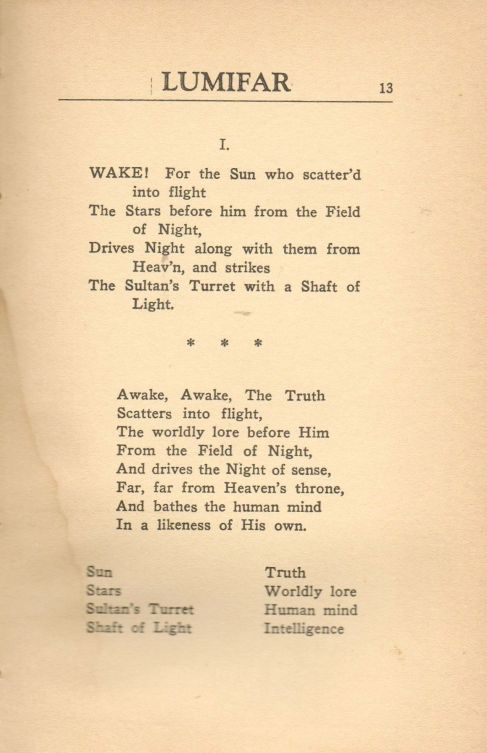
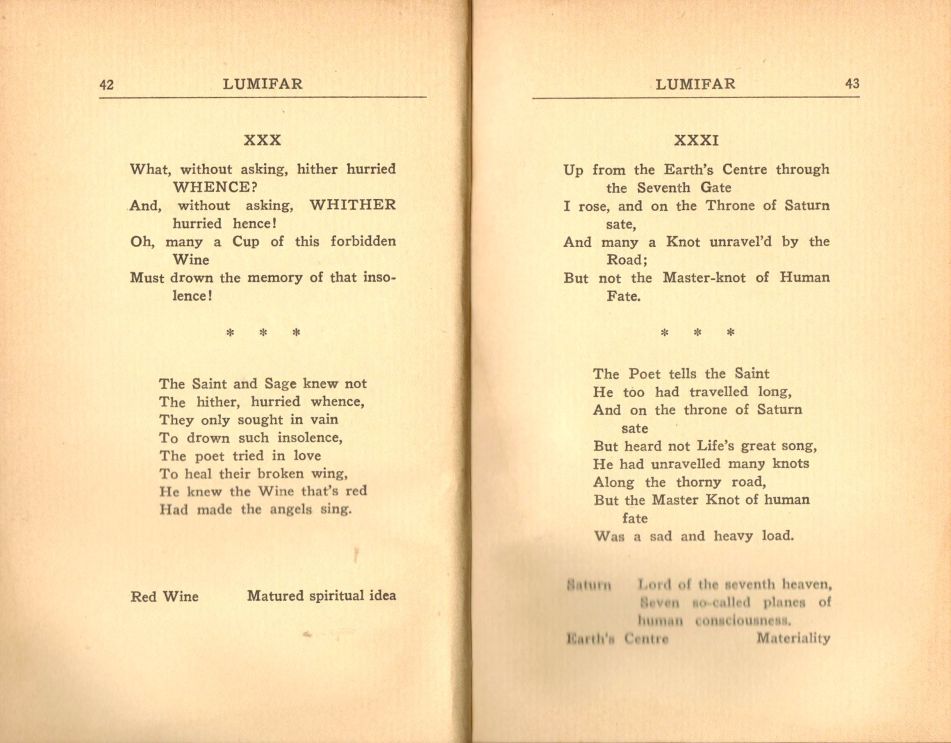
Rutledge’s approach is to quote a verse from FitzGerald (she mainly uses the fourth version, occasionally the third), then beneath it gives her own spiritually revised and rhymed version of it, together with a useful glossary of terms. Her treatment of the opening verse is shown here as Fig.4a (p.13) and a typical two–page spread as Fig.4b (p.42–3.)
To help give a further flavour of the book, of recurring symbols, Wine denotes inspiration; the Tavern, mortality; Roses, spiritual ideas; and the Nightingale, truth. As for the Fire of Spring in verse 7, this represents regeneration; the Caravanserai in verse 17 is “the seeming abode of the senses”; “the luckless Mould” in verse 38 (third version) represents mortality; the Leaden Metal and Gold in verse 59 represent materiality and spirituality respectively; and “that inverted Bowl” in verse 72 is “perverted sense of creation.” But enough – make of all that what you will, and let us move on to consider the author.
Little information is available about her. She was born Jeanette May Cooper in St. Paul, Ramsey, Minnesota in 1876. In 1902 she married Walker Rutledge in Seattle, Washington. In the 1920 census they were living in Seahurst Precinct, Washington, with a son, Walker Jr, age 7, and they were all still together in the same area at the time of the 1930 census, the year Lumifar was published in England. By the time of the 1940 census, she was widowed and living in Seattle. She had by then done her tour of the US and published the book of her experiences. She seems to have continued to live in Seattle, dying there in 1962.
Of her life outside this skeletal framework, little is to be gleaned. In June 1941, there was a gathering of 150 poets in Seattle, ranging in age from 8 to 93. It was “in the form of a ‘coming out party’ incident to publication of the Seattle poetry anthology, under the management of Janette Cooper Rutledge.” (6b) Also, in August 1941 she was involved in the 12th national convention of the League of Western Writers being held in Seattle. (6c) Finally, the following short poem by her, “The Eternal Road,” was published in The Seattle Star on 6 September 1941 (p.8):
The eternal Road of PromiseIs the gift to men;Sing, Oh my Soul,For thou art blest Again and again.
But sometimes the smallest detail of a life can catch the attention. The following story was published in several newspapers in January 1958 (6d):
Mrs. Janette Cooper Rutledge complained to the city council today about telephone business–solicitation calls.
She said the final straw came when she made her way to the phone with difficulty to be informed she had been chosen for a free course in dancing lessons.
Mrs. Rutledge is 81.
Some things haven’t changed much over the years, and that story continues to amuse me for the images it conjures up of her ‘poetical’ response to the caller.
Gabrielson published two editions of his interpretations of Omar. The first, privately published, bore the title–page The Rubaiyat of Omar Khayyam with an Interpretative Commentary by Ernest Louis Gabrielson. The second, published by Rainbow Publications, Caernarfon, North Wales, bore the title–page The Rubaiyat of Omar Khayyam (who wrote the Original Stanzas), and Edward FitzGerald (whose ‘translation’ made the poem widely popular among English–speaking people), and Ernest Ludwig Gabrielson (who has ventured to alter the order of FitzGerald’s stanzas slightly, and also the number thereof. In addition he has added his own interpretation.) (3f) The contents of the latter, like the title–page, were a revised and extended version of the former. Neither edition was dated, though we can actually date them via the wives to whom he dedicated them, so let us take a look at his life.
Gabrielson was born in Liverpool on 3 March 1893 and seemingly baptised as Ernest Ludwik Gabrielson. He was the son of John August Gabrielson, a shipping agent, and his wife Adolfina (née Johannson), who were of Swedish extraction. At the time of the 1911 census he was apprenticed to a wholesale grocer in Liverpool. Records show that in 1917 he was registered (as Ernest Louis Gabrielson) as a conscientious objector, and served a 6 months prison sentence in Wormwood Scrubs with hard labour for disobeying the order of a senior officer (no details given.) In the 1921 census he is Ernest L. Gabrielson, a “Clerk (Provisions)” at David Jones & Co., Liverpool, and by the time of the 1939 register, again as Ernest L. Gabrielson, a Clerk with the Liverpool Education Committee. In 1947 he married his first wife, Florence Margaret Huntley in Liverpool. She died in 1959, and in 1966, in Conway, Caernarvonshire, Wales, he married Rhiannon Blackham (née Roberts.) He seems to have continued to live in Wales until his death in Aberconwy, Gwynned on 16 April 1978.
At this point it is convenient to consider the dates of publication of his two Rubaiyat editions. The dedication of the first edition reads, “To my wife Florence, who meant and means so much.” The wording suggests that this booklet was published after her death, but before his second marriage, and so dates from the period 1959 to 1966. The dedication of the second edition reads: “This Edition is dedicated to RHIANON, my second wife, who adds music and joy to my words and my life.” The second edition thus dates from sometime after 1966, but before his death in 1978. In fact, it seems to have been published in 1977, the year before his death. (The British Library Catalogue dates it as [1977], for example, presumably the acquisition date.)
A brief obituary of Gabrielson was printed in The North Wales Weekly News on 4 May 1978 (p.17). It read:
Mr Ernest Ludwig Gabrielson, 4 Bron Derw, Penmaenmawr, who died recently in his 86th year, was of Swedish descent but was born and educated in Liverpool. He was on the staff of the Education Office in the city for many years.
He is survived by his wife.
Mr Gabrielson was a prolific writer, a poet and a lecturer in Anthroposophy. He was a lecturer and interpreter of Rudolf Steiner’s teachings for many years. He also studied many other religions.
At the funeral the Rev. R.L. Edwards, of Penmaenmawr, officiated, assisted by Commander C.F. Jackson.
The words “prolific author” presumably refer mainly to the many stories for boys he wrote under the pen–name John Gabriel, notably for The Boys’ Realm, The Weekly Tale–Teller and The Red Magazine between about 1915 and 1925 (8a). As to his poetry, I know of only one example, “The Song of the Satellite,” a poem about the Moon, written under the pen–name John Gabriel, and published in the October 1938 issue of The Satellite. Its third verse was an indicator of things to come:
You say I follow Earth because I must –Dragged by some force-of-gravity or other. Well, I may be the Daughter of Earth’s dust,But of her soul – and yours – I am the Mother.
The Satellite (8b) was a Liverpool–published science fiction magazine issued in a mimeographed and stapled format. But more interesting than this poem were three articles on astrology that he wrote under his real name, E.L. Gabrielson. The first, provocatively titled “Astronomy – the Modern Mythology” appeared in the issue of February 1939. The text of it is unavailable, unfortunately, but, from available reactions to it, it clearly inclined to the view that some of the ideas of modern astronomy were unproven assumptions – fiction, even – hence, perhaps, Gabrielson’s choice of a Science Fiction magazine as a platform for his views. But his article caused such a stir among readers of the magazine that he felt compelled to reply to them in his “Lemegetatem” published in the issue for April 1939. This was followed by his third article, “Astrology – the Real ‘Science’ of Astronomy” in the June 1939 issue. But though there are certainly cosmic influences on the Earth that are little understood, Gabrielson’s claim that the tides on Earth weren’t caused by the Moon (recall that poem) went a bit too far for Arthur C. Clarke who, in the July 1939 issue, asked how come, if astronomers were so deluded, they could so accurately calculate the behaviour of the tides years in advance ? This was followed, in the August 1939 issue, by Harry E. Turner’s article, “Astrology – the Pseudo–Science”, after which, for whatever reason, the subject of astrology was dropped, though I have no doubt that Gabrielson remained firmly convinced that he was right and the Arthur C. Clarkes of this world were wrong. Astrology will crop up again shortly, as we shall see.
Gabrielson also contributed two short stories to Outlands, “A Magazine for Adventurous Minds”, described by its editor as a magazine containing articles aimed at those “who aren’t afraid to face facts that run counter to accepted beliefs,” and science fiction or just plain weird stories “with a slant towards the future.” Its first and only issue was published in Liverpool in October 1946. The two stories were “Bird of Time”, written under the name John Gabriel, and “The Opaque Word”, written under the name Anthony Cotrion. Unfortunately the text of neither story appears to have survived, but the former would seem by its title to be Rubaiyat–related. The latter seems to be his only work issued under the pen–name of Anthony Cotrion (8c).
Returning to the above–quoted obituary, the influence of Steiner’s Anthroposophy was presumably in part what inspired his approach to interpreting The Rubaiyat, just as Blavatsky’s Theosophy influenced others. Perhaps not surprisingly, Gabrielson believed that Omar Khayyam was indeed a Sufi (p.3, p.86 – page numbers hereafter will refer to the second edition), but that FitzGerald totally misunderstood this and misrepresented Omar’s verses as a result (p.4, p.86 & p.109.) Not only that, but Gabrielson claimed that Omar was a skilled Astrologer (p.3, p.44 & p.109) (9), and indeed, as we read through Gabrielson’s interpretations, we find his own doubts about Astronomy and faith in Astrology fully confirmed: for him Astronomy is “old barren Reason” and Astrology a “Daughter of the Vine”, the Wisdom (Wine) of Mathematical logic combined with higher Intuition (p.68–9.) Omar’s “Door to which I found no Key” and “Veil past which I could not see” (verse 32, 1st version) are “that Door between Outer Knowledge and Inner Wisdom” and “the Veil of Causation” which is “opaque to Science” (p.43). When it comes to “that inverted Bowl we call the Sky” (verse 52, 1st version), Gabrielson urges us to “Hear the Astrologer!” adding:
Stars are letters of a Book. There is meaning in their groupings and their movements. Omar had looked into the Heavens and his Thoughts were therefore higher and deeper (p.81)
“The answers given by the Celestial Picture-Book,” he goes on, “have been unintelligible to the multitude, and unfathomed even by the few.” (p.82)
As regards Omar “starting from the Goal, / Over the shoulders of the flaming Foal &c” (verse 54, 1st version), Gabrielson assures us that we all rise up from our Earthbound state to our highest Spiritual point, after which we must return to reincarnate on Earth, the process being overseen by the Lords of Karma. “I think that Omar’s own ‘goal’ was the Star Alpha–Centauri – ‘the Flaming Foal,’ and that was the point at which he turned again to reincarnate on Earth.” (p.85) Gabrielson also thought that “Heavenly bodies such as Sun, Moon and Earth have their own great cycles of Reincarnation”. (p.108)
Having read Gabrielson’s poem above, it will come as no surprise to learn that he regarded the Moon as “the Gateway of Birth” (p.92 & p.100.) In fact, those who stood before the Tavern and shouted, “Open then the Door!” (verse 3, 1st version), were those waiting to be born through the Moongate of Birth, though the more they shouted, the shorter their lives would be (p.9).
For anyone who has ever been puzzled by the phrase “all shapes from Mah (Moon) to Mahi (Fish)”(verse 51, 4th version), Gabrielson offers an answer: it is because they both begin with M, the middle letter of the alphabet, frequently associated with Death, but here “in the higher sense of Transformation.” (p.64)
Even more puzzling is Gabrielson’s take on “Existence closing your Account...Millions of Bubbles &c” (verse 46, 4th version):
The Astrologer–poet knew the difference between Existence and Being, you see. Being is Spiritual, IS tence. This period of time is EX – out of – IStence. You have been given or lent a period of Time, on conditions. You will need to render an account of your USE of Time, naturally. You need not fear that the end of your existence will be such a serious matter for the whole Universe. The One and Those who are His emissaries are well aware of you. They have shaped so many men of like calibre with yourself, millions of them! All different, and each one important in his own place, as you are. (p.59)
If you relish the foregoing and would like to know more about Astral and Etheric Bodies and the Akashic Record or Memory of Mother Earth (p.24); Guardian Angels (p.70, p.72 & p.83); and the balancing effects of Grape juice on the Alchemy of the Ego (p.71), then this is the book for you. If you can find a copy, that is, for both editions are surprisingly rare despite their relatively recent dates of publication.
Abdullah Dougan’s little book of 84 pages, Who is the Potter ?, subtitled “A Commentary on the Rubaiyat of Omar Khayyam,” was published by Gnostic Press Ltd., of Auckland, New Zealand in 1991 (3g). In fact, the booklet could aptly be described as ghost–written, as it was compiled by two followers of Dougan, Steven Steff and Pat Field, with some help from Dougan’s widow, Rosalie, from taped question and answer interviews with him, done before his death in 1987. First, then, who was Abdullah Dougan ? (10)
He was born Isa Neil Dougan in Christchurch, New Zealand, on 15 April 1918, the son of William John Kennedy Dougan, a Station Master, and his wife Emily Ellen (née Gilroy.) According to the Preface to Who is the Potter ?, the author began reading The Rubaiyat when he was 17 years old, and he carried a copy with him during his service in the Second World War. It was not to be until he was approaching 50, though, that his revelations about the Omar’s ‘true’ meaning came to him, as he himself developed spiritually.
His occupation in his army record is listed as Salesman, though the Preface to his book tells us he was a builder for most of his working life, and indeed his death certificate lists him as a retired builder. The Preface adds, though, that he was (appropriately!) “a winemaker for twelve years, a potter for ten years, and the spiritual teacher to a small group of pupils for twenty years.”
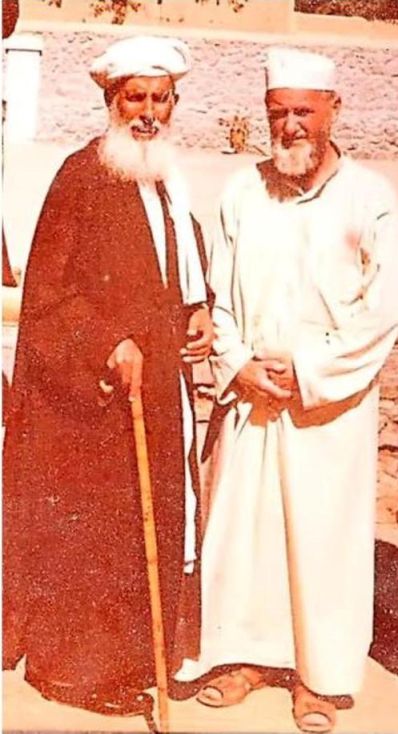
In 1968 he went to Afghanistan, where met Shaikh Abdul al–Qayyum, who became his teacher, initiated him as a Naqshbandi Sufi, and gave him the spiritual name, Abdullah. The photograph in Fig.5a, taken on this visit, shows Abdullah on the right and Shaikh Abdul al–Qayyum on the left. After that he returned to New Zealand to teach in his own right, under his new name.
In 1974 he completed a forty–day fast while travelling in India and Afghanistan. This he reckoned marked a significant stage in his spiritual development. That forty day fast, of course, recalls the similar feats of Moses and Christ in the Bible.
Returning to his personal life, in 1944 he married Daphne May Munns, by whom he had two children. That marriage ended in divorce, seemingly connected with his realisation that modern life was spiritually barren and that the sex–drive was too dominant a force in man. It was at this time that he came under the spell of the Russian (Armenian) born mystic and spiritual teacher Gurdjieff, whose views crop up repeatedly in Who is the Potter ?
In 1978 he married Rosalie Hanley, by whom he had three children to add to her three from a previous marriage. She was to outlive him, aid in the publication of Who is the Potter ?, and die in 2018. (His first wife also outlived him, dying in 2000.)
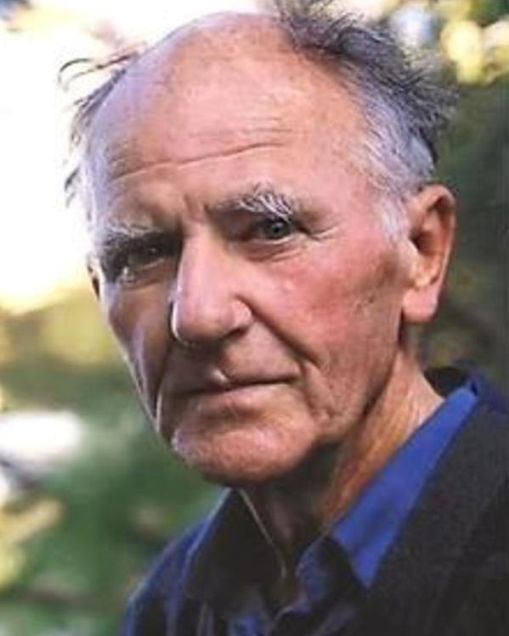
Abdullah Dougan died in Auckland, New Zealand, on 1 September 1987. The photograph of him in Fig.5b was taken in 1986, shortly before his death.
Before going into Abdullah’s interpretations of Omar, it is worth pointing out that he had a novel idea about Omar and FitzGerald. Thus in his Introduction he writes that “Fitzgerald’s (sic) first translation was inspired for the benefit of all mankind and was part of a divine plan that had to be” – he was “an instrument for what Allah wanted to happen” (p.xii). As for Omar, he was not the live–for–today materialist as so many have painted him, but “a very cunning Sufi who used to take pot shots at certain Sufis.” (p.xii) Later he adds, “Omar does not pretend to know all the answers. He was still unsure of himself, unlike Hakim Sana’i, Rumi or Attar – those men knew. Their understanding was on a much higher level than Omar’s.” (p.65)
In Who is the Potter ? Abdullah quotes all 75 verses of FitzGerald’s first version, following each with a commentary. As regards the opening verse, “The stone which chases away the stars is the message of the Holy Koran” and the stars put to flight represent pre–Islamic beliefs overthrown by it. The Sun who catches the Sultan’s turret in a noose of light is “our Holy Father” and the turret “symbolises the male sex organ”, this relating to the old idea, embraced by many Christian saints, that suppression of the sex urge diverts its energy to spiritual enhancement. The bowl of night, meanwhile, represents the female breast, “symbolising the passive force” in contrast to the turret, symbolising the active force. The sexual theme is continued in the third verse, where the crowing Cock “reminds us that the sex energy (cock) must be raised up by the Sun (God)”, but that those shouting for the tavern door (life) to be opened will miss the opportunity for spiritual development, and must settle for a non–spiritual life – admittedly with sex and plenty of real wine, which is why so many people opt for it!
The yellow cheek of the rose turning incarnadine in verse 6 represents the move from a lower to a higher state of consciousness, facilitated by wine (the spirit), and the cup in verse 7 is the vessel of the spirit. Sultan Mahmud in verse 10 represents “the ego which fancies itself to be in an exalted position” and the caravanserai in verse 16 is “like a staging post that represents our life on Earth.” The “all obliterated Tongue” in verse 36 “symbolises man’s ineptness in communicating with God in a real sense” and “Annihilation’s Waste” in verse 38 “represents our Earth in this solar system.” Old barren Reason in verse 40 reflects the fact that reason alone cannot lead to enlightenment because “it only pertains to the third dimension and has no function in the fifth dimension” (that being the dimension of the higher spiritual state.) The vessel on the shoulder of the Angel Shape in verse 42 is not a jar of wine, but represents the spirit of Omar. The Potter in verses 59ff, of course, is God. The windingsheet of vine–leaf in verse 67 offers spiritual protection for his body in preparation for the Day of Judgement. As regards correcting the sorry scheme of things in verse 73, the “thou and I” are not Omar & his Beloved, but Omar & his spirit; and Moon of my Delight in verse 74 is not Omar’s Beloved, but his own spirit.
Sometimes one does wonder if Abdullah really knew what he was talking about, particularly when his theories bordered on Science. For example, he discusses Time in his commentary on verse 8, and talks of our observations of the heavenly bodies being limited on account of “viewing them through the atmosphere of this solar system.” (p.12) Again, he is fond of juggling with dimensions, as in his commentary on verse 9, when he tells us, “If third–dimensional time is all important to you, you will never look for other dimensions of time.” (p.14) (Conventionally, Space consists of 3 dimensions, the x–, y– & z–axes of solid geometry, with Time reckoned as the fourth.) And in his commentary on verse 46 where he has the third dimension that of the senses, the fourth that of thought, and the fifth that of the higher spiritual state (p.51). This is followed by his statement that “X rays are one of the ways the Sun and Earth work together” in that they lead to evolutionary mutations. “The human race is the result of mutation,” he assures us (p.52.)
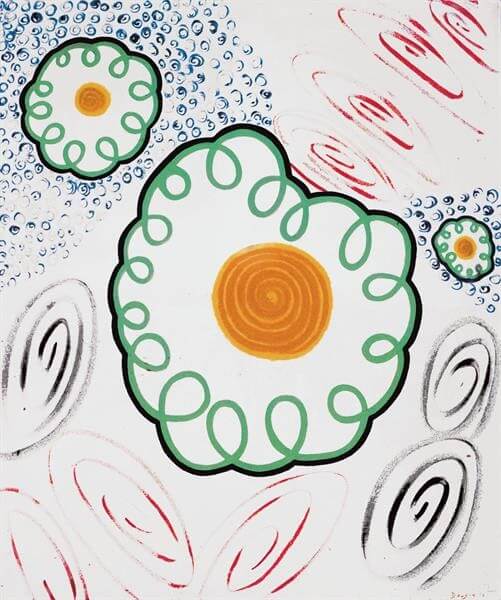
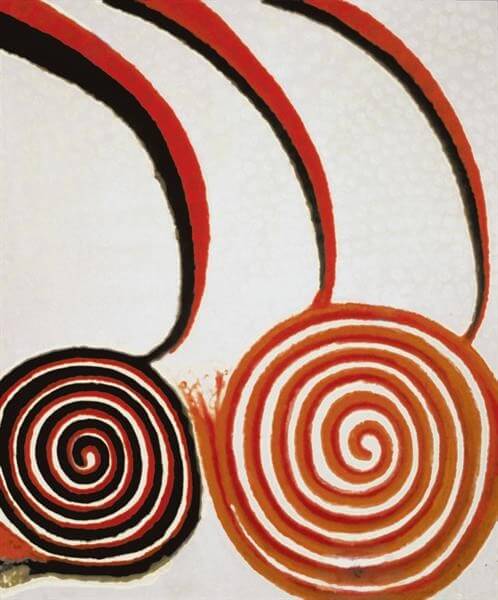
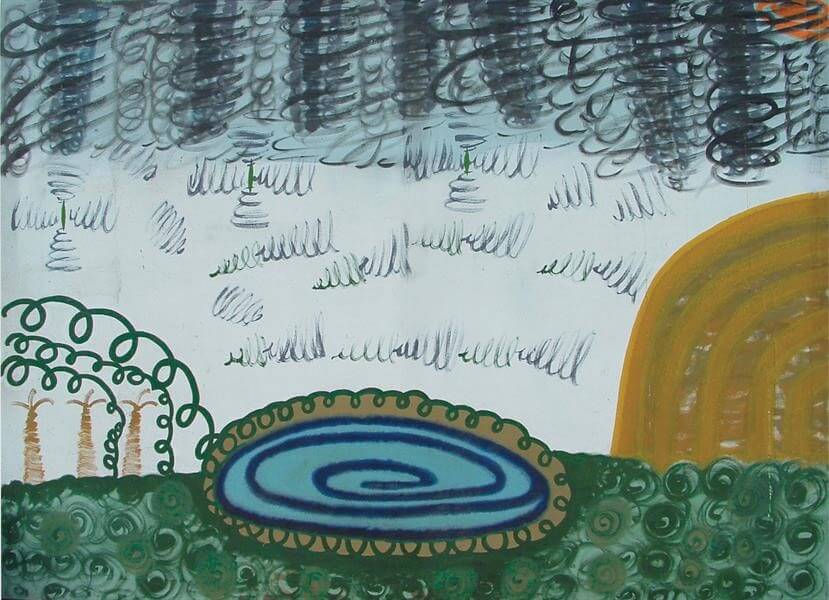
Abdullah was an amateur painter (11) in an abstract manner involving coloured circles, spirals and arcs, the colours and shapes having a symbolic significance, though the symbolism is by no means obvious, and often remains unclear despite the notes he appended to them! But they do give us an idea of Abdullah’s mind–set, and some of his background beliefs. Of particular interest are a set of four paintings he did on “Our Solar System”, all done in 1970 (11a).
As noted earlier, Abdullah was a follower of Gurdjieff, forming an interesting parallel with Pattinson following Blavatsky and Gabrielson following Steiner. It was from Gurdjieff that Abdullah got the idea that the Moon was created when the comet Kondoor, which came from the centre of the Galaxy, struck the Earth and dislodged two pieces, Loonderperzo (which became our Moon) and Anulios (which “is always facing the Sun so we cannot see it.”) Fig.6a, titled “Birth of the Moon” depicts this (11b). This scenario is taken from Gurdjieff’s supposedly allegorical work Beelzebub’s Tales to his Grandson (chapter 9), first published in 1950. At the risk of oversimplifying things, Beelzebub is an extra–terrestrial who has monitored the spiritual progress of human life on Earth for several thousand years, the lack of real progress being a significant feature, of course. As the title indicates, he tells his grandson about it – on board a spaceship! – telling him, for example, that he had visited Atlantis at one point. Gurdjieff’s use of language is not the clearest in many places, and his book rather reminds me of a cross between “Mork and Mindy” and Joyce’s Ulysses – lacking the humour of the former and as obscure as the latter. How Abdullah could take this seriously let alone literally, if indeed he did, is difficult to fathom, though Gurdjieff’s devotees do refer to his obscure language and neologisms as the product of a Higher Mind, and assume they haven’t studied it carefully enough if they don't understand it!
Getting back to his paintings, Abdullah believed (11c) that Mercury, Venus, Earth, Mars and the Asteroids came from the Sun, but that Saturn, Uranus, Neptune, Pluto, “and another planet, as yet unnamed”, were born of Jupiter. “The Earth being the third planet from the Sun,” he tells us, “is at the interval in the octave or law of seven” which is “why man has the choice to work on himself or stay asleep. As you work on yourself you make your vibrations finer and at death you are attracted to the parent planet which is in harmony with your vibration.” So where did the Sun and Jupiter come from ? Abdullah tells us (11d):
The Sun and Jupiter came from His Endlessness and Antares and are the positive and passive suns of our solar system. Like man, the suns have to perfect themselves in a way that we cannot as yet understand. The planets and satellites are all part of this perfecting and are children of the suns. Men are children of the Earth and the Sun, to be used for the cosmic purpose of the perfecting of the Earth and Sun.
Jupiter, of course, is not a sun / star but a planet, but let that pass. His Endlessness (again from Gurdjieff) is apparently the Absolute or “everything existing in the universe without end”, but how the red super–giant Antares in the constellation of Scorpio came into it is a bit of a mystery. Abdullah does tell us that his use of the colour red relates to “Antares, Ahura Mazda or Hu, the Sun of our Sun and the centre of our own galaxy” (11e). Now, Ahura Mazda is the principal god of Zoroastrianism, the benevolent God of the Sky, Hu Sepaas is one of his 101 names, and Antares is one of the Four Royal Stars of Persia (Regulus, Fomalhaut, Aldebaran and Antares), astrologically regarded as Celestial Guardians, though I am not aware of any particular association with Ahura Mazda. But Antares has no connection with our Sun, being some 550 light years away from it, and some 25,000 light years from the centre of our galaxy! Elsewhere, Abdullah refers to “the positive Sun Antares, known to Zoroaster as Ahura Mazda, the negative Sun Betelgeuse, and, in the Sagittarius constellation, a black hole which is the neutralising factor.” (12a) Astronomy is not Abdullah’s strong point, then. Fig.6b titled “Birth of the Suns” (11f) relates to this.
Of even stranger interest is Fig.6c entitled “The Destruction of a previous Civilisation.” The note on it reads thus (11g):
This painting shows what Abdullah believes to have happened prior to our advent on this planet. The Sun and Earth developed a bird to such a degree that it warranted an intellect so that it might become a vehicle of consciousness. This was given but, unfortunately for the goaffadh bird, the sex drive was too strong and they so debilitated themselves by fighting over the females that the intellect atrophied. Then man was given his chance and is now in the middle of this experiment.
Elsewhere (12b) he tells us that some of the more advanced goaffadh birds are around today as spirits who take possession of humans and cause madness, but that they can be warded off using a dowsing pendulum.
I leave readers to form their own opinions about Abdullah’s theories.
[The illustrations can be browsed here.]
Paramahansa Yogananda’s book Wine of the Mystic: a Spiritual Interpretation of the Rubaiyat of Omar Khayyam, was published by the Self–Realisation Fellowship, of Los Angeles, California, in 1994. In the same year, The Rubaiyat of Omar Khayyam Explained by Paramhansa (sic – the two spellings are valid – this latter is Bengali, the former Sanskrit) Yogananda was published by Crystal Clarity Press, Nevada City, California. A slightly revised edition of it, under the same title, was published by UBS Publishers’ Distributors in New Delhi in 1996 – the text relating to the explanations of FitzGerald’s verses was left intact, with the same pagination, and the differences involved only the introductory notes, illustrations and such like (3h). All used FitzGerald’s first version.
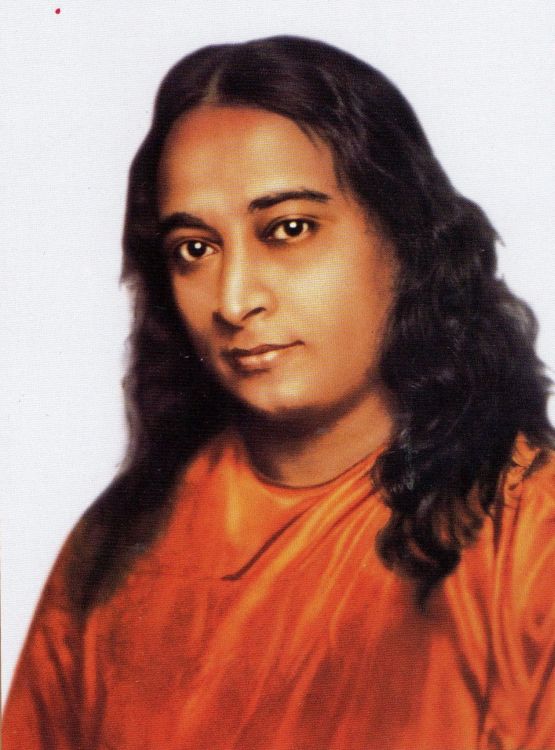
Wine of the Mystic contained Yogananda’s complete commentaries on The Rubaiyat, the Self–Realisation Fellowship being the organisation founded by him in 1920, of which more presently. The Rubaiyat Omar Khayyam Explained was an edited version of this, edited by, and with additional comments by, Swami Kriyananda, otherwise known as J. Donald Walters. He was a long–term and trusted disciple of Yogananda, who served him for some 30 years, before Yogananda’s death in 1952. As Walters tells us, in 1950 Yogananda had entrusted him with editing his Rubaiyat studies, which had first appeared the magazine Inner Culture in 1937–1944, so The Rubaiyat of Omar Khayyam Explained was a long time coming! However, I will here use Wine of the Mystic as arguably the more definitive version of Yogananda’s interpretations. In it Yogananda quotes all 75 of FitzGerald’s verses, each followed by a Glossary of key words, a Spiritual Interpretation, and Practical Application for the reader’s spiritual development. Its frontispiece portrait of a youthful Yogananda is shown in Fig.7 – an image we shall meet many times in what follows.
The opening verse is a good example. The verse itself reads:
Awake! for Morning in the Bowl of Night Has flung the Stone that puts the Stars to Flight: And Lo! the Hunter of the East has caught The Sultan’s Turret in a Noose of Light.
According to Yogananda’s Glossary, Morning represents the Dawn of Awakening from delusive earthly existence; the Bowl of Night represents the darkness of ignorance, which imprisons the immortal soul in mortal consciousness; the Stone represents spiritual discipline and the Stars the attractive twinkling of material desires. The Hunter of the East is Eastern Wisdom, a mighty slayer of delusion; the Sultan’s Turret is the sovereign soul; and the Noose of Light the divine illumination of wisdom, which destroys the captive darkness surrounding the soul.
Another good example of Yogananda’s approach is provided by his Spiritual Interpretation of verse 3. The verse itself reads:
And as the Cock crew those who stood beforeThe Tavern shouted - 'Open then the Door! You know how little while we have to stay,And once departed may return no more.
The meaning of this verse seems simple enough: life is short, enjoy it, glass in hand, while you can, for once death takes you, that is the end, lights out, no more wine. Yogananda however interprets it thus:
As the cock–call of wisdom sounded, delusion–drowsy devotees were aroused, and stood before the tavern of bodily life and cried, “Ah, Soul, awaken! Open the innermost door of silence, wherein lies God–consciousness. How little time we have to stay on earth! If during this short season we can reap the rich harvest of God–wisdom, we need never again be reincarnated, dragged here by earth–binding desires.
Personally, I prefer the simpler version!
As further examples of Yogananda’s use of symbolism, the Red Wine and the Nightingale in v.6 denote “spiritually vitalising divine bliss” and intuition, respectively, though the Wine of v.71 is “divine intoxication” and the Nightingale singing in the branches in v.72 is singing songs of wisdom. The “summer dresses in new bloom” in v.22 are old souls reincarnated in new bodies and “the Tower of Darkness” in v.24 symbolises “the piled–up painful disillusionments of life from which we finally learn.” “The Seventh Gate” in v.31 is not the Seventh Sphere of the Geocentric Universe as conceived in Omar’s day, the sphere of the planet Saturn, but “The Sahasrara, the highest yogic center of divine consciousness and concentrated life force, located in the brain at the top of the head.” In addition “‘Saturn’ here refers to Satan, the negative aspect of the cosmic creative force.” Again, “Drink!” in v.34 means “feel the divine bliss of Spirit within you”; “the fruitful Grape” in v.39 is “the salvation–yielding bliss of God–realization” and the Vine in v.55 is the consciousness and life force that traverse the tree–like spine, rooted in the brain, but all too often planted in earthly desires, rather than being transplanted to the soil of divine consciousness. As for “the subtle Alchemist” in v.43, this refers to that “divine consciousness, which subtly but surely and completely transforms worldly consciousness, as chemicals change the nature of metal” and the “Phantom Figures” of v.46 are human beings, but in an unexpected sense, for as Science tells us, “the physical forms of human beings are not the solid masses we perceive them to be, but electro–magnetic waves.” The Snake of v.58 is not simply that of the Garden of Eden, but “a coiled force” emanating “from a subtle center at the base of the spine, rousing sex” and thus hindering communion with God; the “Windingsheet of Vine–leaf” in v.67 is not a literal windingsheet, but refers to being “protected by the power of divine perception”; and finally “Moon of my Delight” in v.74 is not Omar’s Beloved, as most of us are happy to think, but symbolises “the bliss of security in God, known only to the soul rescued from a transient cosmos.”
Yet again I cannot help but think that FitzGerald's view of Omar is so much more convincing!
Let us now take a look at Yogananda himself. He is well–enough known to have a lengthy Wikipedia page devoted to him and in 1946 his Autobiography of a Yogi was published by The Philosophical Library of New York. It ran to some 500 pages, but proved to be immensely popular as a “classic of spirituality”, and has been reprinted many times down to the present day. We shall have more to say about his autobiography presently, but first some basic key facts about his life.
He was born Mukunda Lal Gosh in India on 5 January 1893, the son of a well–to–do Vice–President of a Railroad Company. In 1915 he joined the ancient monastic Swami Order, thus becoming Swami Yogananda, that name being bestowed upon him by his guru in the order. Yogananda means literally “yoga bliss”, signifying one who has achieved union with God through yoga. He went to America in 1920, and in that same year founded the Self–Realisation Fellowship (SRF) in Boston. The following year he established its international HQ in Los Angeles (recall the publisher of his book Wine of the Mystic, mentioned above), the spread of its popularity being surprisingly rapid, this being promoted by extensive lecture tours. Self–Realisation was to be obtained through yoga and meditation, of course, bringing the practitioner closer to God. It also sought to show the basic unity of Eastern and Western beliefs, lectures being delivered on a curious mixture of Christian as well as Hindu topics, as we shall see. The name Paramhansa was bestowed upon Swami Yogananda by another guru in 1935, so that for a while he became Paramhansa Swami Yogananda. The name Paramhansa means literally “the Highest Swan”, the swan being associated with the God Brahma, hence “one who has achieved the highest spiritual realisation.” In 1937 he founded the Golden Lotus Temple, essentially a hermitage and meditation centre, at Encinitas on the Californian coast, but it slid into the sea as a result of coastal erosion in 1942, a disaster which Yogananda is said to have regarded not as Divine Disapproval, but, by analogy with Christ, as its “crucifixion”, urging that it should be followed by its “resurrection” elsewhere – and in multiple sites – all of which duly came to pass, one of them in Hollywood! Between about 1938 and 1948 his numerous lectures can be traced through newspaper adverts, of which more below. He died of a heart attack on 7 March 1952 whilst delivering a speech at a dinner. Some of his disciples, however, believe that his death was a case of mahasamadhi, a master yogi’s conscious decision to leave this life and achieve final unity with the cosmos, free from reincarnation back on earth. It is also said that after his death his body showed little or no sign of physical deterioration – the state of incorruptibility associated with various Christian saints, of course, though some, like St. Bernadette of Lourdes, have admittedly been given a helping hand with a layer of flesh–coloured wax.
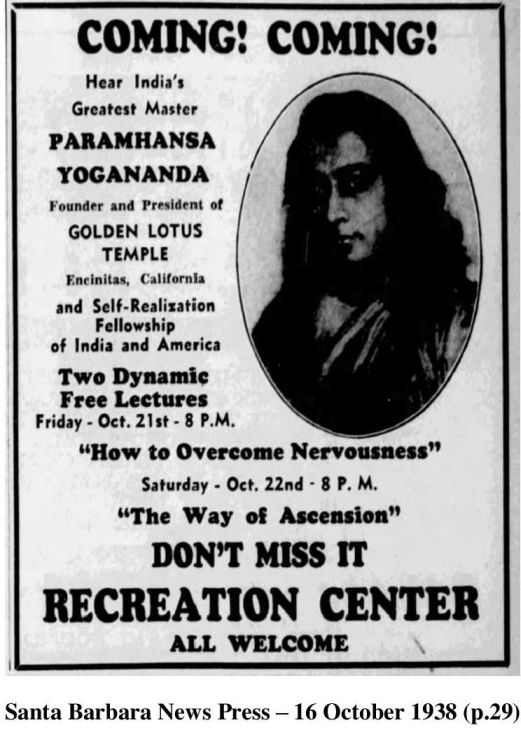
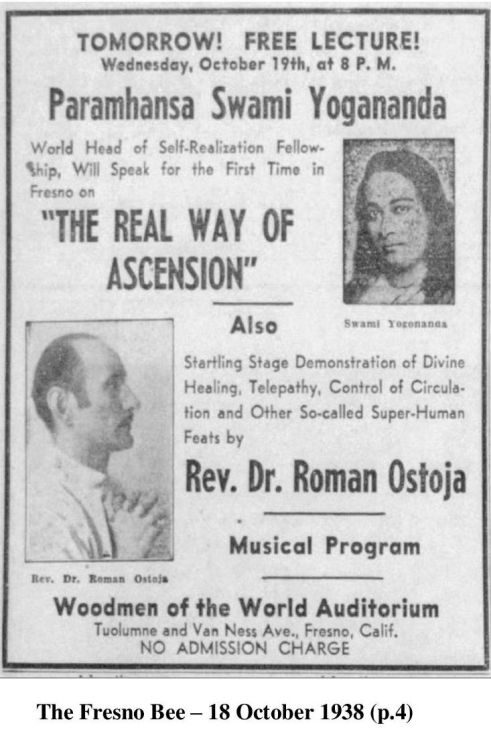
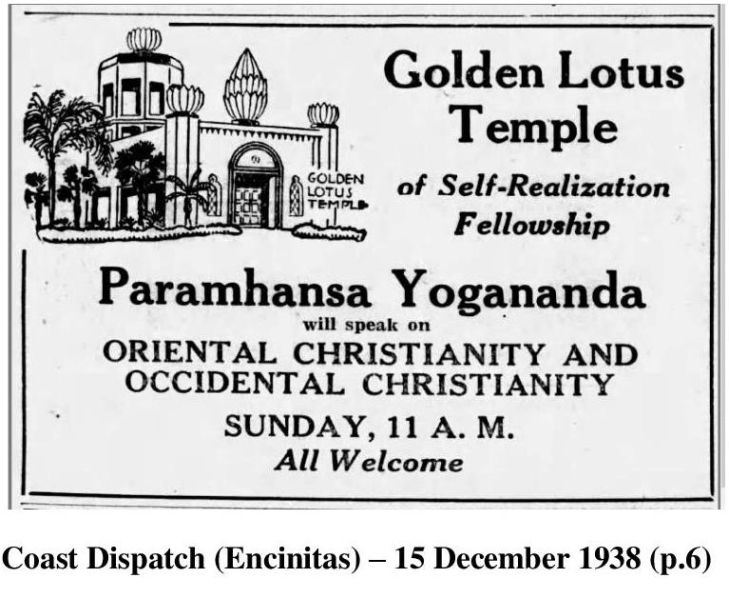
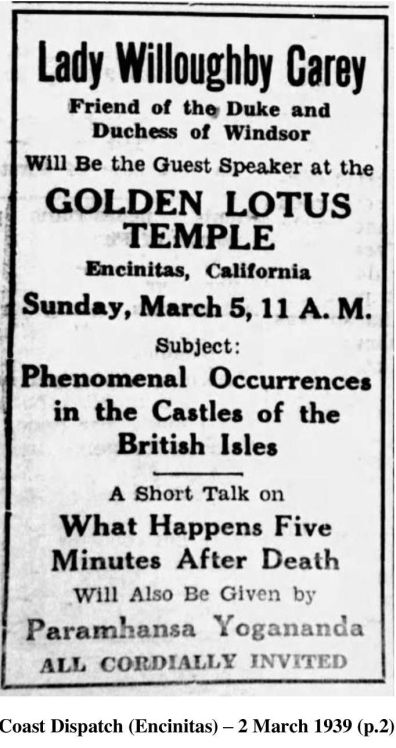
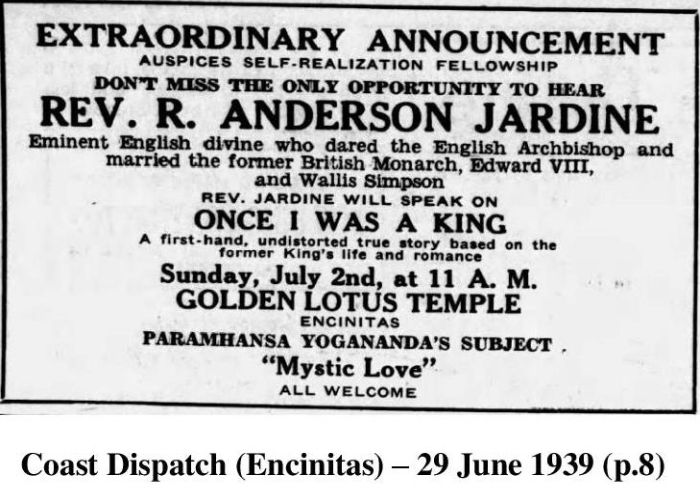
As already indicated, newspaper advertisements tell us a lot about the organisation. Fig.8a is the earliest I have come across, dating from June 1938 – note the Swami in his name. Fig.8b, from October 1938, uses a typical “Roll up! Roll up!” advertising technique, and Fig.8c, also dating from October 1938, shows Yogananda (with Swami again) with a ‘supporting act’ – Rev. Dr. Roman Ostoja and his Super–Human Feats. Fig.8d, dating from December 1938, is in what was to become a regular format, in the Encinitas newspaper Coast Dispatch, for lectures at the Golden Lotus Temple there. This lecture was of the West meets East type. Subsequent lectures bore titles “Who made God ?” (March 1939), “The Mysteries of Prenatal Existence” (April 1939), “God Versus Satan” (May 1939), “Healing Colds by Magnetic Fasting” (June 1939), “How To Make Youth More Lasting” and “How to Develop Personal Magnetism” (both July 1939), “How to Make Yourself Liked by All” (August 1939), “The Art of Becoming Beautiful in Body, Mind and Soul” (October 1939), “How to Govern Your Stars Instead of Being Governed by Them” (July 1940), “How to Measure Your Wisdom” and “Do the Dead Return ?” (both July 1941.) As for using celebrity names to boost publicity, Fig.8e (March 1939) and Fig.8f (June 1939) are two good examples.
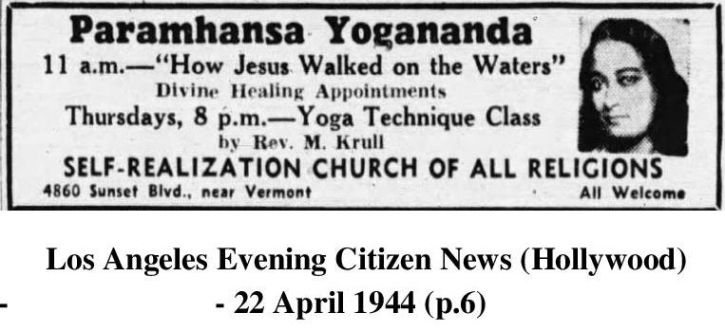
Following the destruction of the Golden Lotus Temple, a common advertising format was as shown in Fig.8g, a lecture on “How Jesus Walked on the Waters”, delivered in April 1944. Other adverts in this format were “Mysteries of the Seven Dimensions” and “Religion of the Atlanteans” (both May 1945), “Will Jesus Reincarnate Again ?” (April 1946), “Does Satan Have Karma ?” (July 1946), “How Jesus Fed 5000 with 5 Loaves” (February 1947); “How Jesus Overcame Death” (March 1947) and “Proof of God” (October 1948.)
[The illustrations can be browsed here.]
Then there’s the thorny issue of the End of the World. He had given a lecture about this at the Golden Lotus Temple back in May 1940, but it resurfaced again in 1945 when a Reverend Charles Long predicted that the world would end at 4.33 pm (BST) on 21 September 1945. He and between 30 and 40 followers had retired from the world to fast and pray in preparation for the event, but Yogananda stepped in to reassure everyone that it wouldn’t happen – at least not in accordance with the Rev. Long’s predictions. Yogananda announced that the World has got to live through an Atomic Era of 100 years first, followed by a Mental Age lasting 3600 years, pushing the End of the World back to the year 5645 at least (13a).
After all that, it will come as no surprise to readers that Yogananda’s Autobiography, though a spiritual classic to some, aroused much scepticism in others. A reviewer in the Kansas City Star on 17 May 1947 (p.12) wrote:
This is the childishly written account of a man who made a success of abandoning reason and relying on the triumph of mind over everything. Those who understand such doubletalk will enjoy reading the stories of magic and astrology and such that fill nearly 500 pages.
Another in the Allentown, Pennsylvania newspaper The Morning Call on 31 August 1947 (p.22) wrote:
To indulge in ‘a willing suspension of disbelief’ is a requisite to appreciate fully the implications of the life and experience of this outstanding advocate of oriental philosophy, who has initiated the western world into some of the mysteries and achievements of yoga.
Here one meets “a saint with two bodies,” one who produces varied fragrant perfumes at will; a swami who defeats ferocious tigers in physical combat; a yogi who defies the law of gravitation by levitating or remaining in the air at will; the authors guru or master who could sense and transfer thought; the mysterious control of astrological influence; rejuvenation through rediscovered herbal knowledge in ancient Sanskrit treatises; and a sainted yogi woman who subsists without food.
The “saint with two bodies” (Swami Pranabananda) is a case of bilocation, of course, a feat supposedly achieved by some Christian saints who are said to have been able to appear in two places at once – St. Francis Xavier and more recently St. Padre Pio are notable examples. In addition to the foregoing yogic feats, we should add Lahiri Mahasaya’s raising from the dead of the boy Rama, and whose mere photograph healed the youthful Yogananda from a near fatal illness. Nor should we omit Yogananda’s vision of the god Krishna in a Bombay hotel room, and the mysterious silver amulet astrally created by his deceased mother for the start of his earthly mission, and which dematerialised when its work was done.
It is only fair to add, though, that the above review does finish on a more positive thought:
This detailed account of Yogananda’s many years of spiritual training is a fitting introduction to Indian metaphysics. A careful reading of this volume would do much to initiate interest in the potentialities of the super–conscious, a much needed antidote for the excessive materialism of the west.
The SRF was in principle a non–profit organisation. Its lectures were free and much of its published material given freely to those who wanted it. Nevertheless, a full–page spread in The Los Angeles Mirror on 17 January 1949 (p.25) was boldly headed “Million Dollar Yogi” but opened by saying that “Paramhansa Yogananda measures his success not in terms of the $3,500,000 assets of the organisation he founded, but in the 150,000 students throughout the United States to whom he says he has brought a spiritual awakening.”
There is no suggestion that Yogananda got up to any financial shenanigans, or any abuse of power so often associated with cult leaders. Even so, one cannot help but think that the financial prosperity of the West was part of the attraction to go there, for Yogananda and a number of other gurus, one of whom was Bishnu Charan, Yogananda’s brother. After a successful tour of Europe teaching yoga health positions, he arrived in the USA in January 1939 accompanied by his star pupil, Buddha Bose, who was “considered to have one of the most perfectly proportioned bodies in India” (13b).
It may strike many readers as odd that if FitzGerald got it so wrong in saying that Omar was no Sufi, so many promoters of the Sufic theory choose to interpret FitzGerald’s verses rather going back to the Persian originals to demonstrate their case.
Again, in reading the foregoing, though the interpretations of different theorists agree in some points, they differ wildly in others. One can see how the awakening in the opening verse can be seen as a spiritual awakening, for example, but then what of the Sultan’s Turret – does it represent the male sex organ (Dougan) or the sovereign soul (Yogananda) ? One can likewise see how Wine, or the effects of it, can come to symbolise inspiration, divine or otherwise, and how the Potter is a good symbol for God. But when it comes to the famous verse “underneath the Bough”, Bjerregaard has the Bough as the Tuba Tree of Paradise whereas Hazeldine has it as the Tree of Knowledge. Likewise the Nightingale, which Pattinson sees as the Soul, Rutledge as Truth, Gabrielson as the power of expression beyond thought, and Yogananda as Intuition. As for FitzGerald’s “Moon of my Delight”, Gabrielson sees it as the Moon of Spiritual Heaven; Dougan as Omar’s own spirit and Yogananda as the bliss of security in God. To my mind these differences tell us more about the interpreter than they do about FitzOmar.
Next, it will not have escaped the reader’s notice that all the promoters of the Sufic case studied here held unconventional if not eccentric beliefs – among them astrology, karma & reincarnation, theosophy, anthroposophy, the teachings of Gurdjieff, Atlantis, the Akashic Record, Guardian Angels, etheric & astral bodies, and a variety of saintly miracles. I leave readers to decide for themselves what that tells us.
As for the books cited in this article, one is tempted to repeat D.D. Home’s little rhyme about Theosophists who invite us to:
Come and worship Mumbo JumboIn the Mountains of the Moon.
But perhaps that is a little unkind, the more so since Home was the spiritualist on whom Robert Browning poured such scorn in his poem “Mr. Sludge the Medium.” Let he who is without sin etc.
To be honest, after a while I find this Sufi type of interpretation rather wearisome, but it clearly holds a fascination for a certain kind of mind, a mind which cannot take things at face value but must see a hidden meaning in them somewhere. Of course, in interpreting poetry (or paintings) some such search is almost inevitable, but I always recall the artist Turner’s comment on some of Ruskin’s interpretations of his paintings: “he puts things into my head and points out meanings in them that I never intended.” (14) (I have tried to bear that warning in mind many times in my own interpretations of some of the stranger illustrated editions of The Rubaiyat, perhaps not always successfully!)
A classic case of this to my mind is the Biblical Song of Solomon, whose second verse (“Let him kiss me with the kisses of his mouth &c”) would seem enough to disqualify it from any Holy Bible. Yet there it sits in the Old Testament, revered by many as an allegory for the Love of God for His Church, or for the Wedding or Union of Christ and the Church. Indeed, some symbolic interpreters of Omar have supported their findings by citing The Song of Solomon as an example of sensuous imagery being used to depict spiritual delights (eg Partlow, op.cit. p.815.)
For myself, I remain sceptical. For me, The Song of Solomon is a somewhat haphazardly stitched together collection of mildly erotic love songs, and The Rubaiyat of Omar Khayyam is what FitzGerald said it was: a collection of the verses of a wine–loving agnostic who disapproved of organised religion and who found “paradise enow” beneath the bough with his Beloved.
Note 1: There are those who believe that Omar wrote none of the verses attributed to him, and that the verses are all by other people, but hung on the common nom–de–plume “Omar Khayyam.” It seems highly implausible to me that a number of different poets would hide behind the same nom–de–plume for no apparent reason, and I myself adhere to the view that Omar wrote an ill–defined core of the verses himself, to which others later added their own variations, from Hedonistic to Sufic.
Note 2: This account is based mainly on the obituary notice of him in The New York Times 29 January 1922 (p.22.) His aim to bring Sufism to the West comes from the last paragraph of his Preface to Sufism: Omar Khayyam and E. FitzGerald (p.4). For the Church for all Creeds & Bjerregaard’s involvement, see the Wichita newspaper The Catholic Advance 17 January 1914 (with Catholic closing sentence, “It is bound to be a failure.”) For broader background of it, including its financier Miss Knopf, see, for example, The New York Herald 29 December 1913 (p.4) & 8 February 1914 (p.31) For his paintings & exhibition, see “Art Renews His Youth” in The Kansas City Times 6 November 1920 (p.15) & “Dr Bjerrigaard’s Art” in The Brooklyn Citizen 20 November 1920 (p.3) (the former mentions his knighthood.) A pioneer in the field of discovering what Christ ‘really’ looked like was Thomas Heaphy in The Likeness of Christ: Being an Inquiry into the Verisimilitude of the Received Likeness of Our Lord (David Bogue, London, 1880; SPCK, London and E. & J.B. Young & Co., New York, 1886.) It was first serialised in The Art Journal in 1861.
Note 3: a) The 1902 edition is Potter #252 & Paas ##4952–3; the 1915 edition is Potter #669 & Paas #4954; b) The first edition is Potter #619 & Paas #4991; the second edition is not noted by Potter, but is Paas #4992; c) Potter #676 & Paas #5020–1; d) Coumans #1010 & Paas #5024; e) Potter #278; f) The first edition is Coumans #1003 & Paas #4977; the second edition is Coumans #1002 & Paas ##4978–9; g) Coumans #1001 & Paas #4973; h) The Crystal Clarity edition is Coumans #1014; UBSPD edition is Paas #5035; the Self–Realisation Fellowship edition is Coumans #1015 & Paas 5033;
Note 4: a) “St. Louis Society Leaders studying the Ethics of Beauty Culture” in The St. Louis Globe–Democrat 8 January 1905 (p.58); b) Los Angeles Times 14 April 1907 (p.41); c) Los Angeles Times 3 October 1908 (p.7); d) Reported in the Massachusetts newspaper The Standard Times 30 September 1905 (p.14); e) Reported in The Morning Tribune (Los Angeles) 22 February 1912 (p.9); f) See the article “The Liquor Question” in The Los Angeles Evening Express 21 August 1916 (p.10); g) The Oakland Post Enquirer 26 April 1929 (p.3); h) The Los Angeles Times 30 January 1921 (p.79–80);
Note 5: Not always. “We should not regard Omar Khayyam as a great mystical poet. Much more truly was he the poet of religious revolt.” F. Hadland Davis, “The Mystical Poetry of Persia” in The Theosophist, July 1914, p.531.
Note 6: a) The Daily Telegraph 1 August 1930 (p.15) & The Guardian 5 August 1930 (p.5); b) Bonners Ferry Herald (Idaho) 12 June 1941 (p.2); c) The Seattle Star 2 August 1941 (p.15); d) This, under the heading “Nuisance”, is from the front page of the Washington newspaper The Spokesman Review, 25 January 1958.
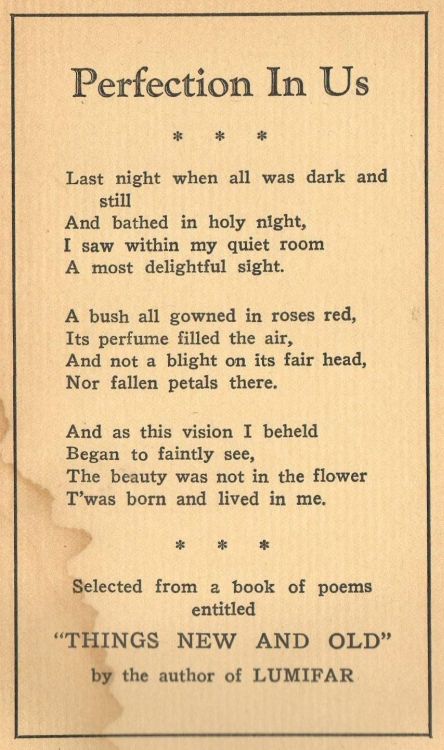
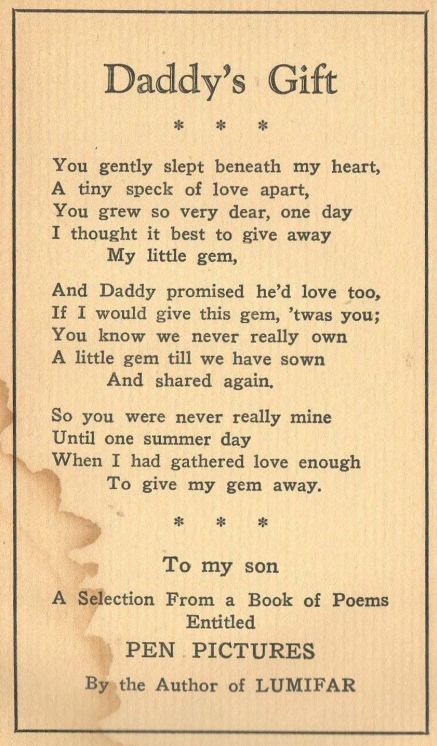
Note 7: At the back of the Argo edition of Lumifar are advertisements for two books of poems, Things Old and New and Pen Pictures, both “by the author of Lumifar.” No details of place or date of publication are given, and no publisher is cited. At the time of writing I have been unable to locate a copy of either of them anywhere. Information about the author being so scant, and since both adverts feature a poem by her, I illustrate them here as Figs. 4c & 4d.
Note 8a: See http://philsp.com/homeville/fmi/n01/n01199.htm#A76 for an excellent listing. Also: http://philsp.com/homeville/fmi/i00/i00840.htm#A7.
Note 8b: See https://fanac.org/fanzines/Satellite/ for a near complete set, but missing February 1939.
Note 8c: See https://www.isfdb.org/cgi-bin/pl.cgi?633460.
Note 9: Though Omar was almost certainly officially regarded as Court Astrologer, there is some evidence that he looked on that post as a sort of penalty for being allowed to pursue his astronomical studies (notably his calendar reform, of course.) See Ali Dashti, In Search of Omar Khayyam (1971), p.45 & Hazhir Teimourian, Omar Khayyam – Poet, Rebel, Astronomer (2007), p.177, but also Mehdi Aminrazavi, The Wine of Wisdom (2005), p.201.
Note 10: Details of Dougan’s life are taken partly from Who is the Potter ?, partly from online ancestry records, and partly from the website of Gnostic Press via the link: https://www.gnosticpress.co.nz/abdullah-dougan/.
Note 11: The Paintings of Abdullah Dougan, edited by Maree Green, John Searle, Kitty Godwin & Pat Field (Gnostic Press Ltd, Auckland, New Zealand, 2009.) Like Who is the Potter ? it was compiled posthumously by followers of Dougan, with some help from his widow, Rosalie. a) p.57–65; b) p.58–9 – Abdullah tells us that this painting can also represent “life striking a person and their emotional and intellectual parts being separated from the body”; c) p.60; d) p.62; e) p.12; f) p.63; g) p.64–5. The paintings can be viewed on the Gnostic Press website: https://www.gnosticpress.co.nz/products/categories/artwork/. The book itself is still available to buy through the Gnostic Press website.
Note 12: Abdullah Dougan, Probings (Gnostic Press, London, 1979). This book was originally written a decade earlier in 1969, but failed to find a publisher. The original manuscript was “edited and minimally added to for Gnostic Press.” a) p.18. Betelgeuse is a bright star in the constellation of Orion, but why that particular star, rather than the more prominent Sirius, for example, is not explained. It is not one of the Four Royal Stars of Persia; b) p.83–5. The name goaffadh seems to have been coined by Abdullah himself, and appears not to be one of Gurdjieff’s neologisms. For the dowsing pendulum see p.47.
Note 13a: Yogananda’s first “End of the World” lecture was reported in Coast Dispatch on 23 May 1940 (p.8). For his response to the Rev. Long see, for example, The Daily News (Bogalusa, Louisiana) 18 September 1945 (p.1 & p.4) and The San Bernardino County Sun 19 September 1945 (p.4). In Canada: The Ottawa Journal 18 September 1945 (p.2.) The story even made the English Press, in The Liverpool Echo on 20 September 1945 (p.2), The Huddersfield Daily Examiner on 22 September 1945 (p.2) and The Yorkshire Post and Leeds Intelligencer on 22 September 1945 (p.4).
Note 13b: See Coast Dispatch 12 January 1939 (p.1) & the Washington Evening Star 21 February 1939 (p.25).
Note 14: Despite this being such a famous quote, the earliest source I have seen for it is Walter Thornbury’s book The Life of J.M.W. Turner R.A. (Hurst & Blackett, London, 1862), vol.2, p.130. Thornbury cites Peter Cunningham as his source, but I have not to date found a copy of it, for it is not in the Memoir by Cunningham contained in John Burnet’s, Turner and his Works (David Brogue, London, 1852).
My thanks are due to Dr. Paul Barker of the Leeds Lodge of the Theosophical Society and Melissa Meims, historian of modern witchcraft and magic, for their efforts (alas unsuccessful) to find information connecting J.S. Pattinson the Theosophist with the book The Symbolism of the Rubaiyat of Omar Khayyam. I must thank Steve Kean, whose great aunt was Florence Margaret Huntley, the first wife of E.L. Gabrielson, for making his detailed family tree available to me. Unfortunately he knew nothing of Gabrielson’s Rubaiyat activities. For their invaluable help in tracing much of Gabrielson’s literary output, I must also thank the compilers of the excellent websites referenced in note 8. Finally, my thanks are due to John Searle of the Gnostic Press, one of the editors of The Paintings of Abdullah Dougan, for his comments on some of Dougan’s work, and to the Gnostic Press website for the use of their material as referenced in Notes 10 & 11.
**********
To return to the Notes and Queries Index, click here.
To return to the Index of the Rubaiyat Archive, click here.