The Rubaiyat of Omar Khayyam illustrated by E. A. Cox was first issued in a limited edition of 1000 copies by F. Lewis Publishers Ltd. of Leigh–on–Sea, Essex, in 1944, and was subsequently issued as an ordinary / cheap edition in 1945, with a reprint in 1946. It uses FitzGerald’s first version and contains eight illustrations in colour It is Coumans #53 & Paas ##2969–73.
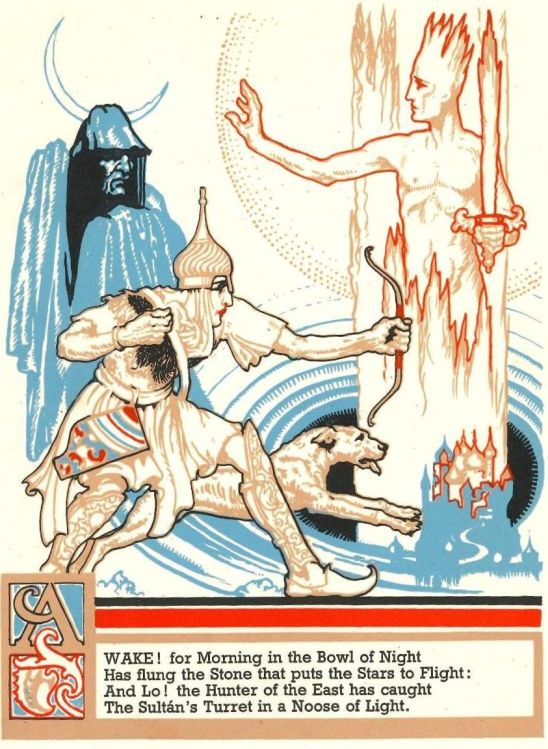
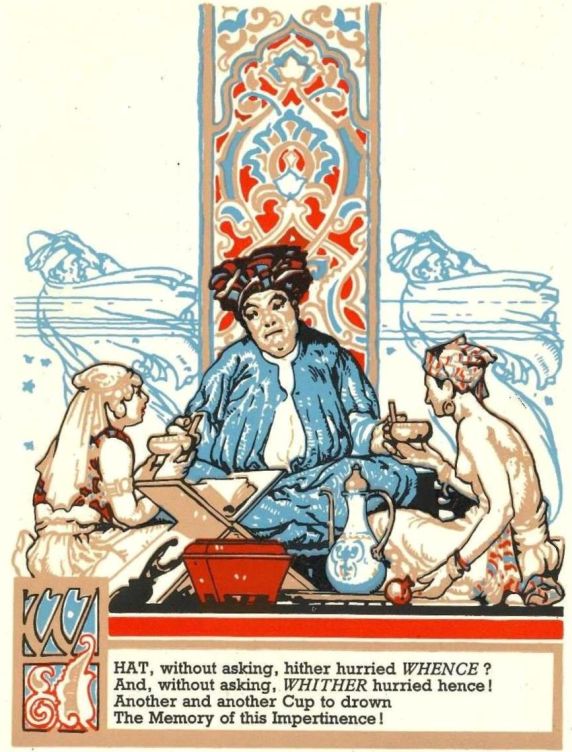
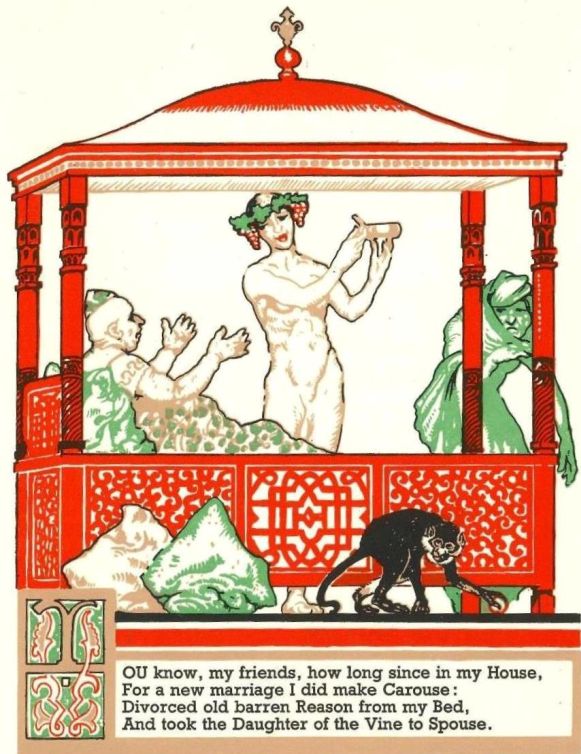
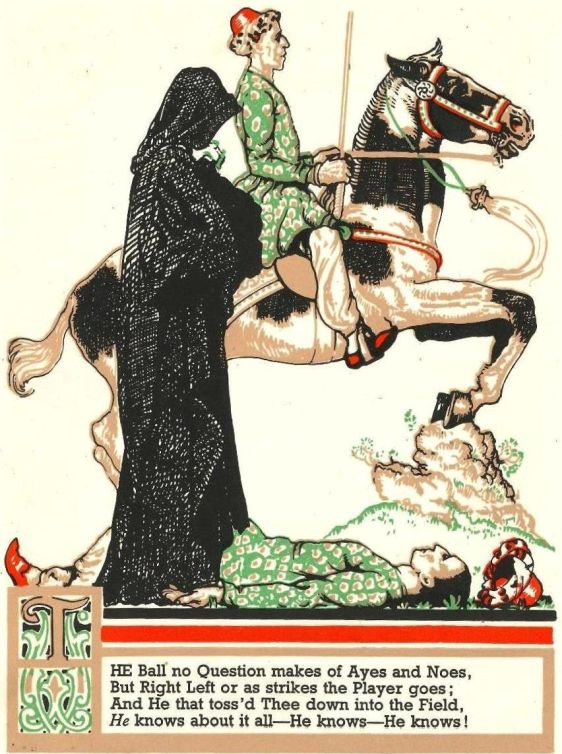
With a rather strange arithmetical regularity after the illustration of the opening verse, they illustrate quatrains 10, 20, 30, 40, 50, 60 &70! Some of the illustrations are fairly literal and routine, but the five more imaginative and interesting ones are as follows.
Fig.1a (quatrain 1): The figure on the right is clearly the flaming Sun rising out of a sort of whirlpool of Night, represented by the figure on the left with the crescent moon. The figure with the bow (without string or arrow!) is clearly the Hunter of the East, with a nod towards the Sultan’s Turret at the bottom right. Note that anything associated with Night is in blue, and associated with Day in brown – the Sultan’s turret is in brown, but the rest of his palace still in blue. This is a neat, but a rather clumsy juxtaposition of images.
Fig.1b (quatrain 30): Omar is presumably the central figure, being offered “another and another” cup of wine simultaneously by two Sakis. The left hand of the girl on the right seems to be reaching for what looks like a pomegranate, and to the left of the red casket–like object is what looks like a stag beetle or scarab! Both are rather puzzling. It is true that the pomegranate and scarab are both symbols of rebirth, as opposed to the “Impertinence” of Death, but perhaps that is to read too much into it. The two figures in blue in the background seem to be being swept along by a wind, presumably – and rather crudely – indicating “hither hurried whence.”
Fig.1c (quatrain 40): The figures of Omar, the Daughter of the Vine, and Old Barren Reason are clear enough, in a format used by other illustrators, but what of that monkey, and what has it got in its left hand ? Is it sneaking off after stealing a piece of fruit ? If so, presumably it is nothing more than a light hearted addition to the scene. On the other hand, the monkey in the Quran signifies the displeasure of Allah (Surah 5.60), so it is possible there is more to it than a bit of a joke.
Fig.1d (quatrain 50): The figure on the horse is clearly “the Player”, with a polo stick rather than a mallet, and the dark cloaked figure Death (without his usual scythe), astride his latest victim, lying on the ground beneath him. Again, a neat but rather clumsy juxtaposition of images.
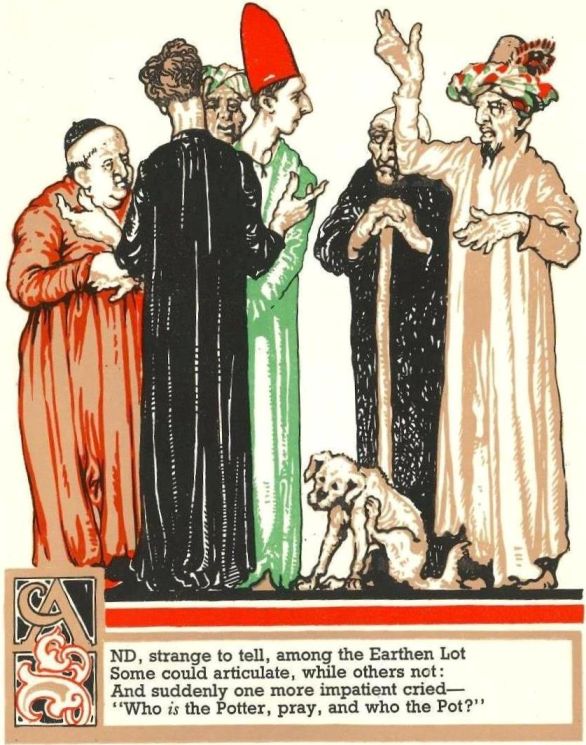
Fig.1e (quatrain 60): Most artists tend to illustrate “that Earthen Lot” by clay pots with human characteristics, but Cox dispenses with clay pots altogether and simply depicts their human form, the one on the right clearly asking “Who is the Potter, pray, and who the Pot ?” The dog scratching itself is a curious addition. It may be a subtle reference to the futility of such questions, or it may be just a bit of a joke, like the monkey in Fig.1c. Certainly, as we shall see presently, Cox could be described as “impish.”
It has been said that Cox’s illustrations are only pseudo–Persian, arising from the ‘orientalist’ misconceptions shared by so many other Rubaiyat illustrators who cannot tell their Persian from their Turkish. To be fair, though, most of us would find it difficult to judge reliably for ourselves.
[The images can be browsed here.]
In 1946, the same year in which F. Lewis Publishers Ltd. issued their reprint of the trade edition of The Rubaiyat, they also issued a limited edition of 1000 copies of FitzGerald’s abridged translation (1) of Jami’s Sufic allegorical poem, Salaman and Absal (It is Paas#6854.) It too was illustrated by Cox – in fact, Cox is one of very few artists who have illustrated both texts (2). He did eight coloured illustrations for it, of which I give four examples here.
Fig.2a (p.18) illustrates the opening line of the “Preliminary Invocation.”
Fig.2b (p.31) shows Salaman playing a lute at an evening banquet, after a day of sport.
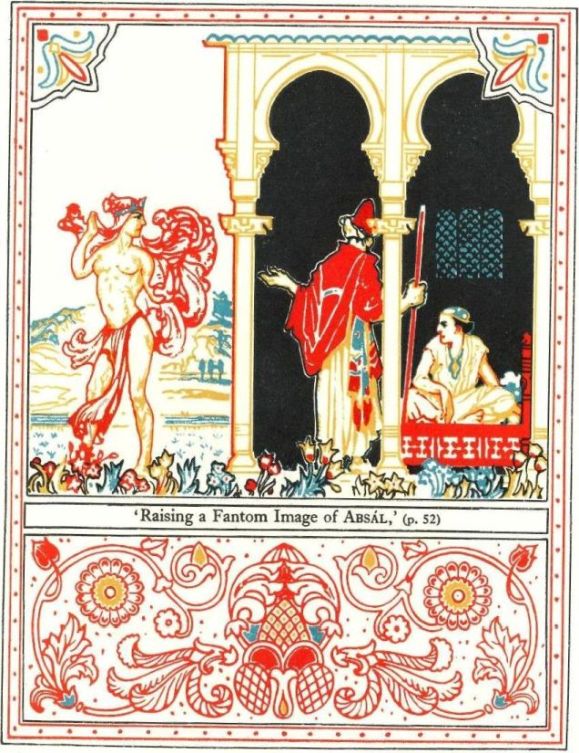
Fig.2c (p.53) shows the Sage conjuring up the image of the dead Absal for the mourning Salaman.
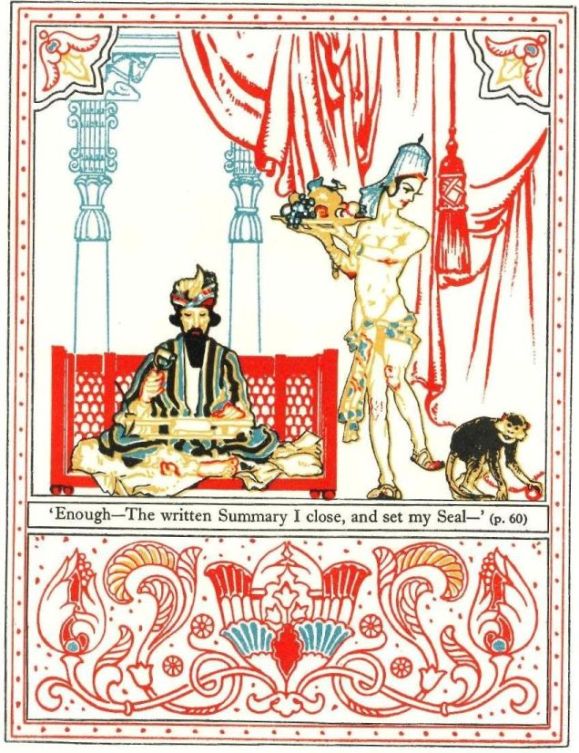
Fig.2d (p.61) seems to have arisen from Cox’s own invention, for it is associated with the closing lines of Jami’s explanation of “the meaning of this Mystery.” It presumably pictures Jami, holding his seal at the end of his Work, with a Serving Girl bringing him a tray of refreshment. And the monkey (with fruit ?) she is kicking up the backside ? That reminds me of the monkey in Fig.1c, though here it seems more likely to be, like the scratching dog in Fig.1e, a bit of fun!
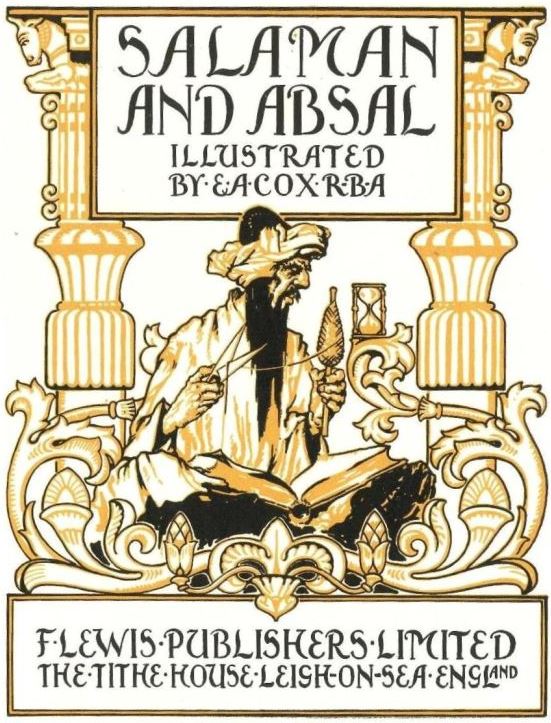
But we are not quite finished yet, for the title–page of the book (Fig.2e) gives us something else to ponder on. Note the hour glass and the spindle of thread being cut by the bearded figure. It could relate to the discussion between the Shah and the Sage about the blessings or otherwise of a son, in which the Sage says, of a wayward son, one could “pull / Him and his vices from the string of Time” (p.26). But one is also reminded of the Three Fates of Greek Mythology: Clotho, who spins the thread of life, Lachesis, who unwinds the thread of life for each individual, and Atropos, who decides when to bring about death by cutting that thread. Personally I find this one of Cox’s more interesting illustrations.
[The images can be browsed here.]
Cox illustrated other books for F. Lewis Publishers Ltd., to which we shall return later. At this point it is useful to take a look at the life of the artist. Though he does feature in the standard dictionaries of book illustrators and has his own Wikipedia page, much has remained untold.
Elijah Albert Cox lived most of his life in London, retired to Kent, and died in the Kent & Canterbury Hospital at Canterbury, on 20 April 1955. If it seems odd to begin with his death, there is a reason for this, for he became well enough known in the county to merit a lengthy article about him in The Kentish Express on 22 October 1954 (p.6). Under the heading “Cheerful Cockney Painted His Way Through Life – Kent home for an artist’s artist,” this is well worth quoting in full here:
Seventy–eight years ago yet another child was born to the Cox’s, of Islington, a furniture decorator and his wife. To them he was just “Nip”, the tiniest boy of the family, who as soon as he was able, wandered day and night along London’s dockland streets and waterfront.
Today he is the sprightly little man Mr. E. Albert Cox of the Little Thatched Cottage, Woollage (sic) Green, near Womenswold, off the Dover–Canterbury road, who so nearly reached the pinnacle of fame in a life as an artist’s artist.
For Cox is one of those men who have stood beside and behind the great, shared their life and work; the superb craftsman who has never had the spark of genius. A painter who could brilliantly light a huge canvas, copy faithfully and create a scene, he owes much to the man who made him his chief assistant, the volatile Sir Frank Brangwyn, RA.
On big stretches of canvas Cox did the upper work while Brangwyn, who would never climb a ladder, worked below. Often there surged in the impish Cox the thought of dropping some colour on to the often irascible genius, but reverence for the Master – and the thought of quick expulsion from the studio – drove the thought away. But there was one day when he got the full blast of the RA’s tongue. They began work on a long canvas and Brangwyn used his colours so forcibly that Cox could not work at the other end, so they came together elbow to elbow in the centre – until Cox trod on the Master’s pet corn – and it was a wonder that the canvas did not smoulder.
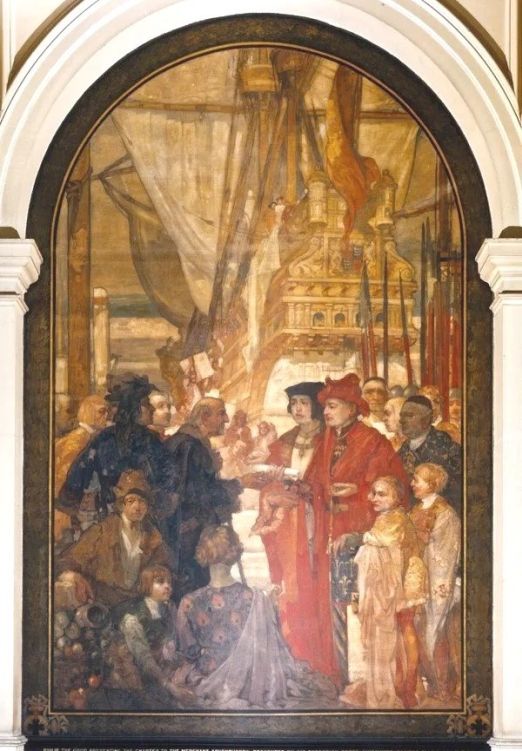
For years Mr Cox was the painter of the Brangwyn scene before setting out on his own. This move brought him a panel at the Royal Exchange – Philip the Good of Burgundy receiving the charters from the Merchant Advocates – alongside those of his old master, Dame Laura Knight and others. That was when the colours had to be mixed with oil of lavender. “I stank of it, and people looked at me when they smelt me, as I went home,” he says.
Then there was a big mural in the offices of the Orient Shipping Line, but soon posters claimed him – not wholly – and Mr Cox became one of the best known commercial artists of his day.
He loved and longed to follow true art, but his life, deep etched by boyhood scenes of gin palaces, crowded, bawling third–rate theatres, the surging flare–lit markets, the quarrels and drink at home with moonlight flits from East End homes gave him the force to get his best reward from commercial life.
Little schooling, wanderings through Hackney Marshes, along the banks of the Lee; work with tools helping his father to decorate the painted furniture of the day; all this taught him the discipline of work allied to the ethereal softness of sea and sky and set him long before he knew it, into the world of art.
The front of a pub seen from his home across the Whitechapel Rd., lace curtained and brass bound, painted on the inside of a cardboard box lid and bought by the landlord for a few shillings was the start of his career. Soon every pub in the neighbourhood had one, framed and admired.
“Nip” tried his hand at many trades and school was not for him. All he knew was that he wanted freedom – to see and draw the ships on London river, sketch and colour the garish scenes of Bank Holidays on Hampstead Heath, where he sold winkles and butter scotch from a barrow.
Jeered at by the boys and gangs of the locality, sometimes taking a beating because he was not good enough at their rowdy games, Cox tended to lead a lonely life in search of beauty of form. Never for him have days been long enough for what he wanted to do, and nobody worried if he did not come home.
These were the conditions which drove Cox to draw and paint on any scrap of paper he could find. It was a chance drawing of a full rigged ship from a model in a ship chandler’s doorway and seen by a patron of the arts who looked over his shoulder which set him finally on the road to the life he loved – and to the art school in the Mile End Rd.
His art did not keep him so he sold fruit, cut linings for neck ties in a factory and then for fourteen years bound himself as a designer to Burroughs, Wellcome & Co., the manufacturing chemists.
Then came his association with the Master. But for the last 25 years Kent has held the heart of this amazing man who lives alone, made his own furniture, and created a formal garden with hedged lanes from a wilderness. Pillars, sculptured figures, a fish pond and a rebuilt arch are all his own work surrounding the four roomed cottage with no modern conveniences in Beggars Lane.
Once he mended his shoes and sewed his patches but now he seeks outside help.
Brushes and a pipe litter the table where he eats and now cares not for the commercial world. Although his life is still full and his agility boundless, the mainspring is running down. The old caravan in which he travelled the countryside and Romney Marsh in particular stands outside the cottage – without a horse and not likely to have one since Tom has gone.
Albert wants to live another 30 years – if fate will let him. For in his withdrawal from the world “Nip” has found peace – and sadness that fate had decreed that this slumland child should so nearly reach the top – and be left wanting.
Albert, for all his work, was never elected an RA.
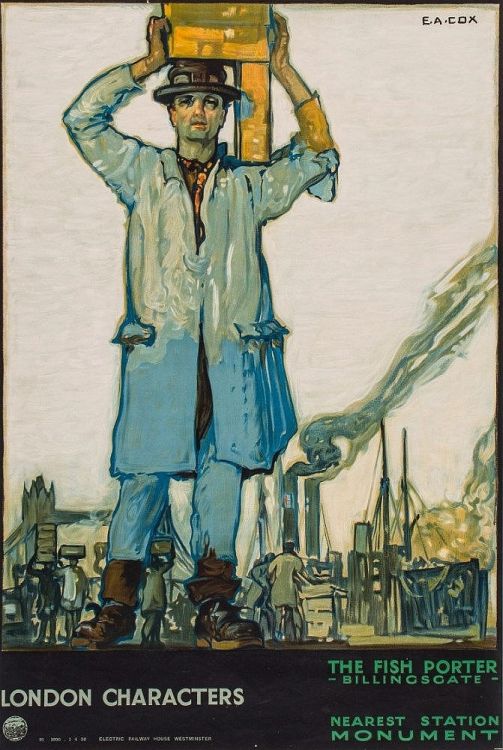
Note the “impish” description of Cox, which perhaps explains some of the quizzical details in some of his illustrations. His panel at the Royal Exchange, titled “Philip the Good presenting the Charter to the Merchant Adventurers,” is shown in Fig.3a. Examples of his poster work are plentiful. Fig.4a (c.1925) shows one for the above mentioned Orient Shipping Line; Fig.4b (issued in 1920) depicts “The Fish Porter”, one of a series of “London Characters” done as a poster for the London Underground; and Fig.4c (c.1923) is a tourist poster advertising the delights of Brighton. We shall return later to his paintings – his escape from the world of commercial art to fulfil his “longing to return to true art.” Meanwhile, we can now supplement the above account with material from other sources.
Cox was born in Islington, London, on 16 October 1876, the son of William Cox and his wife Avies. From the above, we learn that he led a rather deprived childhood in the poverty–stricken slums of the East End of London, the last born, and quite possibly unplanned, even unwanted, child of a large family. The 1881 UK census reveals that our artist, aged 4, was by far the youngest child in his family, then living at 68 Rotherhithe Street, Southwark in South London. His father was 50, his occupation listed as Decorator, and his mother 47; his brothers James (age 29) & Francis Henry (age 20), both also Decorators; another brother Joseph (age 18), was a Shop Lad, and his sister Alice (age 15), a Servant. (In fact, there seem to have been five other older siblings, though these were not living with their parents at the time of the 1881 census, and at least one may have died young.) As we saw earlier, his father was a furniture decorator, though he could perhaps have turned his hand to house decoration with paint, varnish and wallpaper etc. On our artist’s record of baptism at the Church of St. Mary, Islington, his father’s occupation is given as “Artist” which sounds grander than it was.
As regards Cox’s early education, as we have seen it was both unwanted and minimal, but later he seems to have studied at and benefited from the so–called “People’s Palace” at Mile End – the art school in the Mile End Road mentioned in the above newspaper article – though it is not clear when exactly when he was there. Opened in 1887 it offered library facilities and education for the less well–off in the East End of London, and in 1896 became the East London Technical College. Certainly he was living in nearby Bethnal Green at the time of the 1891 census and in the Mile End area at the time of the 1901 census.
At the time of that Census (31 March 1901), our 24 years old “Artist Designer” was single and apparently living in lodgings at 234 Devonshire Street, Stepney. Later that year, on 1 December 1901, at St. John’s Church, Bethnal Green, Elijah Albert Cox, aged 25, a bachelor, and “Designer” by profession, married Annie Benstead, aged 22, a spinster and of no stated profession.
As regards Cox’s artistic training, we know from a listing of scholarships awarded in the (London) Daily News on 25 March 1902 (p.5) that he gained a scholarship worth £20 per annum (together with free tuition) for three years at the London County Council School of Photo–Engraving and Lithography (otherwise known as Bolt Court.)
On 9 November 1907 the Coxs’ daughter Doris Louisa was born, and on 8 December she was baptised at the same church in which her parents had been married. She was to be their only child, as it turned out.
In the 1911 Census the family are recorded as living at 105 Powerscroft Road, Clapton. The census tells us that he was a Designer, specifically working for a Manufacturing Chemist (though no details are given – it could be illustration of equipment, for example, possibly for advertising purposes, but the firm was clearly the Burroughs, Wellcome & Co. mentioned in the newspaper article.) It also tells us that by the time of this census they had had another child besides Doris Louisa (now aged 3) but that, sadly, he, or she, had died.
In 1917, now aged 40, Cox joined up to serve in the army as a heavy lorry driver, his skills in that department being described as “fair.” To which we might add that his army service passed with no recorded Regimental Offences – he was a well behaved soldier, in other words.
In the 1921 census the family were at 299 Camden Road, London N7. By now Cox is listed as “Artist (Painter)” and working from home, effectively self–employed.
In the 1939 Register Cox and his wife, Annie, are recorded as living at 305 Camden Road, Islington (seemingly a house move rather than a renumbering). His profession is listed as “Commercial Artist”, his wife’s as “Unpaid Domestic Duties” (a housewife, in other words!)
Sometime in the 1940s, as we have seen, he retired to Kent, where, in 1949, he exhibited “a charming watercolour of Rye” at the 35th exhibition of the East Kent Art Society at the College of Art in Canterbury. His address at the time was the above mentioned Little Thatched Cottage, Woolage Green (Dover Express, 5 August 1949, p.2.)
Cox’s daughter survived him, having married to become Mrs Doris Louisa Pruden, and was granted probate on his estate in May 1955. (He had died on 20 April, remember.) As for his wife, Annie, she is a bit of a mystery. The above article in The Kentish Express makes no mention of Cox’s wife and daughter. It is possible that they had separated, though Cox & his wife were together in 1939 after 38 years of marriage, so it seems more likely that she died some time before the article was written. Unfortunately, Annie Cox turns out to be a very common name, so she remains unidentified at the time of writing. One might have expected a lengthy obituary of Cox himself given the length of the article about him quoted above, but no. His obituary in The Kentish Express on 29 April 1955 (p.9) said simply:
Mr. E. Albert Cox, RBA, the painter, who has for years lived alone in a tiny earth–floored cottage at Woolage Green, nr. Canterbury, has died. Mr Cox had worked with Sir Frank Brangwyn, RA, and for many years was his principal assistant.
Even in death Cox stood in shade of Brangwyn.
We can piece together Cox’s work with Brangwyn from various sources. Libby Horner in her Frank Brangwyn: a Mission to Decorate Life (2006) lists Cox amongst Brangwyn’s many studio assistants, telling us that he was a neighbour of Brangwyn’s at Ditchling (3), East Sussex, and collaborated with him from 1925 to 1932 (p.242).
We know that Cox worked with Brangwyn on the so-called British Empire panels. This was a set of 16 huge paintings, originally commissioned for the Royal Gallery in the House of Lords, but eventually rejected by them, subsequently ending up in Swansea’s Guild Hall (Brangwyn was of Welsh ancestry.) The panels were painted between 1925 and 1932 (4).
In his book Brangwyn, published in 1978, Rodney Brangwyn (the artist’s great–nephew) tells us:
All the ground–work for the murals, including the squaring-up of cartoon studies and their transfer from paper to canvas, was done by the artist’s team of four or five assistants, now headed by E.A. Cox, an artist who, like Brangwyn himself, had painted a panel for the Royal Exchange in London. (p.163)
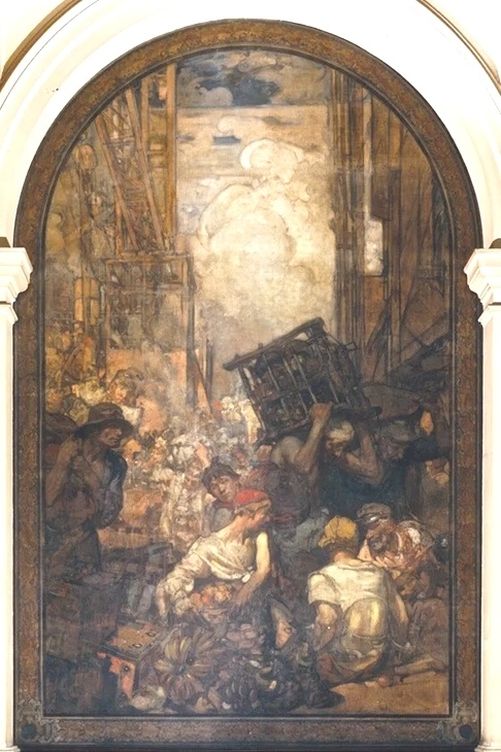
The 24 panels for the Royal Exchange in London, were painted by several artists between 1895 and 1922 (5). Cox’s was the above–mentioned “Philip the Good presenting the Charter to the Merchant Adventurers,” done in 1916 (Fig.3a) and Brangwyn’s was “Modern Commerce,” done in 1906 (Fig.3b.)
The photograph reproduced in Fig.5 shows Cox at work. Taken in 1926 it would seem likely to show him at work at Ditchling. Note the painting in the background looks like one of Brangwyn’s Rubaiyat paintings, though it doesn’t actually match any of his, which, in any case, were all done and published by 1919; plus they appear to have been quite small – only 15 inches by 12 inches (6). It is possible then, that it was Cox doing his own Rubaiyat (or at least ‘Oriental’) painting in Brangwyn’s style. If so, it was never used, and as we have seen, his Rubaiyat illustrations of 1944 (and those of Salaman and Absal) were in a very different style of his own.
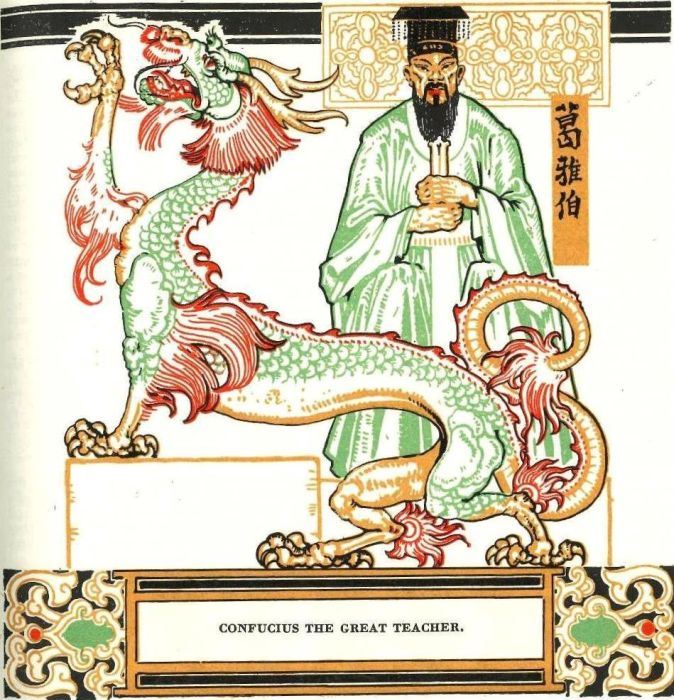
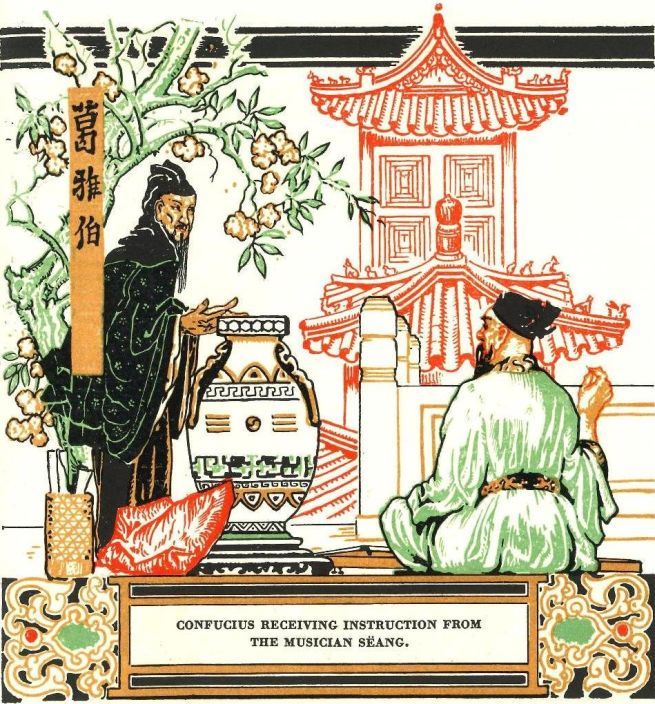
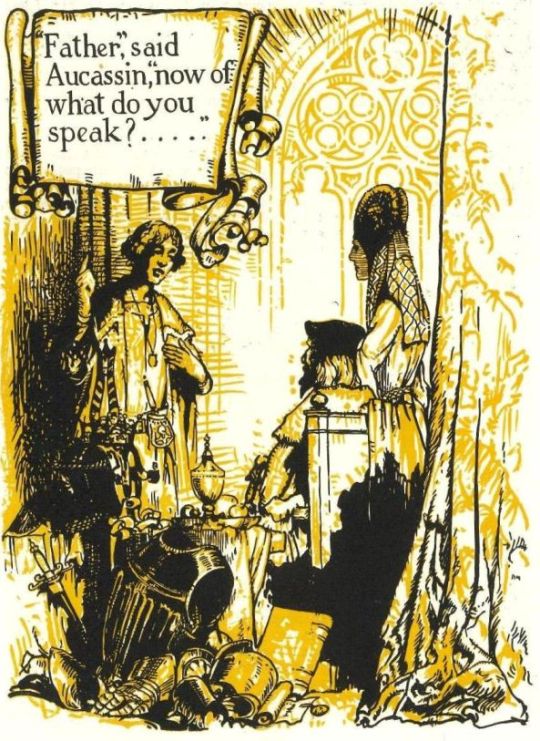
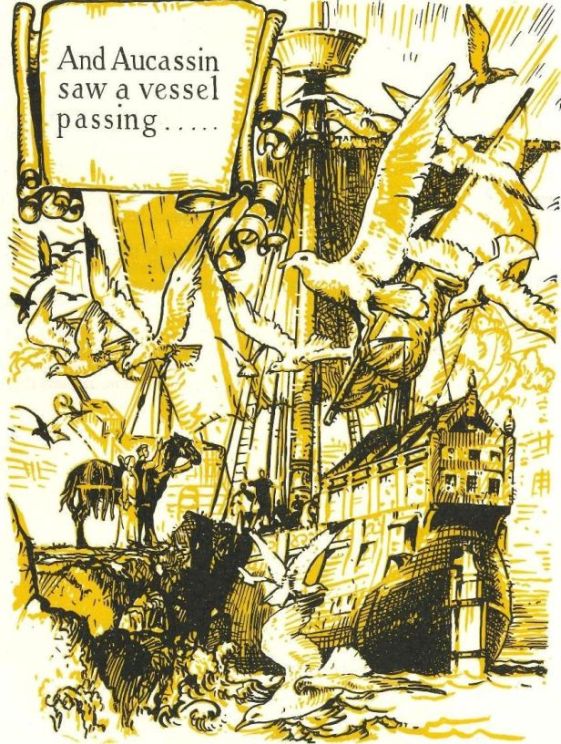
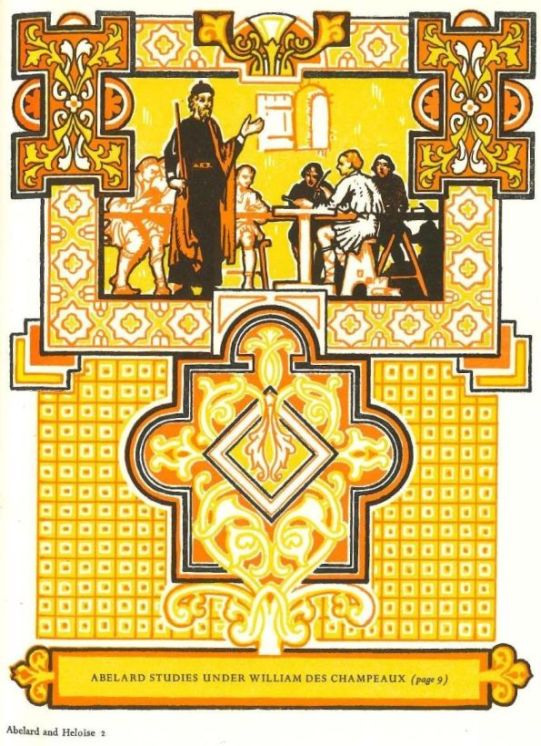
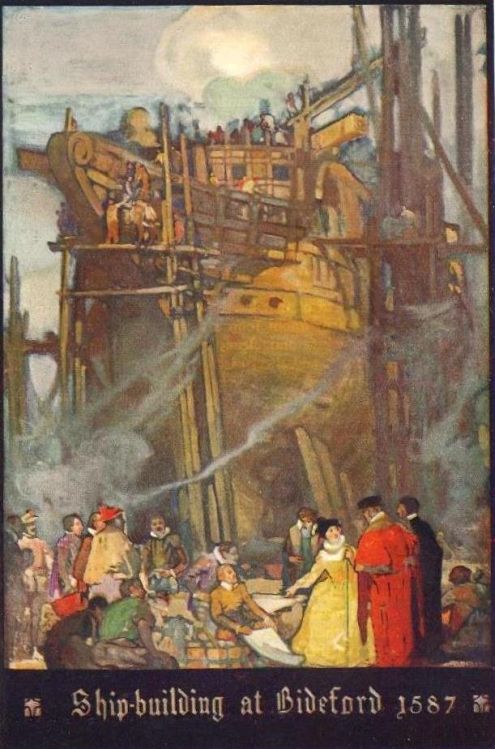
Besides The Rubaiyat and Salaman and Absal, Cox also illustrated for them: The Sayings of Confucius, published in 1946 (Figs.6a (p.11) & 6b (p.25) are examples); Aucassin and Nicolette, published in 1947 (Figs.7a (p.13) & 7b (p.33) are examples); and The Lives, Amours and Misfortunes of Abelard and Heloise, also published in 1947 (Figs.8a (p.17) & 8b (p.49) are examples.) Each of these contained eight coloured illustrations plus illustrated title page.
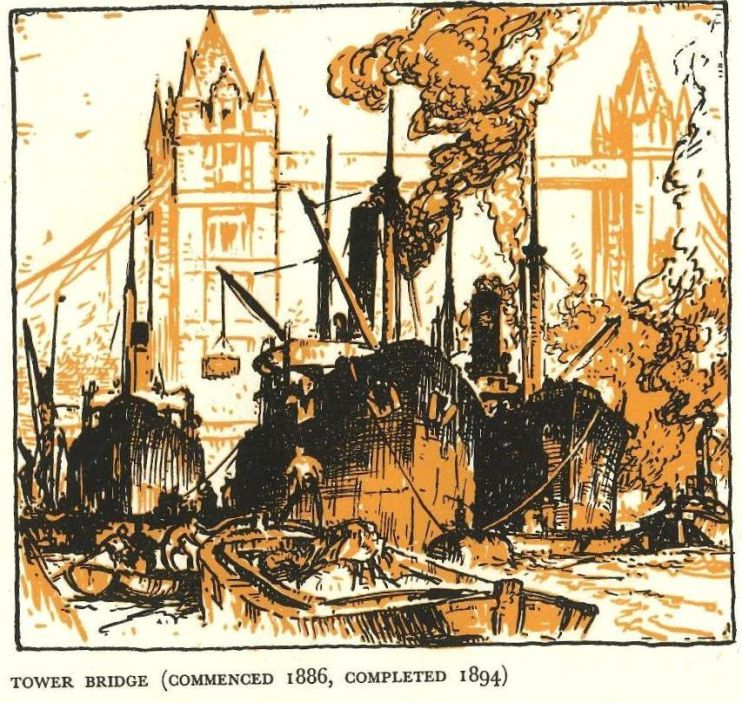
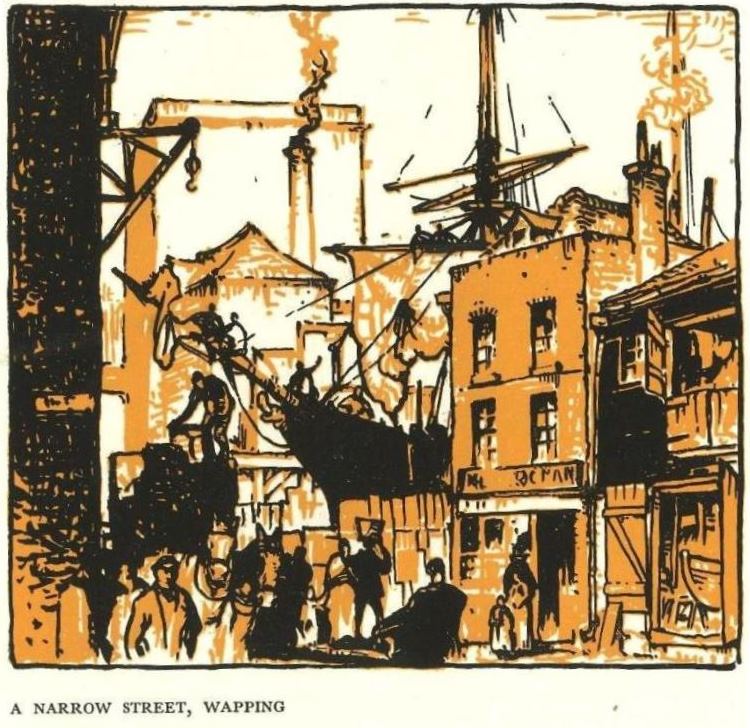
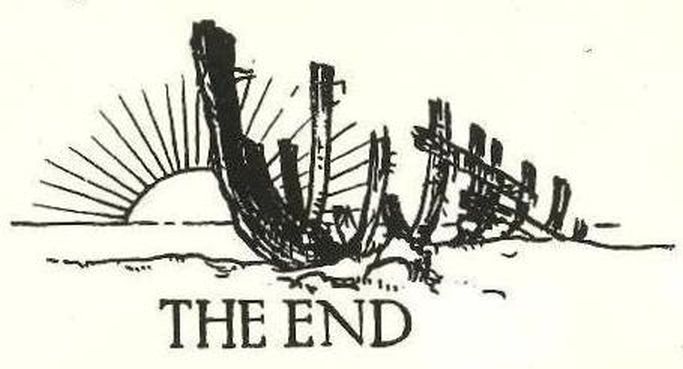
More interesting, in that it relates to Cox’s childhood wanderings in “London dockland’s streets and waterfront,” is his illustrated edition of C. Fox Smith’s book Thames Side Yesterdays published in 1945. In addition to its illustrated title–page (Fig.9a) (7) it contained nine illustrations in the same orange and black colour combination, and numerous in–text drawings. Fig.9b (p.19) and Fig 9c (p.27) are two examples of the former, and Fig.9d (p.45) an example of the latter. As can be seen, these all recall Cox’s urge “to see and draw the ships on London river”, the last, with its skeletal remains of an old ship set against the setting sun, making a fitting end to the book.
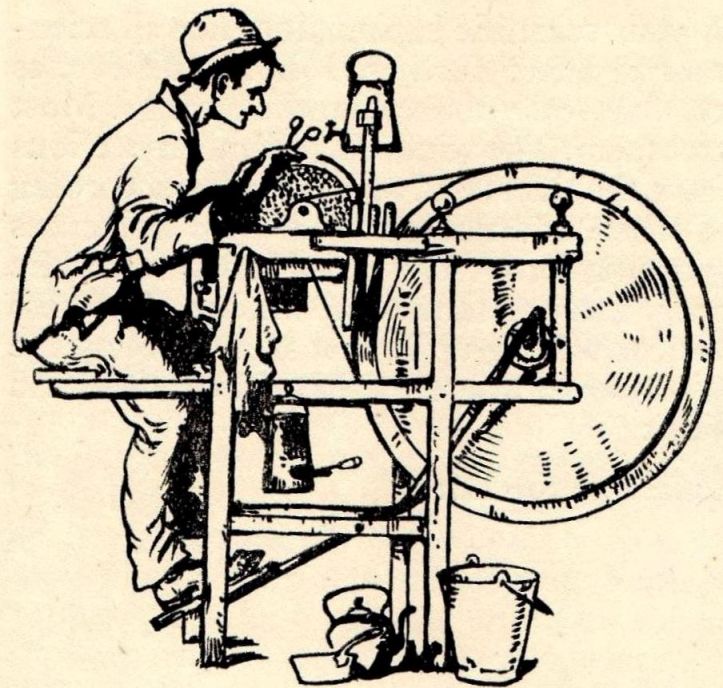
Cox also illustrated for them C. Fox Smith’s other book, Country Days and Country Ways, published in 1947, which was basically a lament for the fast–disappearing life–style of the old English countryside. Like its companion volume, in addition to its illustrated title page it contained nine illustrations in orange & black, and numerous in–text drawings. Figs.10a (p.15) and 10b (p.43) are two examples of the former, and Fig.10c (p.20) an example of the latter. Fig.10a, in the chapter “Heigho ! The Wind and the Rain,” is a nice example of Cox’s impish sense of humour – note the rain water leaking from the lower left of the frame !
[The images can be browsed here.]
The first book illustrated by Cox appears to have been Westward Ho! “Rendered into Modern English” by Charles Kingsley, published by J.M. Dent & Sons Ltd., London in 1923. Two examples of its sixteen coloured plates (including the frontispiece) are shown here as Figs.11a (facing p.180) & 11b (facing p.256) – note again Cox’s fascination for old sailing ships (likewise Fig.7b.)
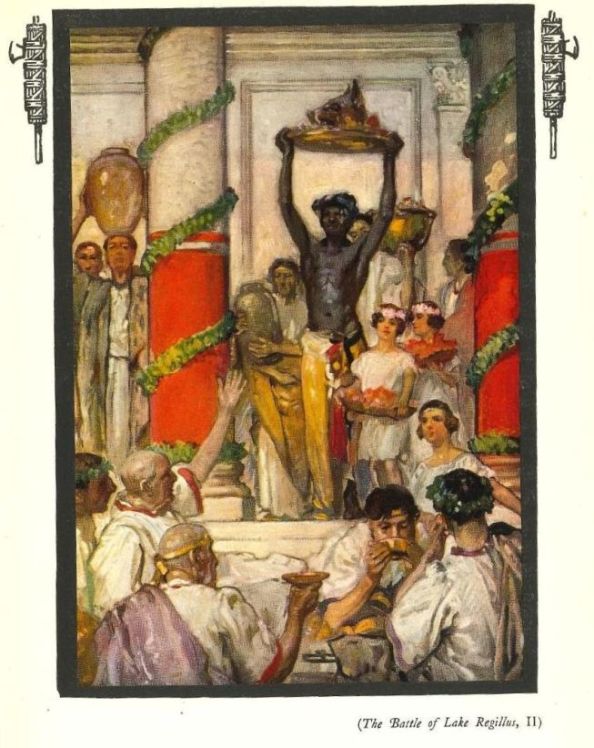
Three years later came an edition of Macaulay’s Lays of Ancient Rome published by Humphrey Milford, Oxford University Press. It was undated, but an entry in The Bookseller dates it to 1926. It contains 12 plates in colour and a coloured frontispiece. Two examples are shown here as Fig.12a (p.59) and Fig.12b (p.149). More imaginative is the frontispiece, titled “And Time passes on...”, shown in Fig.12c. The phrase seems not to be taken from Macaulay, though the passage of Time is inherent in the text. The toppled pillar, the ruined arch, a skull wearing a golden crown, and the discarded armour, helmet and lance in the background, all denote the transience of Earthly Power and the erosion by Time of all things – notably Rome. The puzzle though is the dimly lit human figure, the Moon behind him. He seems to be a tonsured monk carrying a hand–held censor with bells. Does he represent the ultimate triumph of the Church over Pagan Rome ? But if so, why the Moon ? I have seen nothing relating to Cox’s religious beliefs. He was married, and his daughter baptised, in an Anglican Church, though that does not necessarily signify anything. But he certainly painted at least two crucifixion scenes (one dated 1917; the other undated) and designed a mural relating to St. Theresa of Lisieux (undated, but must post-date her canonization in 1925.) Again, though, an artist sometimes paints a picture simply because he is paid to do it.
Readers will no doubt note that the style and use of colour in the illustrations for both Kingsley and Macaulay are much in the style of Brangwyn. As we have seen, in his later books for F. Lewis he had developed a style of his own.
In chronological order, he also illustrated Percy F. Westerman’s story A Mystery of the Broads (Blackie & Son Ltd, London 1930); contributed four illustrations to John Mackenzie Wood’s book The Story of England (James Nisbet & Co., London, 1934) – Fig.13 (p.125) is an example; illustrated Verse Time: the Violet Book of Dramatic Poetry (George Philip & Son, London 1936); and did the dust–jacket design for Russell Thorndike’s novel Doctor Syn on the High Seas (Rich & Cowan, London, 1936.)
[The images can be browsed here.]
The British Museum, which houses nine prints by Cox dating from the 1920s and 1930s, tells us that he was elected a member of the Royal Society of British Artists in 1915 and to the Royal Institute of Painters in Watercolours in 1921; that he exhibited at the Chester Gallery, the Royal Academy, the Fine Art Society, the Society of Graphic Artists, the Royal Scottish Academy, the Walker Art Gallery and the Whitechapel Gallery; and that his work is held by the Victoria and Albert Museum, the National Rail Museum, and provincial galleries including Preston, Bristol and Canterbury.
The V&A houses an Orient Line poster like Fig.4a; an extensive series of posters depicting London Characters, of which “The Fish Porter” (Fig.4b) is one; and a large set of travel posters of which Brighton (Fig.4c) is one. (It also houses some of Cox’s preliminary sketches for the illustrations published in Westward Ho! in 1923 and for the figures in his Philip the Good mural, shown in Fig.3a.) The National Rail Museum, of course, houses numerous posters by Cox advertising travel by train and tram, as well as some of the London Characters series and an extensive series of posters relating to “London’s Country” – an example of this last is “Hop Pickers in Kent”, no.5 in the series, shown in Fig.14.
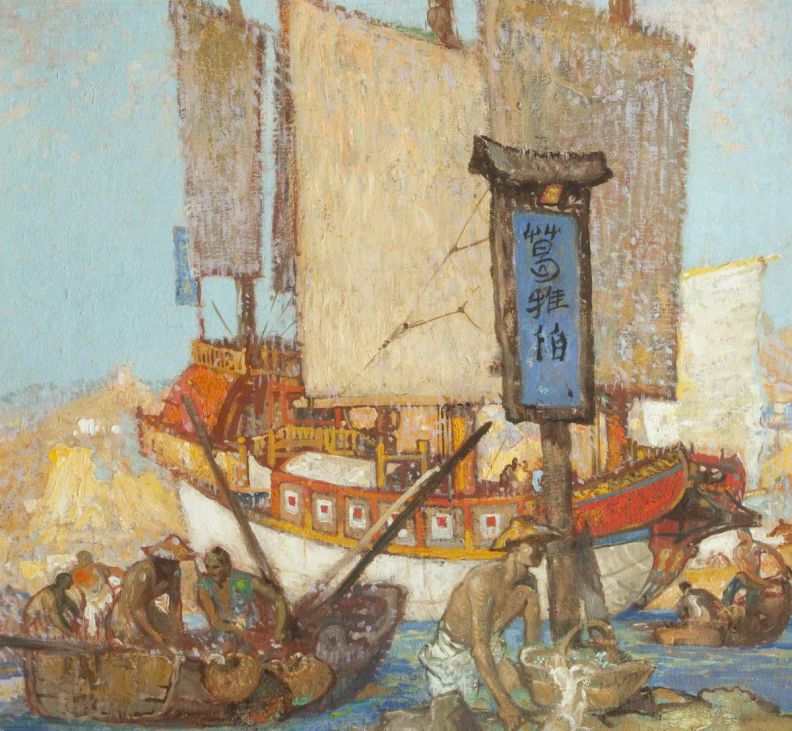
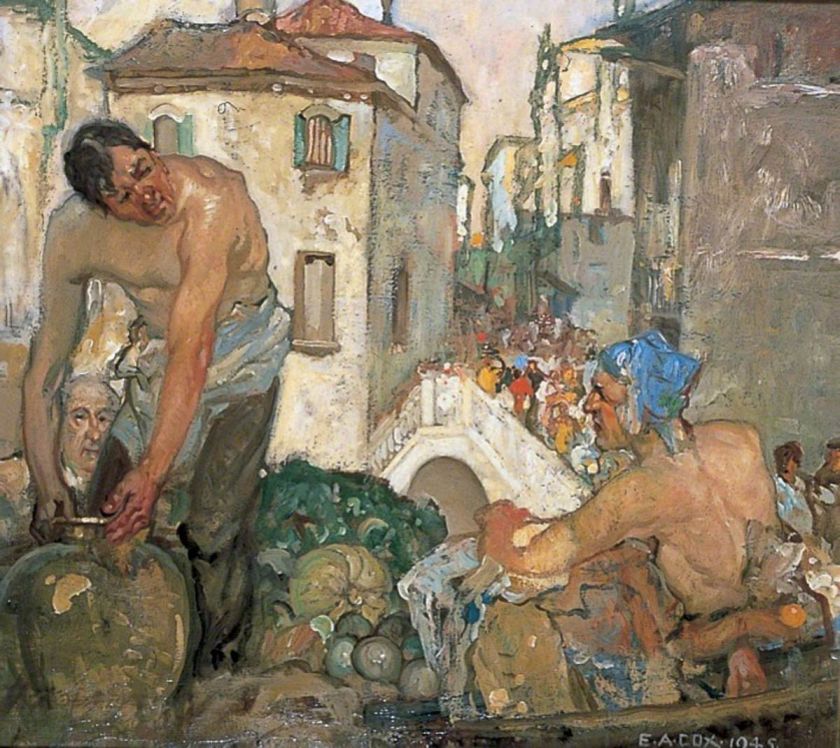
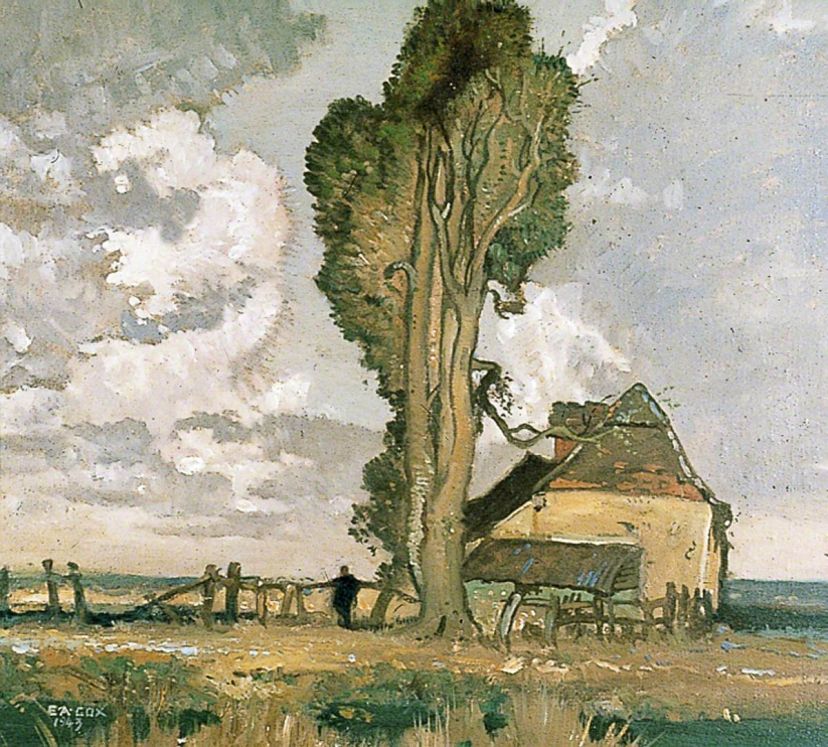
But turning to paintings, the Harris Museum and Art Gallery in Preston houses Cox’s undated painting “In the Land where Time moves slowly” (seemingly China) shown in Fig.15; the Royal West of England Academy in Bristol houses the undated painting “Ann’s Youngest Daughter” (Fig.16). The subject matter of the painting is unclear, but the green apples in the foreground suggest it may have something to do with Maria Ann Smith, aka “Granny” Smith, she of apple fame, though she seems to have had seven daughters and as many sons! If so, was the painting intended for use in an advert ? Canterbury Museum & Gallery houses “Venice” (1945) shown in Fig.17a and “Ancient and Modern” (c.1946) shown in Fig.17b – the latter is a juxtaposed image of ancient ruins (the Roman Forum ?) in front of a Gothic Cathedral (Notre Dame viewed from the south–west ?) Two paintings in Folkestone Museum, both donated by the artist, are “Little Thatched Cottage” (1943) shown in Fig.18a – Cox’s home, as noted above – and “The Departure of William” (c.1948) – William of Orange, perhaps ? – shown in Fig.18b (ships again!)
It is worth reminding ourselves that Cox’s Omarian preoccupation with time in Fig.17b is shared by Figs.2e, 12c & 15.
[The images can be browsed here.]
Personally I find Cox’s story rather sad. He was clearly a talented artist in his own right, yet he is remembered today chiefly for his association with Frank Brangwyn. It seems disproportionately unfair that Brangwyn got a knighthood and was elected an RA, whilst Cox gained neither. But that, unfortunately, is the way of the world. To close with the Omarian lines of Thomas Gray:
Full many a flower is born to blush unseen,And waste its sweetness on the desert air.
**********
Note 1: FitzGerald first published this in 1856 through J. W. Parker & Son of London, with a revised privately circulated version following in 1871. As was FitzGerald’s wont, he revised this yet again, the final version being published with the fourth version of his Rubaiyat by Bernard Quaritch of London in 1879. For full details see A.J. Arberry, FitzGerald’s Salaman and Absal (Cambridge University Press, 1956.)
Note 2: For the de la More Press of London Blanche McManus illustrated various editions of The Rubaiyat starting in 1901 (Potter ##6, 11, 13, 51 & 114; Paas ##1443ff) and an edition of Salaman and Absal in 1904. Later, for the Collins Clear Type Press of London & Glasgow, Margaret R. Caird illustrated an edition titled The Rubaiyat of Omar Khayyam, but actually it also contained Salaman and Absal – four illustrations related to the former, and one to the latter. It was reprinted many times, annoyingly without dates, starting in about 1930. It is Coumans #261 & Paas ##899ff.
Note 3: By the time Cox was there Ditchling had become something of an artists’ colony. Eric Gill had moved there in 1907, followed by (among others) Edward Johnstone in 1912 and Hilary Pepler in 1916. Brangwyn bought a house there (The Jointure) in 1917, but hovered between Ditchling and London for several years, before settling in Ditchling after his wife’s death in 1924.
Note 4: For full details see David Bell, The British Empire Panels (The Guildhall Swansea, c.1960.)
Note 5: For full details see A Guide to the Murals – the Royal Exchange, downloadable as a pdf from https://www.theroyalexchange.co.uk/murals/
Note 6: Ian Elfick and Paul Harris, in TN Foulis: the History and Bibliography of an Edinburgh Publishing House (Oak Knoll Press, 1998) quote Walter Hislop’s memories of the proofing of the fifteen illustrations for the 1919 Foulis edition of The Rubaiyat:
The paintings were small, about 15 by 12, painted in oil. They came to us in two batches, very different in style. It looked as though Brangwyn had done the first lot at his leisure, and the second half after the publisher had agreed to reproduce them, but this is pure surmise on my part. The first batch were smoothly painted and mostly in a low key; the second set were brilliant in colour and, in spite of the small size, executed largely with a palette knife. They were startling at the time, and look quite modern today. (p.28)
Unfortunately the printing was done under post–war conditions, and the final results disappointing, as modern readers will no doubt testify! Elfick & Harris add to this:
In fact, ‘the first lot’ were the original Brangwyn illustrations for Foulis and which appeared in many versions and editions of the Rubaiyat. The second set was prepared specifically for the new edition.
Note 7: The head of Poseidon is here presumably used as a symbol of the maritime commerce of London and the Thames.
**********
My thanks are due to Fred Diba, Joe Howard, Sandra Mason and Danton O'Day for sharing their thoughts on Cox’s illustrations for The Rubaiyat, and on the background painting in Fig.5; and to Libby Horner for sharing her thoughts on Cox’s work with Brangwyn at Ditchling in 1925–1932 and on the puzzling Fig.5. I must also thank the various museums and galleries named in the course of this article for the use of their online images.
**********
To return to the Notes and Queries Index, click here.
To return to the Index of the Rubaiyat Archive, click here.