In 1923, at the request of publisher John Lane, Edward Heron–Allen agreed to write an Introduction to a second edition of Frederick Baron Corvo’s translation of the Rubaiyat of Omar Khayyam, the first edition having been published (unillustrated) by Lane in 1903. It was finally published in 1924 under the title The Rubaiyat of Umar Khaiyam, and with the sub–title, “Translated from the French of J.B. Nicolas by Frederick Baron Corvo, together with a reprint of the French Text. Edited with notes and a comparative study of the original texts, and an Introduction by Edward Heron–Allen FRS. With Sixteen Illustrations in Colour by Hamzeh Carr.” It is Potter #574 & Paas ##4661–3.
Heron–Allen was not hugely keen on Corvo’s translation – and much less on Corvo himself (1) – but he was much more enthusiastic for Carr’s illustrations:
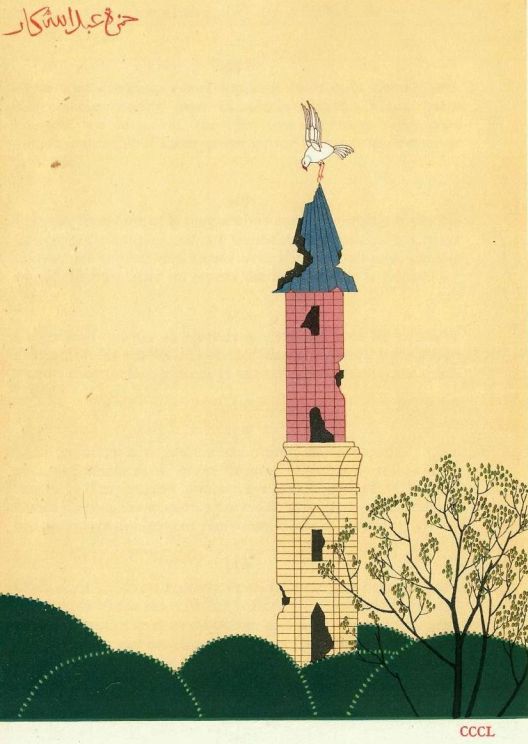
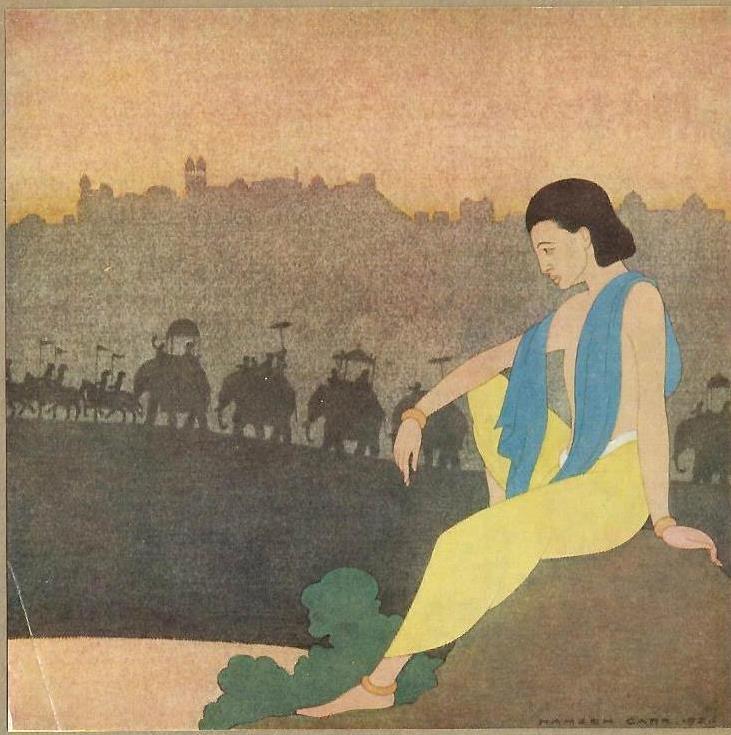
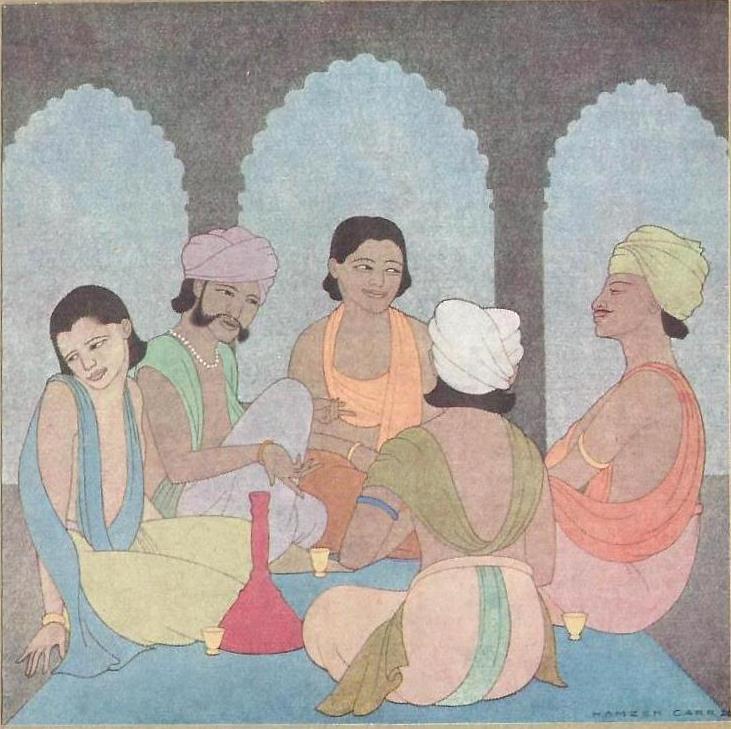
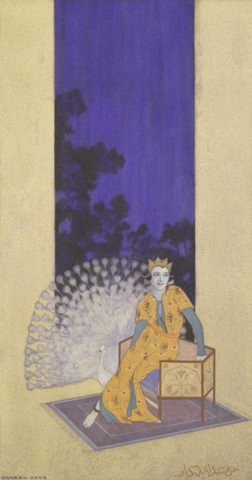
A final word of praise for the eminently characteristic plates contributed to this volume by Hamzeh Abd–ullah Kar. Probably no work published in Europe has been embellished with illustrations so typically and genuinely Eastern as these. They are, to the lamentable, and elaborate prettinesses of Mr. Dulac and his school (so dear to the elemental soul and so popular as suburban Christmas presents), as a mountain waterfall to a penny squirt. If I may be allowed to discriminate where all is so excellent, I would award the meed of highest praise to the Skull upon the ruined walls of Tus, the Moon picture, the Mourners, and the Fakir – I write without any indication of the quatrains to which they are explicative. Mirzah Kar’s work is heretofore unknown to me: I desire its better acquaintance. (p.xi)
Note the Kar rendering of Carr – the Arabic signature on the illustrations does in fact read “Hamzeh Abd–ullah Kar” – though Carr was used on the title–page and was indeed used by the artist himself.
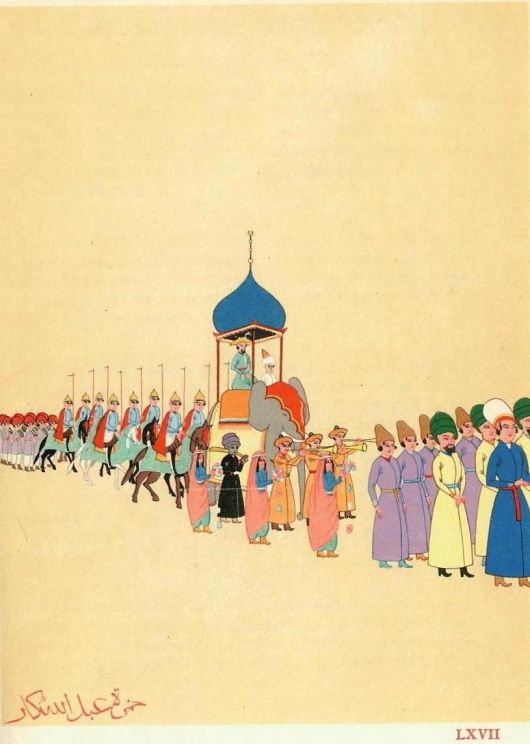
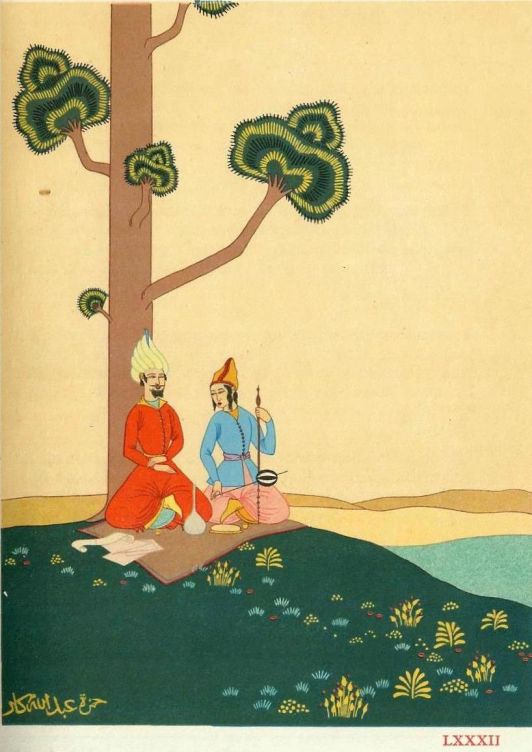
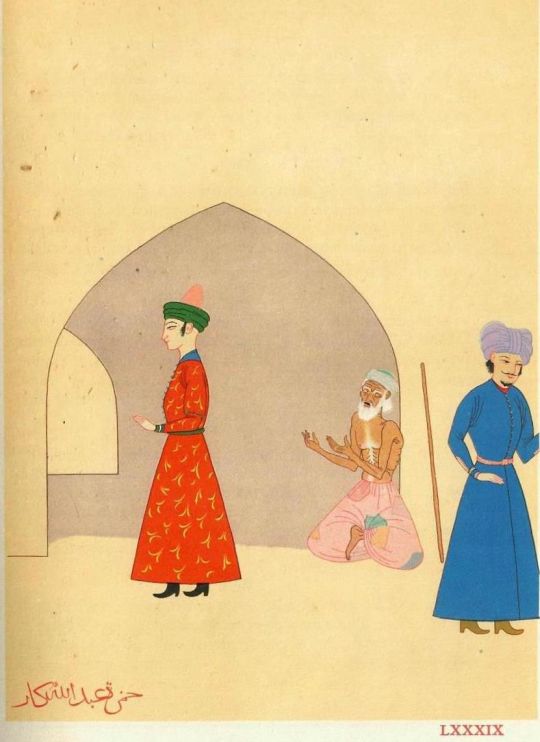
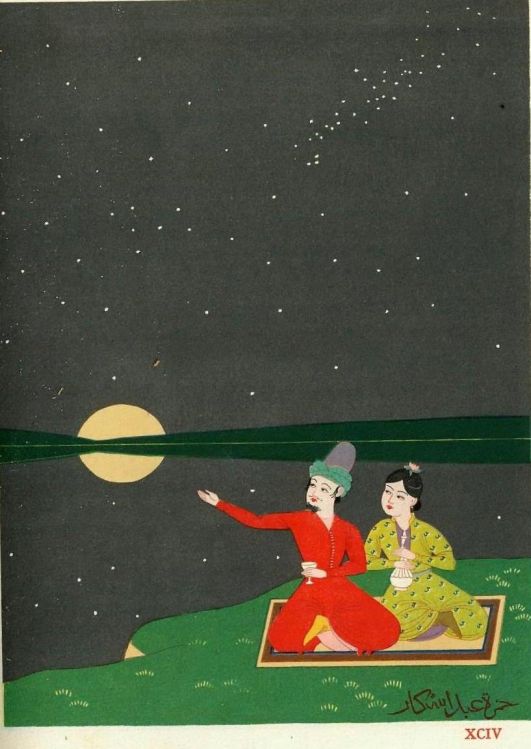
I reproduce ten of the sixteen illustrations here, with a summary of the theme of the verse they illustrate.
Fig.1a – refers to verse 67. This world is a parade of potentates who live and die in turns.
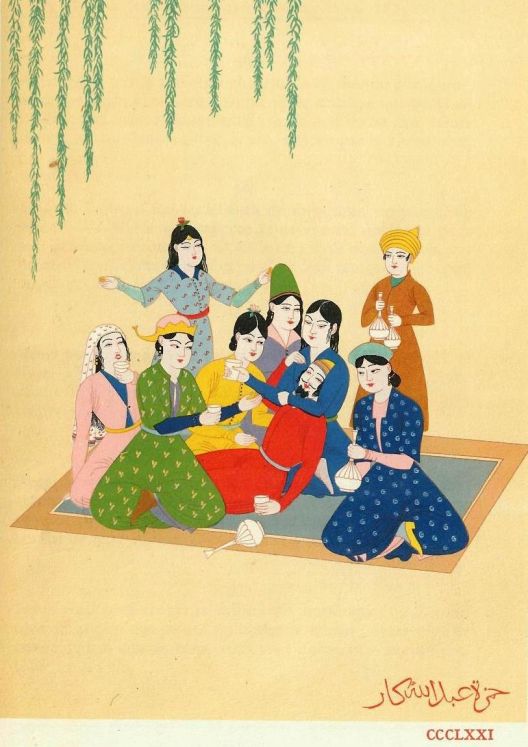
Fig.1b – refers to verse 82. Omar in the Spring–Time, with a Lover like a Houri.
Fig.1c – refers to verse 89 (Heron–Allen’s “Fakir” illustration.) Learn what you are, and where you are going, lest you end in Beggary. A warning against being overly ambitious.
Fig.1d – refers to verse 94 (Heron–Allen’s “Moon” illustration.) This Moon will illuminate the World long after we are gone.
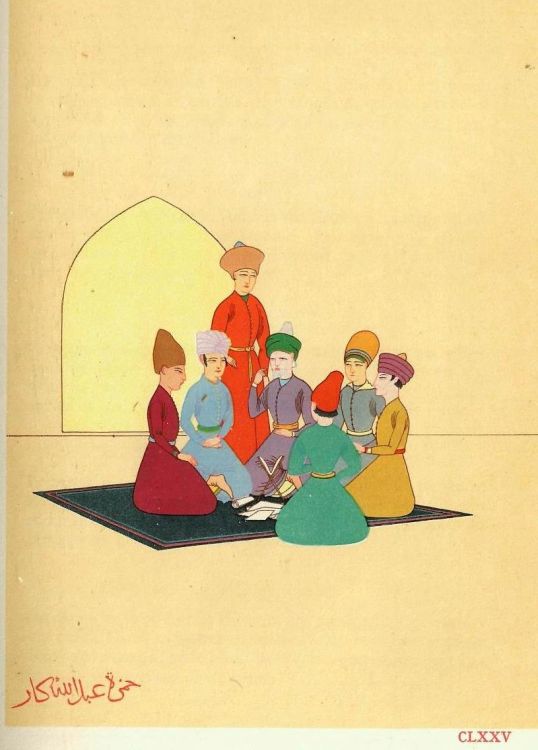
Fig.1e – refers to verse 175. All the attempts of the Learned to solve the Great Mystery of things end in nothing.
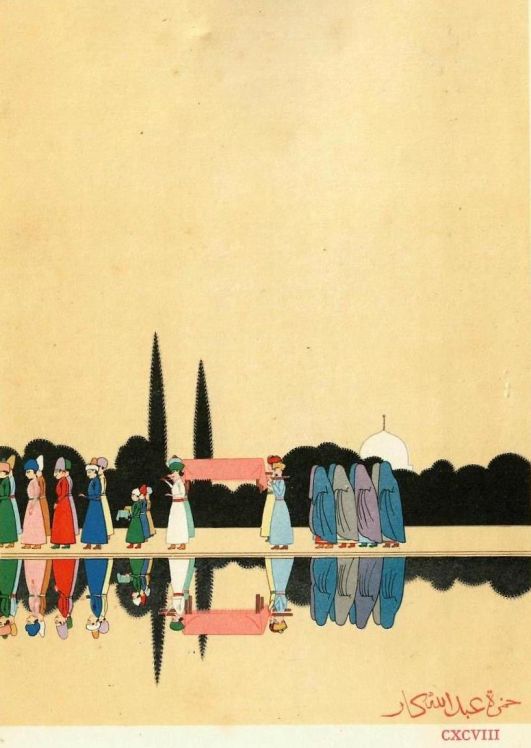
Fig.1f – refers to verse 198. (Heron–Allen’s “Mourners” illustration; the frontispiece.) Those who go to the Grave are destined to be Dust; it is foolish to believe in a resurrection on Judgement Day.
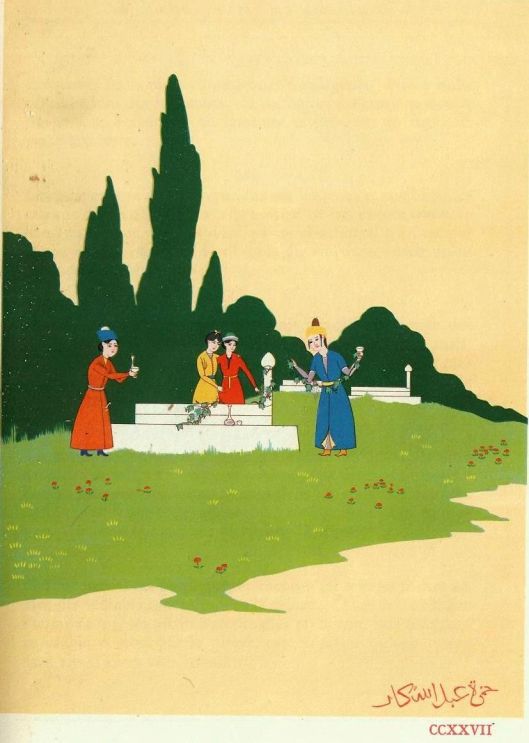
Fig.1g – refers to verse 227. No–one returns from the Grave.
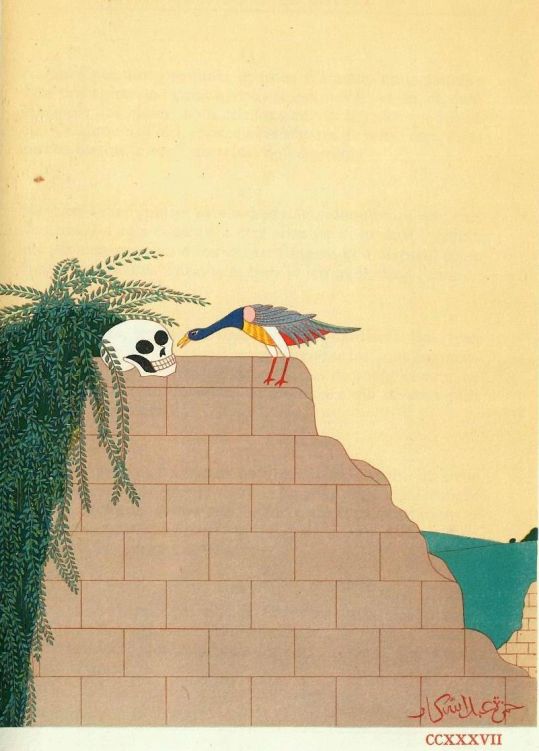
Fig.1h – refers to verse 237. (Heron–Allen’s “Tus” illustration.) A Bird perched on the Skull of King Kavous, asking him, “Where is all your power now ?” The theme of this, like that of Fig.1i below & Fig.1a above, is the transience of earthly power.
Fig.1i – refers to verse 350 – a theme similar to Fig.1h. A Turtle–Dove atop a Tower where a succession of Kings have reigned supreme, crying “Where are they ? Where are they ?” (The dove’s call of “coo, coo” in Persian sounds like “where, where”. See verse 20 of FitzGerald’s second version, and his note on it.)
Fig.1j – refers to verse 371. Omar delivered from the Grief of Time by Wine and Lovers. A “carpe diem” message. (Cf. Fig.1b.)
In 1938 the Illustrated Editions Company of New York published The Rubaiyat of Omar Khayyam, subtitled “Rendered into English Verse by Edward FitzGerald – First and Last Versions – Illustrated by Hamzeh Abd–Ullah Kar.” It is Coumans #257 & Paas #2872.
It used nine of the illustrations from the 1924 Corvo edition, one as a frontispiece, with the others interleaved with the verses of FitzGerald’s first version. Though some of the illustrations were placed facing Fitzgerald’s equivalent of the verse illustrated in the Corvo edition – eg Fig.1b faces Fitzgerald’s famous verse 11 (“Here with a Loaf of Bread beneath the Bough &c”) – other placings are not so apt – eg Fig.1i faces FitzGerald’s verse 53 (“With Earth’s first Clay They did the Last Man’s knead &c.”)
This edition was subsequently reprinted by The World Publishing Company of Cleveland and New York in about 1940 (Paas #4343.)
[The images can be browsed here.]
In 1926 John Lane published an edition of Sir Edwin Arnold’s poem about the life of Buddha, The Light of Asia, illustrated with 16 tipped–in coloured plates by Hamzeh Carr and with an Introduction by Sir E. Denison Ross. Of Carr’s illustrations Ross writes:
One word regarding Mr Hamzeh Carr’s illustrations. As in his Omar Khayyam, Mr Carr has struck a distinctive note which pervades all his pictures. Here one may trace the influence of various schools of art to which Buddhism has given birth, notably, perhaps, that of the Ajanta paintings and that of the Tibetan banners. Symbolism and imagination combine with a deep feeling for Eastern culture, while over the whole series there presides a subdued tone which has been inspired by the underlying solemnity of the sorrowing Buddha. One feels in looking at these illustrations that the artist has been guided rather by the teachings of the modern school of theosophic Buddhists than by the mere study of primitive Buddhism or of the poem itself. At any rate, I feel convinced that the result will make a strong appeal to many enthusiasts. (p.xv–xvi)
An interesting newspaper article written in connection with this edition of The Light of Asia appeared in The Westminster Gazette on 17 September 1926 (p.8.) It was based on a conversation the reporter had with the artist, and information about Carr being so scarce it is worth quoting in full here:
Mr Carr is one of the few Englishmen who have become a Moslem.
“The principal reason for my becoming a Moslem,” he told me, “was a rebellion against prejudice. It seems to me such an impertinence that any one religion should presume to claim a copyright – as it were – to salvation. I am by no means an orthodox Moslem, for, as a Theosophist, I now see that all religions must be one, though differing slightly in the presentation of truth.”
“Naturally my beliefs influence my pictures. In my illustrations to “The Light of Asia”, for example, I have tried to give some idea of the aura, for in illustrating such a wonderful book one feels most acutely how inadequate our conventional methods are.”
“The great difference between Western and Eastern art is that the former is materialistic and the latter is not, and in my future work I shall try the Eastern plan of painting from ‘within’.”
Mr Carr, who spends his winters in Cairo, and comes to England for the summer, designed all the scenery for the recent production of “The Green Hat,” and also the tropical scene for Somerset Maugham’s “The Moon and Sixpence.”
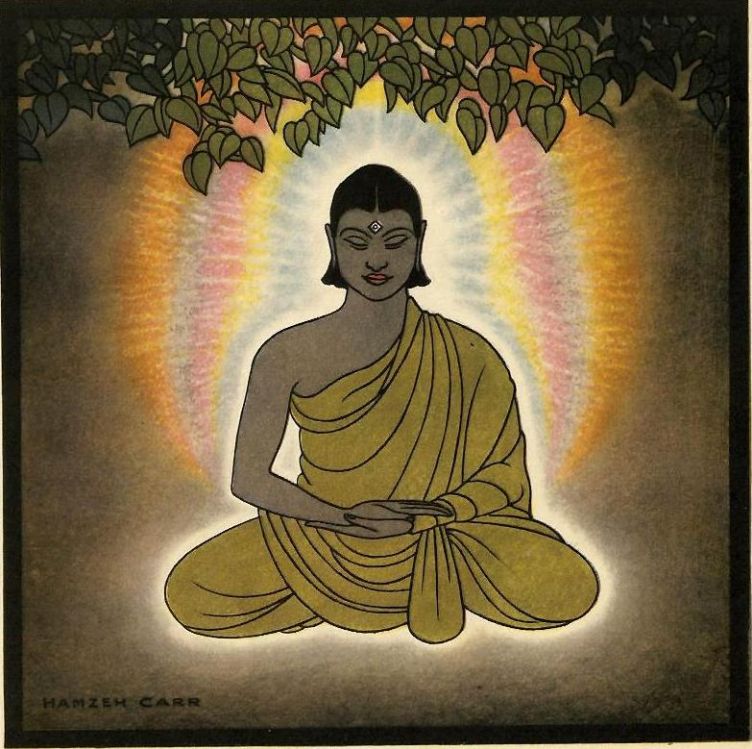
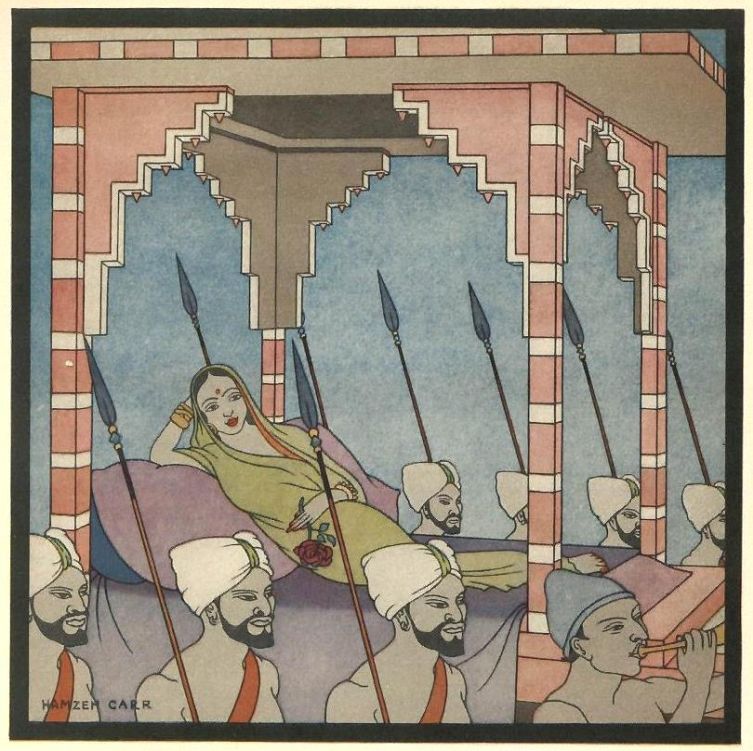
We shall have more to say about Carr, Theosophy, and his scene painting for the theatre later. Meanwhile, I give six examples of the illustrations here. Note that the signature on each is HAMZEH CARR. Note also how the depth of Buddha’s aura increases with the degree of his enlightenment.
Fig.2a (the frontispiece) Presumably a generic image of Buddha.
Fig.2b (facing p.26) Illustrates the line “...and the maid went too”, the maid being Yasodhara, the future bride of Prince Siddartha.
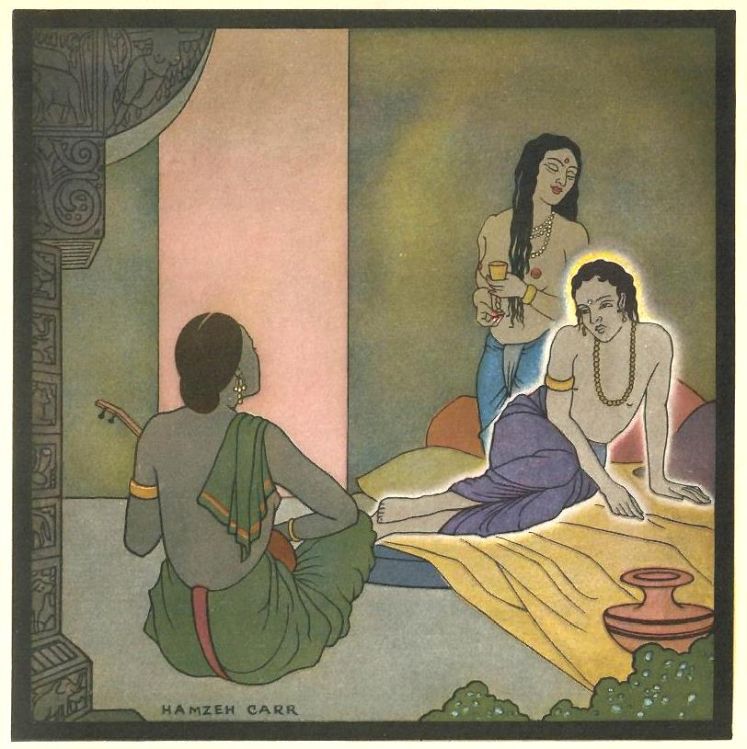
Fig.2c (facing p.44) Illustrates the line (on p.43) “...and some maid told an ancient tale.” The scene is in the palace of Prince Siddartha, where he is listening to some evening entertainment. This is before he has a desire to see the outside world, but his slight aura already reveals his approaching enlightenment. As a result of witnessing the sufferings outside the Palace, of course, he renounces his royal heritage, and leaves Yasodhara, to become Buddha.
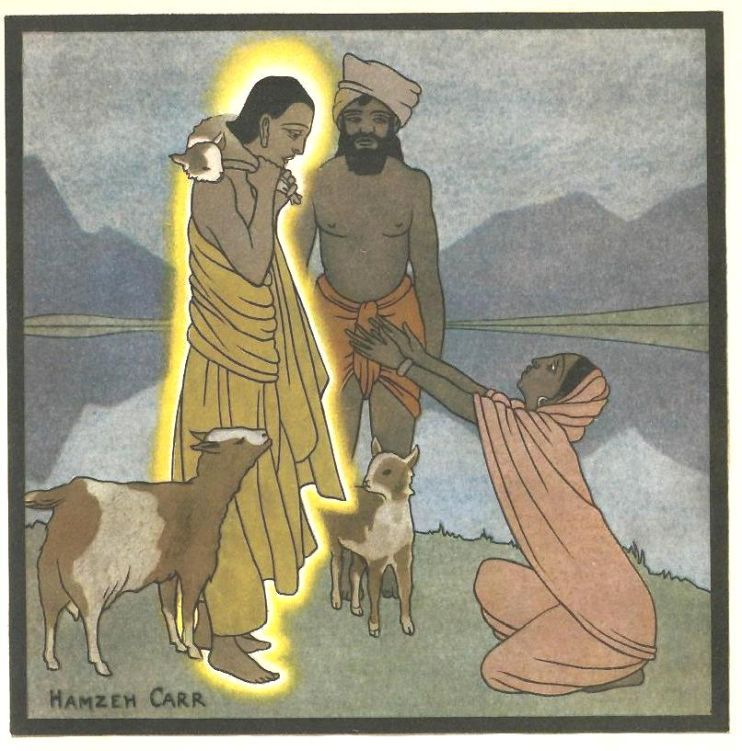
Fig.2d (facing p.94) Illustrates the line “A woman...dove–eyed, young.” The scene is a woman seeking help from Buddha.
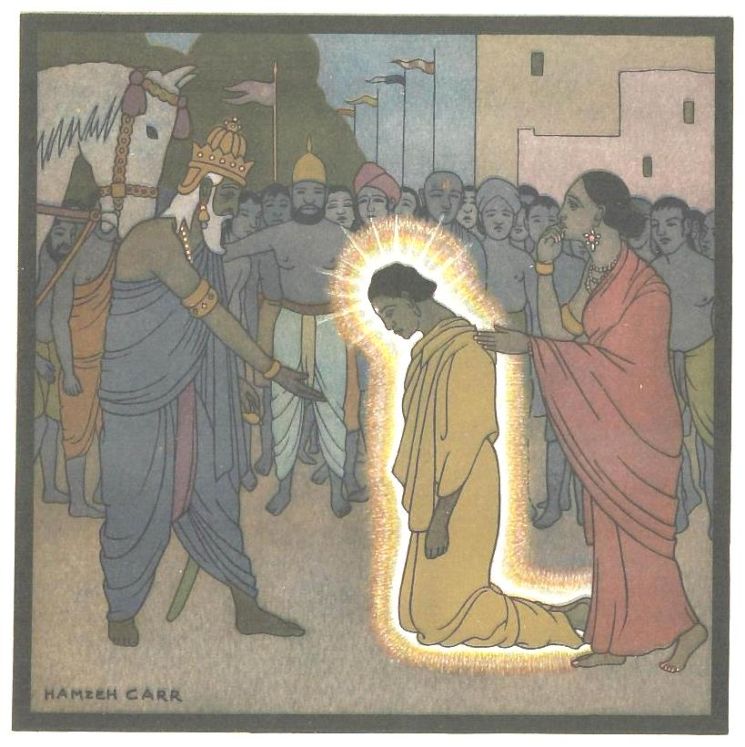
Fig.2e (facing p.150) Illustrates the line “That great Siddartha steals into his realm.” The scene is Buddha returning to the palace to see his wife and father, who yearn for him.
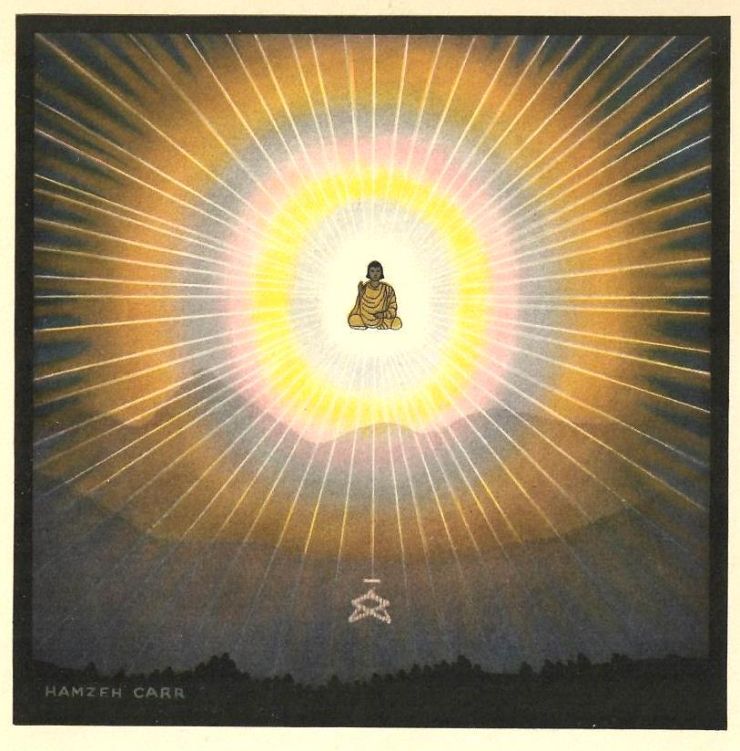
Fig.2f (facing p.176) Illustrates the line “Om Mani Padme Hum”, the Buddhist Mantra and the penultimate line of the poem. Note the curious pentagram below, not the Theosophical Society’s hexagram with central ankh symbol etc.
Clearly Carr was well able to adjust his style from Persian miniature to Buddhist art.
[The images can be browsed here.]
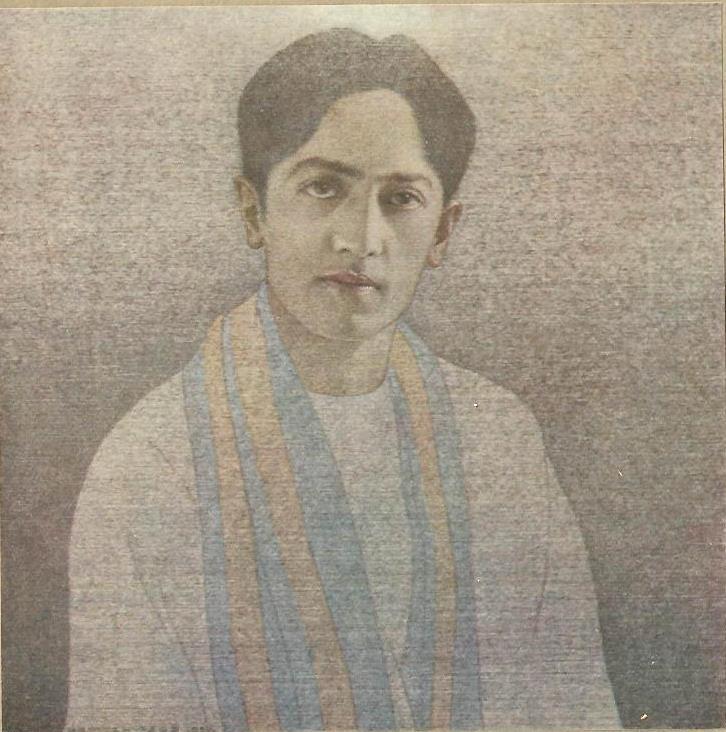
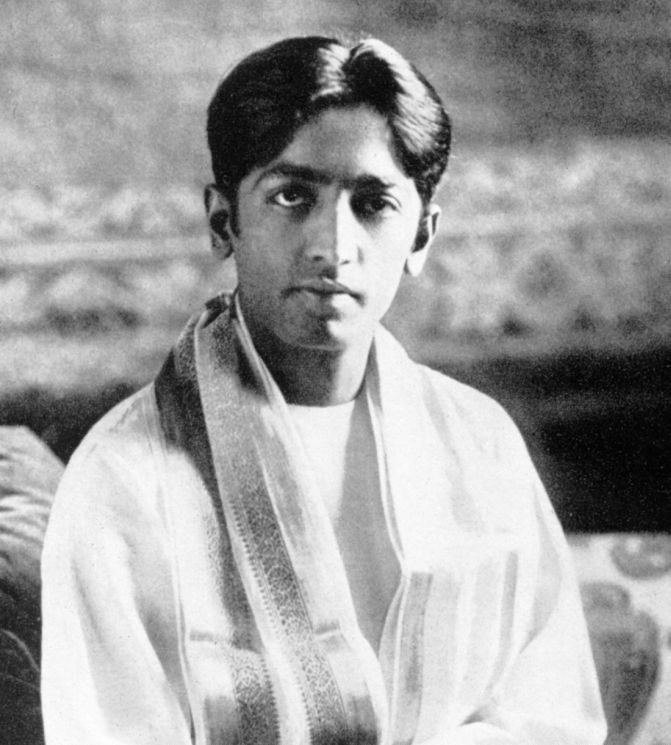
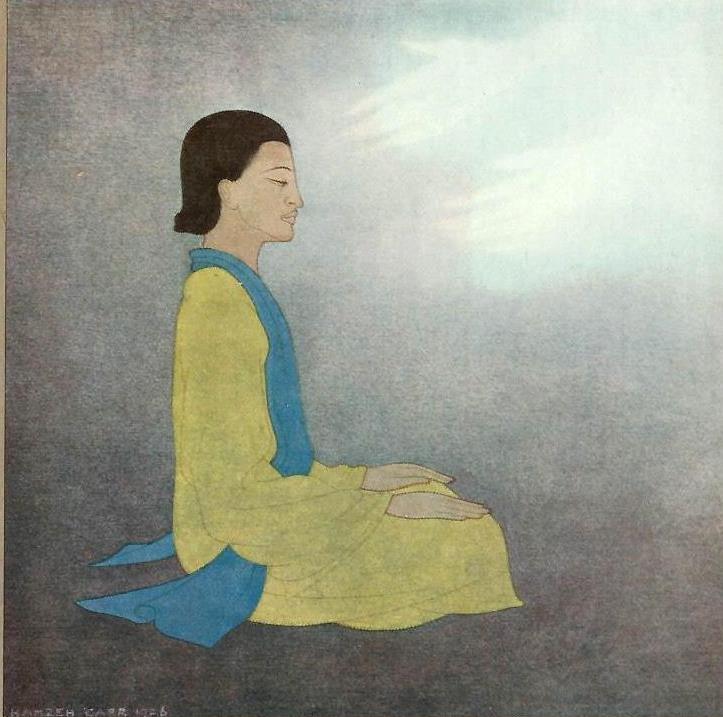
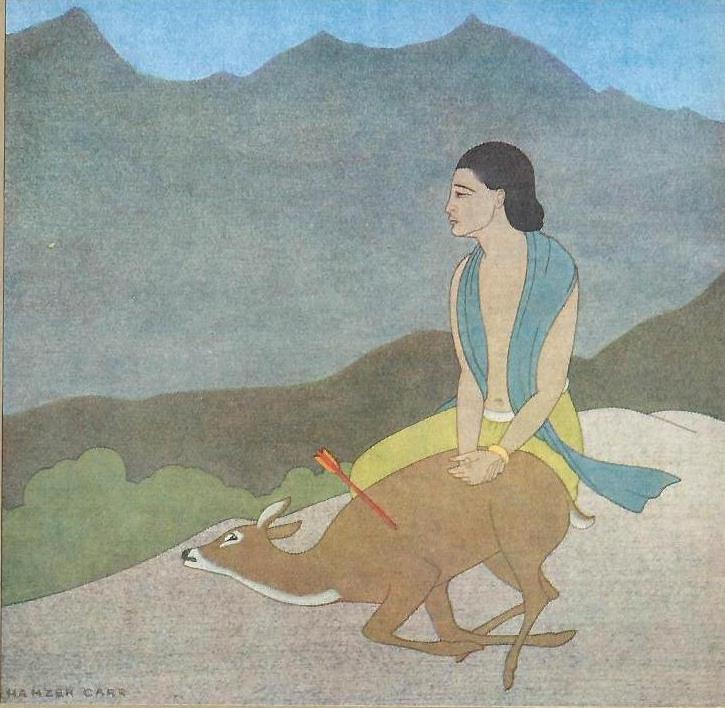
In 1927 The Theosophical Publishing House of London issued an edition of At the Feet of the Master, by Alcyone (J. Krishnamurti.) Though he is not named on the title–page, Carr did five illustrations for it, a frontispiece portrait of Krishnamurti (Fig.3a – seemingly based on a known photograph of him shown in Fig.3b) and one illustration for each of the four qualifications it is necessary to have to follow the Path to Immortality: Discrimination between the Real and the Unreal (Fig.3c) here illustrated by a contemplating figure; Desirelessness – the freedom from all forms of desire (Fig.3d) – the illustration here shows restraint from speaking unnecessarily; the Six points of Conduct (Fig.3e) – here Confidence – trust in your Master; and the most important, Love (Fig.3f) – including that of animals – the illustration shows the crime of hunting for mere sport. Note again the signature HAMZEH CARR.
This edition of a book, first published without illustrations in 1910, received curiously little attention in the Theosophical press at the time, but as Claire Jackson, a consultant archivist for the Theosophical Society in England and Wales, explained to me, though it was published by the Theosophical Publishing House in London, it was done for the Star Publishing Trust (the Dutch–based publications arm of Krishnamurti’s Order of the Star movement.) Carr was probably chosen to illustrate it because of his well–known illustrations for The Light of Asia, but any royalties arising from sales of the book would have gone to the Star Trust, possibly to help fund Krishnamurti’s forthcoming European tour. Reactions to Carr’s illustrations were mixed, Claire told me. Annie Besant, the then President of the Theosophical Society, thought Carr’s illustrations of great interest, whereas one of Krishnamurti’s followers, one “H.C.W.”, thought that though the illustrations had some merit, it would have been preferable if the book had been issued without them!
This appears to be the last book illustrated by Carr, and given that the three books he illustrated were all published between 1924 and 1927, that begs the question of how he earned a living outside that period.
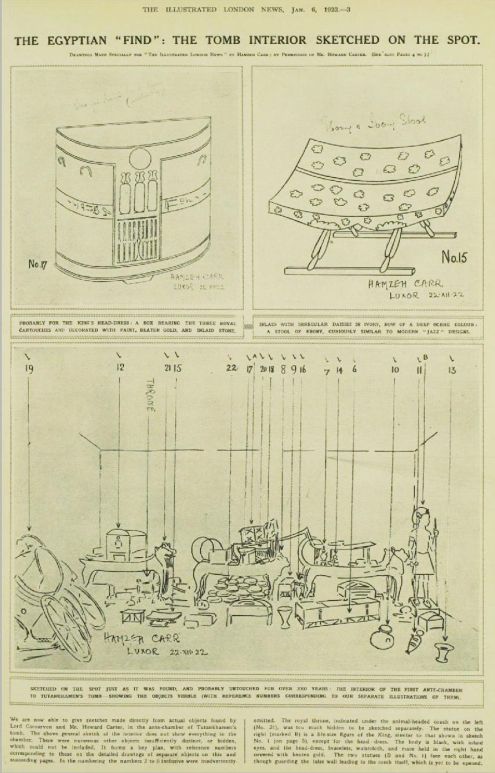
The story of how the tomb of the boy pharaoh was discovered in the Valley of the Kings by Howard Carter, funded by Lord Carnarvon, in November 1922 is so well known as not to need repeating here. The tomb was largely intact, and though the contents were in due course photographed, drawings of them by Hamzeh Carr, done ‘on the spot,’ were published in The Illustrated London News on 6 January 1923. Fig.4 is a sample page (the whole feature spanned five full pages) – note the signature HAMZEH CARR and the date 22 December 1922.
We saw above that Carr spent much of the year in Cairo, but how was he so well–known as an artist (none of his illustrated books had yet been published, remember) as to get a prestigious job like this ? The answer to that, alas, is not yet known, though it must have been partly through the network of the numerous ‘high society’ people resident in Cairo at the time, who had their own weekly English–language newspaper, The Sphinx (2), detailing their comings and goings, their military manoeuvres, their marriages, their parties, their sporting activities, and even attempts to assassinate some of them in the run–up to Egyptian independence in 1922.
Thus in the issue of The Sphinx for 18 March 1922 (p.673 col.2) we read that Hamzeh Carr was one of several artists taking part in an exhibition of paintings, pastels and etchings to be opened by Lady Congreve. In the issue of 13 January 1923 (p.277 col.2–3) we learn that he entered the fancy dress competition at the Three Arts Ball, run to support the Cairo Brotherhood Waifs’ Home, where he won first prize for gentlemen for his Oriental costume, its prototype “to be found in the various ‘editions de luxe’ of Omar Khayyam,” though its wearer described himself as “A Persian Miniature.” The event was attended by Viscount and Lady Allenby. And in the issue of 12 May 1923 (p.16 col.3) we read:
Mr. Hamzeh Carr, whose drawings have often appeared in this paper, and who is among the best known artists in Cairo, has been commissioned by Messrs. Lane, the London publishers, to execute a series of illustrations in colour for Baron Corvo’s prose translation of the Rubaiyyat of Omar Khayyam. Mr. Carr has lately been developing a very decorative style modelled on ancient Persian art and it is in this manner that he will carry out the Omar illustrations. He has also been engaged in miniature work lately, and has, among others, painted a very excellent likeness of H.M. King Fouad.
Unfortunately no picture of this miniature, or others by him, seems to be available, but as the portrait of Krishnamurti shown above demonstrates, he was clearly a skilled portrait painter. What is not known at present is where he trained as an artist, if indeed he ever did, or whether he was just naturally talented and self–taught. Clearly, though, he moved in the ‘higher echelons’ of Cairo society.
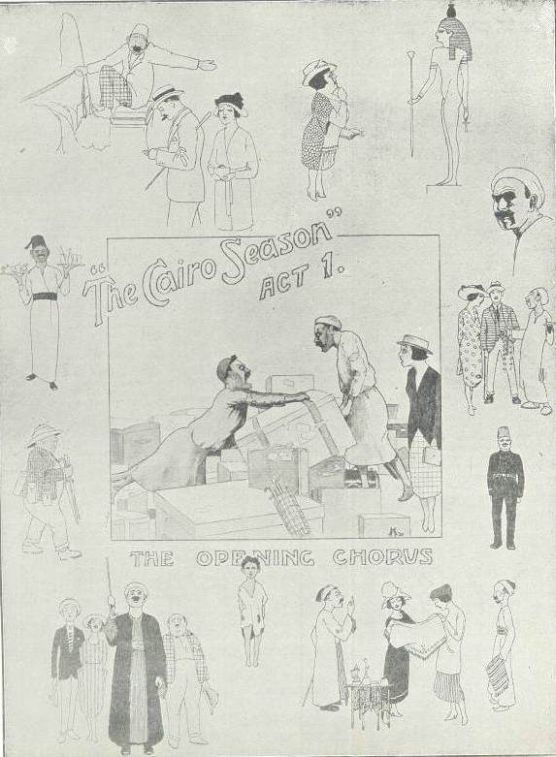
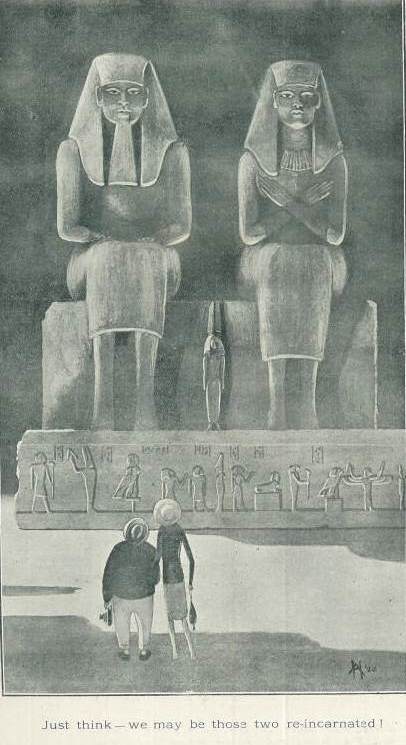
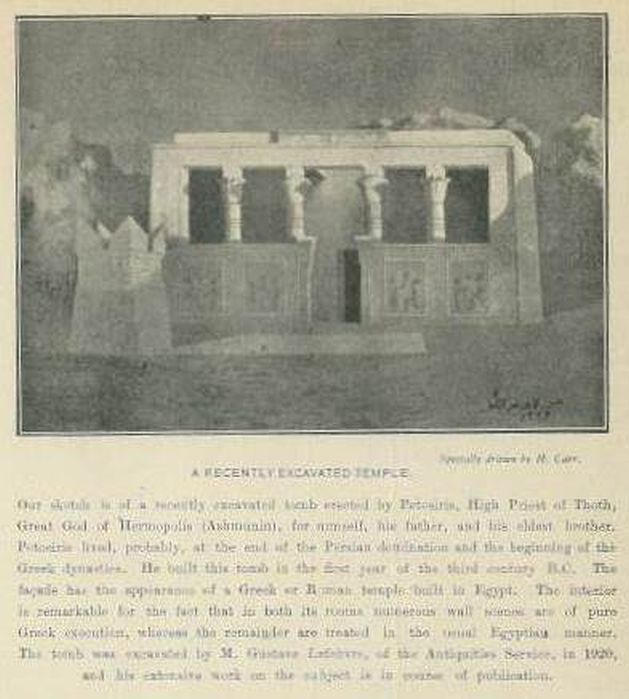
As regards Carr’s art–work published in The Sphinx not many examples have come to light. Surprisingly, two are cartoons. Fig.5a is the cover illustration for the issue of 18 December 1920 and Fig.5b the cover illustration for the issue of 22 January 1921. Note that Carr’s signature is here an HA monogram, presumably standing for Hamzeh Abd–ullah. Fig.5c, from the issue of 19 November 1921 (p.55), is, as its caption indicates, a sketch of the newly excavated 3rd century BC tomb of Petosiris, excavated by Gustave Lefebvre, the results then being prepared for publication.
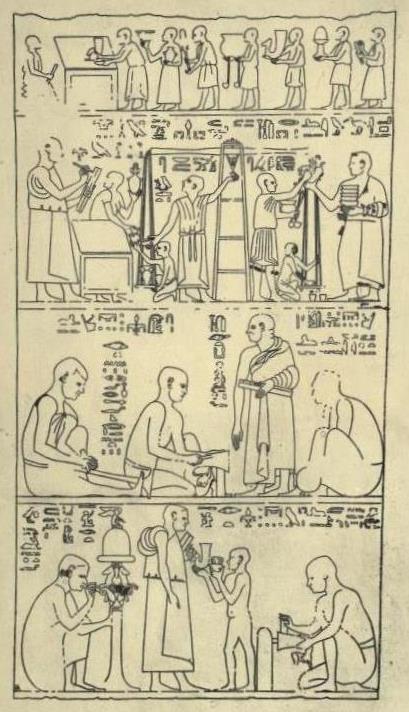
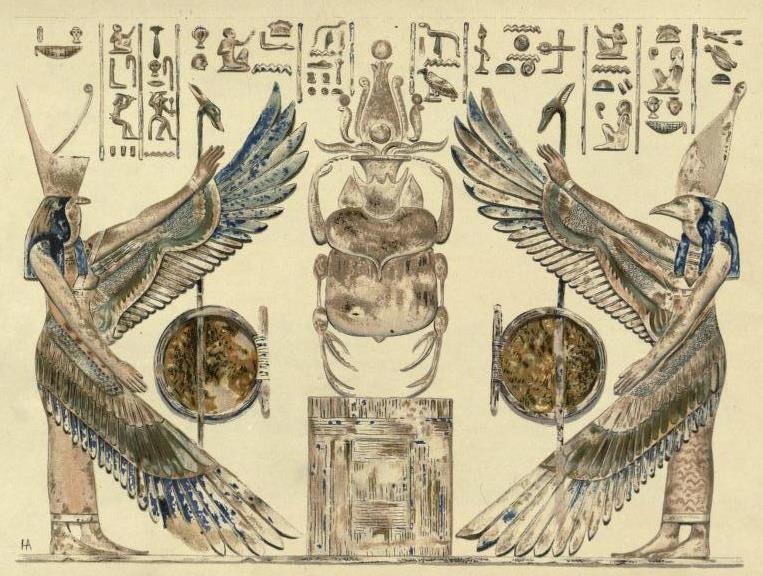
Lefebvre’s book, Le Tombeau de Petosiris, was duly published in Cairo in 1924. It featured not only numerous photographs, but also drawings and watercolours by Hamzeh Carr. Fig.6a (Plate VIII) is an example of the former; Fig.6b (Plate LIII) of the latter. Note again his use of an HA monogram, and again his fame as a Cairo artist must have secured him the job.
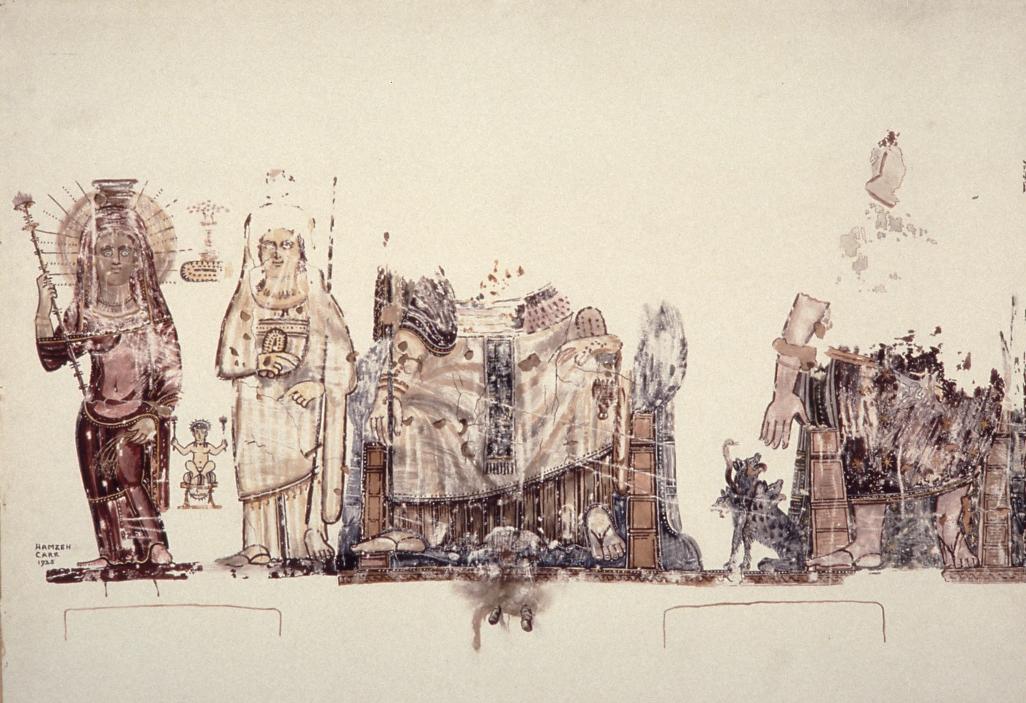
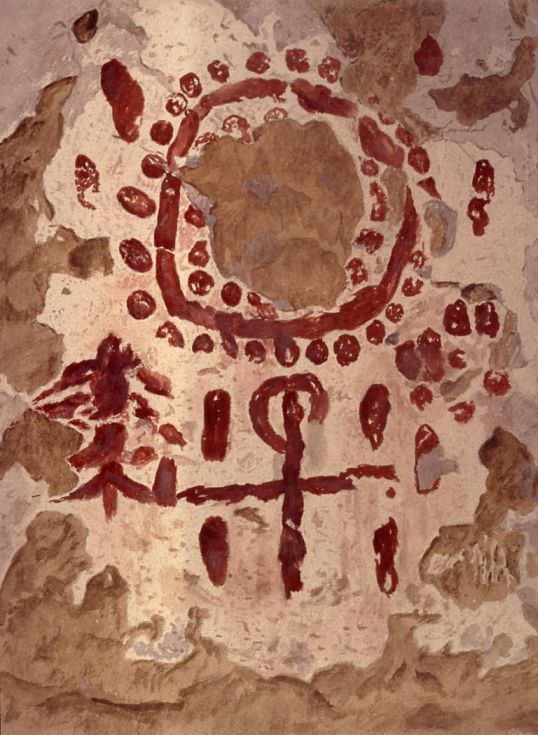
In addition to the Petosiris drawings and watercolours, Carr also did a set of watercolour paintings of the murals uncovered during the University of Michigan’s excavations at Karanis, a site in the Fayyum area of Egypt in 1924–5, though the watercolours appear to have been done later. Two examples are shown here as Fig.7a (a line–up of gods and goddesses) and Fig.7b (an abstract design which may or may not include a chi–rho monogram) – the latter I reproduce for its strangeness. These and others are now in the Kelsey Museum in Michigan, and (along with Carr’s other work for Carter & Lefebvre) are covered in Dr. Terry Wilfong’s interesting article, “Searching for Hamzeh Carr,” which appeared in the Spring 2021 Kelsey Museum of Archaeology Newsletter (p.7–11.) This was probably the first article, aside from newspaper clips, ever published on Carr, and having made contact with Terry, we opted to pool resources.
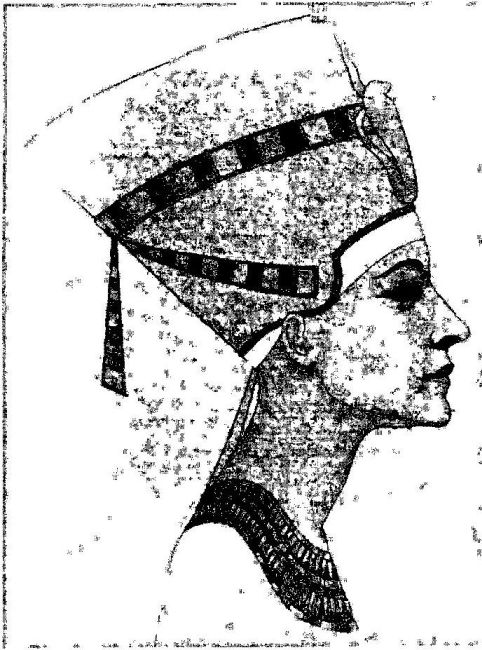
A name not commonly encountered today is that of American musician and composer Ruth Deyo (1884–1960), who from childhood had been fascinated by Ancient Egypt (3a). In 1924 she actually got to go there, and the following year began her opera with her future husband Charles Dalton, “The Diadem of Stars”, set in the reigns of Akhenaton and Tutankhamun, for which it would appear that Carr designed some of the elaborate costumes. Unfortunately, the opera was a long time in taking shape (its score ran to over 700 pages in the end), and after being billed for performance before King Farouk in April 1939, the Second World War broke out and the opera was never actually performed. It is not known whether Carr’s costume designs have survived, but what has survived is his profile portrait of Ruth Deyo as Queen Nefertiti (Fig.8) – apparently Deyo believed herself to be the reincarnation of an Egyptian princess. (She and her husband had also, it seems, incarnated on the planet Mercury at some time in the past.) Ruth Deyo will crop up again later, but meanwhile we turn to another member of Cairo high society, Robert Grenville Gayer–Anderson (1881–1945), nicknamed, for some unknown reason “Pum” (actually an acronym P.U.M. devised by his twin brother, Tom (4, p.1).)
Trained as a doctor, Pum joined the Royal Army Medical Corps in 1904, and was seconded to the Egyptian Army in 1907, achieving the rank of Major by 1914. During the First World War he served in Egypt, Gallipolli, Turkey and Arabia. By the 1920s he was serving in senior political roles, but retired in 1923 to devote himself to the collection of antiquities. He donated many of these to various museums – his donation of the so–called Gayer–Anderson Cat (a bronze sculpture of the Egyptian goddess Bastet) to the British Museum is a prime example. For a large part of his collection, though, he bought and renovated a house in Cairo to store it, presenting this as a Museum to the Egyptian government when he left the country in 1942. His honorific title of Pasha (roughly = Lord) was bestowed by King Farouk in 1943 (4, p.239–40).
Clearly then he moved in high society, and, coincidentally, was invited to a viewing of the tomb of Tutankhamun by Lord Carnarvon’s daughter (4, p.8), though whether that is how he came to know Hamzeh Carr is not clear. What is certain is that Carr was a member of Pum’s Shubbuk Society, a small, select, and resolutely male group of his friends who met once a fortnight at Pum’s Cairo apartment. Dressed in native garb, they reclined on cushions, drinking coffee, smoking uncut Syrian leaf tobacco in their shubbuks, or long Turkish pipes, which were periodically refreshed by a young boy known as “slave of the bowl.” Their talk was about art (presumably including antiquities), literature, religion, and exploration (4, p.179–181.) It all sounds a bit public–school–ish and innocent, and perhaps it was. But occasionally, perhaps, it was hashish or opium that went into those pipes, as Pum is known to have experimented with both (4, p.71, 77). But darker than that, Pum and some of his circle may well have frequented the homosexual underworld of Cairo, in which the prostitution of Arab boys was regarded as akin to Oscar Wilde’s support of ‘Greek Love’ rather than, as we would now see it, child–abuse (4, p.137–8,171). Certainly from an early age Pum had a fascination for naked boys (4, pp.2, 31, 42, 43, 129ff) and kept bound volumes of drawings of them (4, p.132–5.) Whether Hamzeh Carr shared these unsavoury interests is not known. Certainly, Carr remained unmarried, though that of course is no evidence of homosexuality in itself. He may have been drawn to Pum simply on account of their shared interests in Egyptian antiquities, art, comparative religion and occult / psychic phenomena.
Diplomat Sir Laurence Grafftey–Smith, who served in Cairo in the early 1930s, briefly mentions, in his autobiography Bright Levant (1970), painters “Aimy Nimr and Hamzeh Carr, both of whom have pictures hanging on the walls of the ‘Beit–el–Kritly,’ the lovely Cairo house in which Colonel Gayer–Anderson’s treasures survive him.” (p.123.) They are still there. One of them is a portrait of Pum pictured with two of his beloved antiquities. It can be seen on the virtual tour of the museum.
[The images can be browsed here.]
As we saw earlier Hamzeh Carr was a Theosophist and his illustrated edition of At the Feet of the Master was published by The Theosophical Publishing House of London. I emailed the Theosophical Society in London and thus made contact with the above–mentioned Claire Jackson, who was clearly well–placed to answer my questions.
There was a Theosophical Society in Egypt from 1908, she told me, but it was most active from 1917 to 1926, with branches in Cairo, Port Said and Alexandria. Egypt had different Lodges for French, Italian (although they joined up with the French) and English speakers, as well as a Ladies Lodge. There were attempts to attract locals i.e. Arabic speakers but these were not particularly successful. At its height, there were nearly 100 members, although by 1940 it had dropped to 9.
As regards Hamzeh Carr, a search of Theosophical Society membership lists revealed that he joined in Cairo on 14 April 1925. By 1927 he was President of the English Lodge in Cairo, the Theosophical Society’s General Report for that year noting that he “has created a small study class which is assiduously followed by a few young Egyptians – future members in the making of our Society.” (p.193.) The following year the General Report noted that he was still doing “excellent work among a nucleus of young Egyptians who follow regularly his small meetings of elementary Theosophy; six out of the seven new members we had in 1927–8 are his pupils.” (p.182)
Mention was made above of Ruth Deyo, primarily a musician and composer, but also an artist, whose work consisted of colourful abstract drawings in pastel. Twenty eight of these were exhibited at Mrs Albert Sterner’s Galleries in New York in November 1923. But these were no mere patterns, for they were related to her music – for her, music and colour were related – the phenomenon of synaesthesia, shared by other musicians (eg Messiaen & Ligeti) and artists (eg Kandinsky & Klee) – a phenomenon which, alas, appears to have passed me by. Not only were Deyo’s music and pastel drawings related, but she believed that both were given to her from some higher spiritual dimension, some of them delivered in dreams. Though Deyo considered joining The Theosophical Society, she eventually didn’t as she “found it too constraining once she had established contact with higher spheres.” Nevertheless, she was certainly influenced by Madame Blavatsky’s Secret Doctrine and Besant & Leadbeater’s strange book Thought Forms, originally published by the Theosophical Society of London in 1901 (3b). Deyo’s pastel abstracts can certainly be classed with those of Besant & Leadbeater (3a).
But getting back to Carr, the rather unprepossessing painting shown in Fig.9a, which turned up in an auction in 2017, is signed HAMZEH CARR and dated 1926 to the lower right. On the back is roughly written, in capitals, “ALEXANDRIA, EGYPT / VIEW FROM FLAT / WHERE H. S. DUCKWORTH / LIVED 1920–1925.” Claire Jackson wonders if H.S. Duckworth was Hazel Sanderson Duckworth (18937ndash;1959), the daughter of Mrs Ada Christiana Duckworth (1860–1930) who, having been very active in several English and Welsh Lodges of the Theosophical Society, went to Egypt in 1921, where she appears frequently in the Theosophy in Egypt annual reports, giving lectures in both English and French in Cairo and Alexandria to audiences of up to 100 theosophists and non–theosophists. She then led the Lodge in Alexandria until 1930, when she died during her summer sojourn in England. It is a Theosophical possibility, though not certain. (By way of background, the Duckworths ran an Egyptian cotton business.)
A brief mention of this part of Carr’s artistic career was given above. The following short article about it appeared in The Liverpool Daily Post on 4 September 1925 (p.6) under the heading “A Moslem Scene Painter”:
I am told that Hamzeh Abdullah Carr, who is responsible for the stage setting of Michael Arlen’s “The Green Hat,” is an English Moslem who makes his home in Cairo. He is at present in England finishing his designs for an act of “The Moon and Sixpence,” the new Somerset Maugham play in which Henry Ainley is to play the lead. Mr Carr is going to illustrate a new edition of “The Light of Asia.” In October he will return to Cairo for the Egyptian season. He has made a special study of the wonderful Persian illuminated manuscripts in the Royal Library at Cairo, from which he has gained much sense of colour and decorative form.
Hence, of course, his Rubaiyat illustrations. “The Moon and Sixpence” is based on the life of Paul Gauguin, and a review in The Daily Sketch (London) for 26 September 1925 (p.5) tells us, under the sub–heading “Gauguin’s Picture”:
There was a good deal of comment during the interval about the Gauguin which hangs in the hall of the theatre, and represents the hut in which he lived in Tahiti.
Among those who confessed themselves beaten by it was Hamzeh Carr, the artist who has designed the same scene for the production.
There was, anyhow, no doubt about the liking of the audience for this scene, as they gave it a special round of applause.
Unfortunately no images of Carr’s scene paintings seem to have survived, and I am aware of no other plays staged in England for which he did the scene–painting besides the two mentioned in these brief articles.
Gauguin’s picture in the hall was presumably 7ldquo;Te Fare (La Maison)” painted in 1892, the puzzle being who exactly the three people in the painting are.
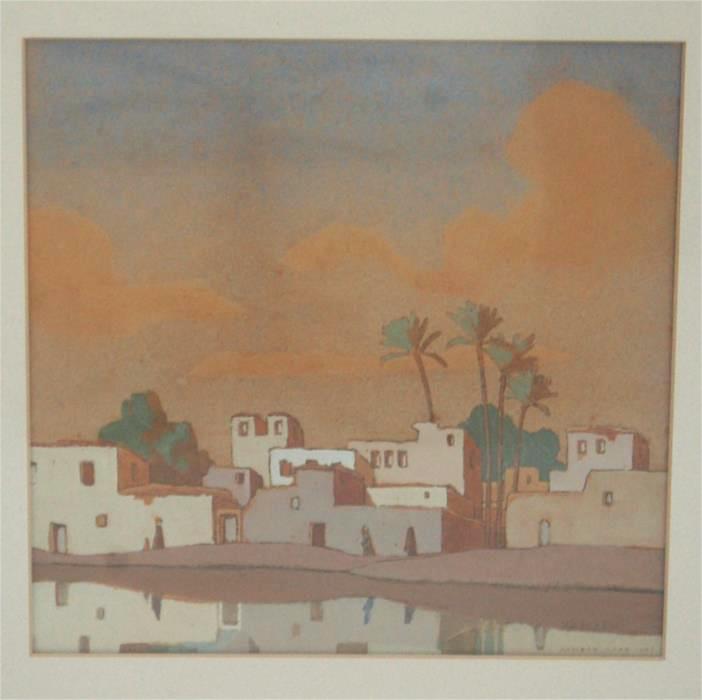
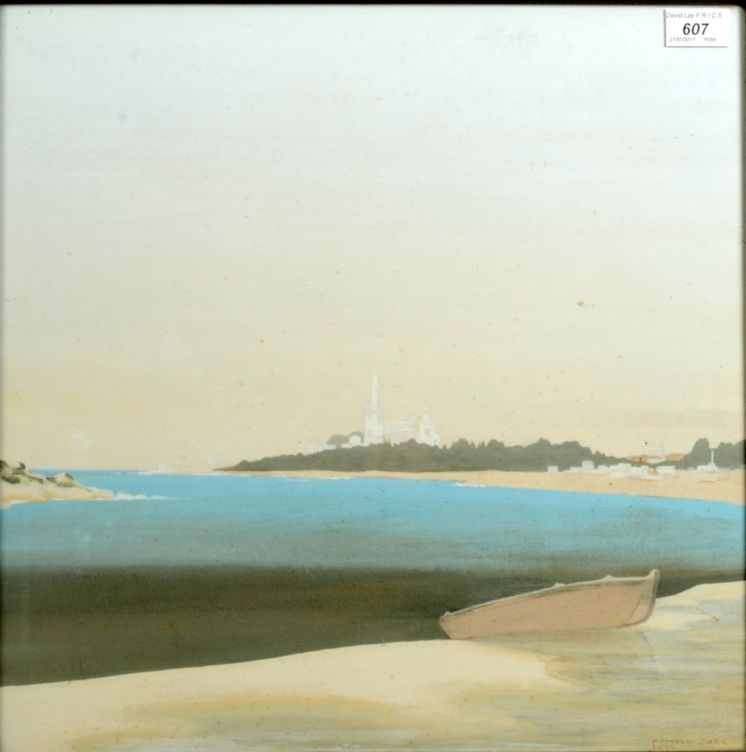
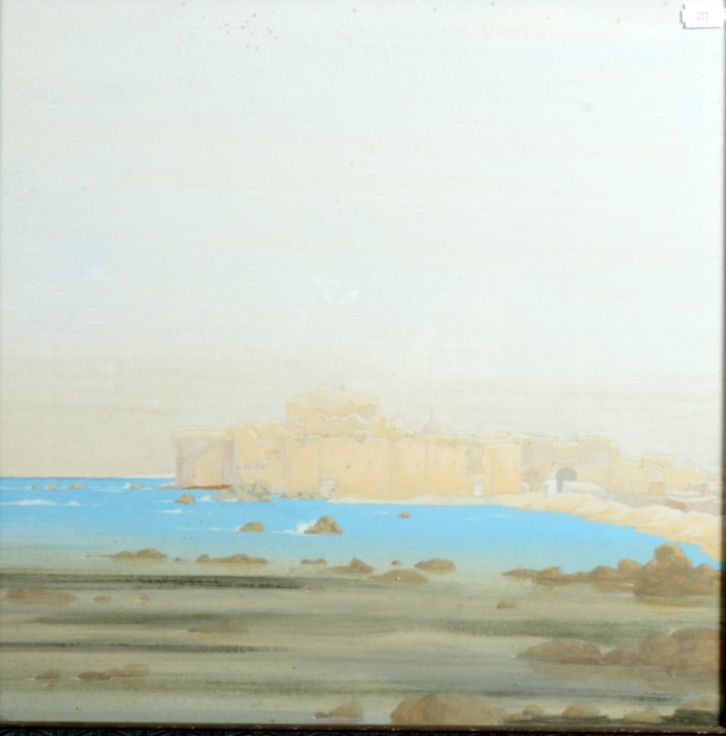
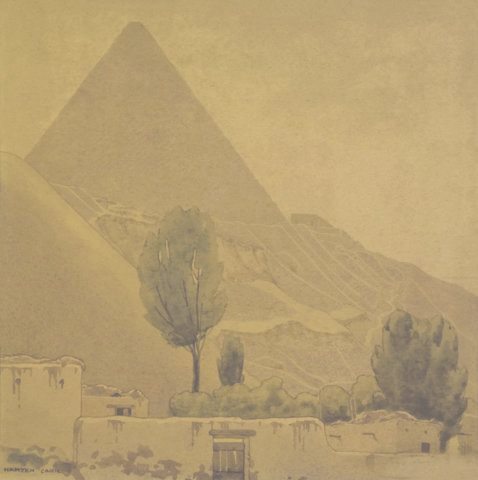
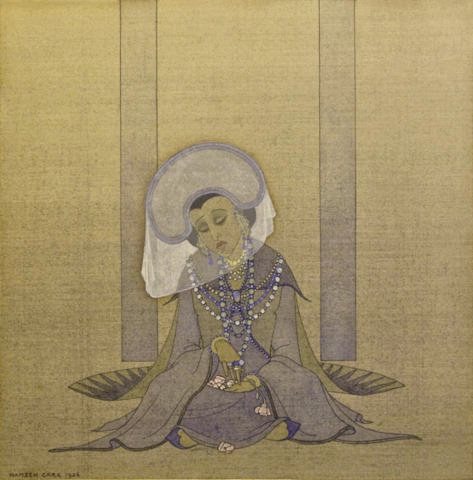
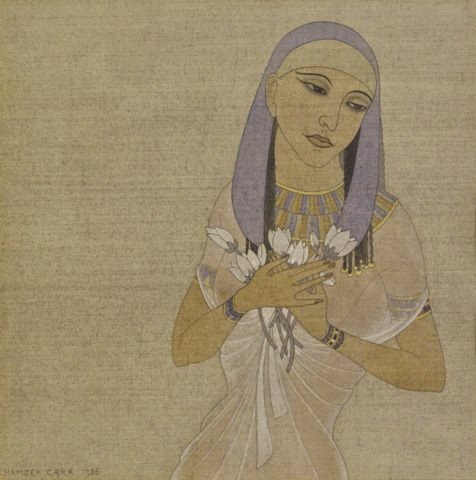
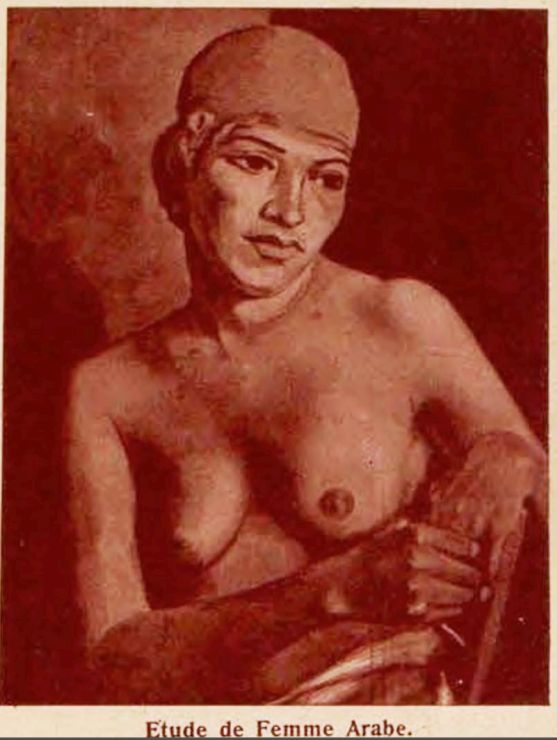
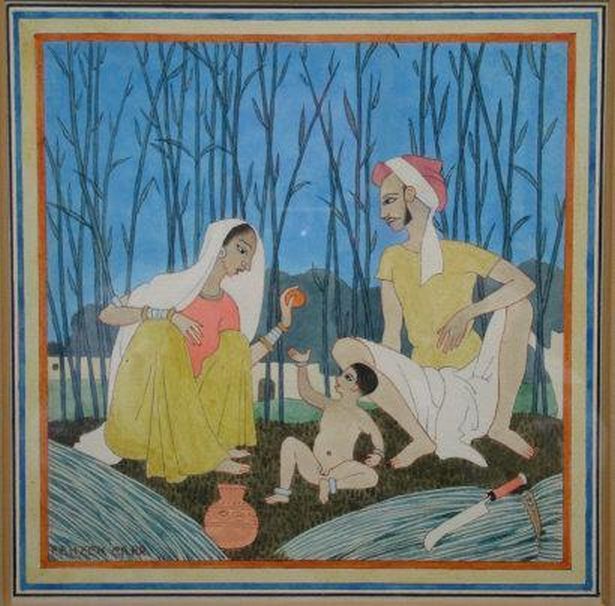
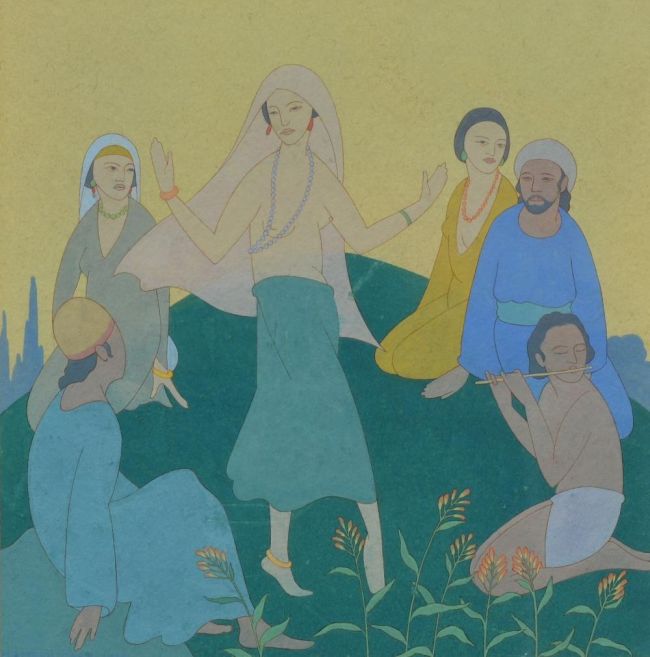
The painting in Fig.9a is one of several landscapes by Hamzeh Carr. Figs.9b & 9c are two others, also painted in Alexandria. Fig.9b depicts the Montaza Palace there. It is signed and dated 1927 at the bottom right. Fig.9c depicts the Citadel of Qaitbay at Alexandria, and though seemingly neither signed nor dated, its similarity to the Montaza Palace painting confirms both artist and date. The landscape in Fig.9d needs no explanation. It is one of four paintings by Hamzeh Carr which Dr. Hussam Rashwan inherited from his grandparents, images of which are reproduced here with his permission (they were also sent to Terry upon seeing his article in the Kelsey Museum Newsletter article in 2021.) The other three paintings, very different in nature, being of human figures, are reproduced here as Figs.10a, 10b & 10c. The first two are signed and dated HAMZEH CARR 1926; the third is again signed HAMZEH CARR to the lower left, and with his Arabic signature to the lower right, but is undated. Another human figure is shown in Fig.10d. Unfortunately this poor image is taken from a newspaper account (in French) of an exhibition in Cairo in 1930 (5), but it is all we have at present. As can be seen from the caption, it is titled simply “Study of Arab Woman.” Two interesting groups of human figures are shown in Figs.10e & 10f, both of which have turned up in past auction catalogues, and both of which are undated, but by their similarity to Carr’s known book illustrations, would seem to date from the 1920s. Fig.10e, which has an Indian feel about it, is signed HAMZEH CARR to the lower left. The auction catalogue titled it simply “A family group seated in a field.” Fig.10f, which is akin to his illustrations for At the Feet of the Master, is said in the auction catalogue to be signed to the lower left, though any signature seems to have been cropped off in preparing the catalogue illustration. This one is titled simply “Watercolour.” Both pictures are, on the surface of it, of unknown purpose, though the former turns out to have a very unexpected purpose and a much later date, as we shall see.
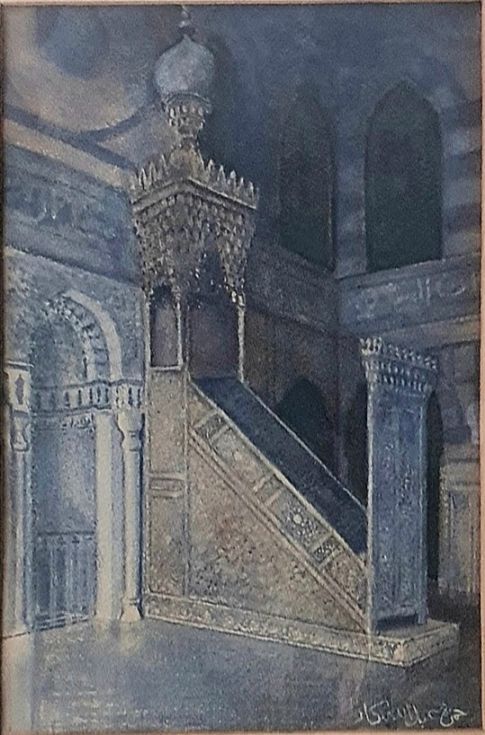
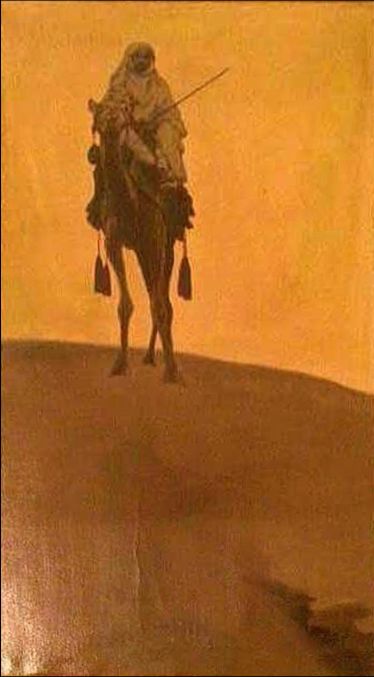
A nicely crafted picture of the minbar (pulpit) in the Abu Elseoud mosque (sent by art–collector Magdy Balbaa to Terry upon seeing his article in the Kelsey Museum Newsletter article in 2021) is shown in Fig.11a. Signed with his Arabic signature to the lower right, it is known to have been exhibited in Cairo in 1929. Another picture in the collection is the curiously appealing picture of a camel and its rider shown in Fig.11b.
[The images can be browsed here.]
In The Times (London) for 8 June 1933 (p.10) appeared the following review, headed “Wertheim Gallery”:
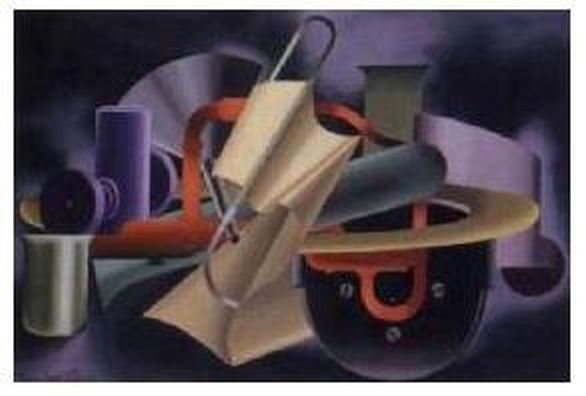
As nearly as may be the paintings by Mr Hamzeh Carr – an artist new to London – at the Wertheim Gallery, 3–5 Burlington Gardens, are studies in pure form – geometrical solids and severely simplified natural objects in architectural arrangements. They are all of the same size and they all bear the same title “Composition,” being distinguished one from the other only by numbers. The deliberate rejection of sentimental or psychological interest could hardly go further, but this is not to say that the paintings are lacking in emotional appeal.
They have, precisely, the emotional appeal of architecture when it is stripped of the associated interest of “style” – the music of solid forms in ordered relationships – and one would say that this kind of composing was a branch of architecture rather than of painting if it were not that the pigment lends its contribution to the effect. Mr Carr uses a limited range of colours, but he gets a good deal out of them, combining decoration with the construction which is his principal aim, and a satisfying character in his work is the just relation of touch to the scale of the work as a whole.
Consistency, indeed, is the most evident general characteristic of his work. You may derive aesthetic pleasure from it or you may not, but you are never left in any doubt about what it is from which you are intended to receive aesthetic pleasure. Personally, and with a ghost of a building at the back of the mind, we find Nos.3, 4, 7 and 14 very pleasing compositions, with a “music” from the relations between objects which is something more than an effect of simple addition.
The review then goes on to discuss the paintings of Miss Ruby Boardman, the other artist featured in this exhibition, who “goes to the opposite extreme” to Hamzeh Carr.
It is a great pity that the author of this review didn’t give an illustration of just one of Carr’s paintings as it would have given his readers a much clearer impression of the artist’s style than his verbal descriptions, doubly so for us today, since none of these paintings seems to have survived. Unfortunately, no exhibition catalogue seems to have survived either (6a), though we know from an Index card in the Lucy Wertheim Archive at the Paul Mellon Centre in London that Carr’s half of the exhibition contained “fourteen paintings all titled Composition.” (6b)
A brief mention of the exhibition featured in The Birmingham Post on 11 June 1933. It gave prominence to Ruby Boardman, but concluded: “Here, too, are Mr Hamzeh Carr’s collection of abstract ‘compositions’ that have a theosophist significance but are puzzling to the uninitiated.” (6b)
That mention of “theosophist” is suggestive of the origins of these paintings. Theosophy has certainly spawned a wide variety of paintings, from the symbolist style of R.W. Machell’s “The Path” (1895) to Hilma af Klint’s geometrical and abstract designs, like her “Swan” series of 1915. Several notable artists have also been influenced by Theosophy, notably Kandinsky, who was influenced by Besant & Leadbeater’s Thought Forms and who, in 1911, wrote his own work, Concerning the Spiritual in Art. (Coincidentally, he also painted a series of works, all titled “Composition,” and distinguished by their numbers 1 to 10. The series spanned the period 1910–1939.) Recall also the thought forms of Ruth Deyo, again following on from Besant and Leadbeater. Having said that, geometrical solids in architectural arrangements don’t have a ring of spirituality about them!
Carr’s work has also been dubbed “surrealist,” though I have seen no firm evidence of a link with that movement, and the Egyptian group of surrealists, Art et Liberté, didn’t form until 1938–9, some 5 years after the exhibition of the Compositions, though the movement had been going in Europe since 1924. There were, of course, geometrical elements in the cubist art of Braque and Picasso, which preceded surrealism, but again, in absence of any images of Compositions, such a link is speculative at best.
So what do we know about Carr’s paintings generally, in the absence of any images of Compositions 1 to 14 ? Fortunately we have images of a number of his pictures through online catalogues and other sources.
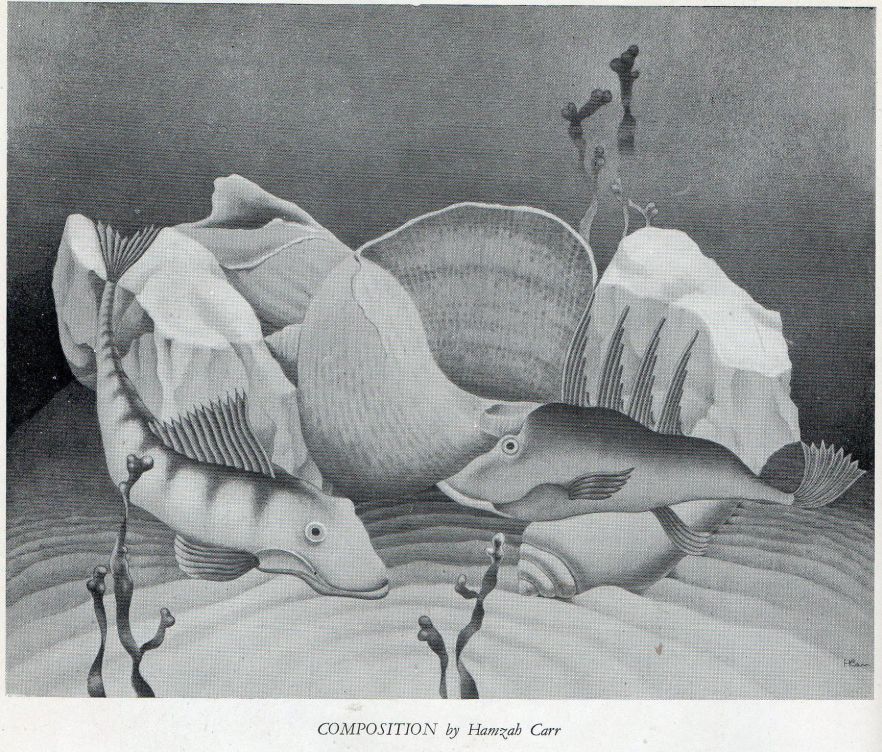
We do actually have one painting by Carr titled “Composition”, but it has no number with it, and it is neither geometrical nor architectural, though possibly surrealist. It is shown in Fig.12, is signed H. Carr, and was published in Soho Centenary 1844–1944, subtitled “A Gift from Artists, Writers and Musicians to the Soho Hospital for Women” (Hutchinson & Co., London, 1944.) Unfortunately no source is quoted for this particular illustration, unlike for several of the others, so when it was actually painted and what relation it had, if any, to Compositions 1 to 14 remains unknown at present, though a possible, and unexpected, purpose for it will be discussed below.
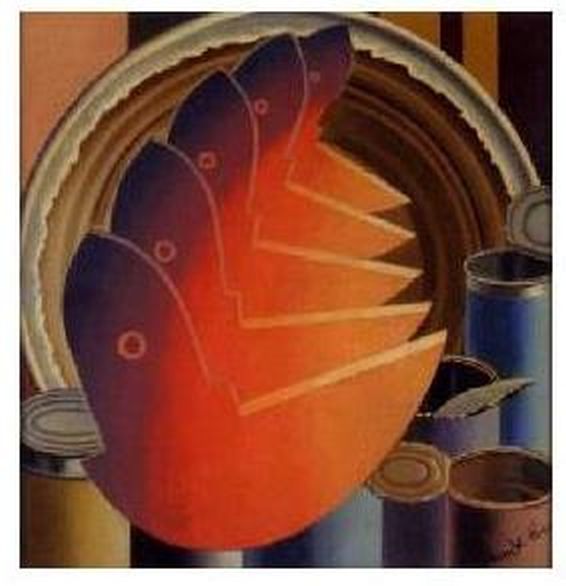
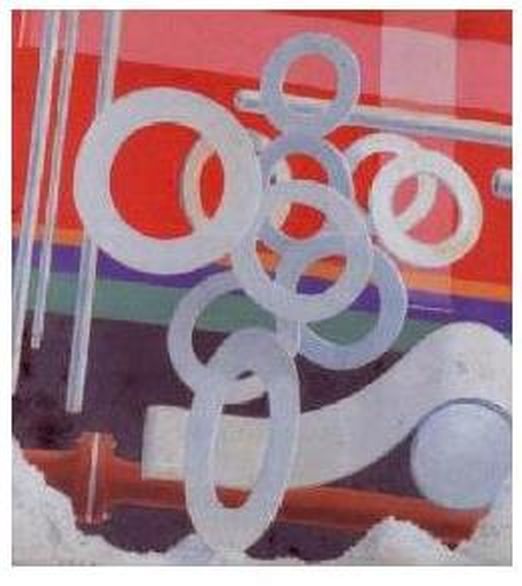
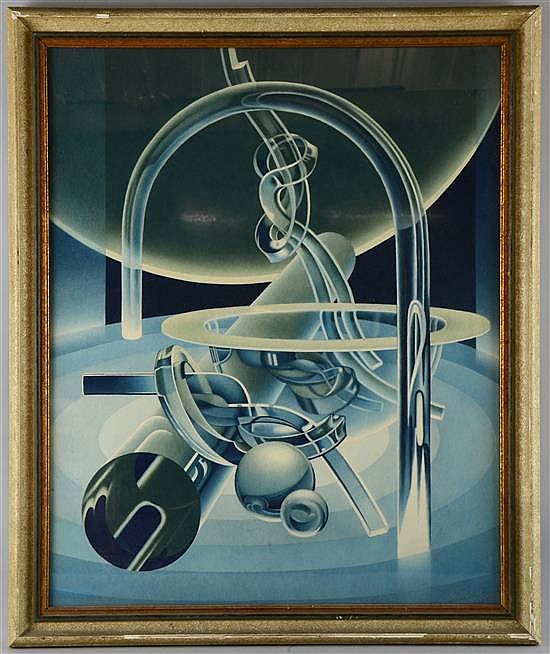
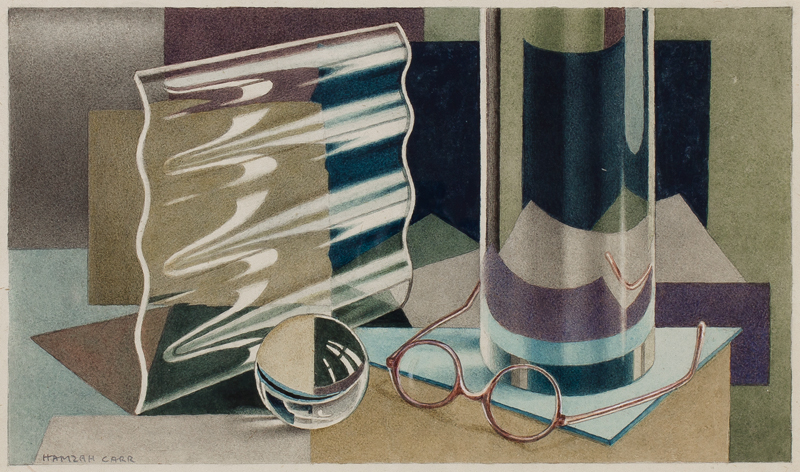
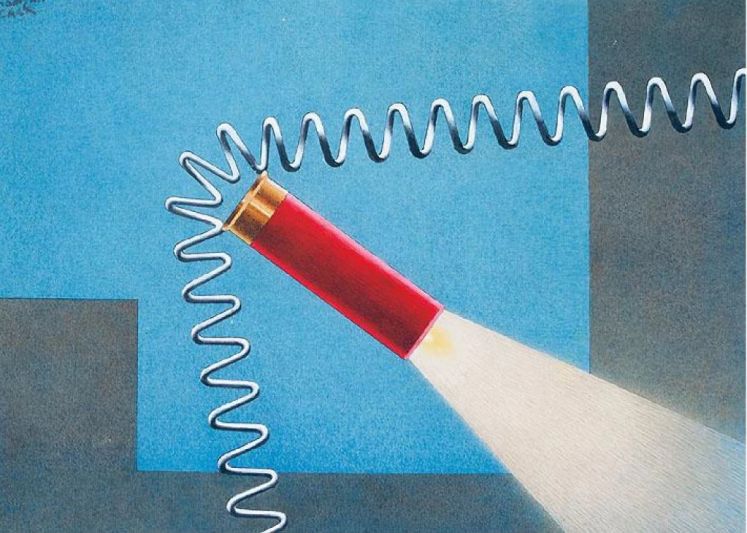
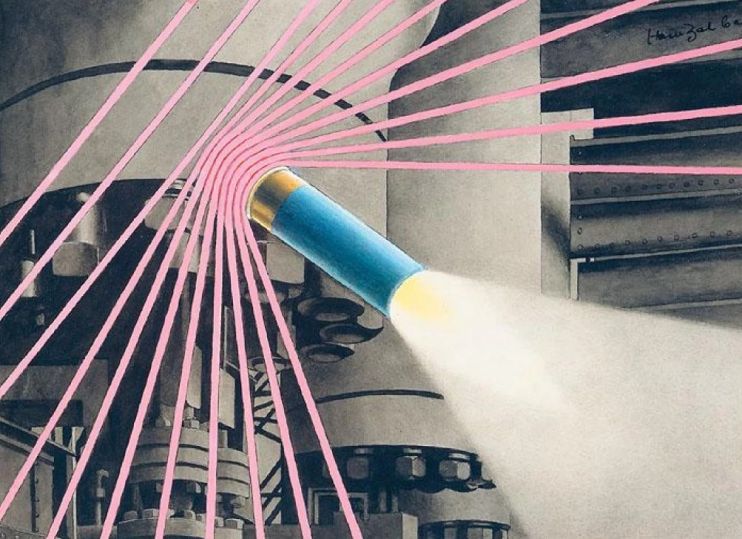
One problem is that many of Carr’s extant paintings are undated. Another is that though we do have titles for them, some of these may have been provided by the compilers of the auction catalogues in which they are found, and so may not reflect the artist’s intentions. One clearly geometrical example is shown here as Fig.13a, titled “Introduction,” though the relation of title to content is far from clear! Three rather abstract examples are Fig.13b, titled “Can Openers”; Fig.13c, titled “Gaskets”; and Fig.13d, titled “Plastics.” This last is the only one dated, to 1946, and clearly related to it, though less abstract, is Fig.13e, titled “Perspex”. None of these titles suggests anything like the spiritual associations of Theosophy or the fantasies of Surrealism. On the contrary, the last four have more of an industrial feel, as do Figs.13f & 13g, both titled “Power Cartridge”, the second clearly a more elaborate version of the first, though what either of them actually signifies is not clear!
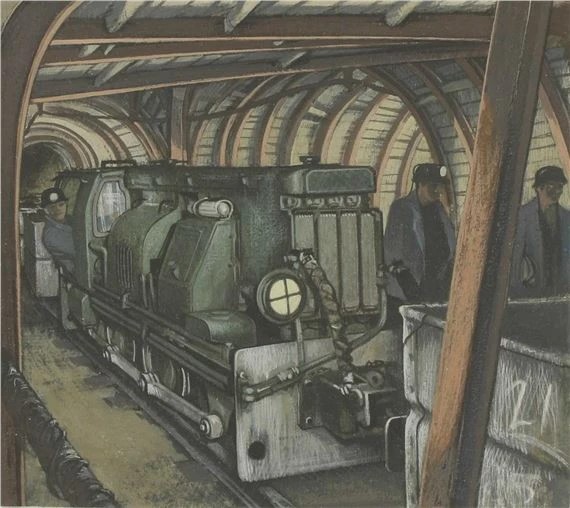
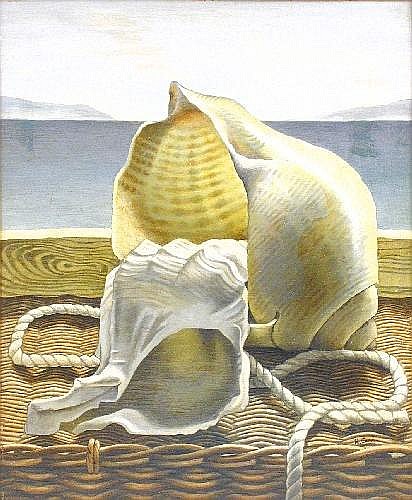
Again, Fig.14a, titled “Fireguard” but undated, has geometrical elements, but they are derived from what appears to be a coal train down a mine, or some sort of underground fire–fighting equipment, given the title. Likewise, Fig.14b, titled “Sea Shells” and again undated, could be merely a still life, though it is one with neat geometrical elements, the equiangular spirals governing their shapes having acquired, in some quarters, an almost mystical significance associated with the Golden Ratio or Divine Proportion. The first of these, of course, is again possibly industrial, and the latter could be, when all is said and done, just a nice still life, though it arguably shares an aquatic theme with Fig.12.
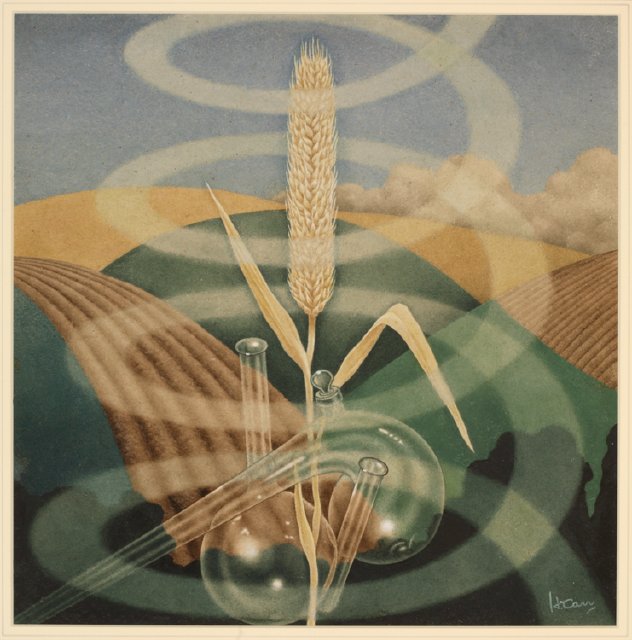
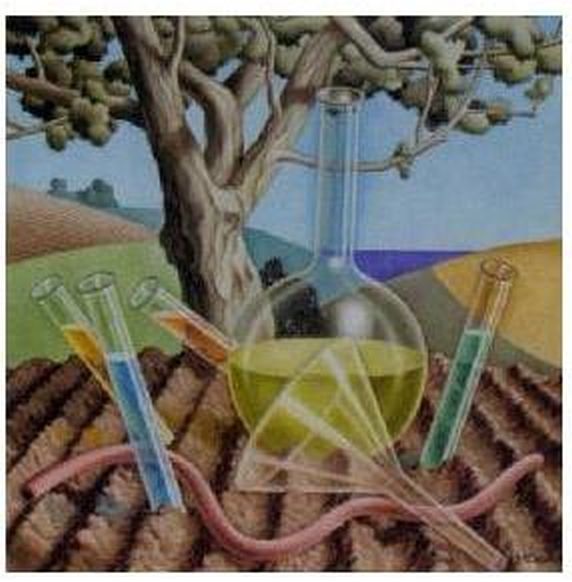
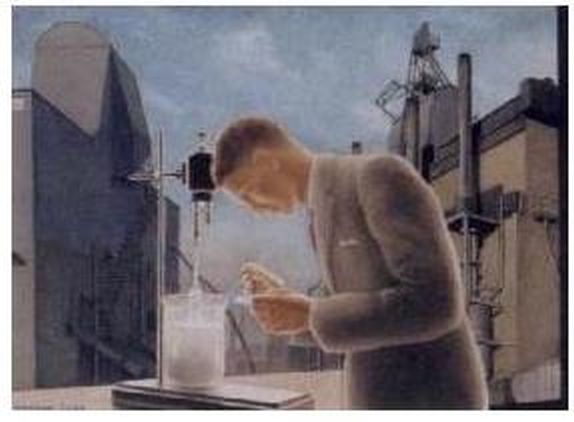
Lastly, Fig.15a is titled “Fertility 1”; Fig.15b is titled “Fertility 2”; and Fig.15c is titled “Research and Production.” None are dated. Though the vortex in the first is characteristic of some spiritual paintings, the presence of a test–tube, flask and retort, with the ear of wheat and the fields in the background suggest science in support of farming; similarly the second, with its assembly of chemical apparatus. The third, of course, is inescapably related to laboratory research – clearly a long way from Theosophy or Surrealism.
[The images can be browsed here.]
So, what is going on here ? The simple answer is: a number of things.
During the Second World War, ICI decided that since conventional newspaper advertising was not really needed in war time, they would use the advertising space to inform the public about the Industry. It became known as “Prestige Advertising” and it ran in three series – “Aspects of an Industry” (July 1941–June 1942); “Services of an Industry” (July 1942–August 1944) and “Portraits of an Industry” (September 1944–March 1946). Between 1946 and 1951 these were followed by a set of individual features titled Equipment, Ancestors, Achievements and Elements of an Industry (7a). (ICI also issued a series under the title “Progress of Chemistry...”, though this series appears only to have been used in The Times of India in 1946–7.)
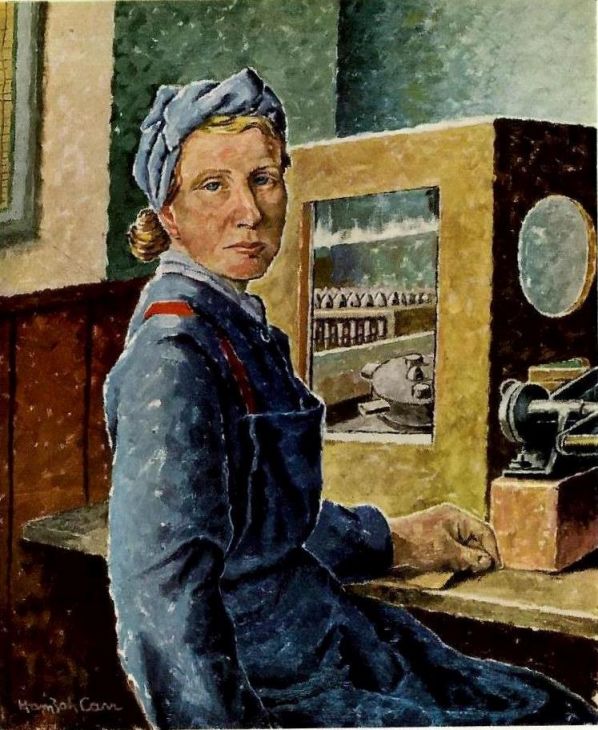
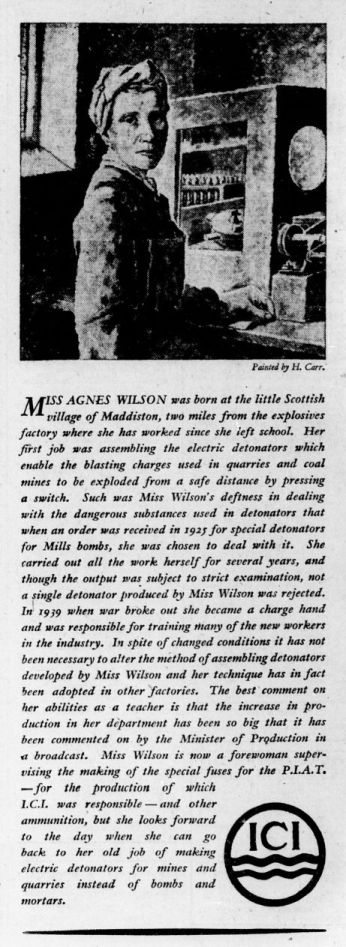
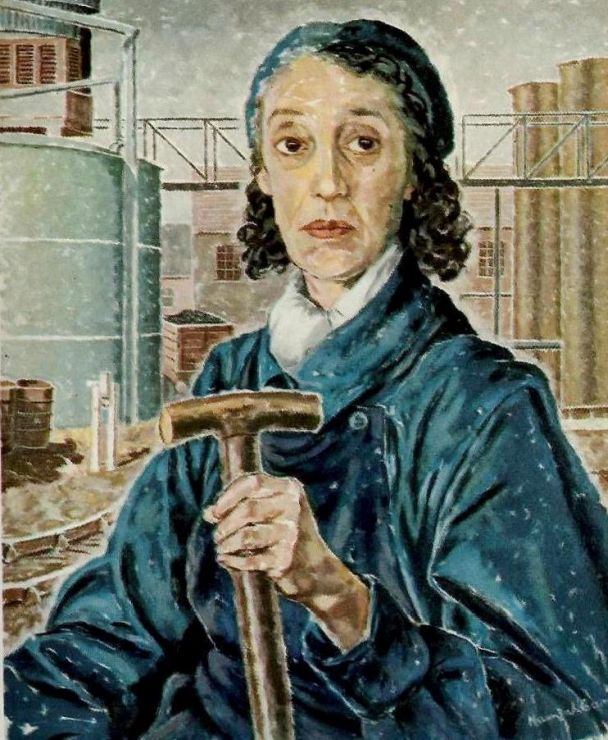
To begin with, we know that Carr did two portraits of ICI employees in the “Portraits of an Industry” series (7a & 7b). One of these, that of Agnes Wilson, is shown in Fig.16a, with its use in the Prestige Adverts shown in Fig.16b, this being taken from The Yorkshire Post and Leeds Intelligencer, 9 July 1945 (p.3.) (The other portrait, of Sarah Ann Brown, is shown in Fig.16c.) But more than that, it transpires that many of the above–mentioned pictures were offered for sale by ICI through Sotheby’s in London in September 2002 (7c). Not surprisingly, Fig.13e (“Perspex”), Fig.15a (“Fertility no.1”), Fig.15b (“Fertility no.2”) and Fig.15c (“Research and Production”) were indeed all done for ICI. More surprisingly, Fig.13a (“Introduction”), Fig.13b (“Can Openers”), Fig.13c (“Gaskets”), Fig.13f (“Power Cartridge” 1), Fig.13g (“Power Cartridge” 2) and Fig.14a (“Fireguard”) were also done for ICI, despite the fact that the first seems to relate more to the geometrical solids theme of “Compositions” 1 to 14; the second two seem like abstract designs based on everyday objects; the Power Cartridge pictures seem curiously symbolist; and the last looks like a scene down a coal mine.
But the biggest surprise from the Sotheby’s auction is that Fig.10e was done for ICI, its original title (lost or changed in the 2009 American auction catalogue from which this image was taken) being “Eta Reeds.” These reeds are abundant in the Tinnevelly district of India, and had proved very useful in the manufacture of a wide range of grades of paper (7d). The real subject of Fig.10e, then, is not the family group, but the growing reeds in the background and the cut reeds in the foreground (note the machete.)
Thus no less than eleven of the foregoing illustrations were done for ICI, and it seems likely that Fig.13d (“Plastics”) was as well, though it is not listed in the sources cited in notes (7b) & (7c).
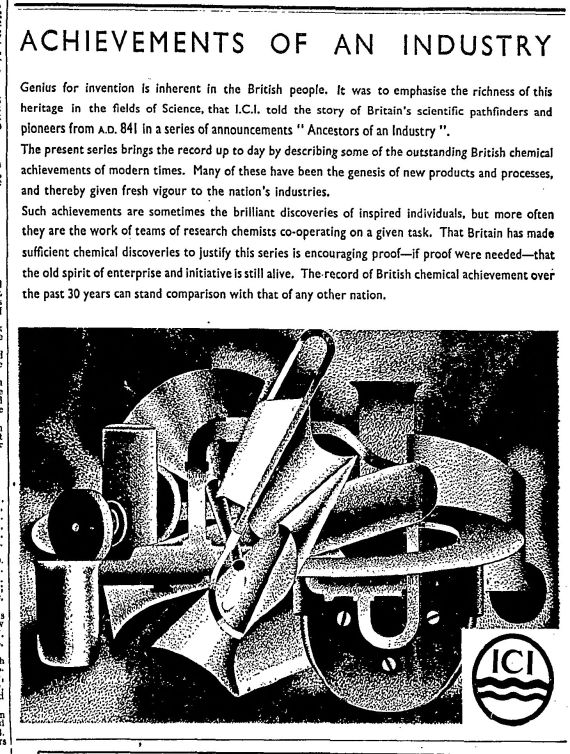
Following an extensive search on the British Newspaper Archive, however, it seems that only one of the eleven was actually used in a newspaper advert – namely, “Introduction.” It was used in the ICI “Achievements of an Industry” feature in 1949 – Fig.16d is an example from The Scotsman, 28 June 1949 (p.7.) I am still not clear why Carr titled it “Introduction”, and what the picture has to do with the “genesis of new products and processes.” Personally speaking, I would have thought that the likes of Figs.15a, 15b & 15c were more suited to the ICI’s aims, but there it is. If Carr was not alone in this, it would appear that artists submitted several paintings to ICI, some of which were used and others not.
One final oddity: the exhibition catalogue cited in note (7b) tells us that one of Carr’s pictures was titled “Fishes” – so could this be Fig.12 ? If so it was “to illustrate an advertisement describing the connection between the chemist and the fishery industry.” But no such advert seems to have appeared in any newspaper, and, as with “Introduction” and “Eta Reeds”, I wouldn’t have guessed that this painting was done for ICI had I not been told it was – it seems more akin to surrealism than the fishing industry.
So, surprisingly, ICI accounts for most of Figs.13-15 inclusive, though not Fig.14b (“Still Life with Shells on a Basket”) & perhaps not Fig.12 (Composition.) So, what of them ? Titles are not always a good guide – “Introduction” (Fig.13a) is a good example – plus some of Carr’s pictures appear to have lost their titles in transit to the auction house, and to have been given a descriptive title by the compiler of the auction catalogue – thus “Eta Reeds” became “A family group seated in a field” (Fig.10e.) The matter of dates further complicates matters for so many of Carr’s paintings seem to be undated. If either “Still Life” or “Composition” had been dated 1937, for example, we would know that they neither belonged to the Compositions 1 to14 series and nor were they done for ICI. But in the absence of dates, for the Compositions series we must go back to that review of the Wertheim Gallery exhibition of 1933 which tells us that the paintings depict “geometrical solids and severely simplified natural objects in architectural arrangements” and that the pictures “are all of the same size.” Clearly Figs.12 & 14b are not the same shape (the dimensions of the former are not stated), and neither has a clear geometrical / architectural arrangement or character to it, so I doubt they belong to the Compositions series. All in all, then, the mystery of that series remains, pending further investigation.
[The images can be browsed here.]
Anyone who has ever tried a search on ancestry sites for Hamzeh Carr knows that he is nowhere to be found. It is clear, then, that Hamzeh was a name adopted on his conversion to Islam, mentioned above. When I first made contact with Terry Wilfong, neither of us knew his real name, but both of us felt that Carr was probably his real surname. The problem was that the search for Carrs, born in England and old enough to be an active artist in the 1920s, and even using exact key word “artist,” threw up quite a number, none of which were totally conclusive. It was Claire Jackson who made a real breakthrough when she found a passenger list for the ship Margha, sailing from London to Bombay departing on 23 October 1925. On board was Forrester Carr of Dyson Lodge, Hove (Sussex), an artist aged 35, heading to Port Said, Egypt. That rang a bell with Terry, as he had been told by a reliable source that one of his possible Carrs, whom he had previously dismissed in favour of a seemingly more likely one, had been listed in an address book of the above–mentioned Ruth Deyo as “Hamzeh Carr–Forrester, 13 Norman Road, Hove.” Claire also came up with a record of an exchange of letters, dated 1943, between Hamzeh Carr, of an unspecified address in Hove, and Arthur Tooth, the owner of a London gallery, these being preserved in the library of the Tate Gallery in London. Scans of the letters from the Tate revealed that Hamzah’s (that’s how he signs it) address was, as we expected, 13 Norman Road, Hove. (Incidentally, Hamzeh was touting for an exhibition, but unfortunately the gallery turned him down – in a letter addressed to “Dear Miss Carr”.) Again, in the 1939 Register (where he is listed as “Artist, Teacher (painting)” and in a 1945 Electoral Roll – dates either side of the Tooth Gallery letters – Forrester Carr is recorded as living at 13 Norman Road, Hove, in both documents with a Mary Chapman, who turns out to be his step–sister, but more of her presently. The Dyson Lodge of the ship’s passenger list of 1925, as we shall see shortly, was the house name of what became 13 Norman Road. (Confusingly, the best online family tree for him gives his name as Forrester Dyson Lodge Carr, but his birth name was definitely Forrester Carr, and the Dyson Lodge part is the house name.) Curiously, someone somewhere knew that Hamzeh Carr was Forrester Carr back in 1942, for Claire came across a “books wanted” entry in the Book Trade Weekly (vol.8, p.37) for that year seeking “Omar Khayyam – Rubaiyat. Ills, by Forrester Carr.”
We are now in position to put together a brief biography of our artist. He was born Forrester Carr on 17 September 1890 at Waltham Cross, Cheshunt, Edmonton (Hertfordshire, about 12 miles north of central London.) He was the son of Thomas Carr, a miller by profession, and his wife, Helen Esther Carr (late Chapman, née Littler.) The 1891 UK Census gives us a good snapshot of his family at that time, consisting of his father (age 43), his mother (age 39), his step–sister Mary Chapman (age 17, Helen Esther’s daughter by her first marriage), his six sisters (ages 14 down to 8) and one older brother (age 6). Forrester was thus the latest, and far away the youngest, child in the family. Also in the house – “The Lodge” – lived a governess and three servants. The family was thus quite well off.
Indeed, the first sighting we have of “Master Forrester Carr” is as a page boy who was “attired in a suit of white corded silk” at a society wedding in the parish church of Waltham Abbey, as reported in The Lady’s Pictorial on 4 August 1894 (p.29.) The bride was Susannah Clarke Carr, the daughter of Forrester’s uncle James.
The 1901 UK census finds him at school in Bishop Stortford, age 10. In 1909 he joined the army (the Gordon Highlanders.) Thus he is not recorded with his family in the 1911 UK Census by which time his parents had moved to High Street, Dunstable, his father now recorded as a Hotel Proprietor. Many of the family had now left the parental home, but Mary Chapman and one daughter remained. This census is interesting in that it tells us that in the course of their 35 year marriage they had had ten children of which nine were still living – quite a record in those days.
As regards Forrester’s career in the army, by 1911 he was a second lieutenant in the 7th Battalion of the Royal Fusiliers (London Regiment) and by 1913 a full lieutenant. By 1915 he was serving in Nigeria, having been seconded to command a police force there, after which he seems to have returned to regular army service. Oddly, he is listed on a passenger manifest as Captain Forrester Carr aboard the Karina departing from Liverpool to Lagos in March 1916, but his name has a line through it, so perhaps he ‘abandoned ship’ for some reason. But whatever, in August 1917 Captain Forrester Carr returned to Liverpool from Lagos aboard the Beventer. He left the army in January 1919, and in the electoral roll for Chertsey, Surrey, for that year, he is recorded as living (or at least registered) at Essex House on Kent Road there.
In the 1921 Census, his parents are living as boarders at 19 St Catherine Terrace, Hove. His step–sister Mary is a secretary, and is listed a visitor with the Askwith family at “Henshaw”, South Nutfield (Surrey.) Forrester is nowhere to be seen, and so is presumably in Egypt. Certainly we know that he was teaching at the School of Fine Art in Cairo by May 1921 under the name Hamzeh Carr (his contract lasting until October 1927 (8)), and that by the end of 1922 he was drawing the contents of Tutankhamun’s tomb for Howard Carter also under the name of Hamzeh Carr. At what stage he converted to Islam is not clear, but the transformation could perhaps have begun during his army service in West Africa or during his time in Cairo.
By 1922 Thomas Carr and his wife, Helen Esther, had moved to the above–mentioned Dyson Lodge in Hove. Fortunately we have a complete set of Electoral Rolls covering 1922 to 1932 from which we can see that they continued to live there, the house becoming 13 Norman Road in 1925. In 1929 Mary Chapman moved in with them, the three living together, until Thomas Carr’s death in 1934. Helen Esther Carr died in 1936, and Mary Chapman continued to live there until her death in 1965 at the age of 92, probate being granted to “Forrester Carr artist.”
As regards Forrester himself, it appears that he was again employed as a teacher at the School of Fine Arts in Cairo from 1 July 1931 to 1 October 1937 (8), presumably with breaks back in England during School vacations, but his travels to and from Egypt seem not to be well recorded. In addition to the 1925 trip to Port Said mentioned above, we know that on 29 August 1936 he sailed from London to Port Said aboard the Oronsay and that on 16 June 1938 he arrived in London, having sailed from Egypt aboard the Otranto. This may well mark his permanent return to England, for, as we saw earlier, in the 1939 Register he was living with Mary Chapman at 13 Norman Road, Hove. Also as noted earlier, he was still with Mary at that same address in 1943 at the time of his letters to the Arthur Tooth Gallery, and still there in 1945 as recorded in the Electoral Roll for that year. Incidentally, in his first letter to the Gallery he mentions in passing that he was doing wartime ARP (Air Raid Precautions) duties.
Electoral Rolls for 1946–1948 reveal that he had moved to London, living at 12 Queen’s Gate Terrace, Kensington, though it is not clear what he was doing there. (perhaps in relation to the ICI Project discussed earlier?) We know he was still painting in the 1940s, and of course there was always that good stand–by for artists in need of funds, teaching, though there is as yet no evidence that he resorted to that at this time.
How long he was in London is not clear either, but by 1962 he was back with step–sister Mary at 13 Norman Road, Hove and he seems to have been still there at the time of Mary’s death in 1965, when he (presumably) inherited £7343 from her, a considerable sum back then. It is not clear whether the Carr family owned the house (by family inheritance ?), and consequently we don’t know if Forrester inherited it. What we do know is that Forrester Carr disappears from all records after 1965. There is no record of his death anywhere in the UK, and as a friend of Claire’s at Westminster Archives found, neither Forrester nor Hamzeh Carr appears in the Deaths Abroad records 1965–1980 kept by the General Register Office. He simply vanishes from history.
This lack of any records at all relating to Carr after 1965 does not bode well and one begins to wonder if he met the sad and anonymous end of a vagrant / homeless ‘John Doe’. Did he perhaps develop a mental illness ? It might explain the lack of any art–work by him after the 1940s, as well as his ‘disappearance’. Had Mary Chapman been looking after him, and when she died he went ‘off the rails’ (in which case what became of her not inconsiderable estate ?) We just don’t know, and all is pure speculation.
It is curious that, as an artist in Egypt, he was known as Hamzeh Carr, yet nowhere in official records when back in England does he use that name: officially he is Forrester Carr, though his paintings dating from when he was back in England are still signed Hamzeh Carr. Perhaps he adopted that name as much for his artist’s name as for his conversion to Islam, though Forrester Carr is a distinctive enough name. But possibly also Hamzeh Carr served as a ‘disguise’ in Egypt to keep his real name separate from any involvement in the homosexual underworld in Cairo, though I stress that that must remain pure speculation for now based solely on his association with Pum.
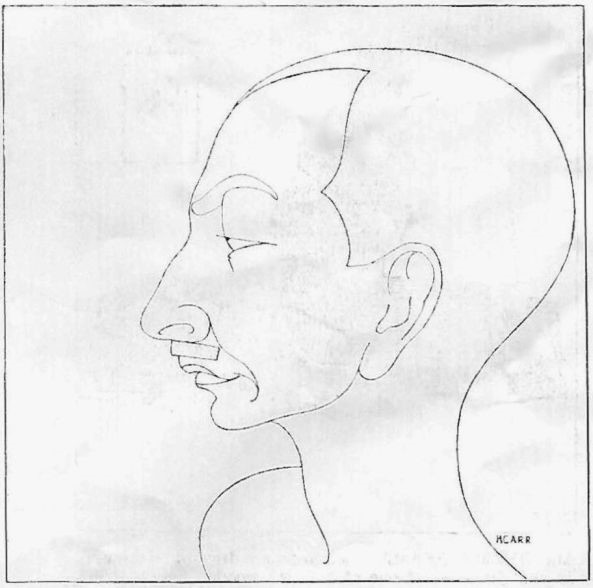
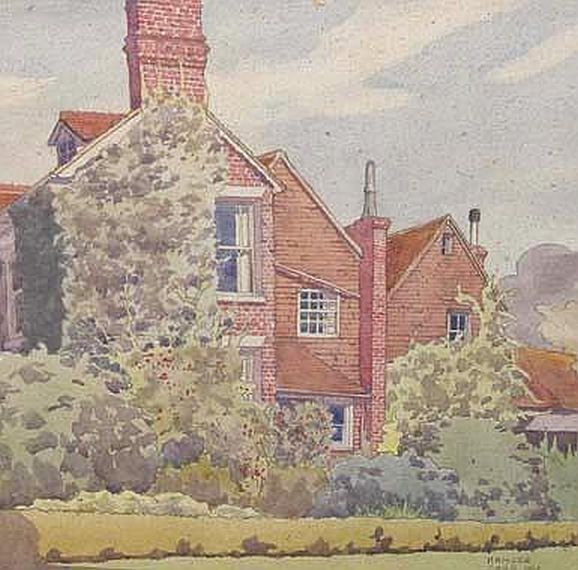
Though we do not have a date or place of death for our artist, we do have a self–portrait of him. It was published in the Special Artists’ Number of The Bodleian, the Journal of Books at the Bodley Head (vol.18, no.7, October 1926. It is shown in Fig.17 and was captioned, “A Self-portrait of Hamzeh Carr, who has this year designed some remarkable illustrations for Sir Edwin Arnold’s The Light of Asia. He also illustrated the special version of the Rubaiyat, translated from the French by Frederick Baron Corvo.” It is signed H.Carr. Also of interest is Fig.18, described in an auction catalogue of 2007 as a “watercolour view of a redbrick house with pitched roofs, chimneys, sash windows and garden foliage.” At the bottom right it is signed and dated 1925 – the year we know Carr was travelling from Dyson Lodge / 13 Norman Road, Hove, to Egypt. Today 13 Norman Road is a modern looking bungalow, and though it may have been rebuilt on the site of a house like its neighbouring, more Victorian–looking, no.11, that doesn’t really match Fig.18, so just where the redbrick house was remains a mystery. Finally, in the Cairo publication The Arab Observer for 19 August 1963 occurs one of the few reminiscences of Hamzeh Carr. It is only one brief paragraph, but would that we had more like it:
Some thirty years ago the tall, stooping figure of Hamzeh Carr used to be a familiar sight in the streets of Cairo. This English painter had become a Muslim, whose sincere piety won him the respect of the devout in his new faith. Some of his pictures still hang in the Gayer–Anderson Museum – “vegetarian” paintings as somebody once called them – ascetic and sensitive like the gentle spirit which conceived them.
(My thanks are due to Terry Wilfong for bringing this and the self–portrait to my attention, and to Claire Jackson for information about the redbrick house.)
Note 1:Note 1: For details on this see my essay “Edward Heron–Allen: A Walk on the Wild Side” at http://www.bobforrestweb.co.uk/The_Rubaiyat/N_and_Q/Heron_Allen/Heron_Allen.htm
Note 2: Digitised versions of a large number of issues of this journal can be found on the website of The American University of Cairo. Though a large number of issues have been preserved and digitised, there are gaps – issues between 26 March 1921 and 11 November 1921 are missing, for example, a period which might well have yielded more examples of Carr’s work. Act 2 of Fig.5a may well fall in that gap.
Note 3a: For Deyo’s opera, see Ann Sears, “An American Composer Answers The Call To Egypt” in The Sonneck Society for American Music Bulletin, Spring 1997, p.1 & p.8–10. For the proposed 1939 performance of the opera & a mention of Carr’s dress designs, see The Chicago Tribune for 29 January 1939 (p.79). For both her opera & her pastels, see Ann H. Murray, “The Spiritual Made Visible: Ruth Lynda Deyo’s Abstract Pastels and Her Grand Egyptian Opera” in Deborah J. Johnson and David Ogawa (eds.), Seeing and Beyond: Essays on Eighteenth– to Twenty–First Century Art in Honour of Kermit S. Champa (New York, 2005.) My thanks are due to Claire Jackson for directing me to the essays by Ann Sears and Ann H. Murray.
Note 3b: Thought Forms studied – and illustrated in colour – the clairvoyantly viewed changes in the human aura produced by a variety of thoughts and feelings like love, devotion, jealousy, anger, ambition and fright. The authors also observed the thought forms of gamblers in Monte Carlo and those of the witnesses of a street accident. In addition it contains illustrations of the effects on the all–pervasive “ether” of music, which can be seen by those with the requisite psychic powers. Examples are given of the effects of music by Mendelssohn, Gounod and Wagner.
Note 4: See Louise Foxcroft, Gayer–Anderson – The Life and Afterlife of the Irish Pasha (American University in Cairo Press, 2016.) I contacted Louise to ask the source of her information about Hamzeh Car and she told me that her information came from Gayer–Anderson’s unpublished autobiographical manuscript, Fateful Attractions, now in the possession of his grandson, the sculptor Theo Gayer–Anderson. She added that Gayer–Anderson’s ‘valet,’ Abd–el–Wahid (who wore women’s undergarments and jewels), was Fayumi and had a store of folk tales, some of which G–A published, illustrated by Hamzeh Carr. If it was indeed published, a copy of it has not survived: G–A did translate Legends of the Bait al–Kretliya, published posthumously in 1951 (he died in 1945) but it was illustrated by Abd al–Aziz Abdu. (My thanks are due to Terry Wilfong for directing me to this useful book.)
Note 5: The article appeared in the Cairo publication Images on 18 March 1930. It also featured Carr’s landscape painting of the exterior of a Cairo Mosque, and a still–life titled “A Frugal Meal”, which I do not reproduce here. A translation of the commentary, for what it is worth, runs:
While Mr. Hamzeh Carr was mainly known in his early days in Egypt for his delicate paintings of Persian legends, with soft and harmonious shades, this year at his recent exhibition on Antikhana Street, he offered us beautiful paintings showing a stronger command of his art and a more solid technique.
His still lifes, with a subtle harmony of colours, are treated in full–bodied paint with simplicity and an excellent understanding of decorative art. His flowers, and, among others, his study of flowers in virginal white on a white background, are particularly successful.
The studies of the Citadel, the Great Pyramid, and the mosques show the same concern for capturing in full a personal inspiration of the chosen subject, with all the love of a painter sincerely in love with his art.
Next to this, we reproduce some paintings by Mr. Carr, where one can appreciate his remarkable talent.
This is fairly typical exhibition review material, unfortunately, telling us little about the artist himself. It is not clear if the Citadel is the painting shown in Fig.9c or if the Great Pyramid is the painting shown in Fig.9d. Again I must thank Terry for bringing this article to my attention.
Note 6a: The National Art Library at the V&A in London has a volume of Wertheim Gallery catalogues for the period 1930–1934, but it is not in there. It seems likely that the exhibition ‘catalogue’ was a single sheet for each artist, for such a listing of 12 titles for the Ruby Boardman half of the exhibition has survived in the Frick Art Research Library in New York. Unfortunately the Hamzeh Carr sheet wasn’t preserved with it.
Note 6b: The Index Card is to be found in Box 30 of the Lucy Wertheim Archive. The Birminham Post clip comes from an album of press cuttings in Box 21 (March 1933–April 1934), the album giving greater prominence to Ruby Boardman. (The Birmingham Post clip is from an issue missing in the British Newspaper Archive.)
Note 7a: The “Portraits of an Industry” series is well covered in WWII: War Pictures by British Artists, edited by Sacha Llewellyn & Paul Liss, this being the Catalogue of an exhibition held at Morley College, London, 28 October to 23 November 2016. This gives us a dated list of the various series of adverts, but it only covers the Portraits series in detail (p.226–239.) A volume titled ICI: Portraits of an Industry (Lund Humphries & Co., Ltd, London, 1947), with a Foreword by Lord McGowan, the then Chairman of ICI, also covered just the portraits, but with interesting biographies of the sitters. Fortunately the British Newspaper Archive enables us to get an overview of the other series of Prestige Adverts, thus “Aspects of an Industry” consisted of 25 numbered titles, and one un–numbered, whilst “Services of an Industry” contained 41 numbered titles. Confusingly, though it is unusual, there can sometimes be more than one illustration for the same title number, “Services of an Industry” no.1 (“Battle Dress”) having at least two different illustrations in English newspapers, and a third, titled “At Your Service” in Indian newspapers (though Indian & English newspapers do generally differ in their illustrations.) There seems to be only one illustration each for the ‘series’ Equipment, Ancestors, Achievements and Elements of an Industry. Progress of Chemistry ran to 7 illustrated parts.
Note 7b: Portraits of an Industry – subtitled “an Exhibition of Pictures depicting the Personnel, Aspects and Services of the British Chemical Industry,” Sponsored by the Central Institute of Art and Design, and held by courtesy of the New English Art Club at Suffolk Galleries 18th October to 9th November 1946.” This 24 page booklet lists the 85 pictures exhibited, though clearly this 85 was a selection from many more. Of the 85, no less than 56 were portraits; 5 from “Aspects of an Industry”; and 24 from “Services of an Industry.” Four were by Hamzeh Carr: Portrait of Agnes Wilson; Portrait of Sarah Ann Brown; Fishes; and Fertility (both from “Services of an Industry.”)
Note 7c: The Sotheby’s Olympia (London) “Modern British Painters” auction on 12 September 2002 featured 11 pictures by Carr: Lot 152 – Fertility No.2; Lot 153 – Fertility No.1; Lot 154 – Eta Reeds; Lot 155 – Perspex; Lot 156 – Research and Production; Lot 157 – Power Cartridge (first version); Lot 158 – Power Cartridge (second version); Lot 159 – Fireguard; Lot 160 – Introduction; Lot 161 – Can Openers; and Lot 162 – Gaskets. Four of these clearly didn’t sell, as they were auctioned again through Rosebery’s of London on 9th–10th December 2003 as Lot 703 – Fertility No.2; Lot 715 – Fireguard; Lot 716 – Eta Reeds; and Lot 719 – Introduction.
Note 7d: See the Notice to Pulp and Paper Manufacturers in The Times of India, 24 June 1941, p.10.
Note 8: Information supplied by Dr. Hussam Rashwan, the owner of the paintings in Figs.9d, !0a, 10b & 10c.
Many people have helped in the research for this article. Mainly I must thank Terry Wilfong and Claire Jackson for their help on many fronts, as detailed in the body of the article. In many ways this has been a joint project with them. Likewise, for their images used at various stages in the text, I must thank the Kelsey Museum of Archaeology (Figs.7a & 7b); Hussam Rashwan (Figs.9d, 10a, 10b & 10c); and Magdy Balbaa (Figs.11a & 11b.) Also Louise Foxcroft for elaborating on material in her book relating to Hamzeh Carr and Yasser Mongy for information about Carr’s paintings in the Gayer–Anderson Museum.
In getting scans of the many sources locked in libraries I must thank the following: Ellie Harrold of the Paul Mellon Centre for Studies in British Art in London for items from the Lucy Wertheim Archive; Cori Hutchinson of the Frick Art Research Library for the Ruby Boardman exhibition list of 1933; Amy McMullen of the National Art Library at the V&A for information on their volume of Wertheim Gallery exhibition catalogues for 1933; Victoria at the Tate Library in London for scans of the Hamzeh Carr to Arthur Tooth letters of 1943; Tom at the National Portrait Gallery in London for scans of the Sotheby Olympia auction catalogue of 12 September 2002; and Mohamed Abdelwahab at the Library of the American University in Cairo for his help in navigating The Sphinx.
Finally, I must thank Fred Diba both for encouraging me to include Hamzeh Carr in my Rubaiyat Artists Series and for his translation work relating to the artist.
**********
To return to the Notes and Queries Index, click here.
To return to the Index of the Rubaiyat Archive, click here.