The Rubaiyat of Omar Khayyam illustrated by Webster Murray was published by Richard Lesley & Co. Ltd of 20 Tudor Street, London EC4. It was undated, but we know that it was published in 1945 as it is listed in The Bookseller for 27 September of that year. It is Coumans #66 & Paas #2964–8 and uses FitzGerald’s first version.
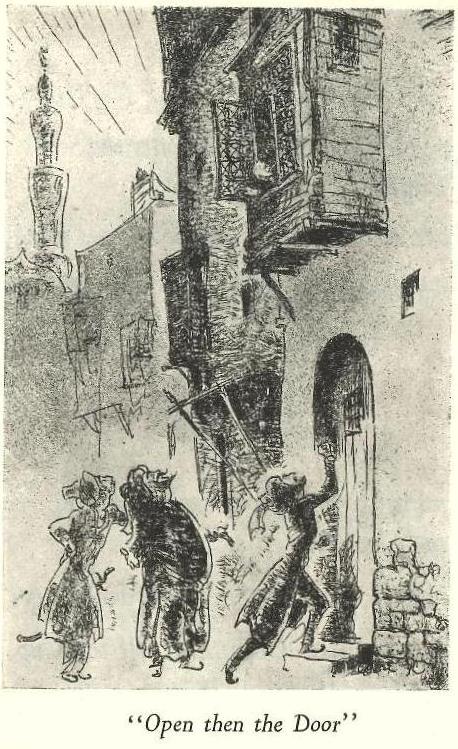
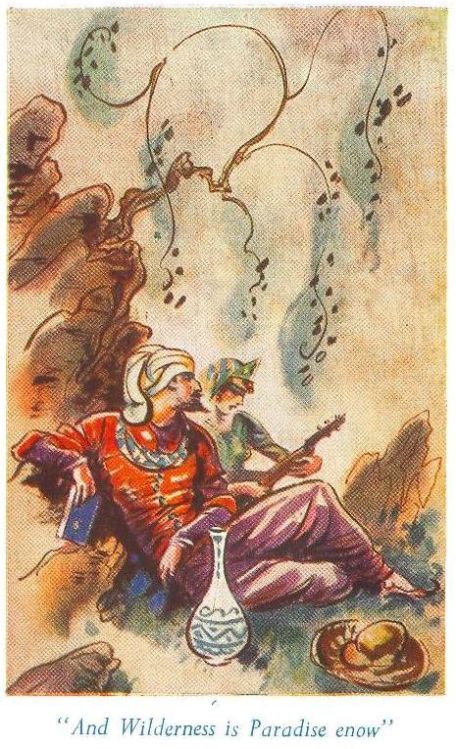
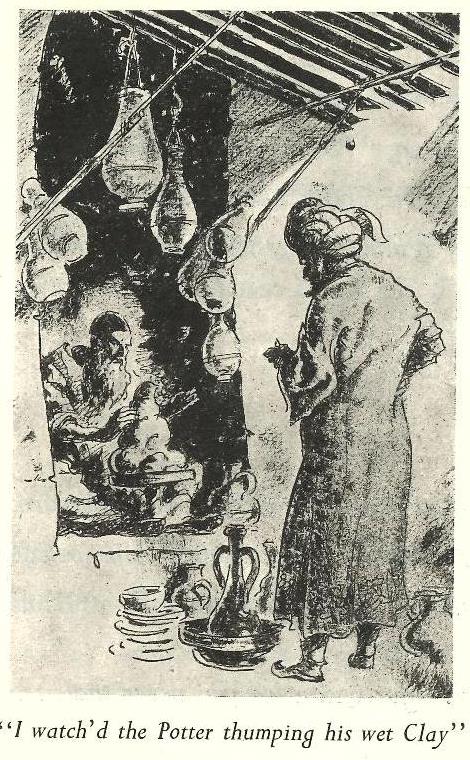
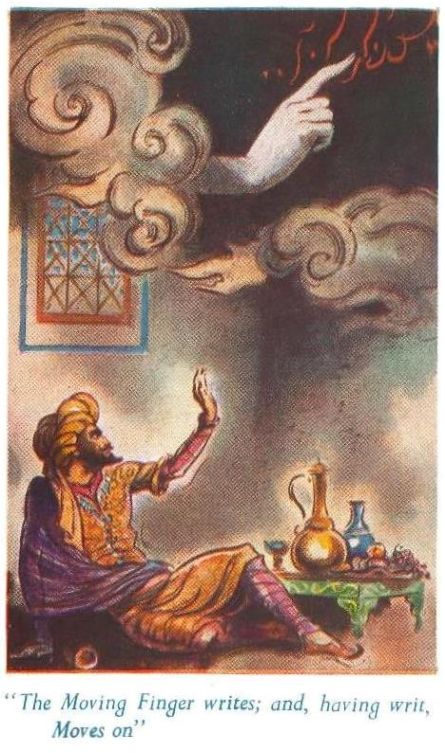
The book contains six illustrations in colour (including the frontispiece) and six in black & white. The frontispiece (Fig.1a) relates to the opening quatrain, showing a curiously spindly Hunter of the East lassoing the Sultan’s Turret with a Noose of Light. Fig.1b illustrates quatrain 3; Fig.1c, quatrain 11; Fig.1d, quatrain 36; Fig.1e, quatrain 51; and Fig.1f, quatrain 67.
[The images can be browsed here.]
As can be seen, the illustrations are skilfully executed, though mostly routine in their literal adherence to the text, only Fig.1a, being a bit more adventurous. Notably though, for an artist with an eye for the ladies, particularly if young and scantily clad (as we shall see), Webster resisted the temptation, indulged in by so many other illustrators, to produce a mildly erotic ‘Oriental’ Rubaiyat. This was presumably by choice rather than a requirement of his publisher, for whom he illustrated three mildly erotic classics, to which we now turn.
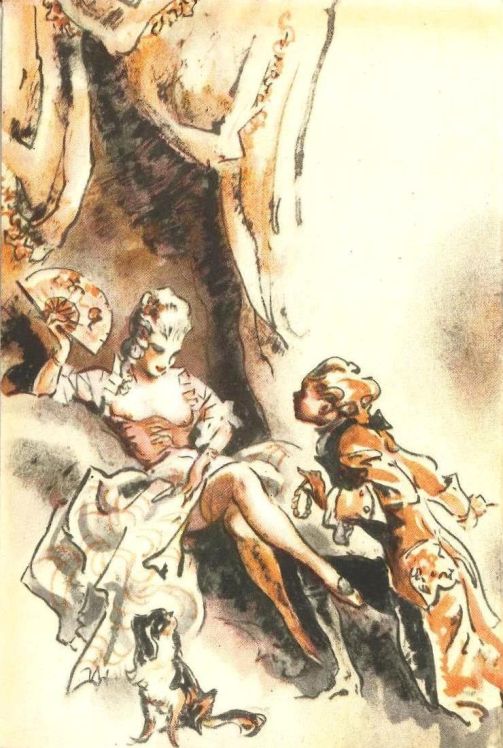
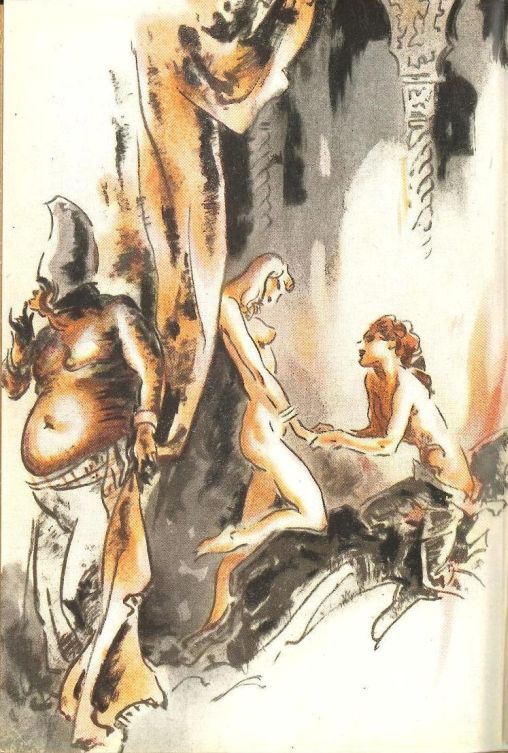
Voltaire’s The History of Candide, or, All for the Best was undated, but its entry in The Bookseller for 25 January 1945 gives its date of publication, in the same year as, but some months before, The Rubaiyat. No translator is named. The book contains twelve coloured illustrations in all, of which I give two examples here. Fig.2a shows Candide returning the Marchioness’ garter in part 1, chapter 22 (facing p.107) and Fig.2b shows Candide with the Circassian virgin in part 2, chapter 6 (facing p.177) – the facial expression of the eunuch to the left is a delightful touch!
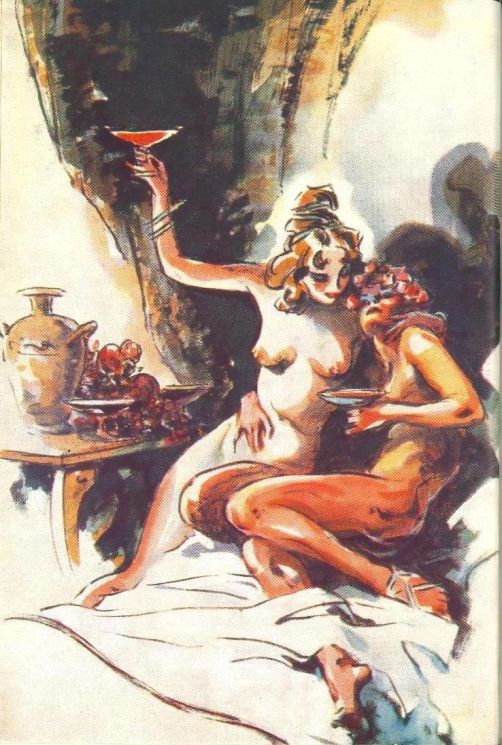
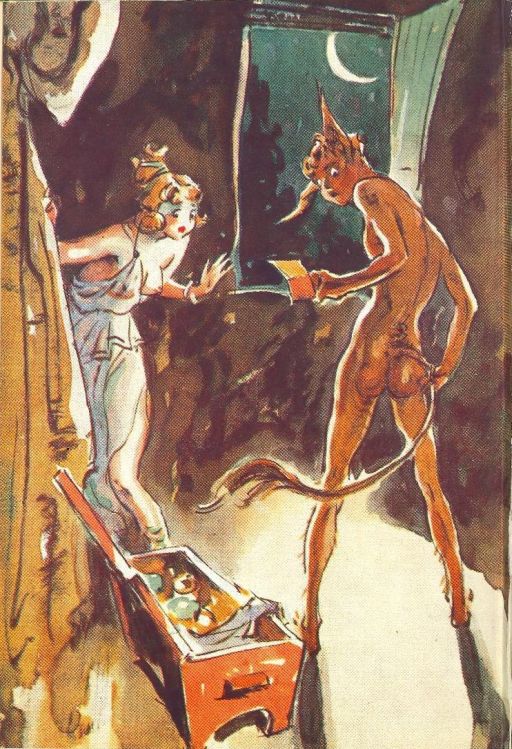
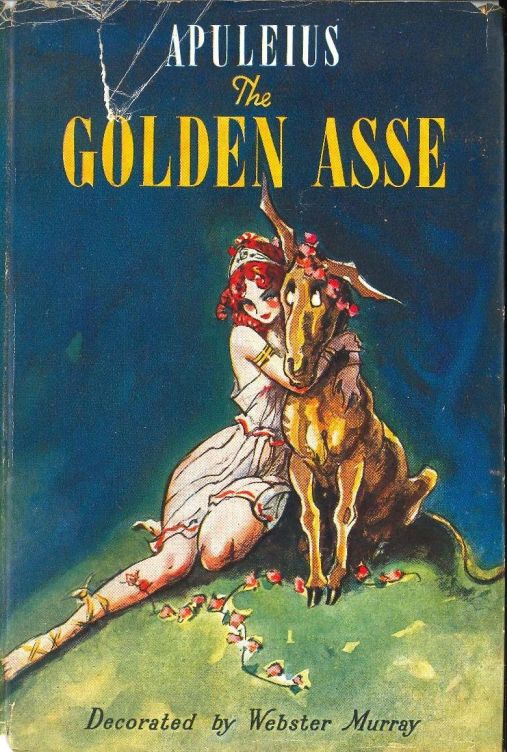
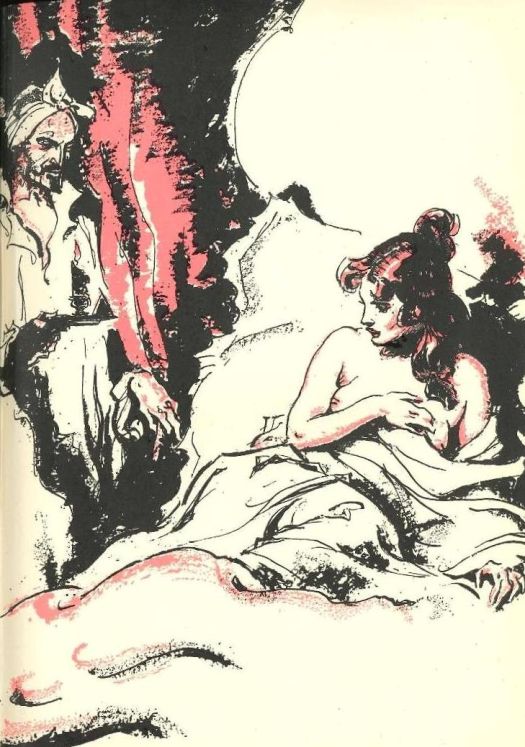
The Golden Asse of Lucius Apuleius was published in 1946. The translation is that of William Adlington, reprinted from the edition of 1639. The book contains nine coloured illustrations, of which I give two examples here. Fig.3a depicts Lucius in bed with Fotis in book 2, chapter 10 (facing p.45) and Fig.3b is the frontispiece showing Lucius turning into an ass on account of the botched spell by Fotis in book 3, chapter 17 (p.69). I cannot resist here reproducing Webster’s dust–jacket design as Fig.3c. It depicts Fotis with Lucius as the ass – the head of the ass is delightfully depicted!
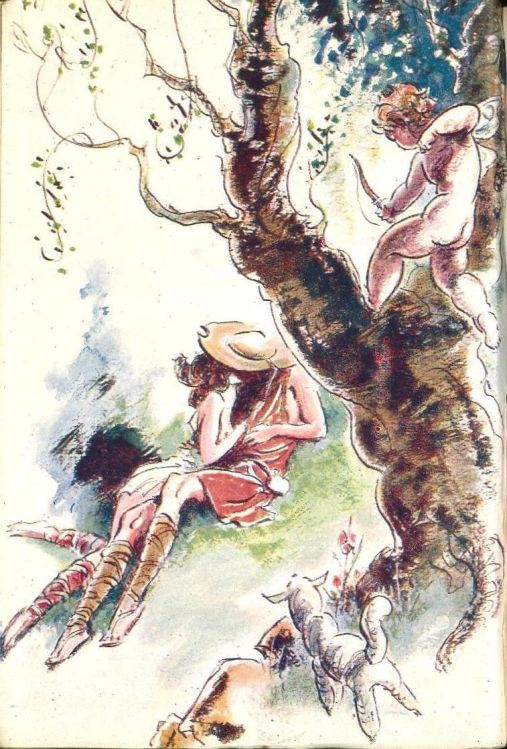
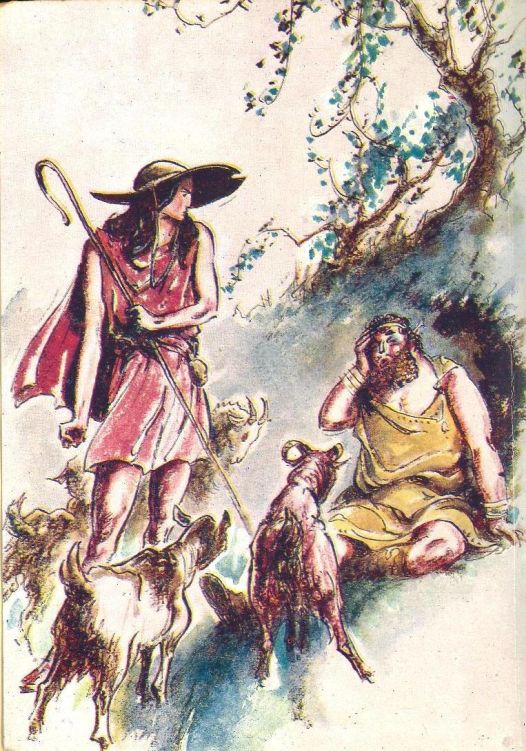
Daphnis and Chloe by Longinus is dated 1947. The translation is that of George Thornley of 1657. It contains ten illustrations in colour, of which I give two examples here. Fig.4a (facing p.27), showing Daphnis and Chloe locked in embrace, with Cupid having fired his bow from the tree, and a quizzical lamb at the base of the tree (Book 1.) Fig.4b (facing p.163) shows Daphnis and the drunken sott Gnatho who has unrequited homosexual designs on him (Book 4).
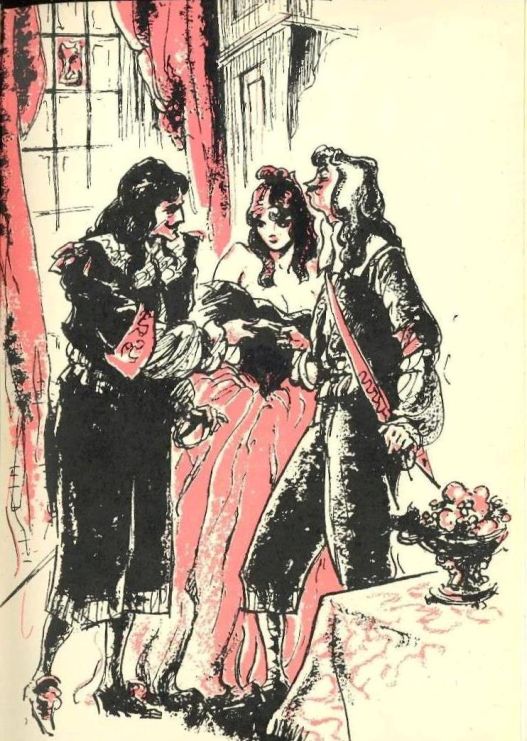
Closely related to the three mildly erotic books which Webster illustrated for Richard Lesley & Co. Ltd. is an edition of Defoe’s Moll Flanders published by Arandar Books Ltd, in 1946. It contained sixteen illustrations in colour, two examples of which are shown here. Fig.5a shows Moll at the time she is a servant in a house where two brothers fall in love with her (facing p.32) and Fig.5b shows Moll with the man in Bath whose wife has gone insane (facing p.96.)
I am not clear what connection there was between Arandar Books and Richard Lesley, as the two certainly shared business premises at 20 Tudor Street, London EC4 between 1944 and 1946 and 187 Piccadilly, London W1 from 1946 until at least 1949. But whatever, it is clear that Webster must have been very busy in the run–up to the period 1945–1947.
[The images can be browsed here.]
Webster’s career in book illustration seems to have begun in 1923 when he did the dust–jacket design for Geoffrey Moss’ novel Sweet Pepper, described as “a novel for those who like a little Pepper with their Sweetness.” In 1930 he did the dust–jacket and frontispiece for Sir Hari Singh Gour’s first novel His Only Love, “a well–drawn psychological study of the fusion of the cultural ideas of East and West.” Unfortunately I have never seen either of these dust–jackets, as they are so easily lost over time, and (at least in the past) have been largely discarded by libraries.
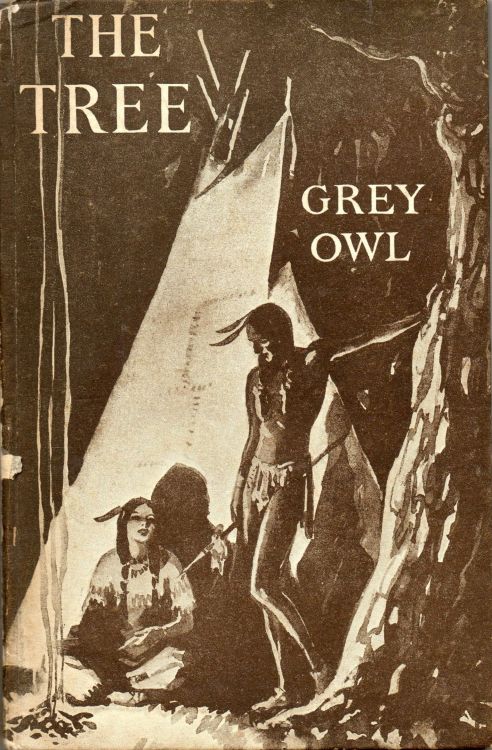
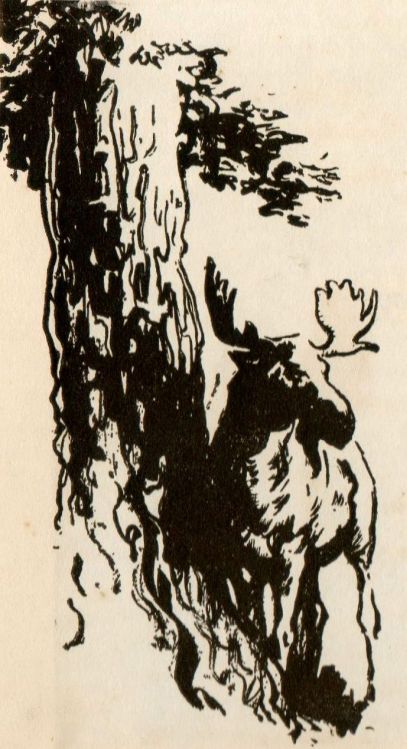
In 1937 he collaborated with Wa–Sha–Quon–Asin (‘Grey Owl’) in the illustration of his book The Tree, basically the account of an aged tree and the scenes of animal and human activity it has witnessed during its life. Grey Owl did the full–page illustrations and Webster the cover design (Fig.6a) and the marginal illustrations (Fig.6b is an example.)
In 1943 Webster went ‘solo’ in illustrating M.C. Carey’s book The Merchant Seaman, a factual study of the Service for young readers, with illustrations in colour of ships and seamen. This brings us to the period covered above, during which time he also illustrated R. S. Young’s Cricket on the Green, subtitled “for club and village cricketers, and for boys.”
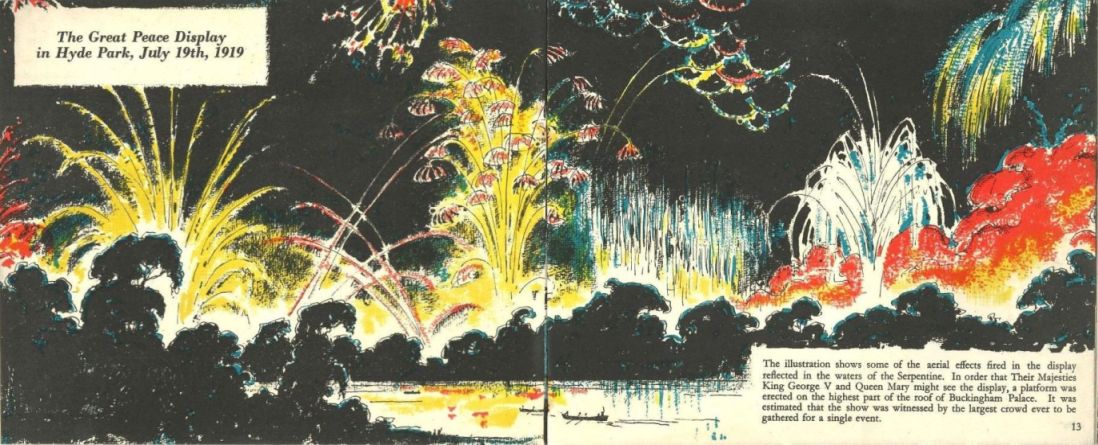
In 1951 he illustrated M. Pardoe and Howard Biggs’s children’s story The Ghost Boat, an example of which is shown in Fig.7 – it shows brothers Peter and John caught in a squall in their boat Aconite (p.69.) The following year (probably) the book All About Horses by Ruth St. Leger Gordon and Kenneth Sparrow appeared, its title telling us all we need to know about its contents. At about this time too, with Alan St. H. Brock, he wrote and illustrated the Puffin Picture Book Fireworks & Fetes (an example is shown in Fig.8.)
I have found no books illustrated by Webster dating from before 1923, or after about 1951 or 1952.
A large part of Webster’s output went into newspapers and magazines, notably The Tatler, The Bystander, and The Sketch, and to my way of thinking these rank as some of his best work.
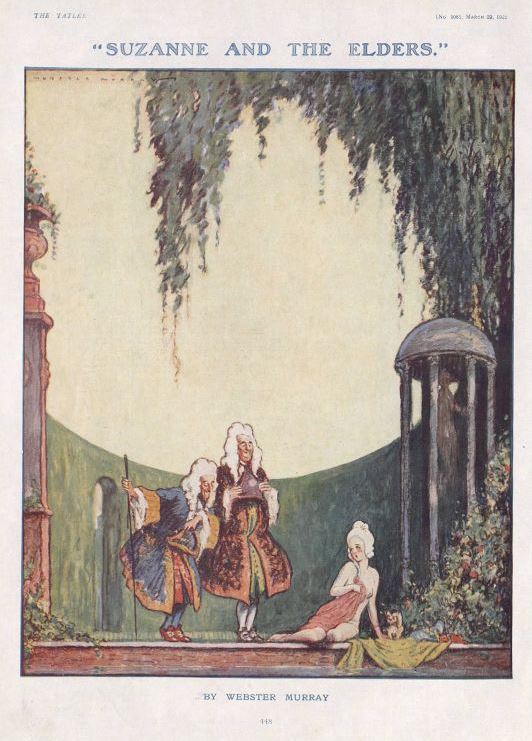
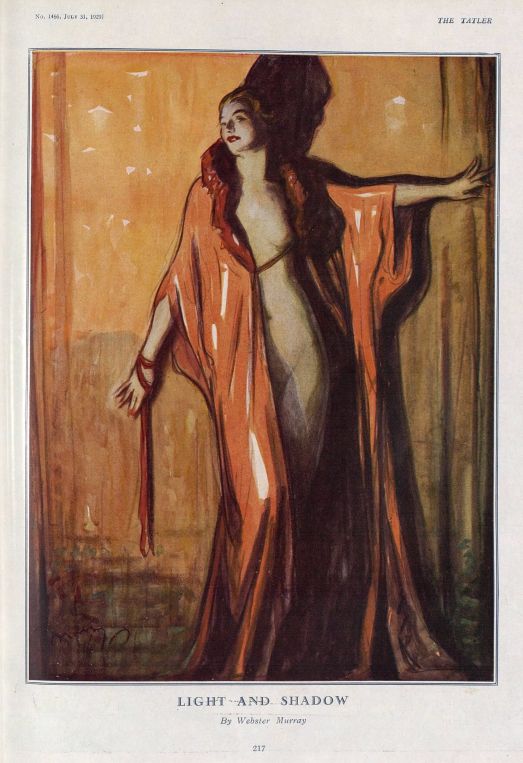
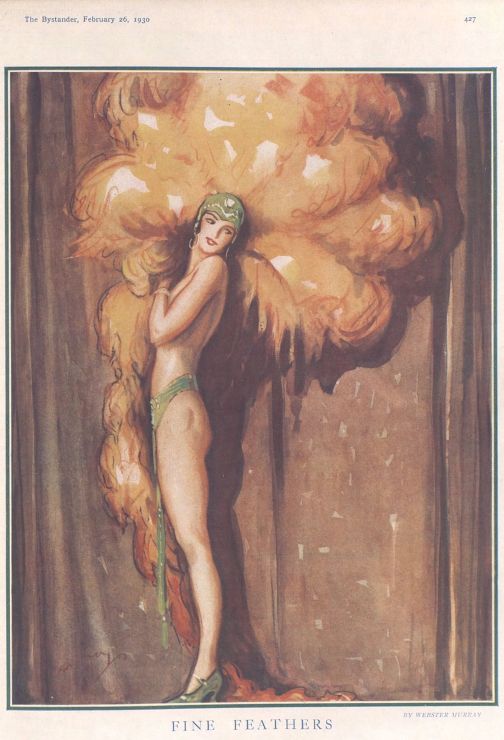
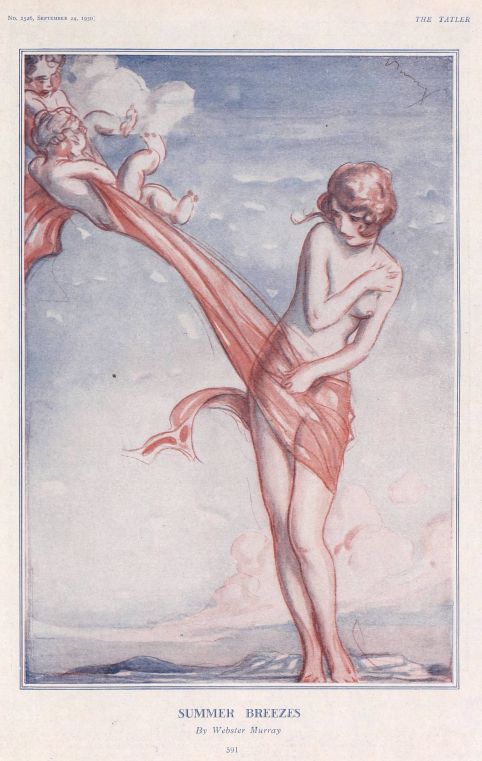
Given his penchant for nude or scantily clad young women, it comes as no surprise to find that these feature extensively in his illustrations. Four examples are given here (selected from many others!) Fig.9a, “Suzanne and the Elders”, from Tatler (29 March 1922, p.448), is an eighteenth century cartoon–like ‘remake’ of the Biblical “History of Susanna”, counted by some as belonging to The Apocrypha, but by others as chapter 13 of The Book of Daniel. As the tale of the virtue of Susanna under threat from lascivious elders, it has long given artists a good excuse to depict a nude. Fig.9b, “Light and Shadow”, is from Tatler (31 July 1929, p.217); Fig.9c, “Fine Feathers”, is from Bystander (26 February 1930, p.427); Fig.9d, “Summer Breezes”, is from Tatler (24 September 1930, p.591.) It is not clear why any of these last three necessitate a near–nude, but there it is.
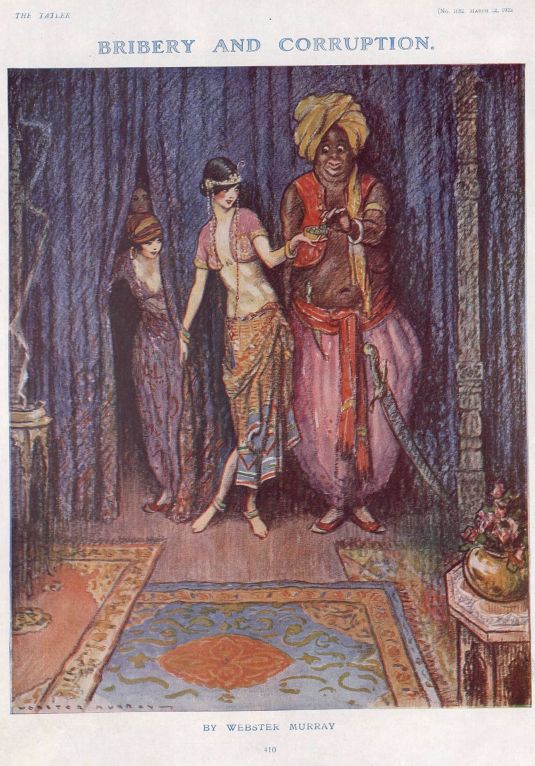
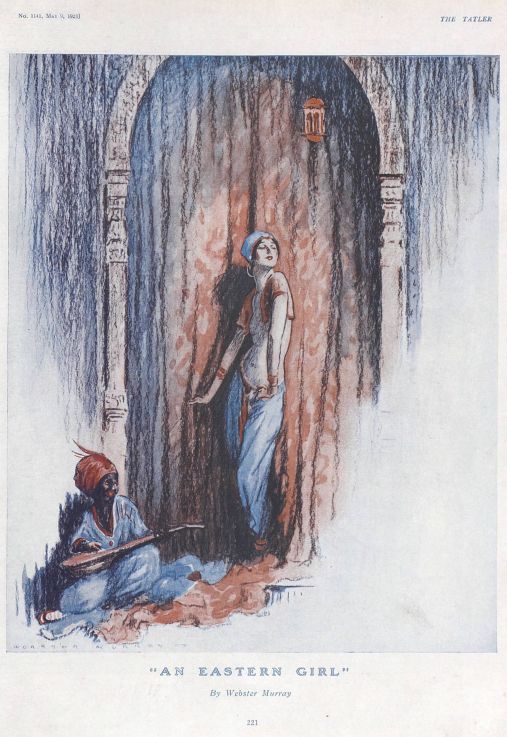
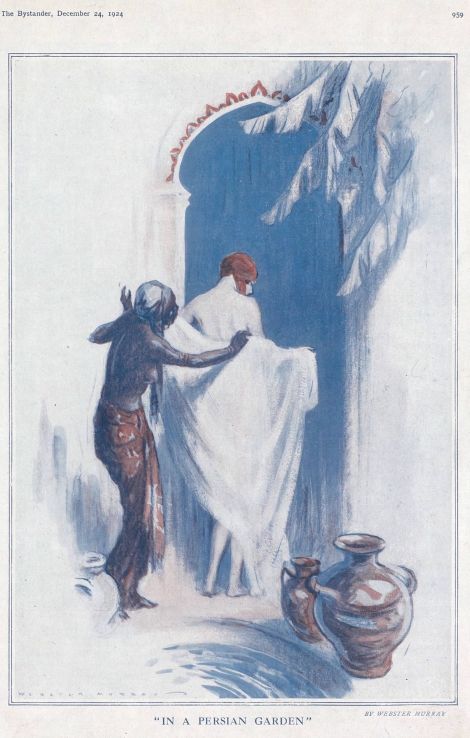
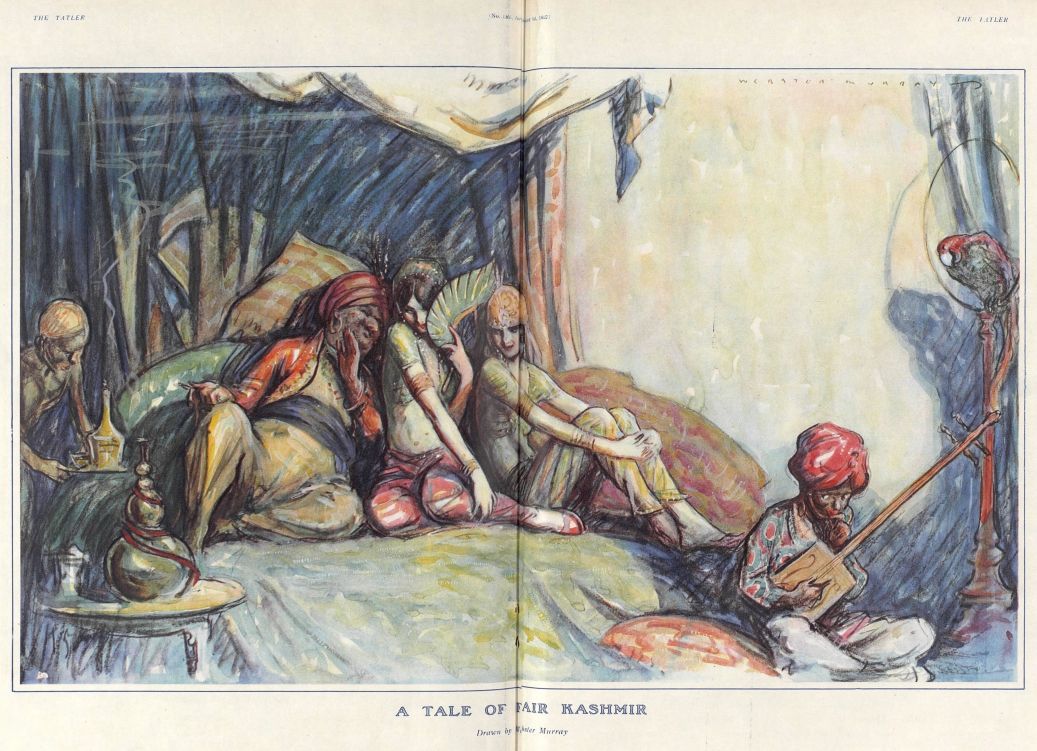
But Webster also had a penchant for the oriental, which surfaced in his Rubaiyat illustrations, of course. Four examples (there are others) are shown here. Fig.10a, “Bribery and Corruption”, from Tatler (22 March 1922, p.410), is a humorous example – note the expression of the eunuch on the right (cf. the eunuch in Fig.2b.) Three other examples, all of a mildly erotic ‘oriental’ nature are: Fig.10b, “An Eastern Girl”, is from Tatler (9 May 1923, p.221); Fig.10c, “In a Persian Garden”, is from Bystander (24 December 1924, p.959); and Fig.10d, “A Tale of Fair Kashmir”, is from Tatler (10 August 1927, p.250–1.)
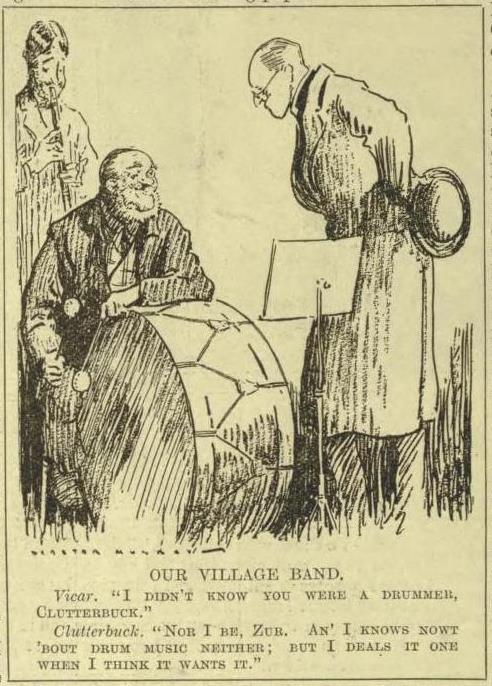
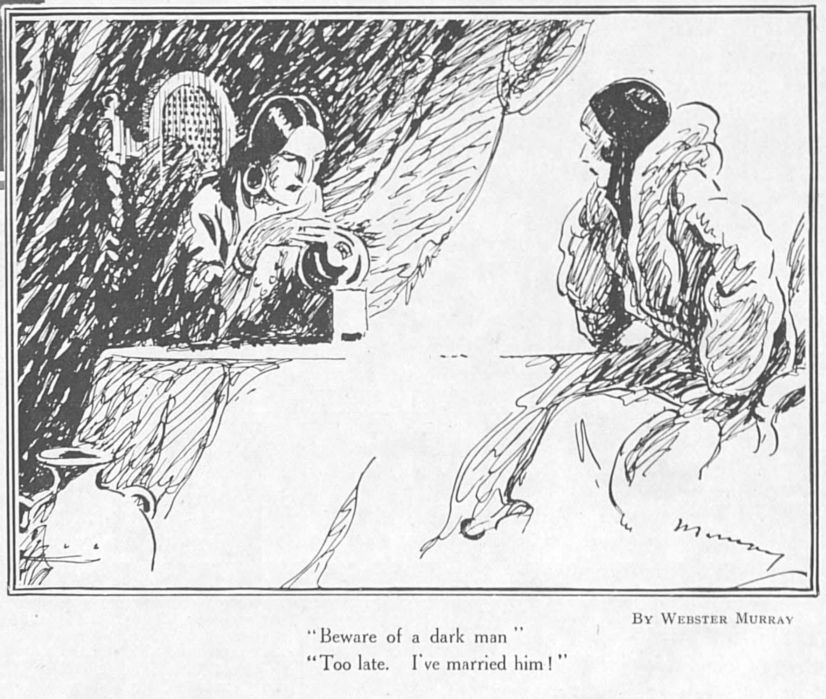
But it is Webster’s quirky sense of humour which impresses me most. Fig.11a and Fig.11b are two of his cartoons. The first is from Punch (16 February 1921, p.128) and the second from Bystander 13 May 1931, p.330.)
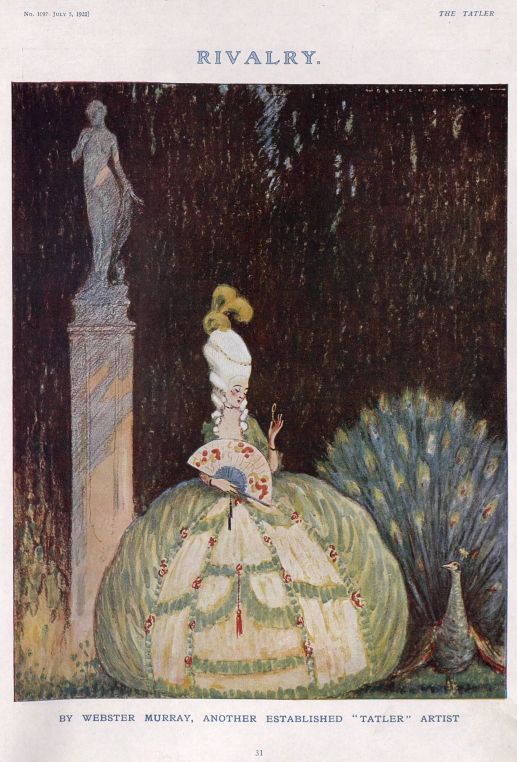
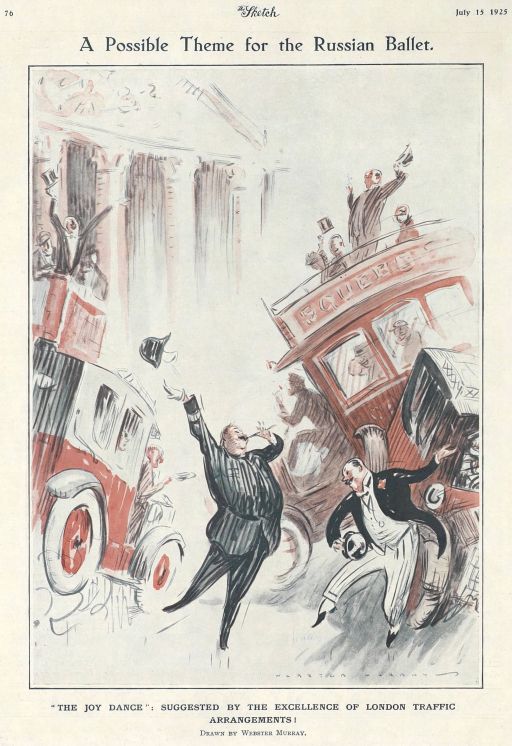
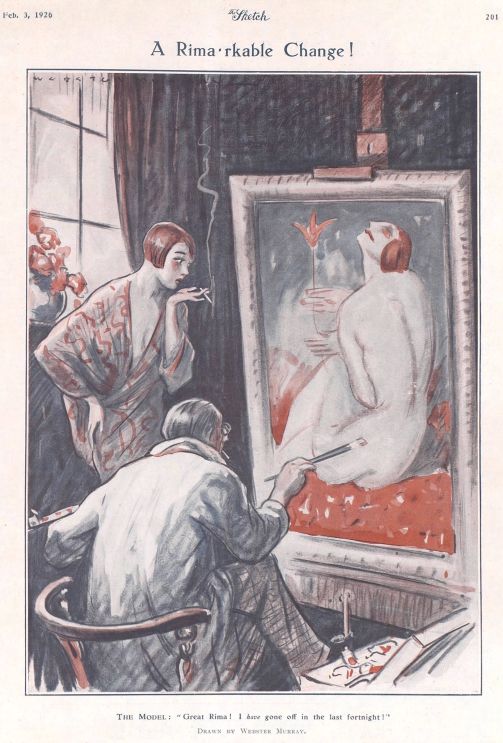
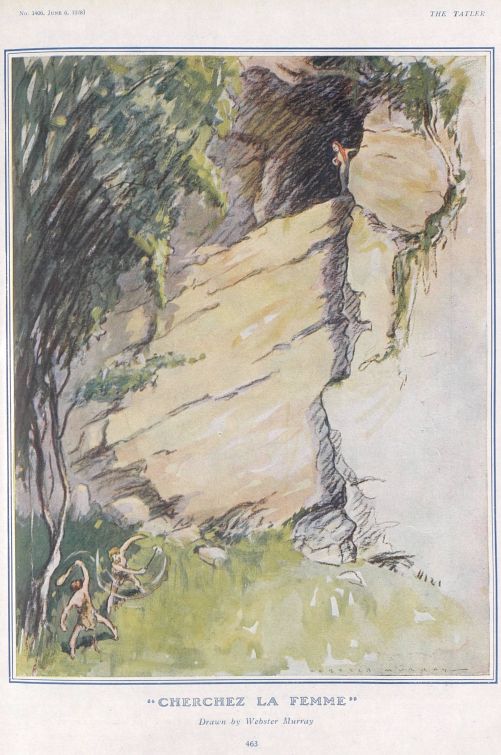
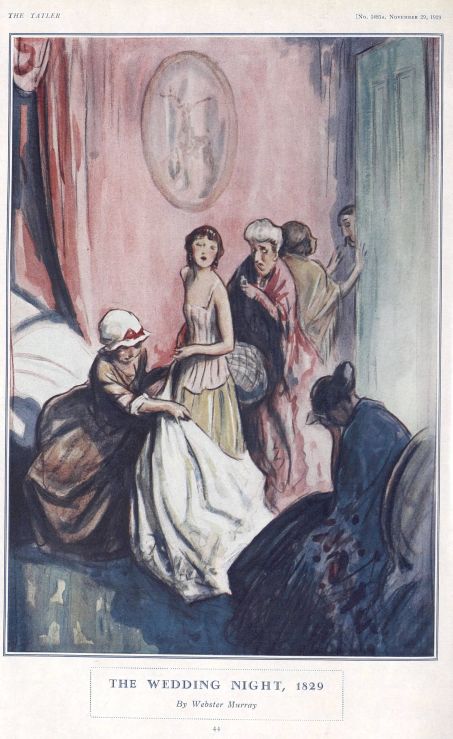
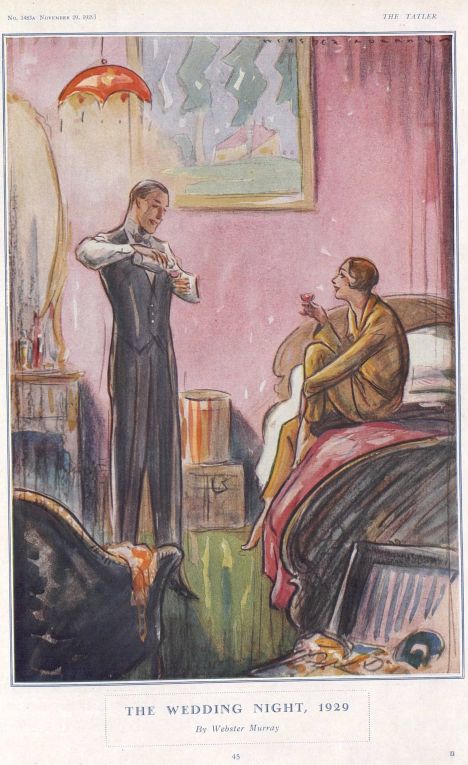
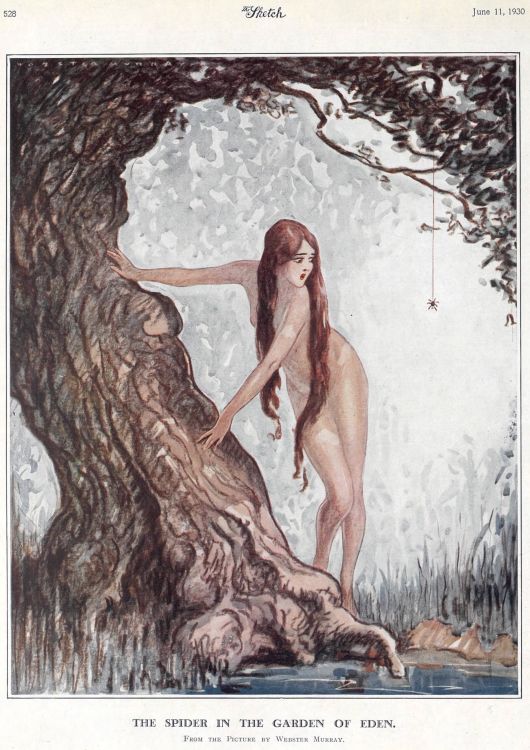
Rather more than simply amusing cartoons are the following, most of which are self–explanatory, though one does allude to a now largely forgotten episode of art history. Fig.12a, “Rivalry”, is from Tatler (5 July 1922, p.31); Fig.12b, “A Possible Theme for the Russian Ballet” (1), is from Sketch (15 July 1925, p.76); Fig.12c, “A Rima’ rkable Change” (2), is from Sketch (3 February 1926, p.201); Fig.12d, “Horrors, My Wife!”, is from Tatler 11 April 1928, p.72–3); Fig.12e, “Cherchez La Femme”, is from Tatler (6 June 1928, p.463); Figs.12f & 12g are a delightful pair of illustrations from Tatler (29 November 1929, p.44 & p.45) depicting “The Wedding Night, 1829” and “The Wedding Night, 1929” respectively; finally, Fig.12h, “The Spider in the Garden of Eden”, is from Sketch (11 June 1930, p.528.)
It is to be emphasised that the foregoing illustrations are merely a selection from among many others, and indeed a whole book could profitably be devoted to them. The foregoing date from 1921 to 1931, though I know of others, not used here, dating from as late as 1936. The Punch cartoon from 1921, though, remains the earliest I have found to date.
[The images can be browsed here.]
Very little is generally known about the life of Webster Murray – he doesn’t feature in any of the major dictionaries of artists and book illustrators, and finding details of him via online ancestry records turns out to be problematical. This is partly because Webster Murray seems to have been his professional name, the Webster being taken from his mother’s maiden name. He was actually born Stanley James Murray in Toronto, Canada, in October 1889, the son of Rev. James Murray, a Presbyterian Minister, and his wife Margaret (née Webster.) The 1911 Canadian Census gives us a snapshot of the family at that time: his father was age 56, his mother 45 and he was age 21 and listed as “Single” and “Artist”. He had two younger sisters, Elizabeth / Beth (age 20) and Helen (age 16.)
In Toronto in August 1911 Stanley James Murray married Florence Margaret Poapst (also age 21), a “diseuse” whose speciality was to be in reciting or singing French Canadian verse under the professional name of Peggy Murray.
Little is heard about him after that, but when his father died in 1919, as the result of being hit by a car, a report on the funeral in The Toronto Star on 22 December 1919 (p.2) noted that, “Stanley Murray, the late Mr. Murray’s only son, who is at present in England, was unable to be present.”
Moving forward in time, in the Toronto newspaper Star Weekly on 29 July 1922 (p.17) we learn much more about him in an article headed, “Young Toronto Artist Successful in England.” This article is well worth quoting in full:
Webster Murray, better known to his Toronto friends as Stan Murray, the son of the late Rev. Dr. Murray of Erskine and St. Paul’s Churches, has come into his own in British art circles as a painter of the front rank and one of the most promising of the younger artists working in London.
He has just held a most successful exhibition of portraits in the Gieve Galleries in London.
His work is best known to Canadians in the beautiful color pieces and centre pages he contributes to the Tatler, quaint, whimsical and humorous drawings of the Queen Anne period, one of the best of the more recent ones being ‘Con Amore’. In these drawings Murray lays claim to be the successor of the late Claude Shepperton, A.R.A., while distinctly different in style, yet possessing the same power of imagination and whimsy which distinguished Shepperton in Punch, the Tatler and other great British publications.
Webster Murray has had several pen and ink drawings in Punch, and has contributed a very large number of color pieces to Tatler, Eve, and similar papers.
He obtained his early training in art in Toronto colleges, but went over to London in 1911, where he has remained ever since, serving throughout the war with a British infantry regiment in which he held a commission and gained a captaincy, and since the war spending some time with his wife and little daughter in France painting, and building up a reputation in London as a portraitist and brilliant illustrator.
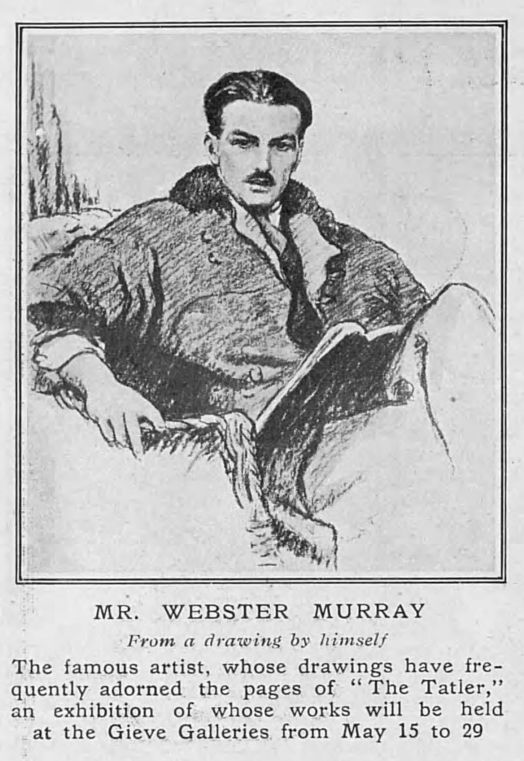
I have been unable to locate “Con Amore”, but examples of his Queen Anne style can be seen in Figs. 9a & 12a. The above article was accompanied by the self–portrait of the artist shown in Fig.13a, and the exhibition mentioned in the caption appears to have featured skilfully done portraits in charcoal, enhanced with watercolours (3). Their young daughter was Joan Margaret Murray, born in London in 1917, and in the 1921 UK Census the family are recorded as living together in London (curiously he registered himself as Jas. Webster Murray.)
We have already seen many of his illustrations for The Tatler & other magazines above, and we shall hear more about his time in France after the Great War below. Meanwhile, his wife was having some success herself, as we learn from the Montreal newspaper The Gazette on 26 May 1920 (p.12) under the heading, “Canadian’s Success – ‘Extraordinary Enthusiasm’ at Peggy Murray’s Recital”:
London, May 25. – Musical critics here speak of the “extraordinarily enthusiastic” reception given Miss Peggy Murray, the Canadian diseuse, at the recital she gave at the Steinway Hall. The audience included a number of prominent Canadians. Miss Murray’s rendering of some of W. H. Drummond’s “habitant poems” was particularly pleasing, especially “Leetle B’atiste”, “The Snow Bird”, “The Red Canoe” and “The Nice Leetle Canadienne.” Perhaps the best of her programme, however, were Kipling’s “How the Rhino Got His Skin” and J. Whitcombe Riley’s “Bear Story.” Miss Murray was born in Ottawa, the daughter of Mr. and Mrs. J. V. Poaps (sic) and is the wife of Mr Webster Murray, the artist, who is the son of Dr. Murray of Toronto.
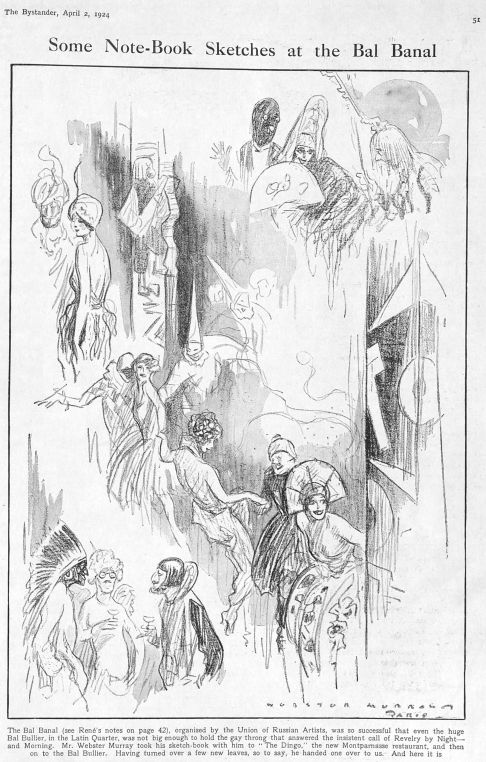
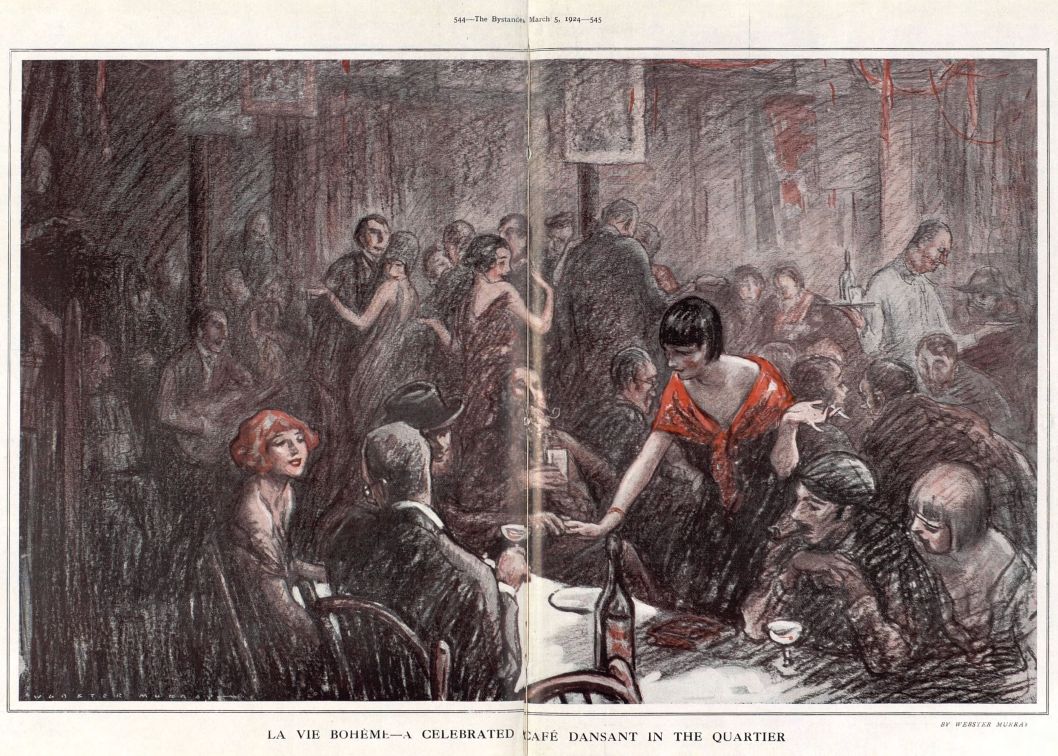
As regards his time in France, documentary evidence is in short supply, but in an article titled “Parisiana” in The Bystander (2 April 1924, p.42) “René” tells us that he “stumbled over the long legs of Webster Murray talking colours the other night at The Dingo, the newest restaurant of Montparnasse.” (4) Interestingly, in the same issue of The Bystander (p.51) there was a page of sketches by Webster done at The Dingo, and at another place of “Revelry by Night – and Morning”, the Bal Banal, this being shown in Fig.14a. Other Parisian scenes by him were published in The Bystander in 1924, the first being a two–page spread in colour of La Vie Bohème, a “Café Dansant”, featured in the issue of 5 March (p.544–5) shown in Fig,14b – there were five in all. (5) Readers may be interested to know that on a visit a few years later Webster recounted his earlier memories of Paris in an article, illustrated by him, titled “Parnasse Revisited” in The Tatler in 1929 (issue 4 September, p.442–3 & p.vi.)
We know that in 1925 he and his wife were back in London, for an account of a Studio Party they gave was published in The Coventry Evening Telegraph on 3 February 1925 (p.4):
Charming people who give studio parties add a good deal to the gaiety of London nowadays. The last of these I attended was given the other night at the Kensington studio of Mr. Webster Murray, the famous ‘Tatler’ artist. The studio itself is a large room with a polished floor, and high, wide windows screened with blue cretonne curtains. At one end of the room is a kind of musicians’ gallery; but the impromptu band – consisting of grand piano and jazz drum – disposed itself underneath the gallery at this party, as the room above was completely filled with furniture that had been stowed away. Candle light and an electric lamp hidden inside a Japanese lantern and decorated with air balloons provided a dim illumination very well suited to the scene, and the dancers – about thirty of them – were all got up in fancy dress quite worthy of an Albert Hall ball. The most exciting thing about the party was the descent we all made to the lower regions by an iron spiral staircase at the end of the room – there to deposit our wraps and the little packets of cheer we had brought to eke out the feast. Mrs. Webster Murray, a delightful little fair–haired Canadian, dressed as Peter Pan, entertained us later with recitations in French–Canadian patois. She is exceedingly clever.
Canadian newspaper reports tell us that in 1926, Webster was in London, but his wife was spending several months in Canada visiting her sister (6a); and that in 1928 she was back in London performing, to great acclaim, at a reception for the French Ambassador (6b). In November 1929, after giving a successful broadcast for the BBC, she headed off back to Canada for an extensive tour (6c).
The marriage had apparently been in trouble for some time, as Webster is recorded as living alone in London in the Post Office Directory for 1930, and though I have found no record of any divorce, in May 1931 in Detroit, Michigan, Florence M. Murray (Poapst) married electrical engineer, Morley D. Williamson. (Her daughter Joan was apparently sent to live with an aunt and uncle in Canada in about 1927, and though she retained contact with her mother, her father more or less dropped out of her life (7).)
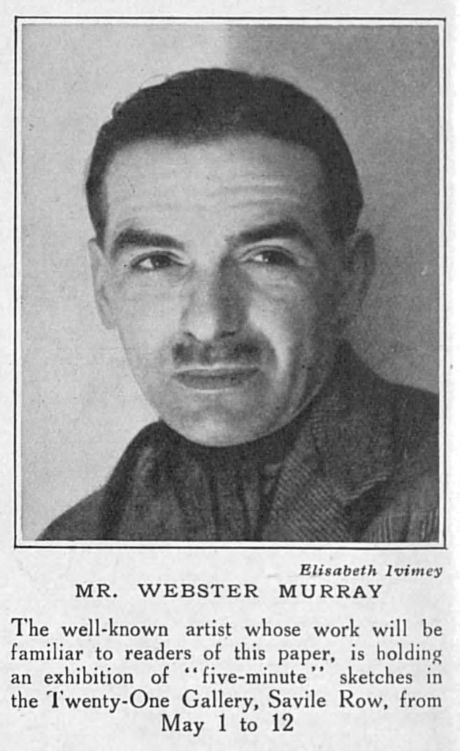
In January 1933, in London, actor George Henry Mulcaster was granted a decree nisi on account of his actress wife’s adultery with artist Webster Murray (who ended up paying costs.) The case was reported in, for example, The Liverpool Echo on 13 January 1933 (p.16). In the same year, Webster had an exhibition of ‘five–minute sketches’ at the Twenty–One Gallery in London. An advertisement for it, with a photograph of the artist, shown in Fig.13b, featured in The Tatler on 3 May 1933 (p.xx). As we shall see presently, Webster honed his skills in doing ‘five–minute sketches’ during his time in Paris back in the 1920s.
His contributions to the likes of Tatler dry up in about 1936, and there is a gap in online sources until late 1939 when he married Joan Kiddell–Monroe, an artist who, unlike her husband, does feature in the standard encyclopedias of artists and book illustrators, most of her work being published after 1940 (8). They feature together in the 1939 Register, living in London as James S. W. Murray, Artist, and Joan Murray, Artist.
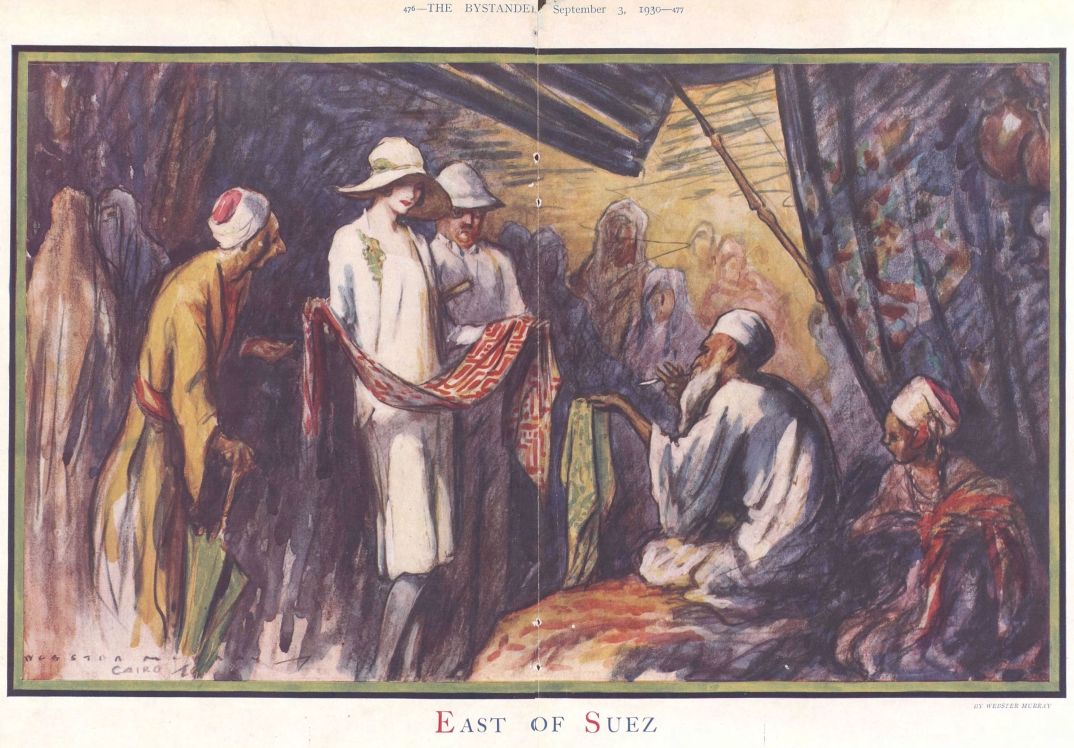
It is from Horne (8) that we learn that during the Second World War she worked for the WVS, but left in 1944 to have a son (James Euan Murray – his father’s name on the birth certificate is given as James Webster Stanley Murray). They travelled in Africa, several of the books illustrated by her being set there. Interestingly, The Bystander on 3 September 1930 (p.476–7) featured a double–page spread by Webster titled “East of Suez” (Fig.14c.) The inscription at the bottom left indicates that it was done in Cairo, though unfortunately the date it was actually painted is illegible (is it [19]29 ?). After Webster’s death in 1957 (it is not stated where) she toured Africa again with her son, eventually going to live in Majorca, where she died in 1972.
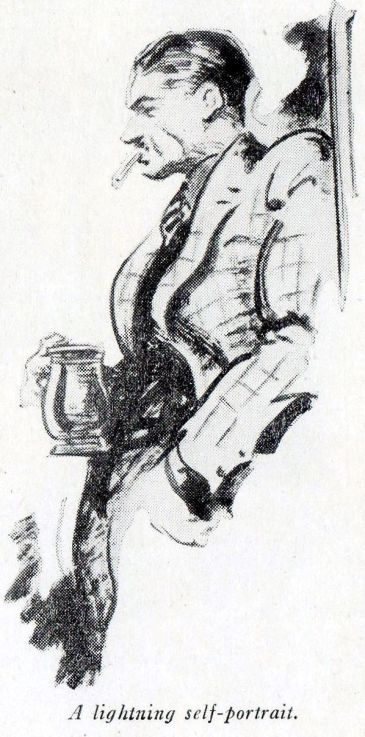
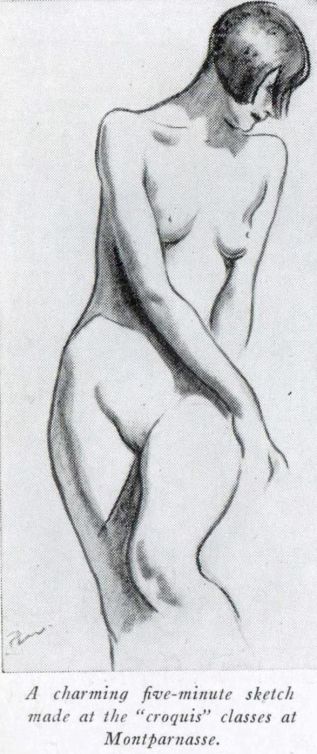
Finally, an odd source of information about Webster is the book Lines of Laughter, subtitled “100 Illustrations by Leading Humorous Artists”, by Percy V. Bradshaw, published in 1946. Webster was one of the 21 artists featured in it, and Bradshaw happened to know him personally, as indeed he knew many of the artists featured, each of whom had a brief biographical sketch attached to his (in one case, her) work. Given the date of publication it will come as no surprise to learn that the majority of the cartoons relate to the period of the Second World War, and consequently have lost much of their humour today. Fig.15a is perhaps the most amusing of Webster’s three wartime cartoons, all done for the magazine Men Only. Also featured in Bradshaw’s section “Webster Murray” (p.84–90) are “a lightning self–portrait” (Fig.15b) and “a charming five–minute sketch” of a nude (Fig.15c) (one of two such featured – I’m not clear what makes these “humorous”!) Bradshaw begins his biographical sketch thus:
Let me tell you something about him. He was born in Toronto, the son of a clergyman. The parental idea was that Webster should be a doctor, or a lawyer, but the youngster had other ideas. He was always sketching, always grabbing drawing prizes at school.
During the school holidays, parental influence got him a job as purser on the big passenger boats which cruised around the Great Lakes.
He left school at the age of 17, to join the Maclean Publishing Company as a junior artist. He was soon making himself very useful, drawing cartoons, designing covers, producing illustrations and working at an art school in the evenings, where his master – a nephew of the famous George Cruikshank – had also numbered Charles Dana Gibson among his pupils. After four years at Maclean, Webster decided that he ought to try his fortune in London.
The MacLean Publishing Company at that time tended to concentrate on publishing specialised trade journals like The Canadian Grocer, The Bookseller & Stationer, and The Farmer’s Magazine, as well as the magazine of current political and commercial affairs, The Financial Post of Canada. They also published The Busy Man’s Magazine, which dealt with the financial, political and social issues of the day, but also featured stories and poems as light relief to the more serious material. Webster might thus have done illustrations for such stories and poems, or cartoons relating to contemporary events, as well as designing advertisements for the trade journals. Unfortunately nothing from this phase of his career has as yet come to light, as copies of the various magazines and journals are today quite rare, and not generally available.
As regards Webster’s early days in London, Bradshaw adds:
For a short time he studied at various art schools – the St. John’s Wood, Slade and Polytechnic – and was busy in his spare time ‘doing’ the Tower, Madame Tussauds, and other sights. Then the Great War arrived.
As we saw above, Webster enlisted in the army, eventually achieving a captaincy. Following his demobilisation in February 1919, he was able to return to his career as an artist:
A new illustrated weekly gave him a happy opening. This was Pan, and he found himself one of a group of brilliant young writers and artists, who included Victor MacClure, Tom Purvis, Barribal, Gilbert Wilkinson, and others.
Webster’s work was noticed, and a little later he was invited to produce a series of double–page drawings for the Tatler. The subjects varied between the humorous and the romantic, and they were one of the most popular features of the Tatler for many years.
But – don’t assume that our promising young artist settled down and lived happily ever afterwards by producing Tatler pages. Not a bit of it. Soon after he had started this work he decided to go to Paris and “rub up his drawing”. He settled in Montparnasse, dividing his time between the “croquis” classes, those five–minute sketches at the Grand Chaumier (sic), the night–life of Montmartre, and the low life around the Bastille. When he had any time to spare from these Bohemian orgies, and from everlasting sketching, he was producing his Parisian impressions for the London magazines and snatching intermittent spots of sleep.
Two years of this wild life was, according to Webster, “quite enough thank you”; he returned to the quietness and sobriety of London, and to regular work for The Sketch, Bystander and other journals. The latter journal sent him to Switzerland with the young man who was destined, many years after, to launch and edit Men Only. The purpose of this trip was to collect material for a “Winter Sports Number.”
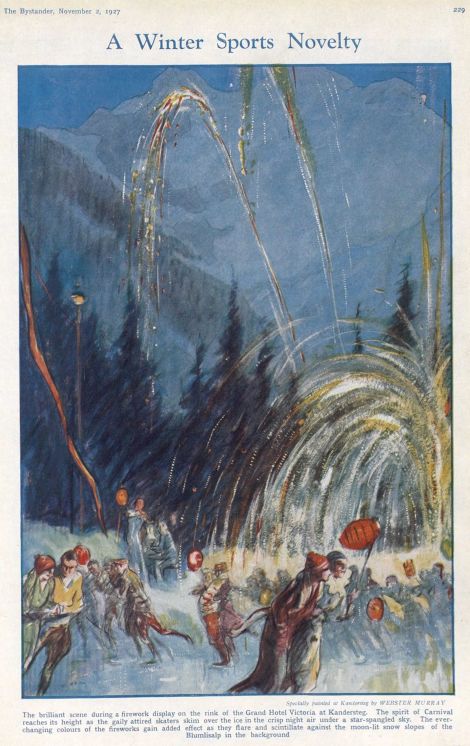
This throws some useful light on the various extracts from other sources, quoted above, particularly the “five–minute sketches” – the French word croquis refers to a rapid sketch, very often of nudes, who don’t have to pose in a position for uncomfortable lengths of time. The Grande Chaumière is the art school in the Montparnasse area of Paris. As for the “Winter Sports Number” of The Bystander, that was the issue of 2 November 1927, for which Webster did the cover illustration, as well as a painting (Fig.14d) of ice–skaters on the rink of the Grand Hotel Victoria at Kandersteg, with a firework display in the background (p.229.). He also did two black and white sketches for a short article by R.A., “Chamonix–Mont Blanc” (p.237.)
After mentioning Webster’s exhibitions of ‘Society’ portraits (he adds Lord Horder, Sir Bernard Spilsbury, Madame Albani and C.B. Cochran to the names in note (3)), Bradshaw goes on:
At the outbreak of the present War he again joined up, with a commission in the R.A.F. defence; but, as he is no longer a youngster, he found the Commando courses – which were prominent features of his later training – too tough for him, and he had, with great regret, to resign. He became an Air Raid Warden, and saw some very hectic service during the Blitz periods.
He lives in a cottage in the village of Marylebone, with his charming wife, Joan Kiddell–Monroe, also an artist, who has made a great success with the books which she has written and illustrated.
There is no mention of his first marriage.
[The images can be browsed here.]
Though the foregoing throws some light on Webster’s life and work, there are gaps. It would be nice to have more detail of his work for the MacLean Publishing Company, for example. Again, it would be useful to know more about the period between when he arrived in England from Canada in 1911 and the publication of the first book illustrated by him in 1921. Bradshaw fills in some details, of course, but how did he earn a living in the pre–War years ? One possibility is that he was doing work for an advertising agency (the experience gained from his time at the MacLean Publishing Company would presumably have served him well in getting such work.) Most newspaper adverts and such like are unsigned, and therefore unattributable. Only when an artist has become famous does it benefit the advertiser to have the artist sign his work, and certainly we know that later in his career he did signed adverts. For example, in the Christmas number of The Sketch 1923 (p.iv), he did a signed advert in colour for ‘Erasmic’ Soap and in 1929, for The Daily Mirror, he did at least two of an extensive series of signed adverts for Lyons’ ‘Nippy’ Chocolates (issues of 18 June & 17 September.) Another possibility is that he was doing uncredited illustrations for stories in newspapers and magazines (as at MacLean’s ?), for he certainly did such work, credited to him, later on. For example, in The Queen (2 December 1922, p.16–8 & p.40) he illustrated “Estelle Returns” by Charles Warrell, and in The Daily Express in late 1930 he illustrated four short stories in their “Cameo Tale” series (issues of 10, 14 & 19 November and 8 December.) Interestingly, in each of these he is named as the illustrator, though for the majority of the stories in the series, which ran from September 1930 to February 1931, the illustrator was unnamed.
Another gap is between 1952, the year of publication of his last book, and 1957, the year of his death. Was he in England earning a living from his portraits of the celebrities of the day, perhaps, or was he travelling abroad, possibly in Africa ? Indeed, exactly when was he in Africa, and where ? And where did he actually die ? I have found no trace of his death in England, though that does not necessarily mean he didn’t die here, as the various combinations of the common names Stanley, James and Murray, combined with his on / off use of the relatively common name Webster, make the tracking of him problematical.
Much remains to be discovered.
Note 1: The reference to Russian Ballet is presumably a dig at the modernist ballets of the Ballets Russes, the most famous example being Stravinsky’s “Rite of Spring”, first performed in Paris in 1913 to a (literally) riotous reception. Later came Satie’s surrealistic ballet “Parade”, described as “cubism in music and choreography”, its score featuring a typewriter, a lottery wheel, a siren and pistol shots. First performed in Paris in 1917, it had, needless to say, a hostile reception. Still later came Milhaud's “Blue Train” (a nickname for the train which connected Calais to the French Riviera.) The ballet focussed not on the train itself, but on the wealthy ‘smart set’ passengers it had transported, as they enjoyed their luxury Mediterranean vacations. First performed in Paris, in 1924, the ballet featured some holiday flirting as the various dancers mimicked swimmers, tennis players, and golfers. “Whimsical” was one word used to describe it, “baffling” another.
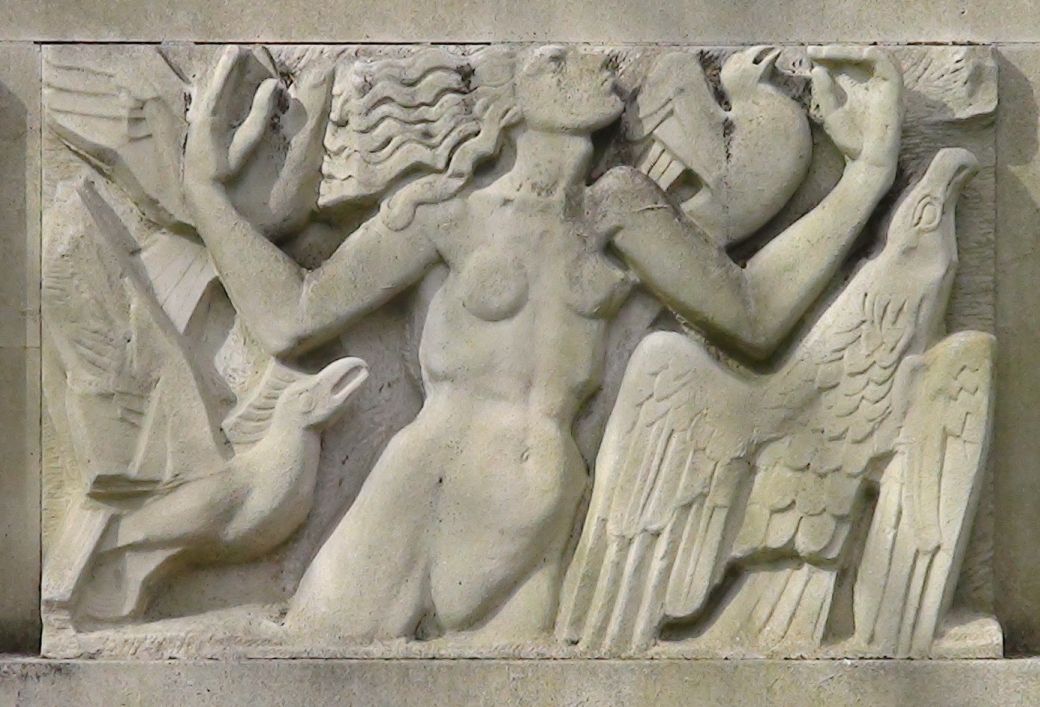
Note 2: Rima was a dryad-like ‘Bird Girl’ who could communicate with birds. She was the heroine of the popular novel Green Mansions, set in the remote forests of Venezuela, written by the naturalist W.H. Hudson, and published in 1904. It was Hudson’s reputation as a naturalist that led to a memorial being erected to his memory in a bird sanctuary in Hyde Park in 1925. Jacob Epstein was chosen to sculpt it, Rima being a suitable subject for it via her association with birds. To put it mildly, the resulting modernist memorial (Fig.16) did not meet with public approval, and, to the sculptor’s fury, it became dubbed “The Hyde Park Atrocity” (an epithet which originated from a headline in The Daily Mail on 25 May 1925.) For a full account, see Terry Friedman, ‘The Hyde Park Atrocity’ – Epstein’s Rima; Creation and Controversy (1988).
Note 3: See, for example, Evening News (London) 22 May 1922 (p.3), the inset portrait of the actress Evelyn Laye being featured more clearly in Tatler 10 May 1922 (p.196). For other portraits see Bystander 11 October 1922 (p.121) for a charcoal–watercolour portrait of Master–huntsman Major W.E. Lyon; and Bystander 19 March 1930 (p.594) for a full–page portrait of the actress Diana Wynyard, specially commissioned for the magazine.
Note 4: “Talking colours” presumably refers to an article Webster wrote on the effects of colour on peoples’ moods, which he particularly noticed in Paris, with its house colours, gaily coloured awnings, and such like. The original article was published in the Royal Magazine, which I regret I have never seen, but extracts from it were quoted in various newspapers and magazines – for example The Kansas City Star (7 June 1924, p.17), from which this is a sample paragraph:
Color is considered a civic asset in Paris. Brightly painted houses must have a cheering effect on the passers–by. Dull grey streets breed discontent. Can you imagine a revolution in a Garden City ? I well remember a house in St. John’s Wood with a vermillion door. It was like a pick–me–up, and I’m certain many a work–weary soul threw back his shoulders when he passed it.
Note 5: Besides the two illustrated here, the others were “Spring Time on the Boulevards” (30 April 1924, p.304–305); “In the Rou Danou” (28 May 1924, p.626); & “The Bar Sinister” (4 June 1924, p.706.)
Note 6: a) The Ontario newspaper The Windsor Star (15 July 1926, p.11); b) The Montreal Star 21 July 1928, p.17); c) The Montreal Star (2 November 1929, p.35.
Note 7: Joan Margaret Murray grew up to be the metaphysical poet Joan Vincent Murray, the Vincent being adopted from the Latin vincere (to conquer.) She died as a result of a heart condition in 1942 at the early age of 24.
Note 8: For example, Alan Horne, The Dictionary of 20th Century British Book Illustrators (1995) and Brigid Peppin & Lucy Micklethwait, Book Illustrators of the Twentieth Century (1984).
**********
To return to the Notes and Queries Index, click here.
To return to the Index of the Rubaiyat Archive, click here.